
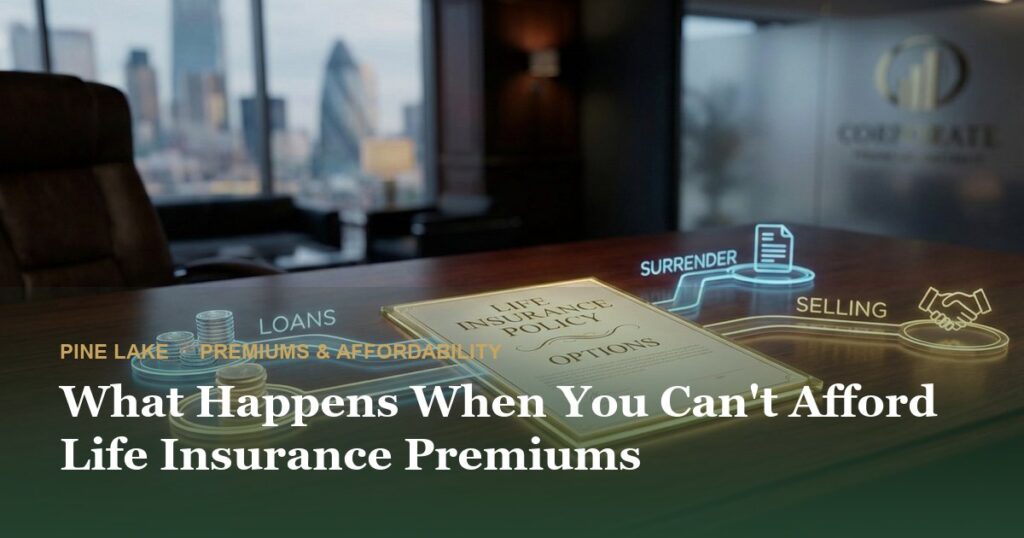
If you can’t afford your life insurance premiums, your policy does not disappear overnight — you first enter a 30–31 day grace period, and after that a series of contractual safety nets can preserve some or all of your coverage or its value. Depending on the policy type, those safety nets include automatic premium loans, reduced paid-up insurance, extended term coverage, carrier hardship programs, and, for policyholders who qualify, selling the policy in a life settlement. The worst outcome — a total lapse with nothing to show for years of payments — is almost always avoidable if you act before the grace period ends.
This guide walks through what actually happens when premiums stop, in the order events unfold, and compares every option available to a policyholder under financial pressure.
In This Article
- Premium Trouble Is a Fork in the Road, Not a Dead End
- Step One: Identify What Kind of Policy You Own
- The Grace Period: Your 30-Day Buffer
- Safety Nets Built Into Cash Value Policies
- Shrinking the Premium Instead of Ending the Policy
- Selling the Policy: The Life Settlement Alternative
- The One Thing Not to Do: Walk Away Silently
- How to Decide: A Practical Framework
- Frequently Asked Questions
Premium Trouble Is a Fork in the Road, Not a Dead End
Millions of policyholders reach a point where the premium that once fit the budget no longer does. Retirement income is fixed, a spouse passes away, medical bills mount, or a universal life policy demands far more than the original illustration suggested. Industry research consistently shows that a large share of permanent policies never pay a death claim because they are surrendered or allowed to lapse — often by owners who never learned what their contract actually offered them.
The key insight is that a premium you cannot pay triggers a sequence, not an instant cancellation. That sequence looks like this:
- Day 1: You miss the premium due date. Nothing happens yet; coverage continues.
- Days 1–31: The grace period runs. You remain fully insured and can pay with no penalty beyond the premium itself.
- End of grace: The policy either lapses, or a built-in mechanism such as an automatic premium loan or a nonforfeiture option takes over.
- After lapse: A reinstatement window (often three to five years) remains open, but with growing hurdles.
Every stage of that sequence has decisions attached, and the earlier you act, the more choices you keep. A policyholder who calls the carrier during the grace period has perhaps six or seven distinct paths; one who waits a year after lapse may have only one.
Step One: Identify What Kind of Policy You Own
Your realistic options depend almost entirely on the contract type, so pull out the policy (or call the carrier for a copy) before deciding anything.
- Term life has no cash value. If you stop paying, coverage simply ends after the grace period. Your main questions are whether the policy has a conversion privilege — and whether that conversion window is about to close — because a convertible term policy can sometimes be converted and then sold rather than abandoned.
- Whole life builds guaranteed cash value and must, by law, offer nonforfeiture options: cash surrender, reduced paid-up insurance, and extended term insurance. Dividends, if any, can also be redirected to pay premiums.
- Universal life (UL, IUL, VUL) is flexible-premium: there is no fixed bill, only a requirement that account value stay high enough to cover monthly charges. “Can’t afford the premium” often really means the policy is underfunded and charges are rising — a different problem with different fixes, covered in why universal life premiums keep rising.
Also request an in-force illustration from the carrier. It projects how long the policy survives at various funding levels and is the single most useful document for this decision. State regulators, coordinated through the National Association of Insurance Commissioners (NAIC), require carriers to provide these on request.
The Grace Period: Your 30-Day Buffer
Virtually every state mandates a grace period of 30 or 31 days after a missed premium during which the policy remains fully in force. If the insured dies during the grace period, the carrier pays the death benefit, typically minus the overdue premium. That means a missed payment is never an emergency on day one — but it starts a clock that should not be ignored.
Use the grace period productively:
- Call the carrier’s policyholder services line. Ask three questions: What is my exact grace-period end date? What is my current cash surrender value? What happens automatically if I do nothing?
- Ask about billing changes. Switching from annual to monthly premiums, moving the due date, or skipping a rider you no longer need can sometimes make the payment manageable.
- Ask about hardship accommodations. Many insurers offer extensions or payment plans, especially for older policyholders — see carrier hardship programs for what to request.
- Check for third-party notice designations. Many states let you name a family member to receive lapse warnings, which prevents silent lapses caused by dementia, hospitalization, or misdirected mail.
What you should not do is let the deadline pass silently. As explained in what happens when life insurance lapses, the consequences after the grace period are dramatically harder to undo.
Safety Nets Built Into Cash Value Policies
If your policy has cash value, the contract itself contains rescue mechanisms that operate even if you never send another premium check.
Automatic premium loan (APL). If elected (check your application or ask the carrier), the insurer automatically borrows from your cash value to pay each missed premium. Coverage continues untouched, though loan interest compounds and will eventually exhaust the policy if never repaid. The mechanics and risks are detailed in our guide to the automatic premium loan provision.
Reduced paid-up insurance (RPU). You stop paying forever and keep a smaller, fully paid death benefit for life. A policy with a $500,000 face amount might convert to $180,000–$250,000 of permanent, premium-free coverage, depending on age and cash value.
Extended term insurance (ETI). Your cash value buys term coverage at the full original face amount for as long as the value can fund — sometimes many years. In many older contracts this is the default if you make no election, which surprises owners who assumed cash surrender was automatic. See the extended term nonforfeiture option for how the duration is calculated.
These nonforfeiture options exist because state law — following NAIC model standards — forbids carriers from confiscating the equity you built. But each is an election with deadlines and trade-offs, so none should be triggered by default when a better fit exists.
| Option | Coverage Continues? | Cash Received Now | Future Premiums | Best For |
|---|---|---|---|---|
| Pay during grace period | Yes, in full | None | Continue as before | One-time missed payment |
| Automatic premium loan | Yes, in full | None | Paid from cash value (loan) | Temporary cash crunch |
| Reduce face amount | Yes, smaller | None | Lower | Permanent budget change, coverage still needed |
| Reduced paid-up insurance | Yes, smaller, for life | None | None ever | Done paying, want lifelong benefit |
| Extended term insurance | Yes, full amount, limited years | None | None | Coverage needed for a defined period |
| Surrender for cash value | No | Cash surrender value (may be taxable) | None | Coverage unneeded, insured young/healthy |
| Life settlement | No (buyer takes over) | Typically 10–35% of face; often 4–8× surrender value | None | Insured 65+ or health-impaired, coverage unneeded |
| Do nothing (lapse) | No | $0 (default nonforfeiture may apply) | None | No one — always the worst outcome |

Shrinking the Premium Instead of Ending the Policy
Before giving up coverage entirely, consider whether a smaller obligation solves the problem.
- Reduce the face amount. Most carriers will cut a $1,000,000 policy to $500,000 or $250,000, cutting the premium proportionally (universal life) or generating paid-up value (whole life). If your children are grown and the mortgage is paid, you may simply need less insurance than you bought at 45.
- Redirect dividends. Participating whole life owners can switch dividends from paid-up additions to premium reduction or offset. Mature policies sometimes become fully self-sustaining this way.
- Drop riders. Waiver of premium, accidental death, and child riders each carry charges. Removing ones you no longer need trims the bill.
- Use policy loans deliberately. A measured loan can bridge a temporary crunch — a job loss, a medical event — without permanent damage, provided you understand the compounding interest. Compare this carefully against giving up the policy in cash value loan vs. surrender.
- Restructure universal life funding. An underfunded UL policy can sometimes be stabilized by lowering the death benefit option from increasing to level, or by a targeted lump-sum catch-up payment identified through an in-force illustration.
These adjustments preserve insurability. Once a policy is gone, replacing coverage in your seventies or eighties — if health allows it at all — is usually far more expensive than fixing the policy you have.
Selling the Policy: The Life Settlement Alternative
For policyholders who no longer need or want the coverage, the policy itself may be a sellable asset. In a life settlement, a state-licensed provider purchases the policy for a lump sum, takes over all future premiums, and collects the death benefit when the insured passes away. The legal foundation dates to Grigsby v. Russell, 222 U.S. 149 (1911), in which the U.S. Supreme Court confirmed a life insurance policy is transferable property.
Why this matters for someone about to lapse: a GAO study of the life settlement market found that policyholders who sold received roughly four to eight times the cash surrender value their insurers would have paid. Typical offers run 10–35% of the face amount, depending on age, health, and policy economics. On a $500,000 policy with a $20,000 surrender value, that can be the difference between $20,000 and $75,000 or more — versus $0 in a lapse.
Eligibility generally requires the insured to be 65 or older (younger with significant health impairments), a face amount of roughly $100,000 or more, and a policy in force at least two years. Permanent policies qualify most readily; term qualifies if convertible. The process takes 60–120 days, so it must begin before lapse, not after. See who qualifies for a life settlement for the full criteria.
The One Thing Not to Do: Walk Away Silently
The most expensive response to unaffordable premiums is the most common one: simply stopping payment and ignoring the mail. Walking away forfeits every alternative on this page and can create surprises beyond lost coverage:
- Phantom income tax. If a policy with an outstanding loan lapses, the IRS treats the forgiven loan above your cost basis as taxable ordinary income — a tax bill with no cash to pay it. The IRS rules here catch many retirees off guard, particularly on old policies with decades of accumulated loans.
- Default elections you didn’t choose. With no instruction from you, the carrier applies the contract’s default nonforfeiture option, which may be extended term insurance that quietly expires in a few years.
- Loss of settlement value. A lapsed policy is worth nothing to a buyer. An in-force policy on a 78-year-old may be worth tens or hundreds of thousands of dollars.
- Harder reinstatement. Reviving a lapsed policy requires new evidence of insurability plus back premiums with interest — hurdles that grow each month, as covered in reinstating a lapsed life insurance policy.
The full downstream damage is catalogued in the consequences of stopping life insurance payments. The short version: silence is a decision, and it is nearly always the worst one available.
How to Decide: A Practical Framework
With the options on the table, the decision comes down to two questions: Do I still need the coverage? and Is the cash flow problem temporary or permanent?
- Still need coverage, temporary crunch: Use the grace period, a policy loan, an APL, or a carrier hardship arrangement to bridge the gap, then resume paying.
- Still need coverage, permanent budget change: Reduce the face amount, drop riders, redirect dividends, or elect reduced paid-up insurance so some benefit survives without premiums.
- No longer need coverage, healthy insured: Compare surrendering for cash value against simply keeping a paid-up amount. Surrender proceeds above your basis are taxable.
- No longer need coverage, insured is 65+ or health-impaired: Get the policy appraised in the life settlement market before surrendering or lapsing. When offers are made, they frequently exceed surrender value several times over — and how much you can sell a policy for can only be known by testing the market.
One caution for policyholders receiving means-tested benefits: a lump sum from a surrender or settlement can affect Medicaid eligibility, so coordinate timing with an elder-law or benefits advisor. Whatever direction fits, make the decision while the policy is alive; every option on this list requires an in-force contract.
Frequently Asked Questions
What happens if I miss one life insurance premium payment?
Nothing immediate. Every state requires a grace period — typically 30 or 31 days — during which your coverage stays fully in force. If you pay the overdue premium within that window, the policy continues as if nothing happened, with no penalty, no new underwriting, and no rate change. If the insured were to die during the grace period, the carrier still pays the death benefit, usually minus the unpaid premium. The danger begins only when the grace period ends without payment or an alternative arrangement.
Can I lower my life insurance premium without canceling the policy?
Often, yes. Most carriers allow you to reduce the face amount, which cuts the premium proportionally; drop riders such as waiver of premium or accidental death; switch dividend options so dividends pay part of the bill on participating whole life; or change the billing mode. On universal life, you can also lower the death benefit or switch from an increasing to a level death benefit option to slow the drain on account value. Call the carrier and ask for every premium-reduction option available on your specific contract.
Is it better to surrender my policy or let it lapse if I can’t pay?
Surrendering is almost always better than lapsing, because you collect the cash surrender value instead of nothing. But both may be worse than the alternatives. Nonforfeiture options like reduced paid-up insurance preserve a death benefit with zero future premiums, and a life settlement — for insureds who qualify, generally 65 or older with a policy of $100,000+ face value — has been shown by GAO research to pay roughly four to eight times surrender value. Get quotes on every path before choosing.
Can I sell my life insurance policy instead of letting it lapse?
Frequently, yes. In a life settlement, a licensed provider buys your policy for a lump sum, assumes all future premiums, and receives the death benefit later. Typical qualifying criteria: insured age 65 or older (younger with serious health conditions), face amount of roughly $100,000 or more, and a policy in force at least two years. Permanent policies qualify most easily; term policies qualify if they are still convertible. The process takes 60–120 days, so you must start while the policy is still in force.
Will I owe taxes if my policy lapses with an outstanding loan?
Possibly, and it surprises many people. When a policy lapses or is surrendered with a loan outstanding, the IRS treats the loan balance as part of your distribution. Any amount above your cost basis — roughly, total premiums paid — is taxed as ordinary income, even though you receive no cash at lapse. Older policies with decades of compounding automatic premium loans can generate five-figure phantom income. Before letting a loaned policy go, ask the carrier for a projected tax report.
What is the cheapest way to keep some life insurance coverage in retirement?
For whole life owners, reduced paid-up insurance is usually the cheapest permanent option: you stop paying entirely and keep a smaller guaranteed death benefit for life, funded by the cash value you already built. Extended term insurance keeps the full face amount but only for a limited period. Universal life owners can often keep a policy alive with a reduced face amount and minimal funding identified through an in-force illustration. Which is cheapest depends on age, cash value, and how long you need coverage.
How long do I have to reinstate my policy after it lapses?
Most contracts allow reinstatement for three to five years after lapse, but the requirements stiffen quickly. You will generally need to pay all back premiums plus interest, repay or reinstate any policy loans, and provide new evidence of insurability — health questions or even an exam. A new two-year contestability period may also apply to reinstated coverage in many states. If your health has declined since the policy lapsed, reinstatement can be denied, which is why acting before lapse is so much safer.
Does cashing out or selling a life insurance policy affect Medicaid eligibility?
It can. Medicaid is means-tested, and a lump sum from a surrender or life settlement counts as an asset that may push you over the eligibility limit until spent down in a compliant way. Some states have explored structured settlement arrangements that direct proceeds toward long-term care. Before surrendering or selling a policy while on or near Medicaid, consult an elder-law attorney or benefits planner so the transaction is timed and structured to protect your eligibility.
Find out what your policy is worth — free, confidential, no obligation.
A 15-minute educational review covers your eligibility, every alternative, and a realistic view of what each path would net you.
Related Reading
- Cant Afford Life Insurance Premiums
- Life Settlement Vs Lapse
- Policy Underwater What To Do
- How To Read In Force Illustration
Pine Lake Legacy does not purchase life insurance policies and does not provide legal, tax, or investment advice. Information provided is for educational purposes only. Eligibility for any option, including life settlements, is not guaranteed and depends on individual circumstances, policy terms, underwriting, and market conditions. Consult independent legal, tax, or financial professionals before making decisions regarding a life insurance policy.