

A policy loan lets you access your life insurance cash value while keeping the coverage alive; a surrender cashes out the value and ends the policy permanently. Loans are income-tax-free while the policy stays in force but accrue compounding interest and can trigger a lapse with a phantom tax bill; surrenders deliver a clean lump sum but are taxable above your cost basis and forfeit the death benefit forever. Insureds 65 and older should also price a third path — a life settlement — which frequently pays several times surrender value.
This guide compares the mechanics, taxes, costs, and failure modes of each route, and shows which situations favor which choice.
In This Article
- Two Doors to the Same Money — With Very Different Exits
- The Tax Comparison: Deferral vs. Recognition
- What Loans Really Cost: Interest, Spread, and the Spiral
- What Surrender Really Costs: Charges, Lost Benefit, and Finality
- The Third Door: Pricing the Policy on the Open Market
- Decision Scenarios: Which Door for Which Situation
- Execution Checklist: Doing Either One Properly
- Frequently Asked Questions

Two Doors to the Same Money — With Very Different Exits
Permanent life insurance is unusual among assets: you can extract its value while keeping it, or by destroying it. Understanding what each door actually does prevents the most common mistakes.
The loan door. A policy loan is an advance from the insurer using your cash value as collateral. It requires no credit check, no application beyond a form, no repayment schedule, and typically arrives within days. The policy — death benefit, riders, dividends — continues intact, though the eventual claim is reduced by whatever loan and interest remain unpaid. Crucially, the loan is not income in the eyes of the IRS while the policy remains in force, no matter how large it grows relative to what you paid in.
The surrender door. Surrendering returns the policy to the carrier for its cash surrender value: the accumulated cash value minus any surrender charges and outstanding loans. Coverage ends, riders end, and the transaction is final — there is no reinstatement from a surrender, unlike a lapse. The proceeds above your cost basis (roughly, total premiums paid) are taxed as ordinary income in the year received.
The two doors also differ in what they demand afterward. A surrender asks nothing further of you. A loan begins a management obligation: interest accrues at the contract rate, and an unmanaged loan compounds toward the ceiling of the cash value, where it can collapse the policy. That failure mode — the loan-driven lapse — is the hinge of the entire comparison, and it connects directly to what happens when life insurance lapses.
The Tax Comparison: Deferral vs. Recognition
Taxes are where the loan-versus-surrender decision is usually won or lost, and the rules reward understanding.
Surrender taxation is immediate and simple. Gain equals cash surrender value (plus any outstanding loan forgiven at surrender) minus cost basis. That gain is ordinary income — not capital gain — in the surrender year. A retiree who paid $70,000 in premiums and surrenders for $115,000 recognizes $45,000 of ordinary income, potentially pushing up Medicare premiums (IRMAA) and the taxability of Social Security benefits along the way; the Social Security Administration counts such income in the formulas that determine how much of your benefit is taxed.
Loan taxation is deferred — conditionally. Borrowed cash is tax-free while the policy lives, even if you never repay it; at death, the loan simply reduces the benefit and the remainder passes income-tax-free to beneficiaries. The condition: the policy must actually stay in force. If it lapses or is surrendered with the loan outstanding, the entire deferred gain crystallizes at once — loan balance plus any cash received, minus basis, taxed as ordinary income in a year when you may receive little or no cash. Policies classified as modified endowment contracts (MECs) lose the favorable loan treatment entirely: MEC loans are taxable to the extent of gain immediately, plus a 10% penalty before age 59½.
Strategic implications: owners intending to hold until death often prefer loans, converting a taxable gain into a tax-free death benefit reduction. Owners likely to drop the policy eventually often do better recognizing the gain on their own schedule via surrender — in a low-income year, for instance — rather than letting a lapse choose the timing. The phantom-income trap and its escape routes are detailed in policy underwater: what to do.
What Loans Really Cost: Interest, Spread, and the Spiral
Policy loan interest is the quiet variable that decides whether a loan strategy succeeds. The mechanics:
- The rate. Contracts specify fixed rates (commonly 5–8%) or variable rates tied to an index. Older policies sometimes carry attractive fixed rates; newer ones vary.
- The spread. Your borrowed cash value may be treated in one of two ways: “direct recognition” carriers credit lower dividends/interest on the loaned portion, while “non-direct recognition” carriers credit as if nothing were borrowed. The true cost of the loan is the interest rate minus what the collateral continues earning — often a net 1–3%, far cheaper than the sticker rate suggests.
- Capitalization. Unpaid interest is added to the loan balance and compounds. This is where discipline matters: a loan whose interest is paid annually in cash is stable indefinitely; a loan left to capitalize grows exponentially against a cash value growing arithmetically.
The spiral endgame: when the loan balance approaches the cash value, the carrier issues warnings and eventually terminates the policy, triggering the deferred tax on decades of gain. This is the same mechanism that undoes policies running on the automatic premium loan provision for too long.
Loan hygiene that prevents the spiral: borrow well under the maximum (many advisors suggest staying below 50–70% of cash value); pay interest in cash annually where possible; review the annual statement’s projected crossover date; and treat any carrier “overloan” warning as a same-month action item. Some contracts offer overloan protection riders that freeze the policy as paid-up before collapse — worth checking, and worth comparing against simply electing reduced paid-up insurance earlier.
| Factor | Policy Loan | Full Surrender | Life Settlement |
|---|---|---|---|
| Coverage continues? | Yes — death benefit reduced by loan balance | No — ends permanently | No — buyer owns policy and pays premiums |
| Cash received | Up to ~90% of cash value, in days | Cash value minus charges and loans | Typically 10–35% of face; often 4–8× surrender value |
| Income tax now | None while policy stays in force (non-MEC) | Ordinary income on gain above basis | Three-tier: tax-free to basis, ordinary to CSV, capital gain above |
| Ongoing obligation | Interest accrues (5–8% typical); must monitor | None | None after closing |
| Biggest risk | Loan spiral → lapse → phantom income tax | Irreversible; forfeits death benefit; tax timing | Eligibility limited; must start 60–120 days ahead |
| Reversible? | Yes — repay loan anytime | No | Rescission window only (15–30 days by state) |
| Best for | Temporary needs; legacy-focused owners | Healthy insureds who no longer need coverage | Insureds 65+/health-impaired who no longer need coverage |
What Surrender Really Costs: Charges, Lost Benefit, and Finality
The surrender check is easy to understand; its full price is not always printed on it.
- Surrender charges. Universal life and many newer whole life contracts impose declining surrender charges for the first 10–15 policy years. Surrendering in year 8 of a 15-year schedule can forfeit thousands that waiting — or choosing another option — would have preserved. Check the contract’s surrender charge table before deciding.
- The death benefit, priced honestly. Surrendering a $400,000 policy for $90,000 means your beneficiaries trade a $400,000 income-tax-free claim for whatever remains of $90,000 after taxes. For an insured in normal health at 60, that may be rational; for an insured at 80 or in declining health, it can be a catastrophic exchange, because the policy’s economic value has quietly risen far above its surrender value.
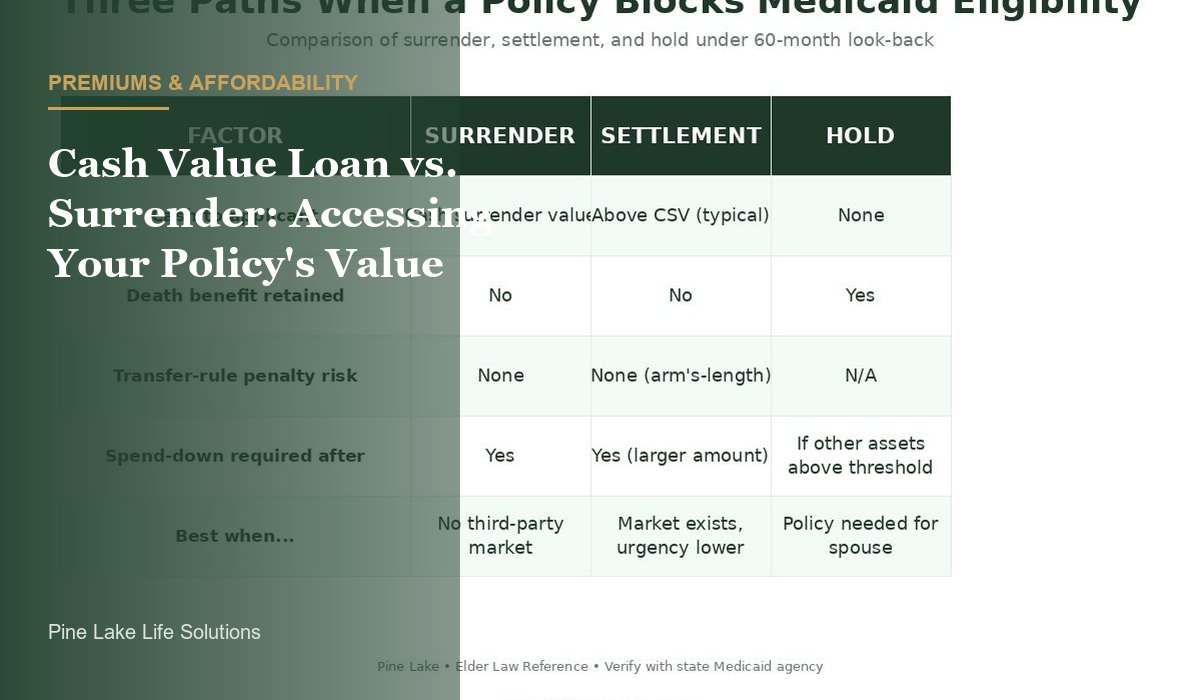
- Benefit-program interactions. A surrender lump sum counts as an asset for means-tested programs. Policyholders on or near Medicaid should structure timing with an elder-law advisor, since proceeds can interrupt eligibility until properly spent down.
- Irreversibility. A lapse has a reinstatement window; a surrender has none. And replacing the coverage later means new underwriting at attained age — often impossible or unaffordable in the exact circumstances (age, illness) that later make people regret surrendering.
Before surrendering, always obtain the carrier’s current in-force illustration and the exact surrender value quote — and read them together, using how to read an in-force illustration. Surprisingly often, the document reveals a cheaper way to keep meaningful coverage than the owner assumed existed.
The Third Door: Pricing the Policy on the Open Market
The loan-versus-surrender framing hides an assumption: that the carrier’s numbers are the only numbers. For a meaningful subset of policyholders, they are not. A life settlement — selling the policy to a state-licensed institutional buyer — prices the contract on the insured’s actual life expectancy rather than on contractual guarantees, and the difference can be dramatic. The GAO’s study of the settlement market found sellers received roughly four to eight times the cash surrender value, with offers typically running 10–35% of the face amount.
Who should price this door before choosing loans or surrender:
- Insureds generally 65 or older — younger with significant health impairments.
- Policies with face amounts of roughly $100,000 or more, in force at least two years.
- Permanent policies (whole life, UL, IUL, VUL, survivorship); term only if still convertible.
Where a settlement fits the comparison: like a surrender, it ends your coverage and generates cash — usually more of it. Taxation follows the three-tier treatment of IRS Rev. Rul. 2009-13 as modified by the 2017 tax act: proceeds up to basis are tax-free, basis-to-cash-surrender-value is ordinary income, and the excess is capital gain — often gentler than surrender treatment on the same dollars. The process runs 60–120 days with independent life expectancy underwriting and escrowed closing, and every state’s regulatory framework (following the NAIC Life Settlements Model Act) includes rescission periods of 15–30 days. Full eligibility details are in who qualifies for a life settlement, and the direct comparison with surrendering is drawn out in life settlement vs. surrender.
The disciplined move: get the surrender quote, the loan illustration, and a settlement appraisal in the same month, and only then decide.
Decision Scenarios: Which Door for Which Situation
Abstract comparisons resolve quickly when mapped onto real situations:
- Temporary cash crunch, coverage still needed (age 45–70): Loan. It bridges the gap without sacrificing insurability or the death benefit, and can be repaid when the crunch passes. Keep the loan modest and pay interest annually. If the crunch is specifically about affording premiums, compare with the options in can’t afford life insurance premiums.
- Permanent income shortfall, some coverage still wanted: Neither, at least not first. A partial surrender (on UL) or a reduced paid-up election (on whole life) may shrink the problem while preserving benefit — often better than either full exit.
- Coverage genuinely unneeded, insured under 65 and healthy: Surrender, timed for a favorable tax year. The settlement market rarely bids meaningfully on young, healthy insureds, and holding an unneeded policy just to defer tax seldom pays.
- Coverage unneeded, insured 65+ or health-impaired: Appraise before surrendering. This is the profile where settlements most often embarrass the surrender value — and where quiet surrenders leave the most money behind.
- Large gain, strong desire to leave a legacy: Loan, held to death. The gain escapes income tax entirely inside the death benefit; beneficiaries receive face minus loan.
- Policy already loan-heavy and drifting toward collapse: Act now, deliberately. Compare a managed surrender (controlling tax timing), a rescue (repay or restructure), an RPU election, or a settlement — anything but drift, because a lapse chooses the worst tax year for you, as shown in stop paying life insurance: consequences.
Each scenario reduces to three questions: Is the coverage still needed? Is the cash need temporary or permanent? And what would the open market pay? Answer all three before opening any door.
Execution Checklist: Doing Either One Properly
Whichever route wins, execution quality protects real dollars.
If taking a loan:
- Request the loan provisions in writing: rate, fixed or variable, direct recognition or not, and how unpaid interest is handled.
- Borrow the minimum that solves the problem, not the maximum available.
- Ask the carrier to bill loan interest annually rather than capitalizing it silently.
- Get a current in-force illustration showing the policy’s projected performance with the loan, including the year it would collapse if untouched.
- Calendar an annual review of loan balance versus cash value.
If surrendering:
- Obtain the exact surrender quote: gross value, surrender charge, loan payoff, and net proceeds — plus the carrier’s estimate of the taxable gain (Form 1099-R will follow).
- Time the surrender for a tax year that minimizes bracket, IRMAA, and Social Security taxation effects; a January-versus-December choice can be worth thousands.
- Confirm no rider value is being abandoned — some chronic-illness or LTC riders have alternatives to forfeiture.
- If the insured is 65+, complete a settlement appraisal first; surrender is always still available afterward if the offers disappoint.
- Never surrender to escape premiums without first checking nonforfeiture options, which convert value into premium-free coverage rather than cash.
And in both cases: get every number in writing, involve your tax preparer before (not after) the transaction, and remember that the carrier’s service line quotes contract values, not advice. The contract gives you the doors; which one you open — and when — is entirely yours.
Frequently Asked Questions
Is it better to borrow against my life insurance or cash it out?
Borrow if you still need the coverage or the cash need is temporary: a policy loan is income-tax-free while the policy stays in force, arrives quickly, and is fully reversible by repayment. Cash out (surrender) if the coverage is genuinely unneeded and you want a clean lump sum with no ongoing management — accepting ordinary income tax on the gain and permanent loss of the death benefit. Insureds 65 or older should get a life settlement appraisal before surrendering, since market offers often exceed surrender value several times over.
Are life insurance policy loans really tax-free?
Yes, with two conditions. First, the policy must not be a modified endowment contract (MEC) — MEC loans are taxed as income to the extent of gain, plus a 10% penalty before age 59½. Second, the policy must remain in force. If it lapses or is surrendered while the loan is outstanding, the deferred gain crystallizes: loan balance plus cash received minus premiums paid is taxed as ordinary income that year, even if you receive no money. Held to death, the loan simply reduces the tax-free benefit.
How much can I borrow against my life insurance policy?
Most carriers lend up to about 90% of the cash value (some slightly more or less), with no credit check and no fixed repayment schedule. The practical maximum should be lower: borrowing near the ceiling leaves no cushion for compounding interest, and when the loan balance reaches the cash value the policy terminates — triggering income tax on the entire deferred gain. A common guideline is to stay under 50–70% of cash value and pay the loan interest in cash annually so the balance never compounds.
What taxes do I pay when I surrender a life insurance policy?
You pay ordinary income tax — not capital gains — on the amount by which your proceeds exceed your cost basis, which is roughly the total premiums you paid. Proceeds include any outstanding loan forgiven at surrender, not just the check you receive. The carrier reports the gain on Form 1099-R. Watch the knock-on effects: a large one-year gain can raise Medicare IRMAA surcharges and increase the taxable share of Social Security benefits, which is why the timing of a surrender is worth planning.
Does a policy loan reduce my death benefit?
Yes. The face amount is unchanged, but any claim is paid net of the outstanding loan and accrued interest. A $500,000 policy carrying an $80,000 loan pays beneficiaries $420,000. If loan interest capitalizes for years, the reduction grows steadily — and if the loan ever equals the cash value, the policy collapses entirely and the death benefit becomes zero, with a tax bill attached. Repaying the loan, in whole or gradually, restores the full net benefit at any time before death.
Can I surrender just part of my life insurance policy?
On universal life, yes — partial withdrawals reduce the cash value and death benefit dollar for dollar (or per the contract formula) and are taxed favorably: withdrawals come out basis-first, so they are tax-free until you have recovered your premiums. Whole life does not allow true partial surrenders, but similar results come from surrendering paid-up additions, taking a modest loan, or electing a reduced face amount. Partial access frequently beats full surrender when you need some cash but want to keep meaningful coverage.
What happens if my policy lapses while I have a loan against it?
The lapse converts your tax deferral into a tax bomb. The IRS treats the forgiven loan as a distribution: loan balance minus cost basis is ordinary income in the lapse year, even though you receive nothing. Decades of compounding loans can produce tens of thousands in phantom income. Carriers send overloan warnings before termination — treat them as urgent. Options at that stage include repaying part of the loan, converting to reduced paid-up status, executing a managed surrender, or pursuing a life settlement while the policy is still in force.
Should I get a life settlement quote before surrendering my policy?
If the insured is 65 or older — or younger with serious health conditions — and the policy’s face amount is $100,000 or more, yes. Surrendering without an appraisal risks leaving most of the policy’s value behind: GAO research found life settlements historically paid roughly four to eight times cash surrender value, with offers typically between 10% and 35% of face amount. The appraisal costs nothing and does not obligate you; surrender remains available afterward if the market offers disappoint. The process takes 60–120 days, so start before any lapse deadline.
Find out what your policy is worth — free, confidential, no obligation.
A 15-minute educational review covers your eligibility, every alternative, and a realistic view of what each path would net you.
Related Reading
- How Much Can I Sell My Life Insurance Policy For
- Life Settlement Vs Surrender
- Reduced Paid Up Insurance Option
- Policy Underwater What To Do
Pine Lake Legacy does not purchase life insurance policies and does not provide legal, tax, or investment advice. Information provided is for educational purposes only. Eligibility for any option, including life settlements, is not guaranteed and depends on individual circumstances, policy terms, underwriting, and market conditions. Consult independent legal, tax, or financial professionals before making decisions regarding a life insurance policy.