
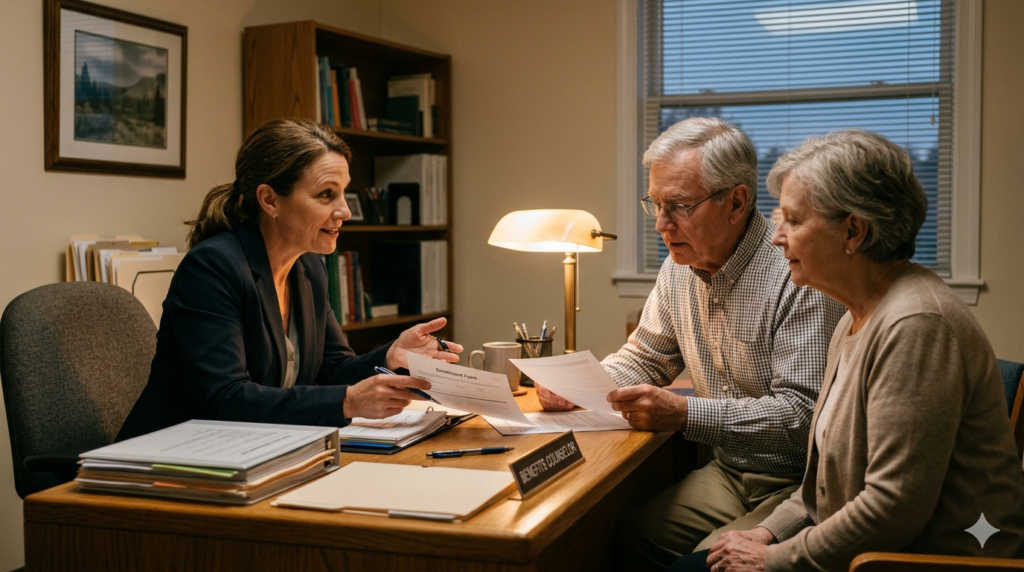
As of 2026, families around Modesto should budget roughly $9,500 to $11,000 a month for a semi-private skilled nursing bed in Stanislaus County and roughly $4,300 to $5,400 a month for assisted living — ranges drawn from Genworth-style cost-of-care survey data for the Modesto metropolitan area, which runs below the California statewide medians of about $11,500 to $12,500 for semi-private nursing and about $6,200 to $6,800 for assisted living. These are survey ranges, not quotes. Confirm the actual daily rate in writing with each facility before you sign anything, because rates in this county vary by more than $2,000 a month between the low and high end of the same city.
But the number that breaks most Stanislaus County households is not the nursing home rate on its own. It is the moment one spouse moves into care in Modesto or Turlock and the other stays in the house in Ceres, Oakdale, or out on county road frontage. One household becomes two. The Social Security checks and the farm draw do not double. That split — two roofs, two utility bills, two grocery budgets, one income — is the arithmetic this page is built around, because it is where the money actually runs out.
Stanislaus County adds a particular wrinkle. This is an agricultural county, and a large share of local household wealth is held in ground, water, and equipment rather than in liquid savings. A family with a substantial balance sheet on paper can be genuinely short of cash the week a discharge planner asks how the first month will be paid. In those households an old life insurance policy is frequently the only asset that is neither the farm nor the house. Pine Lake Life Solutions provides education and a free policy review only; nothing here is legal, tax, or Medi-Cal eligibility advice.
In This Article
- The Split: What Happens the Week One Spouse Enters Care
- Stanislaus County Cost Ranges for 2026, and How They Compare to California
- What Medi-Cal Changed in 2024 — and What It Did Not
- Running the Two-Household Runway
- Where a Life Insurance Policy Fits When the Wealth Is in Ground and Equipment
- When Selling the Policy Is the Wrong Answer for a Married Couple
- The Stanislaus County Call List and Documents to Pull
- Frequently Asked Questions
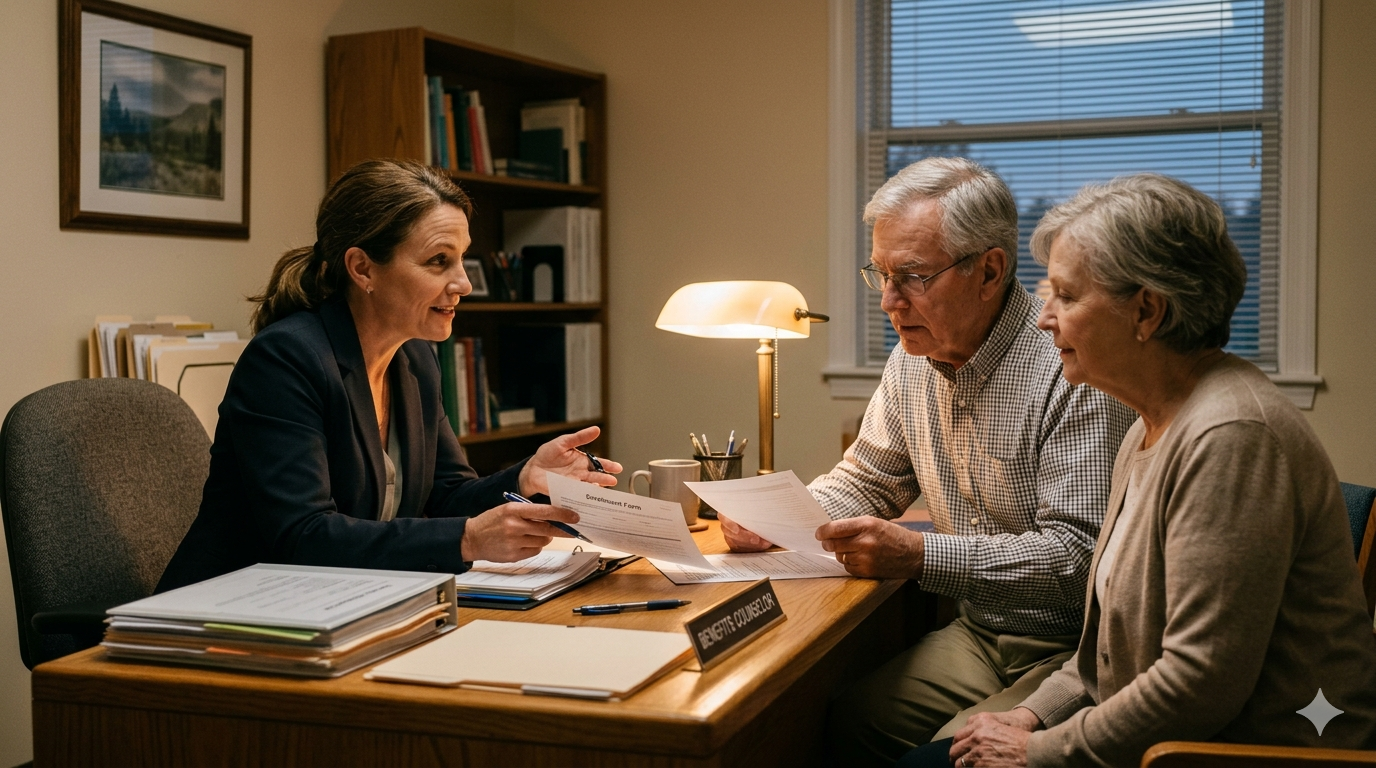
The Split: What Happens the Week One Spouse Enters Care
Start by writing down the two budgets separately, because facilities and county eligibility workers will treat them separately. The spouse entering skilled nursing has one bill: the facility rate, plus whatever the facility does not include. The spouse who stays home in Ceres or Oakdale still has a mortgage or property tax bill, homeowner’s insurance, utilities, a vehicle, groceries for one, Medicare premiums, and any supplemental plan.
In practice a household that ran on roughly $4,500 a month of combined Social Security and a small pension is suddenly looking at that same $4,500 plus a nursing home invoice in the $9,500 to $11,000 range. The gap is not marginal. It is roughly twice the income, every month, indefinitely.
This is why the two most useful phone calls in the first week are not to a facility. They are to the Stanislaus County Community Services Agency, the county office in Modesto that takes Medi-Cal applications, and to the Stanislaus County Department of Aging and Veterans Services, which houses the local aging services and can point you to the free Health Insurance Counseling and Advocacy Program (HICAP) counselors who serve this county. HICAP is California’s State Health Insurance Assistance Program, it costs nothing, and its counselors will not sell you anything.
Write both budgets on one page before you tour a single facility. Families who skip that step routinely commit to a private-pay rate they can carry for four months and then have to move a frail parent a second time.
Stanislaus County Cost Ranges for 2026, and How They Compare to California
The Modesto market sits meaningfully below coastal and Bay Area California pricing, which is the one piece of good news in this county’s numbers. Based on cost-of-care survey ranges for the Modesto metropolitan statistical area as of 2026, plan on the following and verify each with the facility directly.
- Skilled nursing, semi-private room: roughly $9,500 to $11,000 a month, or about $310 to $360 a day.
- Skilled nursing, private room: roughly $11,500 to $13,500 a month.
- Assisted living (a licensed Residential Care Facility for the Elderly, or RCFE): roughly $4,300 to $5,400 a month base rate, before care-level add-ons.
- In-home aide care: roughly $34 to $40 an hour, which is why 24-hour home care in this county typically exceeds the nursing home rate.
Two Stanislaus-specific structural facts matter more than the averages. First, the county’s licensed skilled nursing supply is concentrated in Modesto and Turlock, with far thinner coverage in Oakdale, Patterson, and the west-side communities — so a family living on the county’s edges is often choosing between a longer daily drive and a higher-priced bed. Second, California licenses these two levels of care through two different agencies: skilled nursing facilities through the California Department of Public Health, Licensing and Certification Division, and RCFE assisted living through the California Department of Social Services, Community Care Licensing Division. Inspection and complaint history for the two therefore live in two different public record systems, and you should pull both.
What Medi-Cal Changed in 2024 — and What It Did Not
This is the single most important local fact on this page, and it surprises nearly every family that walks into the Community Services Agency expecting the rules their neighbors described five years ago. California eliminated the Medi-Cal asset test for long-term care and other non-MAGI programs effective January 1, 2024. The old $2,000 countable-resource limit — the number that still applies in Florida, Texas, New Jersey and most other states — no longer governs Medi-Cal eligibility. Confirm with the county that the elimination remains in force for the 2026 determination year, because the change was enacted through the state budget process and its continuation has been debated in subsequent budget cycles.
What did not change is just as important:
- Income rules still apply. A Medi-Cal long-term care resident is generally expected to contribute nearly all monthly income toward the cost of care as a share of cost, retaining a small personal needs allowance (long reported at about $35 a month in California — verify the current figure with the county).
- Estate recovery still applies, though California narrowed it substantially in 2017 so that recovery generally reaches only assets passing through the deceased beneficiary’s probate estate. Property that passes by living trust, joint tenancy, or beneficiary designation is generally outside that reach. See our overview of how Medicaid estate recovery works, then have a California elder law attorney look at your actual deed and trust.
- Transfer rules still exist. The federal standard is a 60-month look-back at gifts and below-market transfers. California has historically applied a shorter 30-month transfer look-back because it never fully implemented the 2005 federal changes, and with the asset test removed the practical bite of transfer penalties is narrower than in most states. This is exactly the point where you want a local attorney rather than a website — including this one. Details are in California’s Medi-Cal asset and income rules.
For the broader mechanics of how nursing home Medicaid spend-down works in states that still have an asset limit, see nursing home Medicaid spend-down and the Stanislaus-specific walkthrough at Medi-Cal spend-down in Stanislaus County.
| Stanislaus County, 2026 (survey ranges — verify) | Monthly | Daily | vs. California median |
|---|---|---|---|
| Skilled nursing, semi-private | $9,500 – $11,000 | $310 – $360 | Below (CA approx. $11,500 – $12,500) |
| Skilled nursing, private | $11,500 – $13,500 | $380 – $445 | Below (CA approx. $14,500 – $15,500) |
| Assisted living (RCFE), base rate | $4,300 – $5,400 | $140 – $180 | Below (CA approx. $6,200 – $6,800) |
| Home health aide, per hour | $34 – $40 / hour | — | Near state range |
| Spouse-at-home household (Ceres / Oakdale) | $2,000 – $3,500 | — | Runs in parallel with the facility bill |

Running the Two-Household Runway
Now do the arithmetic that actually drives the decision. Add up only the assets you could convert to cash within 90 days without selling the ground the family farms or the house the well spouse lives in. Bank accounts, a certificate of deposit, brokerage holdings, the cash surrender value of any permanent life insurance. Then subtract what the spouse at home must keep to run their own household for the next two years — because a runway calculation that leaves the community spouse broke is not a plan.
Divide what is left by the local monthly cost. A Stanislaus County example, using the middle of the 2026 range at $10,200 a month for semi-private skilled nursing:
- $60,000 of genuinely liquid assets, with $24,000 reserved for the spouse at home, leaves $36,000 available. That is roughly three and a half months of private pay.
- $150,000 liquid, with $60,000 reserved, leaves $90,000 — roughly nine months.
- $400,000 liquid, with $100,000 reserved, leaves $300,000 — roughly 29 months, or just under two and a half years.
Most Stanislaus County families land in the first two rows, and that is the honest reason to start a Medi-Cal conversation with the county in the first month rather than the sixth. Note also that income offsets the burn: if the spouse in care contributes $2,100 a month of Social Security toward the bill, the net monthly draw on savings falls from $10,200 to about $8,100, and every one of the runway figures above stretches by roughly a quarter. Build the table with your real income numbers, not the gross facility rate.
Where a Life Insurance Policy Fits When the Wealth Is in Ground and Equipment
This is the part that is specific to an agricultural county. In a Stanislaus County household whose balance sheet is dominated by almond acreage, a water allocation, and a line of equipment, the liquid column can be startlingly short. Selling ground in a crisis is slow, tax-heavy, and often financially irrational; the family may be giving up the income that supports the well spouse. Refinancing takes months. Equipment sells at auction discounts.
An in-force life insurance policy is a different kind of asset, and it has more possible uses than most families realize:
- Cash surrender value — the carrier’s contractual payout for cancelling. Fast and certain, and usually the lowest number available. See surrender versus sale.
- A policy loan against cash value, which keeps the death benefit partly intact for the surviving spouse.
- An accelerated death benefit rider, if the insured has a qualifying terminal or chronic illness. This costs nothing and is often overlooked. Read the rider schedule first.
- A life settlement — a sale of the policy in the secondary market. The federal Government Accountability Office’s study of the market (GAO-10-775) found sellers typically received in the range of roughly 10% to 35% of face value, and generally several multiples of cash surrender value. Whether that applies to a specific policy depends on the insured’s age and health, the death benefit, and the cost of keeping the policy in force. Our county page on selling a life insurance policy in Stanislaus County walks through what a review looks at, and California’s life settlement licensing rules explain the consumer protections that apply, including the state’s rescission period.
Pine Lake Life Solutions does not purchase policies. We provide a free policy review, explain what the market would likely do with a given policy, and tell families plainly when the answer is that the policy has no market value.
When Selling the Policy Is the Wrong Answer for a Married Couple
For a couple splitting into two households, the case against selling is often stronger than the case for it, and any advisor who does not say so is not being straight with you.
Do not sell if the spouse at home needs the death benefit. This is the big one in Stanislaus County. If the well spouse’s own retirement security depends on that death benefit arriving — because the farm income dies with the insured, or because the mortgage would be unpayable on one Social Security check — the policy is not surplus. It is the surviving spouse’s plan.
Do not sell a small policy. Face amounts under roughly $100,000 rarely attract secondary-market interest at all. Below that threshold you are usually comparing a policy loan against a surrender.
Do not disturb a policy already inside a burial exclusion or an irrevocable funeral arrangement. Those are typically protected for eligibility purposes and cashing them out can create a countable asset and a funeral bill in the same month.
Be cautious if the insured is in strong health for their age. Longer projected life expectancy compresses offers, and the household may be better served by keeping the coverage.
And understand what proceeds do to eligibility. Cash from a sale is money in hand. Even in California, where the asset test has been eliminated, a lump sum can affect the share-of-cost calculation, other benefit programs, and estate recovery exposure at the end. Whether a policy’s cash value counts at all is covered in does life insurance count as a Medicaid asset. Run the timing past your own elder law attorney and the county eligibility worker before any transaction closes, not after.
The Stanislaus County Call List and Documents to Pull
Five contacts do most of the work, and none of them charge a family anything:
- Stanislaus County Community Services Agency (Modesto) — takes the Medi-Cal application and answers eligibility questions for this county.
- Stanislaus County Department of Aging and Veterans Services — local aging services, caregiver support, and the front door to HICAP counseling.
- HICAP, California’s State Health Insurance Assistance Program — free, unbiased counseling on Medicare, supplemental coverage, and long-term care insurance claims.
- California Department of Public Health, Licensing and Certification — skilled nursing facility inspection and complaint records. Cross-check against the federal CMS Care Compare listing for each facility you tour.
- California Department of Insurance — the state regulator for life insurance and life settlement transactions, and where a licensing question or a complaint about any buyer or broker belongs. The California Long-Term Care Ombudsman Program handles resident rights and facility disputes.
The documents worth pulling this week: the last two years of bank and brokerage statements; deeds and any trust instrument for the home and the ground; the current Social Security and pension award letters for both spouses; and for every life insurance policy, the cover or declarations page showing carrier, policy number, face amount, and issue date, plus the most recent annual statement and premium notice. That last packet is all a free policy review needs. If you cannot locate the paperwork, call (305) 209-7183 and we will tell you what to ask the carrier for. This page is educational information about how the rules generally work, not advice about your situation; consult your own elder law attorney, tax advisor, and the county agency before acting.
Frequently Asked Questions
Did California really get rid of the Medi-Cal asset limit?
Yes. California eliminated the asset test for Medi-Cal long-term care and other non-MAGI programs effective January 1, 2024, so the old $2,000 countable-resource limit no longer governs eligibility. Income rules, the share-of-cost calculation, and estate recovery all still apply. Because the change came through the state budget, confirm with the Stanislaus County Community Services Agency that it remains in force for 2026.
How long will our savings last against Stanislaus County nursing home rates?
Divide liquid assets by the net monthly gap, not the gross rate. At a mid-range $10,200 a month for a semi-private bed, with $2,100 of the resident’s Social Security going toward the bill, the real draw is roughly $8,100 a month. So $90,000 of available savings is about eleven months. Reserve a separate two-year cushion for the spouse who stays home.
Where do we apply for Medi-Cal long-term care in Stanislaus County?
The Stanislaus County Community Services Agency in Modesto takes Medi-Cal applications for county residents. The Stanislaus County Department of Aging and Veterans Services can help with caregiver resources and connect you to free HICAP counseling, which is California’s State Health Insurance Assistance Program. Neither charges anything, and starting the conversation early is better than waiting.
Can we sell a life insurance policy to pay for care and still qualify later?
Sometimes, but timing matters and the sequence should be reviewed first. Sale proceeds are cash in hand and can affect the share-of-cost calculation, other benefits, and later estate recovery exposure. Have your own elder law attorney and the county eligibility worker look at the plan before anything closes, not afterward. A policy review itself commits you to nothing.
Why is assisted living so much cheaper than skilled nursing here?
They are different levels of care under different California licenses. Assisted living, licensed as a Residential Care Facility for the Elderly by the Department of Social Services, provides housing and personal care. Skilled nursing, licensed by the Department of Public Health, provides round-the-clock licensed nursing. The base assisted living rate also excludes care-level add-ons that can raise the real bill substantially.
Our wealth is in farm ground. Does that count against Medi-Cal?
Property treatment is genuinely complicated and depends on use, ownership form, and income production, and California’s 2024 removal of the asset test changed the analysis further. Do not guess from a website, including this one. Bring the deeds and the trust to a California elder law attorney and to the county eligibility worker before selling or transferring anything.
What paperwork does a free policy review need?
The policy cover or declarations page showing carrier, policy number, face amount, and issue date, plus the most recent annual statement and premium notice. The rider schedule helps, because an accelerated death benefit rider may pay without any sale. If you cannot find the documents, call (305) 209-7183 and we will explain what to request from the carrier.
Find out what your policy is worth — free, confidential, no obligation.
A 15-minute educational review covers your eligibility, every alternative, and a realistic view of what each path would net you.
Related Reading
- Medicaid Spend Down Stanislaus County Ca
- Sell Life Insurance Policy Stanislaus County Ca
- California Medicaid Asset Income Limits
- Life Settlement Licensing California
- Life Settlement Taxes California
- Nursing Home Medicaid Spend Down
- Life Insurance Counts Medicaid Asset
- What Is Medicaid Estate Recovery
- Surrender Vs Sell Policy
Pine Lake Life Solutions does not purchase life insurance policies and does not provide legal, tax, or investment advice. Information provided is for educational purposes only. Eligibility for any option, including life settlements, is not guaranteed and depends on individual circumstances, policy terms, underwriting, and market conditions. Consult independent legal, tax, or financial professionals before making decisions regarding a life insurance policy.