

Before a Stanislaus County family does anything else about long-term-care Medi-Cal, one question has to be answered in writing: does Medi-Cal currently apply an asset test at all? California eliminated the asset test for its non-MAGI Medi-Cal programs effective January 1, 2024, after first raising the limit to $130,000 in July 2022. California’s 2025 budget actions then proposed reinstating an asset limit — a figure around $130,000 for an individual has been discussed, with an effective date around January 1, 2026. Whether that reinstatement actually took effect, at what figure, and with what transition rules is the single most consequential fact on this page, and it is not something to take from any article, including this one. Ask the Stanislaus County Community Services Agency or the California Department of Health Care Services directly, and get the answer in writing before you move a dollar.
That is why this page is organized as a strict sequence rather than a topic list. In a state whose asset rules have changed three times in four years, order of operations is the whole game. Families in Modesto, Turlock, Ceres and Oakdale who surrendered a policy or liquidated an account on advice given under the old rules gave up value for no reason. Families who assumed the asset test was gone permanently may be planning against a rule that has come back.
There is a second local reason order matters here. Stanislaus is one of the country’s major agricultural counties, and a large share of household wealth in these families sits in farm ground, equipment and a family entity rather than in a bank account. Farm assets cannot be liquidated on a Medi-Cal timetable, which frequently makes an old life insurance policy the only realistically available non-farm asset. Pine Lake Life Solutions provides education and a free policy review only; nothing here is legal, tax, or Medi-Cal eligibility advice, and eligibility strategy belongs with your own California elder law attorney.
In This Article
- Step One: Confirm the Current Asset Rule in Writing, Before Anything Else
- Step Two: Start the Level-of-Care Determination in Parallel, Not After
- Step Three: Deal With the Farm Before You Deal With the Bank Account
- Step Four: Inventory the Life Insurance, and Understand the Aggregation Rule
- Step Five: Choose Among the Options for a Policy, in the Right Order
- Step Six: Understand the Look-Back California Actually Applies
- Step Seven: Plan for Estate Recovery, Which California Narrowed
- What Going Out of Order Costs, and When a Policy Sale Is Wrong
- Frequently Asked Questions

Step One: Confirm the Current Asset Rule in Writing, Before Anything Else
Do this first and do not skip it. Call or visit the Stanislaus County Community Services Agency in Modesto, which is the county agency that takes Medi-Cal applications, and ask two questions: whether an asset or resource limit currently applies to long-term-care Medi-Cal for a single applicant in 2026, and if so what the figure is and when it took effect. Ask for the answer in writing or ask for the notice or All County Letter reference.
The reason is the recent history. California phased out the asset test for non-MAGI Medi-Cal — the programs that cover long-term care for older adults and people with disabilities — raising the limit to $130,000 for an individual effective July 1, 2022 and eliminating it entirely effective January 1, 2024. That was a genuinely enormous change, because it meant a Modesto family no longer had to strip a parent down to $2,000 to get help with a nursing facility bill. Then, in the 2025 budget cycle, the state proposed reinstating an asset limit in response to Medi-Cal cost pressure, with figures around $130,000 discussed and an effective date around January 1, 2026.
Three things follow, whatever the current answer is. First, income rules and share-of-cost rules did not go away with the asset test; Medi-Cal has always treated income separately, and a long-term-care beneficiary generally contributes most monthly income toward the cost of care regardless of asset rules. Second, estate recovery did not go away either. Third, the transfer look-back did not go away. So a family that heard ‘California got rid of the asset test’ and concluded that nothing else matters heard only a third of the story.
Do not act on a caseworker’s verbal summary and do not act on a neighbor’s experience from 2023. Get the current rule, then continue.
Step Two: Start the Level-of-Care Determination in Parallel, Not After
Financial eligibility is only half of it. Medi-Cal pays for long-term care only where the person actually needs that level of care, and the determination is functional — help required with bathing, dressing, transferring, toileting, eating, medication management, plus cognitive status — rather than based on diagnosis alone.
For someone entering a nursing facility, the facility’s assessment and the state’s review drive that determination. For someone who wants to stay home, California has several distinct programs and they are not interchangeable. In-Home Supportive Services is the largest and is administered at the county level by the Stanislaus County Community Services Agency, which is the same agency handling Medi-Cal eligibility — a genuine convenience. Community-Based Adult Services provides structured day programs. The Multipurpose Senior Services Program provides care management for people at risk of nursing facility placement. California also operates an Assisted Living Waiver that funds assisted living for Medi-Cal beneficiaries, but it is capacity-limited and operates only in a defined set of counties, so ask the Community Services Agency or the Department of Health Care Services directly whether it currently covers Stanislaus County.
Run this track at the same time as the financial track. Families who complete the financial application first and then discover the clinical determination takes additional weeks lose a month or two of private-pay money — at Modesto-area nursing facility rates, that is real money. Our companion page on what Stanislaus County facilities charge puts a number on it.
Free, unbiased help exists. Stanislaus County’s aging and veterans services division is the local aging agency, and California’s health insurance counseling program, HICAP, provides free Medicare and coverage counseling with no financial stake in the outcome.
Step Three: Deal With the Farm Before You Deal With the Bank Account
This is the step that is specific to Stanislaus County and it belongs third, not last, because it takes the longest.
Stanislaus is one of the highest-value agricultural counties in the United States — almonds, dairy, walnuts, row crops — and a great many families here hold most of their net worth in ground, irrigation infrastructure, equipment and often a family LLC or partnership rather than in liquid accounts. That structure interacts with Medi-Cal in ways a bank balance does not.
Several distinct questions have to be answered, and each takes time. Is the property income-producing, and is it genuinely essential to self-support — a category that receives different treatment from ordinary investment property under long-standing eligibility rules, subject to specific conditions that have to be documented rather than asserted. Is the ground titled to the individual, to a trust, or to an entity, because the answer changes both countability and estate recovery exposure. Are there leases, and is the lease income being reported. Is there a buy-sell agreement among siblings that would be triggered by a transfer.
The practical problem is liquidity. Even where farm ground is countable, it cannot be sold on a Medi-Cal timetable. Almond ground does not close in thirty days, equipment auctions are seasonal, and a forced sale in a bad water year destroys value. That is precisely why an old life insurance policy — which can be reviewed and, if appropriate, transacted in a matter of weeks rather than seasons — is so often the only realistically available non-farm asset in these households.
Get an agricultural-literate California elder law attorney involved at this step. Not a general practitioner, and not the facility’s business office.
Step Four: Inventory the Life Insurance, and Understand the Aggregation Rule
Only now do you look at the policies, and the first task is inventory rather than action. For every policy, write down five facts: the carrier, whether it is group or individually owned, the face amount, the current cash surrender value, and the current premium. Then request an in-force illustration from each carrier, which shows whether the policy is on a path to lapse.
The reason this matters is the aggregation rule, which applies whenever an asset test is in force. Medi-Cal does not begin with cash value. It aggregates the total face value of every life insurance policy the applicant owns. If the combined face value stays at or under a small threshold — commonly $1,500 under the standard rule — the policies are excluded outright and their cash value is ignored. Exceed the threshold and the exclusion disappears for all of them, and the full cash surrender value of every cash-value policy becomes countable. Two small paid-up policies totaling $2,000 of face value therefore break the exclusion. Term insurance has no cash value and contributes nothing countable, but it still counts toward the aggregation. The mechanics are covered in how life insurance counts as a Medicaid asset.
Whether that rule currently bites in California depends entirely on Step One. If no asset test applies, cash value is not a countability problem at all — which changes the analysis of what to do with a policy from a Medi-Cal question into a pure financial question about whether the premium is worth paying. If an asset test has returned, the aggregation rule returns with it. Same policy, different answer, driven by a rule you confirmed in writing rather than assumed.
| Step | What to do | Who to ask | What going out of order costs |
|---|---|---|---|
| 1 | Confirm in writing whether a Medi-Cal asset limit applies in 2026 and at what figure | Stanislaus County Community Services Agency; California DHCS | Liquidating assets under a rule that may not apply |
| 2 | Request the level-of-care determination and ask which home-based program fits | County Community Services Agency (also administers IHSS) | Two extra months of private pay at Modesto rates |
| 3 | Sort out titling, entity structure and self-support treatment of farm assets | An agriculture-literate California elder law attorney | A forced sale of ground at a discount |
| 4 | Inventory every policy: carrier, group or individual, face, cash value, premium; request in-force illustrations | The carriers, in writing | Missing a rider or a policy on the verge of lapse |
| 5 | Choose among riders, doing nothing, reduced paid-up, funeral trust, or a market review – in that order | Your attorney, then a free policy review | Surrendering for a fraction of what the policy was worth |
| 6 | Confirm the look-back period currently applied and document past transfers | County agency or DHCS, in writing | A penalty period beginning when the money is gone |
| 7 | Plan titling around California’s probate-limited estate recovery | Your California elder law attorney | An avoidable claim against the farm or the house |
Step Five: Choose Among the Options for a Policy, in the Right Order
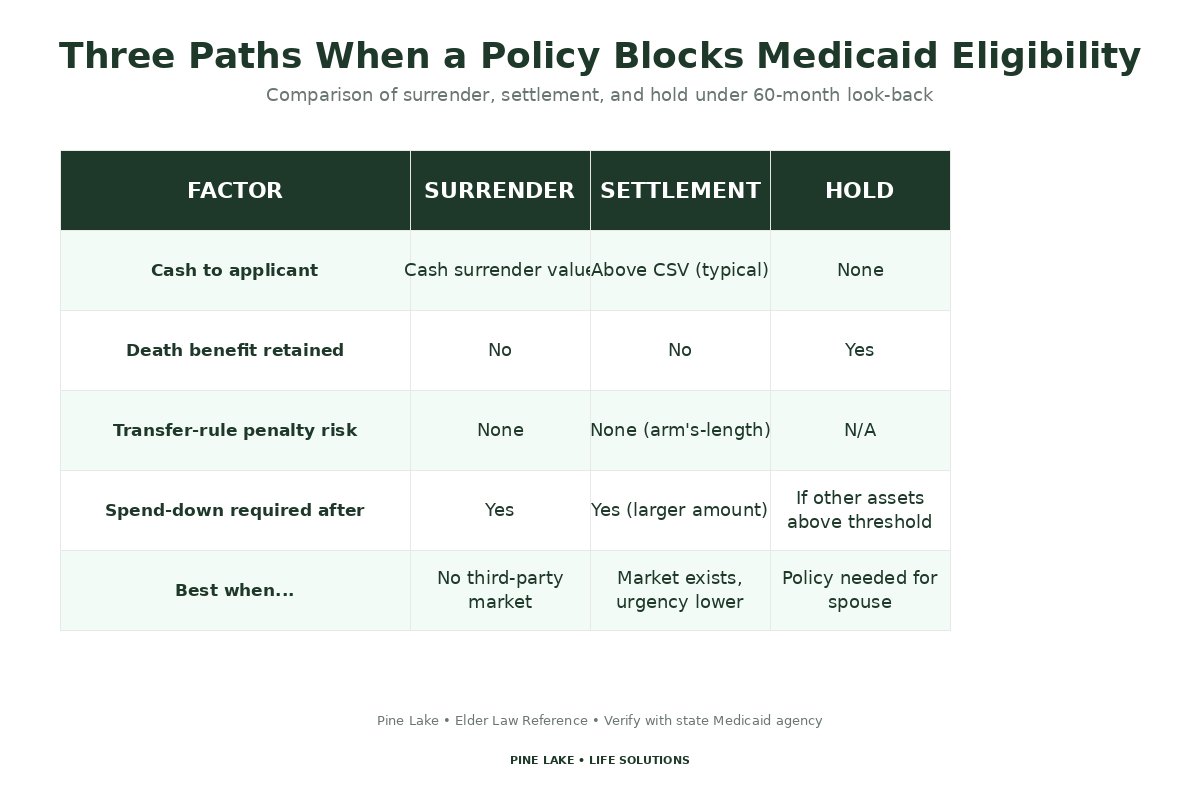
There are five things a family can do with a cash-value policy, and they should be considered in this order rather than the order an insurance agent presents them.
First, read the riders. An accelerated death benefit or chronic illness rider may release funds at no cost, with the policy staying in force. If a qualifying condition exists, this is free money the family may already own and it should be checked before anything is sold or surrendered.
Second, consider doing nothing. If no asset test applies, or the policies are inside the exclusion, or someone genuinely needs the death benefit, the correct answer may be to leave it alone. A surviving spouse whose income drops when the insured dies is the clearest case.
Third, consider a reduced paid-up election. This converts the policy to a smaller death benefit with no further premiums, which stops the premium drain and shrinks or eliminates the cash value that was creating a countability problem, while keeping some coverage in place.
Fourth, consider an irrevocable funeral arrangement. Within the limits California allows, countable cash can sometimes be converted into an excluded burial resource. The word irrevocable is doing the work; a revocable arrangement generally stays countable.
Fifth, and only for a larger policy nobody needs, consider a secondary-market review. The federal Government Accountability Office’s study of the market (GAO-10-775) found sellers historically received roughly 10 to 35 percent of face value and multiples of what the same policies would have paid on surrender. Selling for fair value is not a gift and is generally not a transfer-penalty problem, but the proceeds are cash, and cash behaves differently from a policy under any asset test that is in force. Sequence it deliberately.
Going out of order is what costs money. Surrendering a policy in month one, before confirming whether an asset test even applies, is the single most common and most expensive mistake in this sequence.
Step Six: Understand the Look-Back California Actually Applies
The federal standard, adopted nationally in 2006, is a 60-month look-back on transfers of assets for less than fair market value. California is a genuine outlier: the state has historically continued to apply a 30-month look-back for Medi-Cal long-term care because the Department of Health Care Services has not adopted the regulations needed to implement the longer federal period, and DHCS has said the longer period would not apply until those regulations are in place.
Do not treat that as settled. It has been a pending item for years, and the correct move is to ask the Stanislaus County Community Services Agency or DHCS what look-back period currently applies in 2026 and to get the answer in writing. Plan conservatively in the meantime: assume the longer period could apply to a transfer you make today, because the rule that governs is the rule in force when the application is filed, not the rule you believed when you made the gift.
What counts as a transfer catches families out. Gifts to grandchildren, a below-market sale of ground to a son who farms it, forgiving a loan, adding a child to a deed, or paying a caregiving daughter informally without a written personal care agreement at a reasonable rate can all be treated as uncompensated transfers. In an agricultural family where informal arrangements among siblings are the norm, this is not a hypothetical risk. The general mechanics are covered in what the Medicaid look-back period is.
Selling an asset for its fair value — including a life insurance policy at a market price — is not a gift. Transferring one for materially less than value can be.
Step Seven: Plan for Estate Recovery, Which California Narrowed
Estate recovery is the last step in the sequence and it is the one families most often ignore, which is unfortunate because California’s rules here are unusually favorable and worth planning around deliberately.
California substantially narrowed its Medi-Cal estate recovery program effective in 2017. Recovery is generally limited to the probate estate, which means assets that pass outside probate — for example through a properly funded living trust, or by survivorship — are generally outside the reach of a recovery claim. The state also applies exemptions and a hardship waiver process, and it limits recovery in specified circumstances including where a surviving spouse is living.
Two practical implications for a Stanislaus County family. First, how the farm and the house are titled matters enormously to the eventual recovery exposure, and that is a planning decision to make with an attorney well before a crisis rather than during one. Second, because California’s recovery reach is narrower than most states’, the calculus about whether to preserve a policy for the next generation versus liquidate it now looks different here than it would in a state with aggressive recovery. The general framework is described in what Medicaid estate recovery is, and the statewide figures are collected in the California Medi-Cal asset and income limits reference — verify each with the county agency before relying on it.
None of this is legal advice and none of it substitutes for having a California elder law attorney read your actual documents.
What Going Out of Order Costs, and When a Policy Sale Is Wrong
The cost of a wrong sequence is concrete. Surrender a $180,000 whole life policy in month one to ‘spend down’ and you may have given up multiples of that surrender value for nothing, under a rule that may not even have applied. Sell ground in a hurry and you take a discount that no eligibility outcome recovers. Make a gift to a grandchild before checking the look-back and you create a penalty period that starts exactly when the money is gone. File the financial application without starting the level-of-care determination and you pay a facility privately for two extra months at Modesto rates.
The right sequence, restated: confirm the current asset rule in writing; start the clinical determination in parallel; deal with the farm; inventory the insurance; choose among the policy options in order; understand the look-back; plan for estate recovery.
And be clear about when a policy sale is the wrong answer regardless of sequence. When the face amount is under roughly $100,000, the secondary market generally shows little interest. When the policies are already inside the face-value exclusion, selling converts a non-countable asset into countable cash. When the insured is in good health for their age, offers will be weak or nonexistent because pricing turns on life expectancy. When a surviving spouse’s income depends on the death benefit, it is her plan and should stay. And when an unread accelerated benefit rider could release funds at no cost, that comes first.
If none of those apply and you want a straight answer on a specific policy, a free policy review will give you one, including when the answer is no. The California tax treatment of proceeds is separate — see how California treats settlement proceeds and take it to your own accountant. For the general spend-down process see how a nursing home spend-down works. For questions about a carrier, agent, or anyone soliciting you, the regulator is the California Department of Insurance.
Frequently Asked Questions
Did California really eliminate the Medi-Cal asset test?
California eliminated the asset test for non-MAGI Medi-Cal effective January 1, 2024, after raising the limit to $130,000 in July 2022. The state’s 2025 budget actions then proposed reinstating a limit around $130,000 with an effective date near January 1, 2026. Confirm the current 2026 rule in writing with the county agency or DHCS before acting.
Where do we apply for Medi-Cal in Stanislaus County?
The Stanislaus County Community Services Agency in Modesto takes Medi-Cal applications and also administers In-Home Supportive Services, which is convenient because both tracks run through one agency. Ask specifically about long-term-care Medi-Cal rather than general Medi-Cal, and request the current asset rule in writing while you are there.
Does California use a 60-month look-back?
The federal standard is 60 months, but California has historically continued applying a 30-month look-back for Medi-Cal long-term care because the state has not adopted implementing regulations. Do not treat that as settled. Ask the county agency or DHCS what period applies in 2026, and plan conservatively for any transfer you make now.
How is farm ground treated for Medi-Cal?
It depends on titling, whether the property is income-producing, and whether it qualifies as property essential to self-support, a category with specific conditions that must be documented rather than asserted. The bigger practical problem is liquidity, since ground and equipment cannot be sold on a Medi-Cal timetable. Get an agriculture-literate California elder law attorney involved early.
Does Medi-Cal take the house after death in California?
California narrowed its estate recovery program effective in 2017, limiting recovery generally to the probate estate, so assets passing outside probate are often beyond a claim’s reach. Exemptions and hardship waivers also apply. How the house and farm are titled matters enormously, and that is a planning decision to make well before a crisis.
Should we surrender a life insurance policy to qualify?
Not before Step One. Surrendering a policy under an asset rule that may not currently apply is the most common and most expensive mistake in this sequence. Read the riders first, consider a reduced paid-up election, and for a larger policy nobody needs, ask whether a secondary-market review would produce materially more than surrender value.
Who provides free help in Stanislaus County?
The county’s aging and veterans services division is the local aging agency and a good first call for options counseling. HICAP, California’s health insurance counseling and advocacy program, provides free Medicare and coverage counseling with no financial stake in the outcome. For eligibility strategy and titling, retain your own California elder law attorney.
Find out what your policy is worth — free, confidential, no obligation.
A 15-minute educational review covers your eligibility, every alternative, and a realistic view of what each path would net you.
Related Reading
- Nursing Home Costs Stanislaus County Ca
- Sell Life Insurance Policy Stanislaus County Ca
- California Medicaid Asset Income Limits
- Life Settlement Taxes California
- Sell Life Insurance Policy Butte County Ca
- Nursing Home Medicaid Spend Down
- Life Insurance Counts Medicaid Asset
- What Is Medicaid Estate Recovery
- What Is The Medicaid Look Back Period
Pine Lake Life Solutions does not purchase life insurance policies and does not provide legal, tax, or investment advice. Information provided is for educational purposes only. Eligibility for any option, including life settlements, is not guaranteed and depends on individual circumstances, policy terms, underwriting, and market conditions. Consult independent legal, tax, or financial professionals before making decisions regarding a life insurance policy.