
Ocala, Florida is the county seat of Marion County, and a long-term-care Medicaid application from here moves through three separate offices – the Florida Department of Children and Families for the money, the CARES unit at the Department of Elder Affairs for the level of care, and Elder Options, the area agency on aging for north central Florida, for enrollment and options counseling. None of the three will start the others moving. That is why this page is a countdown rather than a checklist: the tasks are sequential, several have lead times measured in months, and the only one that can be done in a week is the one that pays the least.
The coverage is Florida Medicaid’s Statewide Medicaid Managed Care Long-Term Care program, SMMC LTC, which pays for nursing facility care and for home and community-based services through a contracted managed care plan. As of 2026 the countable-asset limit for a single applicant is $2,000, and monthly income is capped at 300 percent of the federal SSI benefit rate – roughly $2,900 to $3,000. Verify both figures with DCF, and treat every dollar amount below as a range to confirm rather than a quote.
Start at whatever month you are actually standing in. Nothing on this timeline can be done retroactively, and the two items with the longest lead times – the income trust and the life insurance decision – are the two families discover last.
In This Article
- Month 12: Stop the Gifting Clock and Open the Paper Trail
- Month 9: Choose the Door Before the Hospital Chooses It for You
- Month 6: Get the Qualified Income Trust Drafted
- Month 3: The Policy Decision, Because a Sale Takes 60 to 120 Days
- Month 1: The CARES Assessment and the Marion County Homestead File
- Filing Week: ACCESS Florida, the Ocala Office, and the Balances
- The 45 Days After, and Why Ocala’s Affordable Housing Cuts Both Ways
- Frequently Asked Questions
Month 12: Stop the Gifting Clock and Open the Paper Trail
Florida reviews 60 months of financial history backward from the application date. Anything transferred for less than fair value inside that window creates a penalty period, computed by dividing the amount transferred by a state average private-pay rate. Because Florida’s average rate is lower than in the Northeast, the same gift buys a longer penalty here than it would in Connecticut – which routinely surprises households that moved south.
At twelve months out, two actions matter. First, stop unstructured generosity. Helping a grandchild with a car, paying a nephew’s tuition, adding a daughter’s name to a deed – all read as uncompensated transfers, and none of them look different to a caseworker than a scheme would. Second, start the retrieval of records, because that is the task with the longest tail.
Order sixty consecutive months of monthly statements for every checking, savings, money market, certificate, brokerage and retirement account, including accounts closed during the period. Banks routinely take four to eight weeks and longer if they have been acquired. Marion County has a particular version of this problem: households here often bank at a mix of national banks and Florida credit unions, and accounts opened for a specific purpose – a horse trailer loan, a farm operating line – get closed and forgotten.
Which brings up the local wrinkle worth naming at month twelve. Marion County is horse country, and an Ocala-area household may own acreage beyond the homestead, barns, equipment, a trailer, and livestock. All of it is countable at fair market value, all of it is genuinely hard to value, and none of it sells quickly. If any of that is on your balance sheet, the twelve-month mark is when to get a Florida elder law attorney involved, not the week before filing.
Month 9: Choose the Door Before the Hospital Chooses It for You
SMMC LTC covers both nursing facility placement and home and community-based services, and the two paths have different practical constraints.
Nursing facility coverage is available to anyone who meets the financial and level-of-care tests. Home and community-based enrollment runs through a managed care plan and, historically, through a wait list managed by the aging network – which means a family whose goal is to keep a parent at home needs to be in the queue long before the crisis. Call Elder Options, the area agency on aging serving Marion County from Gainesville, and ask to be screened. It costs nothing, and the Elder Helpline they operate is the fastest route into the system.
Also at month nine, price the two settings locally. Given as ranges from cost-of-care survey data of the Genworth and CareScout type carried toward 2026: skilled nursing in the Ocala area has run roughly $8,500 to $9,800 a month for a semi-private room and roughly $9,500 to $11,000 for a private room – at or modestly below a Florida statewide median in the range of $9,000 to $10,500 semi-private. Assisted living in Ocala has run roughly $3,600 to $4,700 a month against a Florida median closer to $4,200 to $5,200, which makes Marion County one of the more affordable assisted living markets in the state. Memory care adds roughly $900 to $1,800. Confirm current pricing with facilities and check quality ratings on the federal Care Compare site.
The Ocala advantage is real: care here costs meaningfully less than in Naples, Sarasota or Palm Beach County. The offsetting local fact is on the other side of the ledger, and it appears in month one.
Month 6: Get the Qualified Income Trust Drafted
Florida is an income-cap state, which households from medically needy states find genuinely alarming when they first hear it. If monthly income exceeds 300 percent of the federal SSI benefit rate, the applicant is over the ceiling – full stop, regardless of how high the care bill is.
The remedy is a Qualified Income Trust, commonly called a QIT or Miller trust. Excess income is deposited into a dedicated trust account each month and directed to the cost of care, which brings countable income under the cap. Three rules govern it and each has cost families months:
- The trust must be properly drafted. This is not a form-download exercise; Florida has specific requirements and DCF reviews the document.
- It must be funded every single month, in the month it is needed. A month it is not funded is a month that can be lost.
- It must generally be in place for the month for which coverage is sought – so a family that waits until the nursing home bill arrives to learn about it loses the intervening months.
Six months out is the right time. It gives room to have counsel draft it, to open the dedicated account at a bank that understands what it is, and to run one or two practice months so the deposit becomes routine before it becomes critical. A QIT addresses income only; the $2,000 resource test is a separate problem, which the next month addresses. Our overview of Florida Medicaid asset and income limits lays out both sides.
| Countdown Point | Task | Lead Time | Cost of Skipping It |
|---|---|---|---|
| Month 12 | Stop gifting; order 60 months of statements; value farm assets | 4 to 8 weeks per institution | Verification-gap denial; a transfer penalty measured in months |
| Month 9 | Choose facility versus home-based care; get screened by Elder Options | Weeks to months for a waiver queue | The hospital discharge desk chooses for you |
| Month 6 | Have a Qualified Income Trust drafted and the account opened | 2 to 6 weeks plus practice months | Every month the trust is unfunded can be lost |
| Month 3 | Decide the life insurance question | Settlement 60 to 120 days; surrender 2 to 6 weeks | Only the fastest, lowest-value option remains |
| Month 1 | Prepare for the CARES assessment; build the homestead file | 1 to 3 weeks for county records | Financial approval with no level-of-care determination |
| Filing week | File in ACCESS Florida on a chosen date; fund the QIT | Same week | Denial for being over the limit on the wrong calendar day |
| After filing | Answer every verification by its printed deadline | Roughly 45 days to determination | Private-pay exposure of $9,000 to $10,000 per month |

Month 3: The Policy Decision, Because a Sale Takes 60 to 120 Days
This is the milestone with a hard lead time, and it is why the countdown exists.
The counting rule is face-value aggregation. Add the face amounts of every policy on the applicant’s life. If the total exceeds the small burial-insurance threshold – Florida has historically applied a $2,500 face-value figure, which should be confirmed with DCF for 2026 – the entire cash surrender value of every policy becomes a countable resource. Not the excess. All of it. A $55,000 whole life policy holding $17,000 of accumulated value does not add $2,500 against a $2,000 limit. It adds $17,000. See how life insurance counts as a Medicaid asset. Term insurance with no cash value normally counts for nothing.
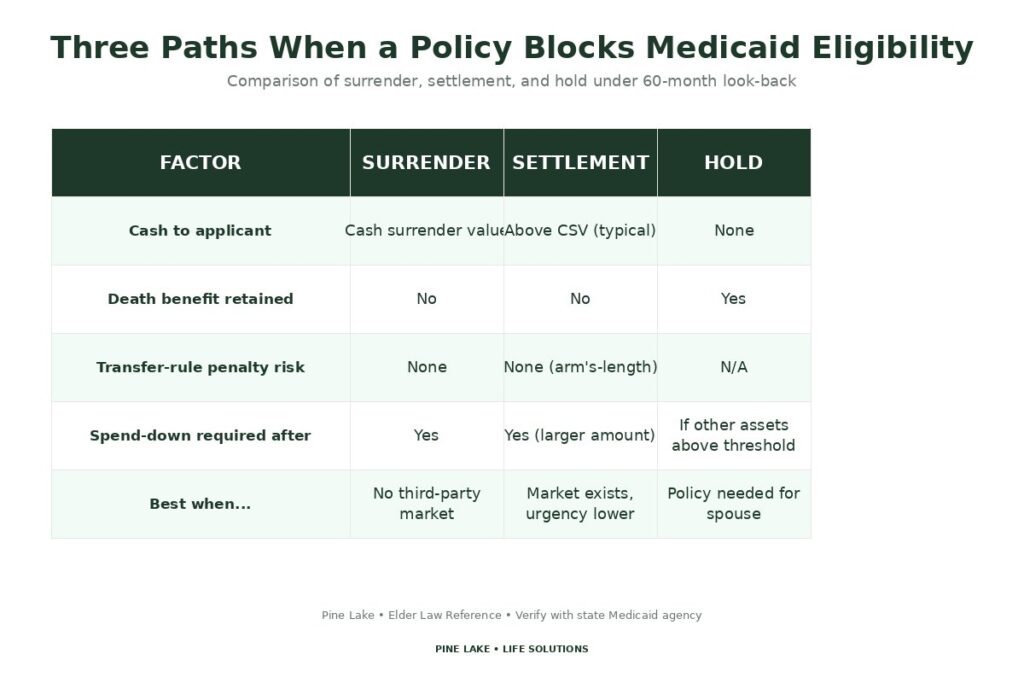
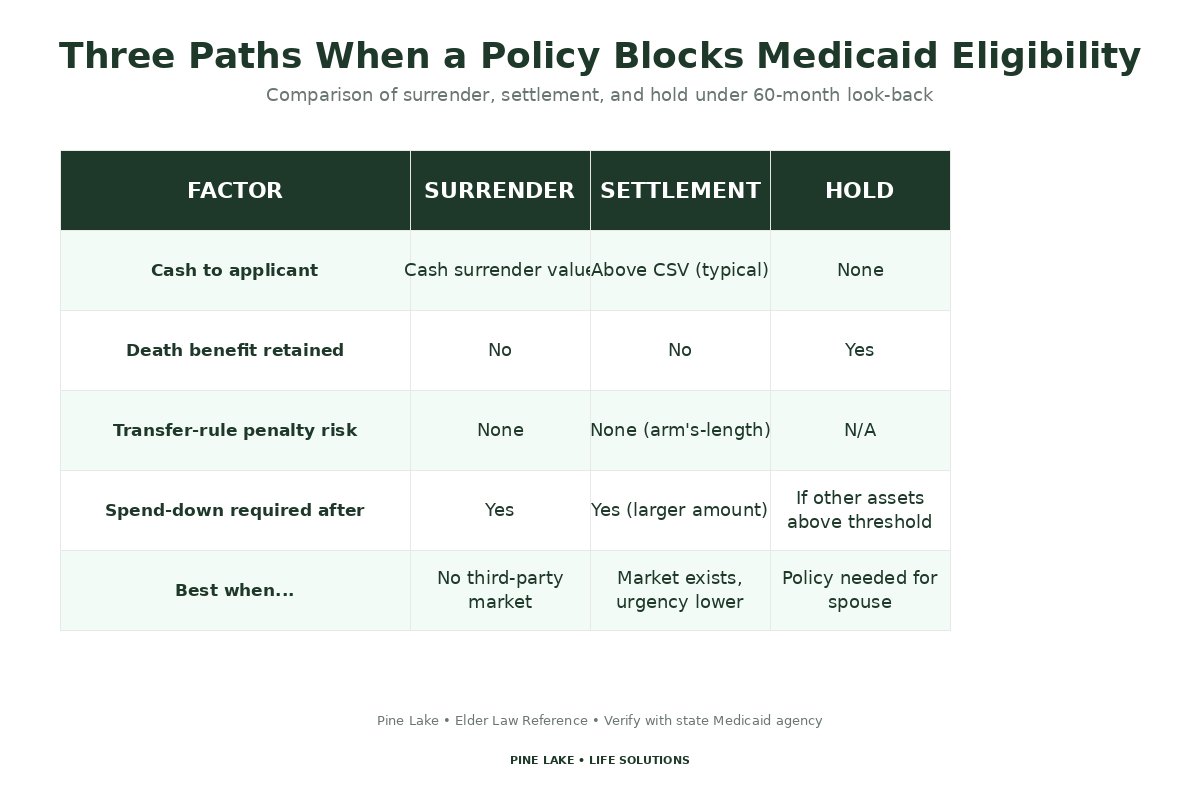
Four exits, with real timelines. Surrender takes two to six weeks and pays the least. A reduced paid-up election takes similar time, ends the premium, preserves a smaller death benefit, and sometimes drops total face value under the burial threshold – resolving the problem without spending the value. Funding an irrevocable funeral arrangement can move value from a countable category into an excluded one. A life settlement – a sale to a licensed institutional buyer – typically takes 60 to 120 days from first review to funded payment, which is exactly why month three is the deadline and not month one. Our explainer on what the first eligibility review looks at describes how a policy is screened at the start of that process, and how the look-back treats a policy sale covers the point that proceeds spent on care are not a transfer while proceeds given away are.
Pine Lake Life Solutions does not purchase policies. We provide education and a free policy review, and we will say plainly when there is no market.
Selling is the wrong answer in five situations: the face amount is under roughly $100,000, where institutional buyers generally will not bid; total face value already sits under the burial threshold, so the cash value is already disregarded and a sale would create countable cash; the insured is in good health, which produces weak offers or none; a surviving spouse needs the death benefit; or the policy is trust-owned or names an irrevocable beneficiary whose consent cannot be obtained on this timeline.
Month 1: The CARES Assessment and the Marion County Homestead File
Two things happen in the final month, and the first one is medical.
CARES – the Comprehensive Assessment and Review for Long-Term Care Services unit at the Florida Department of Elder Affairs – determines whether the applicant functionally requires a nursing-facility level of care. Financial eligibility alone is not coverage. Prepare specifically: a current medication list, the most recent hospital or rehabilitation discharge summary, physician notes naming which activities of daily living require hands-on assistance, any cognitive testing, and a candid description of a typical 24 hours including nights. Do not present a parent at their best; the assessor needs the accurate picture.
The second is the homestead file, and it is where Ocala differs from the coastal Florida markets. Florida’s constitutional homestead protection is unusually strong, and it has generally limited the reach of Medicaid estate recovery against a homestead passing to qualifying heirs – a genuine advantage over most states. To rely on it you need the documents: the deed showing how title is held, the Marion County Property Appraiser’s homestead exemption record and valuation, and the mortgage payoff statement. If the property includes acreage or agricultural exemption beyond the homestead parcel, get the parcel breakdown, because the exemption and the countable acreage are not the same thing.
Then the rest of the file: deeds for every property, vehicle titles, policies with current in-force illustrations, annuity contracts in full, trust documents, Social Security and pension award letters, and a written explanation with receipts for every unusual transaction in sixty months. Include the QIT document and the first funding deposit.
Filing Week: ACCESS Florida, the Ocala Office, and the Balances
File through ACCESS Florida, the state’s online application, or at the DCF Economic Self-Sufficiency office serving Marion County in Ocala. Online creates a timestamp and a record of what was uploaded, which is worth having.
Choose the filing date deliberately. Countable resources are tested at a point in time, so the checking balance on the first of the month – after Social Security lands – can be the difference between approval and denial against a $2,000 limit. Know what the balances will be.
Ask DCF three questions in writing at filing: what retroactive coverage period applies to this case, what verifications remain outstanding, and who the assigned worker is. Answer every verification request by the date printed on the notice and keep proof of when you responded. Missed verification deadlines cause more denials than genuine ineligibility does.
Confirm at the same time that the QIT deposit for the filing month has been made. A trust that exists but was not funded in the month at issue is the single most preventable Florida denial there is.
The 45 Days After, and Why Ocala’s Affordable Housing Cuts Both Ways
Florida generally works toward a determination within roughly 45 days of a complete application, longer when verifications are outstanding. During that window a nursing facility will typically admit and bill as Medicaid pending, accumulating private charges at $9,000 to $10,000 a month in this market. Approval with retroactive coverage resolves most of that. A denial for a document gap leaves the family owing the accumulated balance.
Now the local fact that changes the math more than any rule on this page. Marion County has one of the higher concentrations of residents aged 65 and over in Florida – the retirement communities south and west of Ocala, plus the northern portion of the large Villages development that extends into Marion County, have pushed the county’s older share well above the national figure. But Marion County home values have run in the range of roughly $280,000 to $320,000 as of 2026, far below Collier or Sarasota counties.
Cheap care and cheap housing sound like good news together. They are not, in combination. A paid-off Ocala house at $300,000 converts to roughly 33 months of private-pay skilled nursing at $9,000 a month, where a Naples house at $700,000 converts to about 60 months at a higher rate. The Ocala household has a shorter runway in absolute months despite the lower monthly bill, because the asset side is smaller by more than the cost side is. That is the specific Marion County squeeze, and it is why the twelve-month countdown matters here more than in a wealthier county. Work the numbers on nursing home costs in Ocala.
Nothing on this page is legal, tax, or eligibility advice. Eligibility questions go to DCF, level-of-care questions to CARES, options counseling and SHINE coverage counseling to Elder Options, licensing verification to the Florida Office of Insurance Regulation, planning to your own Florida elder law attorney, and the policy question to a free review. For the local commercial view, see life settlements in Ocala.
Frequently Asked Questions
Which office takes a long-term-care Medicaid application in Ocala, Florida?
Financial eligibility is decided by the Florida Department of Children and Families through its Economic Self-Sufficiency program, filed online in ACCESS Florida or at the office serving Marion County in Ocala. The level-of-care determination is made by the CARES unit at the Department of Elder Affairs, and options counseling and enrollment support come from Elder Options, the area agency on aging for north central Florida.
What is a Qualified Income Trust and when do we need one?
It is the mechanism Florida uses when monthly income exceeds 300 percent of the federal SSI benefit rate, roughly $2,900 to $3,000 as of 2026. Excess income is deposited into a dedicated trust account each month and directed to the cost of care. It must be properly drafted, in place for the month coverage is sought, and funded every single month without exception.
Do horses, barns and acreage count as assets in Marion County?
Generally yes, at fair market value, for anything beyond the homestead parcel – land, structures, equipment, trailers and livestock. All of it is countable, all of it is genuinely difficult to value, and none of it liquidates quickly. If an Ocala-area household holds equine or agricultural assets, involve a Florida elder law attorney a year out rather than weeks out.
Does Florida’s homestead protection really shield the Ocala house?
Florida’s constitutional homestead protection is unusually strong and has generally limited Medicaid estate recovery against a homestead passing to qualifying heirs, which is a real advantage over most states. It is not automatic and depends on how title passes. Get the deed, the Marion County Property Appraiser’s exemption record, and advice from a Florida elder law attorney.
Why does the life insurance decision have to happen three months out?
Because a life settlement typically takes 60 to 120 days from first review to funded payment, while surrender or a reduced paid-up election takes two to six weeks. A family that first examines the policy in filing week has only the fastest and least valuable option left. Three months preserves the whole menu, including the ones that keep more value in the family.
Ocala care is cheaper than the coast – doesn’t that mean more time?
Not necessarily. Marion County home values, roughly $280,000 to $320,000 as of 2026, are far below the coastal counties, so the asset side is smaller by more than the cost side is. A paid-off Ocala house converts to roughly 33 months of private-pay skilled nursing. The lower monthly bill does not offset the smaller balance sheet.
Find out what your policy is worth — free, confidential, no obligation.
A 15-minute educational review covers your eligibility, every alternative, and a realistic view of what each path would net you.
Related Reading
- Nursing Home Costs Ocala Fl
- Life Settlements Ocala Fl
- Florida Medicaid Asset Income Limits
- Sell Life Insurance Policy Alachua County Fl
- Nursing Home Medicaid Spend Down
- Life Insurance Counts Medicaid Asset
- Medicaid Lookback Selling Policy
- Stage 1 Policy Eligibility Review Explained
Pine Lake Life Solutions does not purchase life insurance policies and does not provide legal, tax, or investment advice. Information provided is for educational purposes only. Eligibility for any option, including life settlements, is not guaranteed and depends on individual circumstances, policy terms, underwriting, and market conditions. Consult independent legal, tax, or financial professionals before making decisions regarding a life insurance policy.