

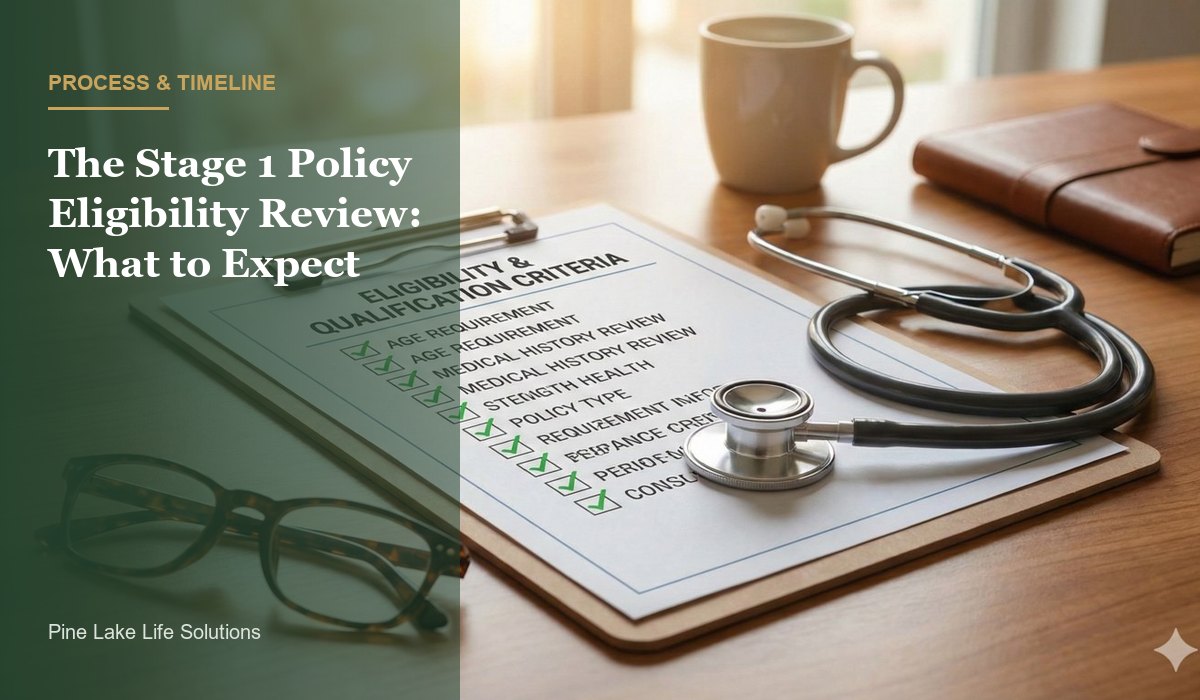
A Stage 1 policy eligibility review is a free, roughly 15-minute educational conversation that screens whether your life insurance policy is likely to qualify for a life settlement and walks you through every alternative before anything else happens. No medical records are pulled, no paperwork is signed, and nothing about your policy changes. The reviewer looks at a handful of basic facts — your age, general health picture, policy type, face amount, and premium load — and compares them against what licensed institutional buyers actually purchase. You leave the call knowing whether a full application makes sense or whether another option, like a reduced paid-up policy or an accelerated death benefit rider, fits better.
This article explains what happens during Stage 1, what information you should have handy, how eligibility is judged, and what a yes or a no actually means for your next step.
In This Article
- Why the Process Starts With a Screening Call, Not an Application
- What Information You Will Be Asked to Share
- How the 15 Minutes Are Actually Spent
- The Eligibility Yardsticks Behind the Conversation
- The Alternatives Discussion: Why It Is Built Into Stage 1
- What a “Yes” Means — and What It Does Not Mean
- What a “No” Looks Like, and Why It Is Still Valuable
- How to Prepare So Your 15 Minutes Count
- After Stage 1: The Bridge Into Full Underwriting
- Frequently Asked Questions

Why the Process Starts With a Screening Call, Not an Application
The full life settlement process runs 60 to 120 days and involves HIPAA authorizations, medical records collection, and two independent life expectancy reports. That is a meaningful commitment of time and personal information, and roughly speaking, most policyholders who ask about settlements do not end up qualifying — the policy is too small, the insured is too young and healthy, or the coverage is a non-convertible term contract. A Stage 1 eligibility review exists so that nobody starts the heavy machinery of Stage 2 full underwriting without a realistic chance of an offer at the end.
Think of it the way a mortgage pre-qualification relates to a full loan application. In 15 minutes, an educator can compare your situation against the buying criteria licensed providers publish and apply every day: insureds generally age 65 or older (younger with significant health impairments), face values generally $100,000 and up, policies in force at least two years, and permanent coverage such as universal life, whole life, or convertible term. If your policy clears those thresholds, moving forward is a reasonable use of your time. If it does not, you find that out in a quarter of an hour instead of two months.
Because Pine Lake operates as an educational firm rather than a buyer, the Stage 1 call carries no sales pressure by design. The reviewer has no inventory quota. The only deliverable is clarity: qualify, probably qualify, or better served by an alternative.
What Information You Will Be Asked to Share
Stage 1 is deliberately light on paperwork. You will not sign a HIPAA release, and no one contacts your doctors or your insurance carrier. Instead, the conversation covers six things you can usually answer from memory or from your most recent annual policy statement:
- The insured’s age and date of birth. Age is the single biggest eligibility driver because it anchors life expectancy.
- A general health picture. Not records — just headline conditions: cardiac history, cancer diagnoses, COPD, diabetes, recent hospitalizations, or changes since the policy was issued.
- Policy type. Universal life, indexed UL, variable UL, whole life, survivorship, or term. If term, whether a conversion privilege still exists and when it expires.
- Face amount. The death benefit, which generally needs to be $100,000 or more to attract institutional buyers.
- Premium and cash value. What you are paying to keep the policy alive and roughly what the carrier would pay if you surrendered.
- Ownership. Whether the policy is owned by the insured, a spouse, a trust, or a business, since ownership determines who must sign later.
If you have an annual statement or an in-force illustration nearby, the review is sharper — but it is not required. The point of Stage 1 is a directional read, not underwriting precision. Precision comes later, in independent life expectancy reports ordered during Stage 2.
How the 15 Minutes Are Actually Spent
A typical Stage 1 review breaks into three short segments. The first five minutes gather the facts listed above. The reviewer is listening for threshold issues — a 58-year-old in good health, a $40,000 face amount, a term policy whose conversion deadline passed — that would end the analysis early and honestly.
The middle five minutes map your situation against the market. Licensed providers price policies using discounted cash flow models built on life expectancy estimates, premium schedules, and face value, which is why the value calculation favors older insureds, health changes since issue, and policies with manageable premiums. The reviewer explains where your policy sits on that map and, when it appears eligible, what the realistic range looks like. Per the U.S. Government Accountability Office’s study of the industry (GAO-10-775), settlements have typically paid several times cash surrender value — often 4 to 8 times — and roughly 10 to 35 percent of face value, though no individual outcome is ever guaranteed.
The final five minutes cover alternatives, which is the part most policyholders have never heard from anyone. Before anyone recommends selling, you should hear about surrender, reduced paid-up options, policy loans, accelerated death benefit riders, 1035 exchanges, and simply letting a policy lapse when it truly has no market value. A settlement is irreversible; the review treats it as one option among several, not the default.
The Eligibility Yardsticks Behind the Conversation
Eligibility in Stage 1 is judged against criteria that come from how institutional buyers — pension funds, asset managers, and specialty funds working through licensed providers — actually underwrite. The yardsticks are consistent across the market:
- Age 65 or older is the general floor, because buyers need a life expectancy short enough for the discounted purchase price to work. Younger insureds can qualify with significant health impairments that shorten projected life expectancy.
- Face value of $100,000 or more. Underwriting a case costs the same whether the policy is $50,000 or $2 million, so small policies rarely justify the transaction costs.
- Two or more years in force. State laws modeled on the NAIC’s framework restrict settling newly issued policies, a guardrail against stranger-originated life insurance; the National Association of Insurance Commissioners publishes the underlying model standards at content.naic.org.
- Permanent coverage, or convertible term. Universal life, indexed and variable UL, whole life, and survivorship policies all trade. Term policies qualify only while a conversion privilege remains exercisable.
- A health change since issue. Not required, but a new diagnosis or progression since the policy was underwritten is what most often creates settlement value.
A fuller treatment of these thresholds lives in who qualifies for a life settlement; Stage 1 simply applies them to your specific facts in real time.
| Aspect | Stage 1: Eligibility Review | Stage 2: Full Underwriting |
|---|---|---|
| Time required | About 15 minutes | Weeks (part of the 60–120 day process) |
| Cost to policyholder | Free | Free to the policyholder |
| Paperwork signed | None | HIPAA authorization and application |
| Medical records | Not collected — verbal health summary only | Collected from all treating physicians |
| Life expectancy reports | None | Two independent reports (2–6 weeks) |
| Carrier involvement | None | In-force illustration requested |
| Output | Eligible / not eligible, plus alternatives review | Packaged case marketed to licensed buyers |
| Commitment created | None — purely educational | None until a purchase contract is signed |
The Alternatives Discussion: Why It Is Built Into Stage 1
An eligibility review that only screens for “can this policy be sold” would be a sales funnel, not education. The alternatives segment exists because for many policyholders, another option genuinely produces a better outcome than a settlement — and an educational firm is obligated to say so.
The alternatives typically covered include:
- Keeping the policy, sometimes by restructuring premiums or using accumulated cash value to carry the cost.
- Reduced paid-up insurance, which stops premiums entirely in exchange for a smaller permanent death benefit.
- Policy loans or partial withdrawals, which raise cash while the death benefit (reduced by the loan) stays with your family.
- Accelerated death benefit riders, which can advance a portion of the death benefit during serious illness, often without selling anything.
- A 1035 exchange into a policy or annuity that better fits current needs, preserved tax-free under Internal Revenue Code rules described at IRS.gov.
- Surrender or lapse, appropriate when a policy has neither family purpose nor market value.
The reviewer also flags the downsides of settling: your heirs lose the death benefit, proceeds may be taxable, and a lump sum can affect eligibility for means-tested benefits such as Medicaid. Hearing the trade-offs before Stage 2 — rather than at the closing table — is the entire philosophy of starting with education. A deeper primer sits at what is a life settlement.
What a “Yes” Means — and What It Does Not Mean
If the review concludes that your policy appears eligible, it is important to understand precisely what that conclusion is. It means your facts fit the pattern of policies that licensed buyers purchase, and that proceeding to Stage 2 full underwriting is a rational next step. It does not mean an offer exists, and it does not commit you to anything.
Between a Stage 1 yes and an actual offer stand several real gates. Your medical records must be collected and reviewed. Two independent life expectancy underwriters must each issue a report, a process that takes two to six weeks on its own. An in-force illustration from your carrier must confirm the premium schedule buyers will model. Only after that package is assembled and marketed to licensed providers do offers arrive — or not. Some cases that look promising in Stage 1 come back with life expectancy estimates long enough that no buyer bids meaningfully above cash surrender value, and the honest advice at that point is to keep the policy or pursue an alternative.
Equally important: a yes has no expiration pressure attached. Policyholders sometimes complete Stage 1, sit with the information for months, and return after a health event or a premium increase changes the calculus. Because Stage 1 involves no signed authorizations, there is nothing to unwind. The step-by-step process guide shows exactly where Stage 1 sits in the larger sequence.
What a “No” Looks Like, and Why It Is Still Valuable
Roughly half the value of Stage 1 is delivered when the answer is no. A clear, well-explained no protects you from spending 60 to 120 days on a process that ends in disappointment, and it usually comes with a specific reason you can act on.
Common reasons a policy does not clear Stage 1, and what each implies:
- The insured is too young and healthy. The policy may become marketable later; some policyholders re-run Stage 1 after a milestone birthday or a health change.
- The face amount is too small. Below roughly $100,000, transaction costs swamp the economics. Surrender value or reduced paid-up options usually dominate.
- The term conversion window has closed. A non-convertible term policy has no vehicle for a buyer to hold, so the market simply is not there. If the window is still open but closing, the review will flag the deadline urgently, because settling convertible term requires converting first.
- The policy is too new. State laws patterned on the NAIC Life Settlements Model Act restrict settlements within the first two years (with narrow exceptions); the model’s provisions are published in the NAIC Model Act. Waiting out the period may reopen the door.
In every no scenario, the alternatives discussion still happens, so you leave with a plan rather than a rejection.
How to Prepare So Your 15 Minutes Count
You can complete a Stage 1 review with nothing in hand, but ten minutes of preparation makes the read materially more accurate. Before the call, try to locate:
- Your most recent annual policy statement, which shows face amount, cash value, loans, and premium paid.
- The policy’s issue date, to confirm the two-years-in-force threshold.
- Your premium notice, so the reviewer can see the carrying cost buyers will subtract in their models.
- A one-line health summary for the insured: major diagnoses, dates, and current treatments. You will not be asked for records — just the headlines.
- Ownership details: if a trust or business owns the policy, note the trustee or officer who would sign documents later.
It also helps to think through your goal before the call. Policyholders come to Stage 1 for different reasons — premiums that have become unaffordable, coverage that outlived its purpose, cash needs for care or retirement — and the best next step differs by goal. Someone drowning in premiums might be served by reduced paid-up insurance; someone facing long-term-care costs might weigh a settlement against an accelerated benefit rider; a New Jersey policyholder can also verify any broker or provider they later deal with through the state’s insurance regulator at NJ DOBI. Arriving with your goal named lets the reviewer aim the whole 15 minutes at it.
After Stage 1: The Bridge Into Full Underwriting
When a policyholder decides to proceed, the transition from Stage 1 to Stage 2 is the moment the process becomes formal. You sign a HIPAA authorization permitting medical records collection, and the case moves into full underwriting: records are gathered from your physicians, two independent life expectancy underwriters each analyze the file, and your carrier produces an in-force illustration confirming how the policy performs at various premium levels. Everything is then packaged and presented to licensed institutional buyers, whose competing bids drive the auction dynamic that determines your ultimate offer.
The full journey from HIPAA signature to funded escrow typically runs 60 to 120 days. Records collection is usually the longest and least predictable leg; life expectancy reports take two to six weeks; marketing, negotiation, contracts with state-mandated disclosures, carrier change-of-ownership paperwork, and escrow funding fill out the remainder. The timeline article breaks each leg down week by week.
Two features of the bridge deserve emphasis. First, you can stop at any point before signing a purchase contract, and even after signing, state rescission windows of 15 to 30 days let you unwind a completed sale. Second, the information asymmetry that Stage 1 was designed to cure stays cured: because you entered underwriting understanding eligibility, alternatives, and realistic ranges, the offers that eventually arrive land on an educated recipient rather than a hopeful one. That is what a screening stage is for.
Frequently Asked Questions
What is a Stage 1 policy eligibility review in a life settlement?
It is a free, approximately 15-minute educational review that screens whether your life insurance policy is likely to qualify for a life settlement before any formal process begins. The reviewer looks at the insured’s age, general health, policy type, face amount, premiums, and ownership, compares them against what licensed buyers actually purchase, and walks through every alternative — surrender, reduced paid-up insurance, loans, accelerated benefit riders, and keeping the policy. No records are pulled and nothing is signed.
Do I need to provide medical records for a Stage 1 eligibility review?
No. Stage 1 requires only a verbal health summary — major diagnoses, approximate dates, and current treatments. Medical records are not collected until you decide to proceed to Stage 2 full underwriting and sign a HIPAA authorization. This is deliberate: the screening stage exists so you can learn whether a settlement is realistic before sharing any protected health information or committing to the 60-to-120-day full process.
How long does the Stage 1 review take and what does it cost?
The review itself takes about 15 minutes and is free. There is no charge at any later stage to the policyholder either — in a completed settlement, compensation comes out of the transaction, which is one reason regulators require compensation disclosures in the closing documents. The 15-minute format works because eligibility turns on a handful of facts: age, health changes since issue, policy type, face amount, time in force, and premium load.
What makes a life insurance policy fail a Stage 1 eligibility review?
The most common disqualifiers are an insured who is under 65 and in good health, a face amount below roughly $100,000, a term policy whose conversion privilege has expired, and a policy that has been in force less than two years. Some of these are permanent (a closed conversion window), while others resolve with time — a policy can be re-screened after a health change, a birthday, or the two-year mark.
Does passing the Stage 1 review mean I will definitely get an offer?
No. Passing Stage 1 means your facts fit the pattern of policies licensed buyers purchase, so full underwriting is worth your time. Actual offers depend on what two independent life expectancy reports conclude, what your carrier’s in-force illustration shows about future premiums, and how licensed providers bid once the case is marketed. Some cases that screen well in Stage 1 receive no offer meaningfully above cash surrender value, and the honest recommendation then is to keep the policy or pursue an alternative.
Will a Stage 1 eligibility review affect my life insurance policy or my credit?
No. Stage 1 involves no contact with your insurance carrier, no credit inquiry, no signed authorizations, and no change to your policy. Your coverage, beneficiaries, premiums, and cash value are exactly the same after the call as before it. The carrier is not contacted until Stage 2, and even then only to request an in-force illustration — your policy itself does not change unless and until you sign a purchase contract and closing paperwork much later.
What alternatives to selling my policy are discussed during Stage 1?
A proper Stage 1 review covers keeping the policy with restructured premiums, reduced paid-up insurance that stops premiums in exchange for a smaller death benefit, policy loans or withdrawals against cash value, accelerated death benefit riders for serious illness, tax-free 1035 exchanges into a better-fitting product, and surrender or lapse when nothing else fits. It also covers the downsides of settling: loss of the death benefit to heirs, potential taxes, and possible effects on means-tested benefits like Medicaid.
What happens after the Stage 1 review if I decide to move forward?
You sign a HIPAA authorization, which starts Stage 2 full underwriting: medical records are collected from your physicians, two independent life expectancy underwriters analyze the file, and your carrier provides an in-force illustration. The packaged case is then marketed to licensed institutional buyers, offers are negotiated, contracts with state-mandated disclosures are signed, the carrier processes change-of-ownership paperwork, and funds are released from escrow. The full sequence typically takes 60 to 120 days, and you can stop any time before signing a contract.
Find out what your policy is worth — free, confidential, no obligation.
A 15-minute educational review covers your eligibility, every alternative, and a realistic view of what each path would net you.
Related Reading
- Stage 2 Full Underwriting Explained
- Life Settlement Process Step By Step
- Who Qualifies For A Life Settlement
- Life Settlement Timeline
Pine Lake Legacy does not purchase life insurance policies and does not provide legal, tax, or investment advice. Information provided is for educational purposes only. Eligibility for any option, including life settlements, is not guaranteed and depends on individual circumstances, policy terms, underwriting, and market conditions. Consult independent legal, tax, or financial professionals before making decisions regarding a life insurance policy.