
The biggest red flags in a life settlement transaction are unlicensed intermediaries, upfront fees, guaranteed offers made before underwriting, pressure to sign quickly, hidden compensation, single-bid pricing, and closings without independent escrow. Each one signals that the process is being run for someone other than you. Life settlements are legitimate, regulated transactions, which is exactly why deviations from the regulated pattern are so informative.
This checklist walks through the warning signs stage by stage, from first contact through closing, and tells you what the trustworthy version of each step looks like.
In This Article
- Why Red Flags Work: The Regulated Baseline
- First-Contact Red Flags: How the Deal Finds You
- Licensing and Identity Red Flags
- Money Red Flags: Fees, Offers, and the Missing Auction
- Medical and Privacy Red Flags
- STOLI and Manufactured-Policy Red Flags
- Closing-Stage Red Flags: Where Good Deals Go Bad
- Using the Checklist: What to Do When a Flag Appears
- Frequently Asked Questions
Why Red Flags Work: The Regulated Baseline
A red flag is only meaningful against a baseline of what normal looks like, and in life settlements the baseline is unusually well defined because the transaction is regulated at the state level. Most states have adopted frameworks based on the NAIC Life Settlements Model Act, which prescribes licensing for brokers and providers, mandatory disclosures, privacy protections, escrow standards, and a post-closing rescission window of 15 to 30 days depending on the state.
That gives consumers a powerful heuristic: legitimate transactions follow the regulated pattern, and each departure from the pattern is information. The normal shape of a settlement:
- Licensed parties on every seat, verifiable through your state insurance department
- Written disclosures of compensation and offers
- Medical underwriting producing typically two independent life expectancy reports over 2 to 6 weeks
- Competitive bidding among multiple providers
- Independent escrow at closing, funds released when the carrier confirms transfer
- A rescission period after funding
- An overall timeline of roughly 60 to 120 days
Nobody legitimate needs to skip these steps, because the steps are how the market works. When someone proposes skipping one, faster money, no medical exam needed, we’ll handle the paperwork trust us, the proposal itself is the finding.
If you are new to the transaction, ground yourself in how life settlements work and the consumer protections that apply; the rest of this article assumes that baseline and hunts deviations from it, stage by stage.
First-Contact Red Flags: How the Deal Finds You
Trouble often announces itself in the opening approach, before any document is exchanged.
- Unsolicited contact promising specific dollar amounts. No one can honestly quote your policy’s value before life expectancy underwriting, which takes 2 to 6 weeks and drives the entire price. Cold calls or mailers announcing your policy is worth $250,000 are marketing fiction; real offers emerge from a process, not a postcard. Market norms, typically 10 to 35 percent of face value, are ranges, and where you fall in them cannot be known in advance.
- We buy any policy, everyone qualifies. Eligibility is real: insureds generally 65 or older, face amounts generally $100,000 or more, policies in force at least 2 years. Someone claiming universal qualification is either uninformed or setting a hook; check who actually qualifies.
- Urgency from the first conversation. This offer expires Friday, rates are about to change, sign now. A genuine settlement takes 60 to 120 days; there is no legitimate reason for a decision measured in hours. Manufactured deadlines exist to prevent exactly the verification this checklist prescribes.
- Reluctance to identify themselves precisely. Legitimate intermediaries state their legal name, firm, role, broker representing you or provider buying for investors, and license number without prompting. Vagueness about identity or role, we’re a national network of funders, is a flag on its own; the role distinction and why it matters is explained in broker vs. provider.
- Discouraging outside advice. Any suggestion that you keep the transaction from your attorney, CPA, or family inverts the behavior of every honest professional in this market.
None of these first-contact flags proves fraud; each proves the interaction has left the regulated pattern, and that is reason enough to stop.
Licensing and Identity Red Flags
Licensing is the checkpoint where a few minutes of diligence neutralizes the majority of bad actors, because operating unlicensed is both a hallmark of fraud and, in most states, illegal in itself.
The flags:
- No license number offered, or excuses: licensed in another state, our parent company holds it, licensing does not apply to our model
- A license that exists but is the wrong type, a general insurance producer credential is not a life settlement broker license in most states
- Mismatch between the name on the license and the entity asking for your documents
- Disciplinary history the person denied or failed to mention
The verification routine: look up the individual and the firm with your state insurance department before sharing any medical or policy information. The NAIC links to every state regulator; New Jersey residents use the Department of Banking and Insurance. Confirm the license is active, matches the claimed role, and carries no unexplained enforcement history. Save what you find.
Identity flags extend to the paperwork. Contracts naming entities you have never spoken with, signature pages that arrive separately from the agreements they execute, and requests to sign documents with blanks to be filled in later are all serious. So is any request for credentials that make no sense for the transaction, online banking passwords, for example; settlements require policy documents and medical authorizations, never your account logins.
The step-by-step process for finding legitimately licensed representation, including what the license does and does not guarantee, is covered in how to find a licensed life settlement broker. The short version stands: no license, no conversation.
Money Red Flags: Fees, Offers, and the Missing Auction
The financial architecture of a settlement is where sellers lose the most to bad practice, often without any outright fraud, just structures tilted against them.
- Upfront fees. Legitimate broker compensation is paid from proceeds at closing. Demands for advance payment, appraisal fees, marketing fees, processing fees, are a classic abuse: the fee is collected, and the marketing never happens. The correct amount to pay before closing is zero.
- Undisclosed or shifting compensation. Most states require written disclosure of broker compensation. Refusal to put fees in writing, answers that change between conversations, or the discovery of referral fees you were never told about all flag a transaction being priced around you rather than for you.
- The single mysterious bid. One offer, sourced from an unnamed buyer, presented as the market. Without competitive bidding you have no price discovery, and without seeing all offers, which brokers in most states are legally obliged to present, you cannot know an auction occurred. Ask for the bid history: who was contacted, who bid, how rounds progressed. The forces a real auction harnesses are described in what drives life settlement offers.
- Offers wildly outside market norms. Settlements typically pay 10 to 35 percent of face value and 4 to 8 times cash surrender value. An offer far below that range, on a policy with a short life expectancy and cheap premiums, suggests a captive process. An offer implausibly above it, used to win your signature before being negotiated down through discovered problems, is the bait-and-switch variant.
- Pressure to accept before your advisors review. The money version of the urgency flag, and equally disqualifying.
The antidote to all five is the same: written disclosures, visible competition, and offers evaluated against the framework in evaluating a life settlement offer.
| Stage | Red Flag | What Legitimate Looks Like | Response |
|---|---|---|---|
| First contact | Guaranteed price before underwriting; expiring offers | Ranges only; 60-120 day process acknowledged | Slow down; verify identity |
| Licensing | No license number; wrong license type; identity mismatches | Active state life settlement license, freely disclosed | Stop until verified with regulator |
| Fees | Upfront charges; undisclosed or shifting compensation | Success-based fees, disclosed in writing | Walk away from advance fees |
| Pricing | Single unnamed bid; offers far outside 10-35% of face norms | Multi-provider auction; all bids shown | Demand bid history or re-auction |
| Medical | Coaching to exaggerate health; open-ended HIPAA releases | Honest records; scoped, revocable authorizations | Refuse; report solicitation to fraud |
| Policy origin | Free insurance or investor-initiated policies (STOLI) | Policy bought in good faith, in force 2+ years | Decline entirely; illegal scheme |
| Closing | No independent escrow; changed documents; lapse pressure | Escrowed funds released on carrier confirmation | Halt closing; involve attorney |
| Post-closing | Rescission rights never mentioned; funding delays | 15-30 day state rescission window stated in documents | Complaint to state insurance department |

Medical and Privacy Red Flags
A settlement necessarily involves your health information, HIPAA authorizations, medical records, and life expectancy underwriting, which creates a distinct family of warning signs.
- Coaching you to misstate your health. Any suggestion to exaggerate conditions to shorten your apparent life expectancy, or to conceal improvements, is solicitation to fraud. It exposes you, not just the intermediary, to civil and criminal consequences and can void the transaction. Honest underwriting cuts both ways: your records as they are, completely documented.
- No underwriting at all. The inverse flag. A firm offer with no life expectancy reports behind it is not an underwritten price; it is a number chosen for effect. The standard is typically two independent reports from specialized firms, taking 2 to 6 weeks. Ask which underwriting firms were used and what the reports concluded; sellers are entitled to that transparency.
- Open-ended medical authorizations. HIPAA releases should be scoped to the transaction, identified parties, defined purpose, revocable. Authorizations naming no recipient, or granting perpetual access to all records for all purposes, hand your medical file to strangers indefinitely.
- Data leakage. If you start receiving calls from unrelated funders after sharing records with one party, your information was shopped beyond its authorization. State privacy provisions under the NAIC-based framework restrict redisclosure; violations belong in a complaint to your insurance department.
- Post-sale contact promises that dodge the question. After a legitimate sale, the buyer will periodically verify your health status, within limits state law places on frequency and manner. An intermediary who denies any future contact, or cannot describe it, has not told you the truth about the product.
The privacy trade-off is a real, permanent feature of selling a policy, one of the honest downsides to weigh alongside taxes and lost coverage in the settlement-versus-surrender decision.
STOLI and Manufactured-Policy Red Flags
One category of red flag differs in kind from the rest, because it can implicate you in an illegal scheme rather than merely costing you money: stranger-originated life insurance, or STOLI.
The legitimate secondary market rests on Grigsby v. Russell, the 1911 Supreme Court decision confirming that a policy bought in good faith is property the owner may sell. STOLI inverts that: investors induce a senior to take out a new policy for the purpose of selling it to them, manufacturing a bet on a stranger’s life. It is prohibited under state law, the NAIC Model Act framework targets it explicitly, and the two-year in-force requirement exists substantially to frustrate it.
The pitch patterns to recognize:
- Free insurance, someone else pays the premiums for a policy on your life, and you profit by selling it after two years
- Premium-financing arrangements where the exit was always a sale to investors, not repayment
- Cash inducements simply for applying for coverage, or applications inflating your net worth to justify face amounts you would never buy yourself
- Being asked to certify, falsely, that no sale arrangement exists when one does
Why you should care beyond legality: participants have faced rescinded policies, litigation with carriers, tax complications, and damaged insurability. The insured in a STOLI scheme is usually the least sophisticated party and often the one left holding consequences.
The full anatomy of these schemes, and their history, is in stranger-originated life insurance explained. The bright line is simple: selling a policy you bought for genuine protection is legitimate; acquiring a policy in order to sell it never was.
Closing-Stage Red Flags: Where Good Deals Go Bad
Even a transaction that ran cleanly for ninety days can fail at the finish. Closing mechanics deserve their own vigilance.
- No independent escrow. The protective structure is standard: an independent escrow agent holds the purchase funds, and they release to you when the carrier confirms the ownership and beneficiary changes. A buyer proposing to pay you directly after transfer, on trust, is asking you to surrender the policy first and hope. Refuse, regardless of reputation.
- Documents that changed. Final contracts with different numbers, parties, or terms than negotiated, or signature pages circulated separately from the agreements they bind. Read the final set completely; better, have your attorney do it.
- Pressure to let the policy lapse during closing. You must keep premiums current until funds are escrowed and the transfer is done; the 30 to 31 day grace period is your margin for error, not a place to park the policy. A counterparty encouraging you to stop paying is creating leverage: a lapsing policy negotiates from desperation.
- Silence about rescission. Most states give sellers 15 to 30 days after closing to unwind the sale by returning proceeds. Closing packages should state your state’s window plainly. Its absence from the paperwork, or a counterparty who has never heard of it, marks a process that skipped consumer protections, and possibly more.
- Funding delays with excuses. Once the carrier confirms transfer, escrowed funds should move promptly. Rolling explanations for missing money are the endgame flag; involve your attorney and your state insurance department immediately.
The federal GAO examination of this market emphasized how outcomes depend on process integrity. Closing is where integrity is finally tested, and where the checklist earns its keep.
Using the Checklist: What to Do When a Flag Appears
Red flags vary in severity, and the response should match. A workable triage:
- Stop-immediately flags. No license, upfront fee demands, coaching to misrepresent health, STOLI pitches, closings without escrow. These are not negotiable defects; end the engagement, in writing, and do not share further documents.
- Explain-or-exit flags. A single bid, fee answers that shifted, an affiliated provider disclosed late, timeline promises that ignore the 60 to 120 day reality. Demand a written explanation and corroboration, the bid sheet, the disclosure form, the license record. A satisfactory answer, documented, can rehabilitate the process; a defensive one completes the picture.
- Context flags. Marketing puffery, enthusiasm, imperfect paperwork on first draft. Worth noting and correcting, not necessarily disqualifying, professionals fix these promptly when asked.
When flags harden into suspected misconduct, escalate: your state insurance department takes complaints against licensees and investigates unlicensed activity, with contacts available through the NAIC; your attorney can advise on rescission, most states allow 15 to 30 days post-closing, and on contract remedies; and suspected fraud can be reported to state fraud bureaus.
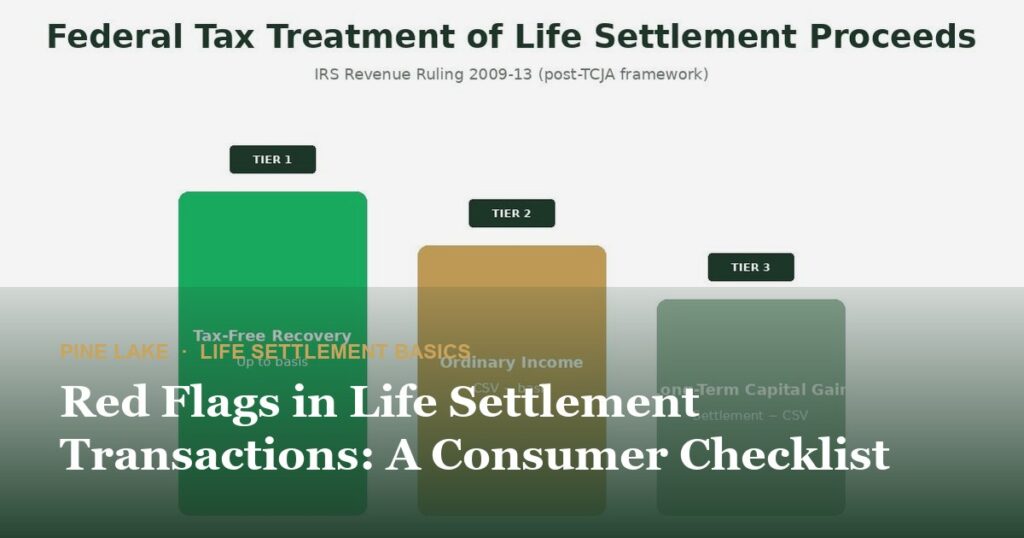
The habits that prevent most problems in the first place: verify licenses before sharing anything; get every material representation, fees, bids, timelines, escrow, in writing; involve your CPA and attorney early, including on the tax treatment under IRS Revenue Ruling 2009-13, with guidance at the IRS and a plain-English summary in the tax treatment guide; insist on competitive bidding you can see; and use the rescission window as a genuine final review.
A life settlement handled by licensed parties, at documented arm’s length, with visible competition and escrowed closing, is a legitimate financial transaction. The checklist exists so you can tell that transaction apart from its imitations, and act on the difference.
Frequently Asked Questions
What are the biggest red flags when selling a life insurance policy?
The disqualifying ones: an intermediary who cannot produce an active life settlement license in your state; any demand for upfront fees, since legitimate compensation comes out of closing proceeds; guaranteed prices quoted before medical underwriting, which takes 2 to 6 weeks and drives all pricing; pressure to sign within days when the real process runs 60 to 120; closings without an independent escrow agent; and any coaching to misstate your health. Each represents a departure from the regulated pattern that legitimate transactions follow, and each justifies walking away.
Is it a scam if someone offers to buy my life insurance policy without a medical exam or records review?
Treat it as one. Life settlement pricing is built on life expectancy underwriting, typically two independent reports produced from your medical records over 2 to 6 weeks. A firm price offered without that underwriting is a number invented for effect, usually either far below what a competitive process would produce or an inflated hook to be negotiated down after you commit. The absence of underwriting also often accompanies other flags: no license, no escrow, no disclosed fees. Legitimate buyers always underwrite; it is how they invest.
Should I ever pay an upfront fee to sell my life insurance policy?
No. Broker compensation in legitimate life settlements is success-based and paid from the transaction proceeds at closing, with written disclosure required in most states. Advance charges, appraisal fees, marketing fees, processing fees, document fees, are the signature of a well-worn abuse pattern in which the fee is collected and the promised marketing never occurs. The rule has no meaningful exceptions for consumers: the correct amount to pay anyone before your settlement closes is zero, and a demand for more is a reason to end the engagement, not negotiate.
How can I tell if a life settlement offer is too low?
Benchmark it against market norms and process quality. Settlements typically pay 10 to 35 percent of face value and roughly 4 to 8 times cash surrender value, with life expectancy and premium costs determining position in that range. An offer can be legitimately modest if your life expectancy is long or premiums are heavy, those are verifiable facts. But if the offer arrived without competitive bidding, from a single unnamed buyer, or through a broker who will not show the full bid history, the number reflects a captive process rather than the market. Re-auction before accepting.
What is STOLI and why is it dangerous for seniors?
STOLI, stranger-originated life insurance, is a prohibited scheme in which investors induce a senior to take out a new policy specifically so it can be sold to them, often pitched as free insurance or easy profit after two years. It differs fundamentally from a legitimate settlement, which sells a policy originally bought in good faith. Participants risk rescinded policies, litigation with insurers, tax problems, and damaged insurability, and the senior is typically the party left with the consequences. Any proposal to acquire coverage in order to sell it should be declined outright.
Why does missing escrow matter so much in a life settlement closing?
Because escrow is what prevents the worst possible sequencing: transferring ownership of your policy before you have been paid. The standard protective structure places the buyer’s funds with an independent escrow agent, released to you when the insurance carrier confirms the ownership and beneficiary changes. Without it, you are relying on a counterparty’s promise after you have already surrendered the asset, and if payment stalls, your leverage is gone. No reputation or reassurance substitutes for the structure; a closing proposed without independent escrow should not proceed.
Who do I contact if I suspect a life settlement scam or misconduct?
Start with your state insurance department, which licenses settlement brokers and providers, investigates complaints against licensees, and pursues unlicensed activity; the NAIC website links to every state regulator, and New Jersey uses the Department of Banking and Insurance. If you are mid-transaction, involve your own attorney immediately, and remember that most states provide a 15 to 30 day rescission window after closing during which you can unwind a completed sale by returning the proceeds. Suspected fraud can also be reported to your state’s insurance fraud bureau.
Can a legitimate life settlement still be a bad deal for me?
Yes, and that is worth stating plainly. A transaction can be fully licensed, disclosed, and escrowed and still be wrong for your situation: if premiums remain affordable and your family needs the death benefit, keeping the policy usually delivers more value than any offer; a sale may create taxable income under the three-tier framework of Revenue Ruling 2009-13; proceeds can affect Medicaid and other needs-based benefits; and coverage lost is rarely replaceable at older ages. Red-flag screening protects you from bad actors, but only a genuine comparison of alternatives protects you from a bad decision.
Find out what your policy is worth — free, confidential, no obligation.
A 15-minute educational review covers your eligibility, every alternative, and a realistic view of what each path would net you.
Related Reading
- Life Settlement Scams To Avoid
- Life Settlement Consumer Protections
- Questions To Ask Life Settlement Broker
Pine Lake Legacy does not purchase life insurance policies and does not provide legal, tax, or investment advice. Information provided is for educational purposes only. Eligibility for any option, including life settlements, is not guaranteed and depends on individual circumstances, policy terms, underwriting, and market conditions. Consult independent legal, tax, or financial professionals before making decisions regarding a life insurance policy.