
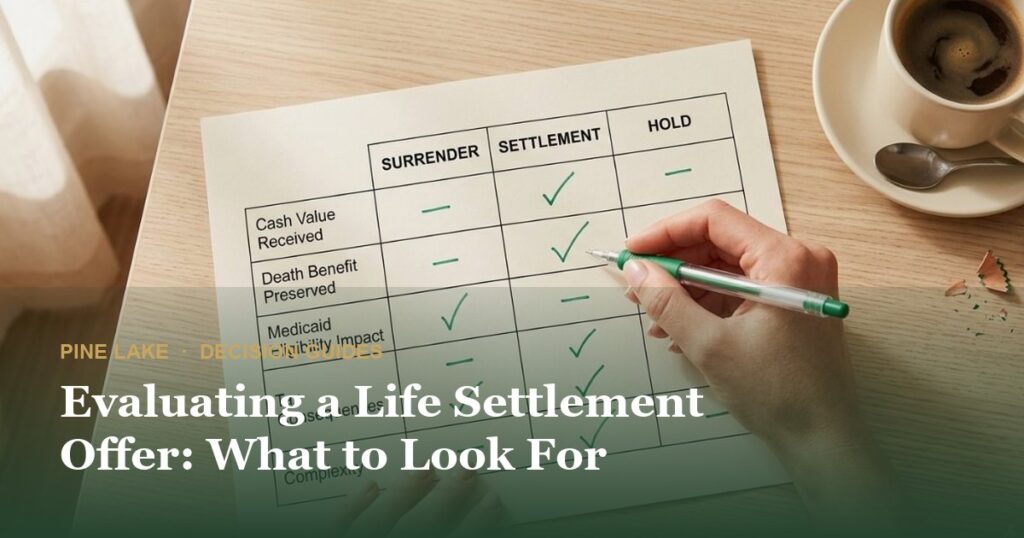
Evaluating a life settlement offer means testing it against three benchmarks — your policy’s surrender value, published market ranges, and the offer’s own fine print — before any signature. A credible offer typically lands between 10% and 35% of face value and roughly 4–8 times cash surrender value, comes from a state-licensed provider, and spells out every fee in writing. An offer that fails any one of those tests deserves scrutiny, not speed. Most sellers only do this once in their lives, while the buyer across the table prices policies every day.
Below is a practical evaluation checklist covering price benchmarks, fee math, contract terms, counterparty checks, and the personal factors that decide whether any offer is good enough.
In This Article
- Benchmark the Price Against Published Market Ranges
- Demand the Full Fee Picture in Writing
- Read the Offer Letter Like a Contract, Because It Is One
- Verify Who Is Actually Buying Your Policy
- Model the After-Tax Outcome Before Judging the Number
- Weigh What You Give Up: The Non-Price Side of the Ledger
- Test the Market: One Offer Is Not a Valuation
- Watch for the Signals That an Offer Should Be Declined
- Frequently Asked Questions
Benchmark the Price Against Published Market Ranges
The first evaluation test is crude but powerful: where does the offer sit relative to known market ranges? The GAO’s report on life settlements found that policy sellers have typically received far more than surrender value — settlements generally run 4 to 8 times the cash surrender value and commonly fall between 10% and 35% of the policy’s face amount, depending on the insured’s health, the premium burden, and policy type.
Apply the test in three steps:
- Get your current cash surrender value in writing from the carrier
- Divide the offer by that surrender value — a multiple below about 2× warrants questions
- Divide the offer by the face amount — a result far below 10% may still be legitimate for a healthy insured with expensive premiums, but you should understand why
Ranges are context, not law. A 78-year-old with significant health impairments and a low-premium universal life policy should expect the upper end; a 68-year-old in excellent health may receive offers near the bottom or none at all. The pricing logic behind these ranges — life expectancy reports, premium streams, and discount rates — is unpacked in our explainer on how life settlement value is calculated.
Demand the Full Fee Picture in Writing
An offer you cannot decompose is an offer you cannot evaluate. The number that matters is net proceeds: the gross price minus broker commission and any transaction charges. Broker compensation is negotiable and varies widely, which means two identical gross offers can net very different amounts.
Insist on a written statement showing:
- Gross purchase price
- Broker commission in dollars and as a percentage of the offer
- Any administrative, document, or courier fees
- Treatment of the policy loan balance, if any, at closing
- Final net amount wired to you from escrow
States adopting the NAIC Life Settlements Model Act framework generally mandate compensation disclosure, and New Jersey’s Viatical Settlements Act, enforced by the NJ Department of Banking and Insurance, requires licensing of the intermediaries handling your file. If you worked with a broker, ask whether they shopped the policy to multiple providers and request the full bid history — seeing every bid received, not just the winner, tells you whether the market was actually tested. Our list of questions to ask a life settlement broker includes the exact wording to use.
Read the Offer Letter Like a Contract, Because It Is One
The dollar figure gets the attention; the conditions determine whether you ever receive it. Evaluate the offer letter and draft purchase agreement for these terms:
- Price contingencies: clauses allowing re-underwriting or repricing if medical records or carrier illustrations change before closing
- Funding certainty: whether capital is committed or subject to a third-party funder’s approval
- Expiration: the date the offer lapses, and whether extensions are available
- Rescission rights: your statutory window to unwind the sale after closing, typically 15–30 days depending on state
- Premium responsibility: who pays premiums between signing and closing, and whether prepaid premiums are refunded to you
- Escrow mechanics: an independent escrow agent should hold funds before ownership transfers
Ambiguity favors the drafter. If a clause could be read two ways, ask for it to be clarified in writing rather than accepting a verbal assurance. Sellers unfamiliar with the closing sequence should review how life settlements work end to end, so each contract term maps to a step in the 60–120 day process you can anticipate rather than react to.
Verify Who Is Actually Buying Your Policy
Behind every offer is a counterparty, and counterparty quality is an evaluation criterion in its own right. The purchaser should be a licensed life settlement provider — the regulated entity permitted to buy policies in your state — typically backed by institutional capital such as pension funds and asset managers whose returns come from mortality experience rather than stock markets.
Run these checks before valuing the offer at face:
- Look up the provider’s license with your state insurance department; unlicensed purchases can void your consumer protections
- Confirm which legal entity signs the purchase agreement and whether it matches the license
- Ask how long the provider has operated and whether it has completed transactions in your state
- Confirm escrow will be handled by an independent agent, with funds deposited before the ownership change is submitted to the carrier
The secondary market’s legitimacy rests on Grigsby v. Russell, the 1911 Supreme Court decision confirming a policy is transferable property — but the practical safeguards are state-level and only attach when you transact with licensed parties. If you are unsure whether you are dealing with a broker, a provider, or a lead generator dressed up as either, our guide to brokers versus providers sorts out who owes you what.
| Evaluation Test | Passing Signal | Failing Signal |
|---|---|---|
| Price vs. surrender value | Roughly 4–8× cash surrender value | At or barely above surrender value |
| Price vs. face amount | Within the 10–35% range typical for health/premium profile | Unexplained outlier with vague conditions |
| Fee disclosure | Written breakdown: gross, commission in dollars, net | Verbal estimates; refusal to itemize |
| Contract terms | Firm price, committed funding, clear rescission rights | Re-underwriting clauses, funder approval contingencies |
| Counterparty | Licensed provider, independent escrow agent | Unlicensed entity; buyer-controlled escrow |
| Market test | Multiple bids on identical inputs | Single unsolicited offer, no auction |
| Tax modeling | After-tax proceeds computed with a CPA | Decision made on gross number alone |

Model the After-Tax Outcome Before Judging the Number
A gross offer means little until you estimate what survives taxation. Under IRS Revenue Ruling 2009-13, as modified by the 2017 Tax Cuts and Jobs Act, life settlement proceeds are split into three tiers: recovery of your cost basis is tax-free; the amount between basis and cash surrender value is ordinary income; and proceeds above cash surrender value are capital gain.
Practical implications for evaluation:
- A policy with high accumulated premiums (high basis) shelters more of the proceeds
- A policy with large cash value relative to basis produces more ordinary income
- Outstanding policy loans can generate taxable income at closing on top of the tiers
- Viatical settlements — where the insured is terminally ill with a life expectancy under 24 months — are often entirely income-tax-free under IRC 101(g)
Ask your CPA to compute the after-tax figure and compare it against the after-tax result of surrendering, since surrender has its own, simpler tax treatment. The two calculations diverge in ways that surprise sellers, which we detail in life settlement tax versus surrender tax. An offer’s rank can change once taxes are in the model, so run the numbers before emotionally committing to a headline price.
Weigh What You Give Up: The Non-Price Side of the Ledger
Evaluation is not only about whether the price is fair — it is about whether any price is sufficient for what you surrender. Selling means:
- Permanent loss of the death benefit. Your beneficiaries receive nothing from this policy, ever, unless the offer includes a retained death benefit component.
- Irreversibility. After the rescission window closes (15–30 days by state), the sale is final.
- Benefit-eligibility effects. A lump sum counts as an asset and can affect means-tested programs; review Medicaid rules with an elder-law attorney before closing if eligibility matters to you.
- Insurability. If your health has declined since issue, replacing coverage later may be impossible or unaffordable.
- Privacy and ongoing contact. The buyer will periodically verify your health status for the rest of your life.
A strong offer on a policy your family still needs is a bad trade. Before evaluating price, confirm the decision to exit is right — our guide on when not to do a life settlement lays out the situations where declining every offer is the correct answer.
Test the Market: One Offer Is Not a Valuation
A single unsolicited offer tells you what one buyer hopes to pay, not what your policy is worth. Competitive tension is the seller’s main pricing lever in this market. If your offer arrived directly from a provider without an auction, evaluation should include finding out what other buyers would pay.
Ways to create or verify competition:
- Engage a licensed broker who submits the policy to multiple providers and owes you a duty to seek the best terms — then demand the full bid sheet
- If you prefer staying direct, approach two or three additional licensed providers yourself and compare bids on identical inputs
- Ask the original bidder whether their offer reflects a competitive process or an opening position
Sellers frequently discover meaningful spreads between the first offer and the best offer after shopping. The trade-off is commission cost versus auction lift, which cuts differently depending on policy size — a tension we examine in selling through a broker versus selling direct. Whatever route you take, receiving and comparing several bids converts evaluation from guesswork into evidence, and our framework for handling multiple life settlement offers shows how to run that comparison cleanly.
Watch for the Signals That an Offer Should Be Declined
Some offers fail evaluation regardless of price. Decline or pause when you see:
- Pressure tactics: artificially short deadlines, discouragement from consulting advisors, or urgency framed around “the offer disappearing”
- Disclosure resistance: refusal to put commissions, fees, or bid history in writing
- Licensing gaps: the buyer or intermediary cannot demonstrate a current license in your state
- Escrow shortcuts: proposals to transfer ownership before funds are secured with an independent escrow agent
- Origin problems: any suggestion the policy was originated for investors — STOLI arrangements are prohibited, and involvement can create serious legal exposure
- Numbers that don’t reconcile: an offer below or barely above surrender value, or wildly above market ranges with vague conditions attached
A legitimate buyer expects due diligence and survives it comfortably. When several of these signals appear together, the correct evaluation outcome is to walk away and, if the conduct seems unlawful, report it to your state insurance department. Our dedicated guide to life settlement red flags catalogs these warning signs with real-world patterns, and an independent review — a second broker, a fee-only advisor, or an attorney — costs little compared to a mispriced or unsafe sale.
Frequently Asked Questions
How do I know if a life settlement offer is fair for my policy?
Test it against three benchmarks: it should meaningfully exceed your cash surrender value (settlements historically run about 4 to 8 times CSV per the GAO), it should fall in a defensible spot within the typical 10–35% of face value range given your age, health, and premium costs, and it should hold up against competing bids on identical inputs. An offer that passes all three, from a licensed provider with fees disclosed in writing, is credibly fair. One that fails any test needs explanation before acceptance.
What documents should I ask for before accepting a life settlement offer?
Request the written offer letter with all contingencies, a draft closing or settlement statement itemizing gross price, broker commission in dollars, other fees, and net proceeds, the draft purchase agreement, the escrow agreement naming an independent escrow agent, and proof of the provider’s license in your state. If a broker ran an auction, also request the complete bid history showing every provider contacted and each bid received. Evaluating an offer without these documents means evaluating a number with no context.
Is a life settlement offer negotiable or is it take-it-or-leave-it?
Offers are frequently negotiable, especially when the buyer knows competing bids exist. Providers price policies with margin built in, and an opening offer is often not their ceiling. Leverage comes from competition — multiple providers bidding on the same policy — and from information, such as understanding your life expectancy reports and premium schedule. You can counter on price, but also on terms: removing repricing contingencies, extending the expiration date, or clarifying premium refunds at closing all have real value.
What percentage of face value should a life settlement offer be?
Published market data, including the GAO’s study, puts typical settlements between roughly 10% and 35% of face value, though individual results fall outside that band. Where you land depends chiefly on the insured’s life expectancy, the annual premium burden as a percentage of face value, the policy type, and prevailing discount rates among institutional buyers. Shorter life expectancy and cheaper premiums push offers higher. Use the percentage as a sanity check, not a target — the stronger benchmark is competitive bids on your specific policy.
Can I back out after accepting a life settlement offer?
Yes, within limits. Before closing, you can generally withdraw, though the offer letter’s terms control any obligations you accepted. After closing, state law provides a rescission window — typically 15 to 30 days depending on the state — during which you may unwind the transaction by returning the proceeds, and rescission commonly applies automatically if the insured dies during the window. Once that period expires, the sale is permanent. Confirm the exact rescission terms for your state in the purchase agreement before signing.
Do I need a lawyer or financial advisor to evaluate a life settlement offer?
It is not legally required, but independent review is inexpensive insurance on a five- or six-figure decision. A CPA can model the three-tier tax treatment under Revenue Ruling 2009-13 and compare after-tax outcomes against surrender. An attorney can flag repricing contingencies and escrow weaknesses in the purchase agreement. A fee-only advisor can test whether selling fits your broader plan at all. Independent review matters most for trust-owned policies, sellers near Medicaid eligibility, and offers with unusual structures like retained death benefits.
Why would a life settlement offer be lower than I expected?
Common reasons include longer life expectancy estimates than you assumed, high ongoing premiums that the buyer must fund for years, a policy type investors discount (such as variable products), high discount rates in the current capital environment, or a large broker commission compressing your net. Sometimes the cause is process, not policy: a single buyer with no competition has no reason to bid aggressively. Ask what life expectancy reports and premium assumptions were used, then test the market with additional licensed bidders before concluding the price is the market.
What happens to my policy loans and prepaid premiums when I sell?
Outstanding policy loans are typically paid off or netted out at closing, reducing your proceeds, and a loan can also increase the taxable portion of the transaction — factor both into your evaluation. Prepaid premiums are a negotiation point: well-drafted agreements refund the unearned portion of premiums you paid covering periods after the closing date. Confirm both treatments in the purchase agreement and on the draft closing statement rather than assuming, because practices vary between buyers and the dollars involved can be significant.
Find out what your policy is worth — free, confidential, no obligation.
A 15-minute educational review covers your eligibility, every alternative, and a realistic view of what each path would net you.
Related Reading
- How To Compare Life Settlement Offers
- Negotiating Life Settlement Offer
- Second Opinion Life Settlement Offer
- What Is A Life Settlement
Pine Lake Legacy does not purchase life insurance policies and does not provide legal, tax, or investment advice. Information provided is for educational purposes only. Eligibility for any option, including life settlements, is not guaranteed and depends on individual circumstances, policy terms, underwriting, and market conditions. Consult independent legal, tax, or financial professionals before making decisions regarding a life insurance policy.