
New Hampshire gives a planner more ways to fix a stuck irrevocable trust than almost any other jurisdiction, which matters because the most common problem with a 2004-vintage ILIT is not that the policy is failing but that the instrument does not clearly permit the trustee to do anything about it. A trust drafted to hold one policy until the insured’s death, with no express power to sell, no adviser, and a trustee who is the settlor’s brother, is a governance problem before it is an insurance problem.
The state’s trust code — RSA 564-B, New Hampshire’s version of the Uniform Trust Code, layered with successive modernization acts — supplies nonjudicial settlement agreements, decanting authority, and a well-developed directed-trust and trust-adviser framework. Combined with the state’s tax posture as of 2026, which includes no estate tax, no inheritance tax, and no personal income tax following the repeal of the Interest and Dividends Tax, New Hampshire is a jurisdiction where an obsolete ILIT can usually be repaired or unwound cleanly rather than litigated. This guide covers the toolkit and what to do with the policy once the governance is sorted.
In This Article
- Why New Hampshire Trusts Are Unusually Fixable
- Tool One: The Nonjudicial Settlement Agreement
- Tool Two: Decanting
- Tool Three: Advisers, Protectors, and Directed Administration
- Diagnosing the Policy Before You Fix the Trust
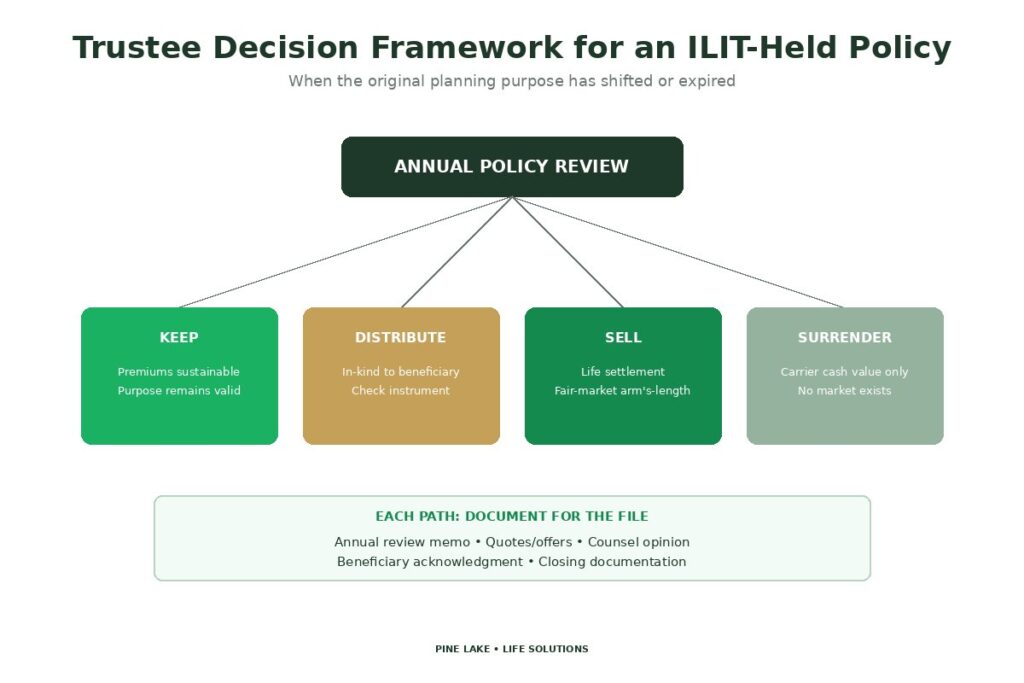
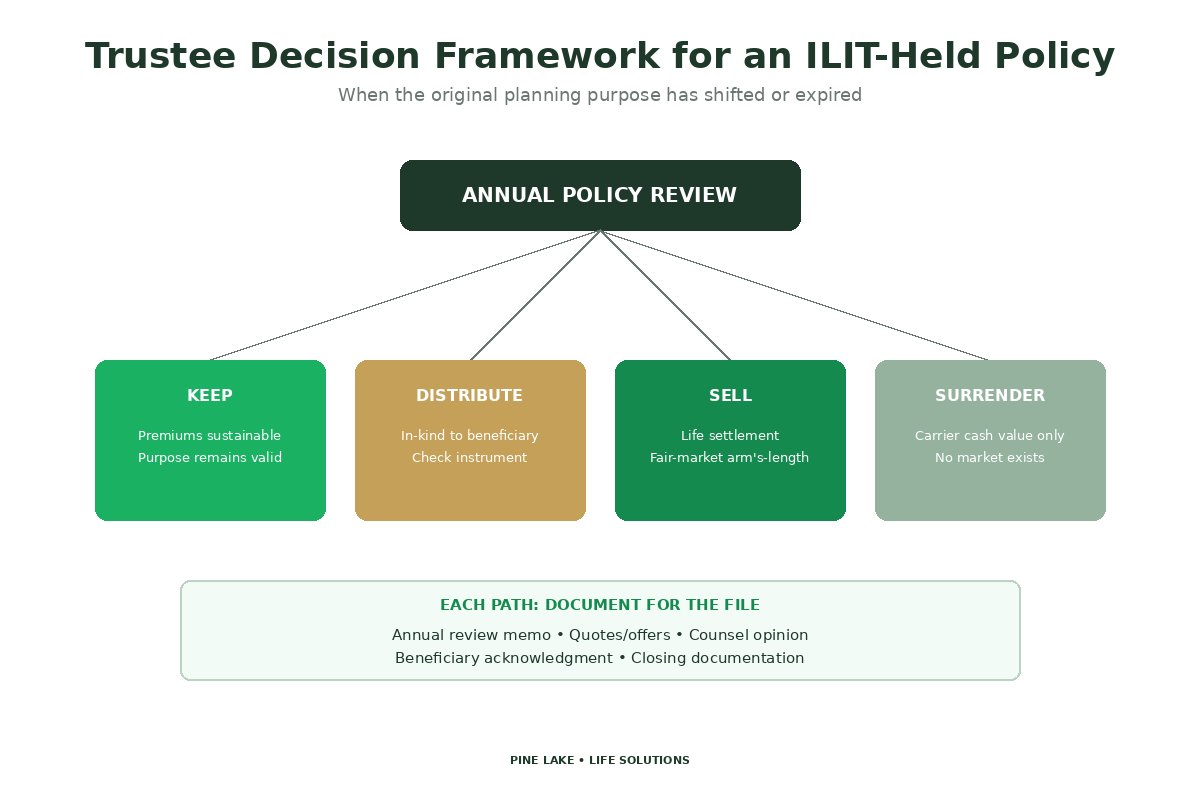
- The Six Disposition Paths
- Tax Posture, Regulator, and Statute
- Frequently Asked Questions
Why New Hampshire Trusts Are Unusually Fixable
Three structural features do most of the work.
A modern trust code with repeated legislative attention. New Hampshire enacted its Uniform Trust Code at RSA 564-B and has amended it through successive trust modernization acts, adding flexibility that older states’ codes lack. The state also repealed the common law rule against perpetuities for trusts holding a power of alienation, permitting very long duration.
A separate foundation statute. New Hampshire enacted a civil-law-style foundation act, which is unusual among U.S. states and signals a legislature actively courting trust business. Practitioners should treat that as evidence of judicial and legislative receptiveness to well-drafted modification petitions, not as a tool for a typical ILIT.
No state fiduciary income tax as of 2026. New Hampshire has never taxed earned income, and the Interest and Dividends Tax was repealed effective for taxable periods beginning after December 31, 2024. For a trust, that means accumulated income faces no New Hampshire layer, and a gain on a policy disposition faces no state tax. Confirm the current posture with the Department of Revenue Administration, but as of 2026 this removes a variable that complicates the same analysis in Vermont, Rhode Island, or Massachusetts.
Set against that: the federal basic exclusion is $15 million per decedent for 2026, and New Hampshire imposes no estate or inheritance tax. The transfer tax rationale that supported nearly every New Hampshire ILIT written before 2013 is gone for the overwhelming majority of families. What remains is an instrument, a trustee, and a policy — and the question of what to do with all three.
Tool One: The Nonjudicial Settlement Agreement
New Hampshire’s trust code permits interested persons to enter binding nonjudicial settlement agreements on matters not inconsistent with a material purpose of the trust. Confirm the current provision and its scope limits in RSA 564-B before relying on it.
For an ILIT, the recurring uses are:
- Resolving ambiguity about the trustee’s authority to dispose of the policy where the instrument is silent. This is the single most common blockage.
- Approving a specific proposed transaction — the sale of the policy at a stated price to a stated licensed provider — with the consent of the beneficiaries who would otherwise complain about it later.
- Agreeing on the direction of the trust after the policy is gone, including an accelerated distribution schedule where the trust’s only asset becomes cash.
- Appointing a successor or additional trustee, or adding an adviser with authority over insurance.
The virtue of the nonjudicial route is speed and cost. The limit is that it cannot override a material purpose of the trust, and it requires the participation of the interested persons — which is a problem where a beneficiary is a minor, unborn, or unlocatable, and where virtual representation may or may not reach them. Read the representation provisions carefully.
Practically, a settlement agreement is also the cleanest answer to the consent question that arises whenever a trust disposes of its principal asset. Beneficiaries have no legal veto over a trustee’s exercise of a power the trustee actually holds, but documented consent converts a contestable decision into an uncontested one. The consent dynamics generally are set out at consent requirements when an irrevocable trust sells a policy.
Tool Two: Decanting
New Hampshire’s trust code includes decanting authority permitting a trustee with discretionary distribution power to distribute trust property to a second trust with different terms. Confirm the current provision, the required notice, and the limits on changing beneficial interests before proceeding.
For an ILIT, decanting solves problems a settlement agreement cannot:
- Adding administrative powers the original instrument lacks — an express power to sell insurance, a power to borrow, a power to appoint an insurance adviser.
- Changing the trustee succession mechanism where the named successors have died or declined.
- Consolidating multiple trusts holding fragments of the same insurance plan, which is common where a family created separate trusts per child.
- Extending or shortening duration where the original terms no longer make sense for what will be a cash trust.
What decanting does not do well is change who benefits. The statutory limits are real and the exercise is a fiduciary act subject to the trustee’s duties. A trustee decanting to give themselves a power they did not have should expect that decision to be scrutinized.
Sequence matters. Fix the instrument first, then transact. A trustee who sells a policy under ambiguous authority and decants afterward to cure the defect has the sequence backward, and the cure may not be retroactive.
| Problem with the ILIT | New Hampshire tool | Principal limitation |
|---|---|---|
| Instrument silent on power to sell the policy | Nonjudicial settlement agreement | Cannot override a material purpose; needs all interested persons |
| Instrument lacks needed administrative powers | Decanting to a second trust | Statutory limits on changing beneficial interests |
| Trustee unwilling to monitor a specialized asset | Appoint an insurance adviser under the directed-trust framework | Requires instrument authority or a modification first |
| Beneficiaries cannot all be assembled | Trust protector modification power | Protector powers are construed narrowly |
| Trust has only cash after disposition | Settlement agreement accelerating distribution | Material purpose limits still apply |

Tool Three: Advisers, Protectors, and Directed Administration
New Hampshire’s code contains a developed framework for trust advisers and trust protectors, permitting an instrument — or a modified instrument — to allocate specific powers away from the trustee and to limit the trustee’s liability for acting on a direction.
Two applications for insurance-holding trusts.
Appointing an insurance adviser. Where a corporate trustee is unwilling to take on the monitoring and disposition duty for a life insurance contract — a common and reasonable position, since it is a specialized asset — the answer is often to name an adviser who holds that authority. This converts a stalemate into a workable structure. The adviser then owes the duty, and the file should reflect who holds it.
Empowering a protector to modify. Where the instrument is defective and the beneficiaries cannot all be assembled for a settlement agreement, a protector with a modification power may be able to fix the defect unilaterally. Read the scope of the power narrowly; protectors’ powers are construed against expansion.
Whichever structure applies, the planner’s first task in any engagement is to read the instrument and identify who actually holds the duty to monitor the policy and who has authority to dispose of it. Directing the entire conversation at a trustee who holds neither wastes months. The underlying duty framework is at a trustee’s duty regarding an underperforming policy.
One more governance item that surfaces in nearly every one of these files: the Crummey record. Withdrawal rights derived from Crummey v. Commissioner, 397 F.2d 82 (9th Cir. 1968), are what made contributions present-interest gifts eligible for the annual exclusion, and most files go silent after a few years. The exposure is a gift tax exposure — unqualified contributions, understated or unfiled returns, consumed exclusion — rather than a trust defect, and it should be raised with the client’s tax counsel deliberately. Options are at what to do when Crummey notices are missing.
Diagnosing the Policy Before You Fix the Trust
Governance repair is only worth doing if the underlying asset justifies it. Diagnose first.
Request a current in-force illustration from the carrier in writing, run at both guaranteed and current assumptions, showing the death benefit, account value, the premium required to carry the contract to a stated maturity age, and the projected lapse date under the current premium. Carriers commonly take two to four weeks. For a guaranteed universal life contract, ask explicitly whether the no-lapse guarantee remains intact and to what age — late or reduced premiums can compromise it, sometimes irreversibly, and this is the single most commonly missed item.
Then note the valuation gap. Cash surrender value is a carrier cancellation formula fixed at issue. Market value depends on the insured’s current life expectancy, the premium stream required to hold the contract, the death benefit, and a buyer’s cost of capital. Where health has declined since underwriting, those two figures diverge substantially, and the divergence runs in only one direction, because an owner can always surrender instead.
The policies that clear the secondary market threshold: insureds generally over 70 or younger with a significant impairment, face amounts above roughly $100,000, and universal life, guaranteed universal life, or convertible term chassis. Small whole life and final expense contracts under roughly $75,000 do not, because the fixed costs of a transaction — two independent life expectancy reports, legal review, escrow, carrier verification of coverage — leave no room.
Pine Lake Life Solutions is an educational resource for planners and fiduciaries and does not purchase policies. Licensed providers price policies; a no-cost review through a licensed broker produces an indicative range that belongs in the file alongside the surrender value and the illustration.
The Six Disposition Paths
With authority sorted and the policy diagnosed, six paths exist. The comparison memo is what protects the fiduciary, and it should be written even where the conclusion is to change nothing.
- Continue as drafted. Right where a live purpose remains — a buy-sell obligation, equalization among children, a special needs or second-marriage beneficiary — and the premium is sustainable. New Hampshire’s lack of a state estate tax means the liquidity purpose is rarely the live one.
- Reduce the death benefit or elect a nonforfeiture option. Trades face amount for the end of the funding obligation.
- Section 1035 exchange into a contract with better guarantees or lower cost. Preserves deferral; generates no cash; does not extinguish an outstanding policy loan cleanly.
- Surrender for cash value. Simple, and often the worst economic outcome where health has declined.
- Secondary market sale. Typically the highest cash figure for an older or impaired insured, at the cost of ending coverage and generating a taxable event with information reporting. The trust-owned process — trustee authority, beneficiary notice, carrier verification of coverage, escrow, and the change of ownership — is at selling a trust-owned policy.
- Distribute the policy in kind where the instrument permits and a beneficiary will carry it. Watch IRC § 2035’s three-year rule if the distributee is the insured, and IRC § 101(a)(2)’s transfer-for-value rules, which can convert an otherwise tax-free death benefit into ordinary income where no exception applies.
Once the policy is gone the trust usually holds cash and has no continuing purpose, which raises termination and distribution questions the toolkit above is well suited to answer. The sequence is set out at ILIT termination and policy disposition.
Tax Posture, Regulator, and Statute
State taxes. As of 2026 New Hampshire imposes no estate tax, no inheritance tax, and no personal income tax — the Interest and Dividends Tax having been repealed for taxable periods beginning after December 31, 2024. A trust’s gain on a policy disposition therefore faces no New Hampshire layer, and the analysis is entirely federal. The framework is at New Hampshire life settlement taxes. Confirm the current posture with the Department of Revenue Administration.
Federal. A reportable policy sale triggers the IRC § 6050Y regime and generates Forms 1099-LS and 1099-SB. Revenue Rulings 2009-13 and 2009-14 supply the gain framework for the seller and the buyer, and the Tax Cuts and Jobs Act removed the cost-of-insurance basis reduction for transactions after August 25, 2009, generally raising basis relative to the older analysis. Whether the trust is a grantor trust as to the settlor determines whose return reports the gain — read the instrument. Route the computation to the client’s accountant rather than opining in your own voice.
Regulator. The New Hampshire Insurance Department, headed by the Insurance Commissioner, licenses producers and settlement market participants, maintains a licensee lookup, and receives consumer complaints. See New Hampshire Insurance Department consumer help.
Statute. New Hampshire’s insurance law sits in RSA Title XXXVII, with viatical and life settlement provisions in the 408-series of chapters and implementing rules in the New Hampshire Code of Administrative Rules. We are not asserting a precise chapter and section number here. Pull the current citation from the General Court’s statute portal or confirm with the Department before using it in a memo or an opinion letter. Licensing detail is at New Hampshire life settlement licensing.
For any settlement, three items belong in the trust file: license verification for both the broker and the ultimate provider; the broker’s written compensation disclosure, since the broker owes a duty to the policy owner — here, the trustee — rather than to the buyer; and the calendared statutory rescission window running from receipt of proceeds. Where the insured is simultaneously the subject of long-term care planning, coordinate with elder law counsel; that analysis is at the New Hampshire elder law guide.
Frequently Asked Questions
What is the most common reason a New Hampshire ILIT is stuck?
The instrument does not clearly give the trustee power to sell the policy. A trust drafted to hold one contract until the insured’s death, with no express disposition power, no adviser, and a family member serving as trustee, is a governance problem before it is an insurance problem. Fix the authority before transacting, not afterward.
Can a nonjudicial settlement agreement authorize a policy sale?
Often, yes. New Hampshire’s trust code permits interested persons to enter binding agreements on matters not inconsistent with a material purpose of the trust, and approving a specific proposed transaction is a recurring use. The limits are that it cannot override a material purpose and requires the interested persons — a problem where beneficiaries are minor, unborn, or unlocatable.
When is decanting the better tool than a settlement agreement?
When the instrument lacks administrative powers rather than merely being ambiguous — adding an express power to sell insurance, fixing a broken trustee succession, consolidating multiple trusts, or adjusting duration for what will become a cash trust. Decanting does not work well for changing who benefits, and statutory limits on beneficial interests are real.
Does New Hampshire tax a trust’s gain on a life settlement?
Not as of 2026. New Hampshire has no estate tax, no inheritance tax, and no personal income tax following repeal of the Interest and Dividends Tax for periods beginning after December 31, 2024. The analysis is entirely federal, involving IRC § 101, basis under Revenue Rulings 2009-13 and 2009-14, and § 6050Y information reporting.
Why appoint an insurance adviser rather than press the corporate trustee?
Because declining to take on monitoring duty for a specialized asset is a reasonable trustee position, and pressing it produces stalemate. New Hampshire’s directed-trust framework lets an instrument allocate that authority to an adviser and limit the trustee’s liability for acting on direction. The file should then reflect clearly who holds the duty.
What should be requested from the carrier before any decision?
A current in-force illustration in writing, at both guaranteed and current assumptions, showing death benefit, account value, the premium required to carry the contract to maturity, and the projected lapse date. For guaranteed universal life, ask explicitly whether the no-lapse guarantee is intact and to what age — that is the item most often missed.
Find out what your policy is worth — free, confidential, no obligation.
A 15-minute educational review covers your eligibility, every alternative, and a realistic view of what each path would net you.
Related Reading
- Sell Ilit Trust Owned Policy
- Trustee Duty Underperforming Policy
- Irrevocable Trust Sell Policy Consent
- Ilit Termination Policy Disposition
- Crummey Notices Missing
- New Hampshire Insurance Department Consumer Help
- Life Settlement Licensing New Hampshire
- Life Settlement Taxes New Hampshire
- Elder Law Attorney Life Settlement Guide New Hampshire
Pine Lake Life Solutions does not purchase life insurance policies and does not provide legal, tax, or investment advice. Information provided is for educational purposes only. Eligibility for any option, including life settlements, is not guaranteed and depends on individual circumstances, policy terms, underwriting, and market conditions. Consult independent legal, tax, or financial professionals before making decisions regarding a life insurance policy.