
Missing Crummey notices are a gift tax problem, not a policy problem — the life insurance inside the trust is still valid, the death benefit is still payable, and the trust still owns it. What is at risk is the annual gift tax exclusion the family claimed on years of premium contributions, which could mean those gifts consumed lifetime exemption instead and that gift tax returns were filed incorrectly or not at all.
The mechanism goes back to Crummey v. Commissioner, 397 F.2d 82 (9th Cir. 1968), which held that a beneficiary’s temporary right to withdraw a contribution to a trust converts what would be a future interest into a present interest — the requirement for the annual gift tax exclusion. The notice is how the beneficiary learns the withdrawal right exists. Skip the notice for a decade and the IRS may argue the right was illusory.
This page explains the real exposure, the practical cleanup steps families use, and how it interacts with decisions about the policy itself — including when the trust and the policy should simply be left alone. Pine Lake Legacy offers a free, no-obligation policy review and is not a law firm or tax advisor; this issue requires counsel.
In This Article
What the Notice Is Supposed to Do
An irrevocable life insurance trust needs cash to pay premiums. The grantor contributes that cash. Absent something more, a contribution to an irrevocable trust is a gift of a future interest, which does not qualify for the annual gift tax exclusion — $19,000 per recipient in 2025, indexed for inflation, so confirm the 2026 figure with the IRS.
The Crummey mechanism fixes this by giving each beneficiary a limited window, commonly 30 days, to withdraw their share of the contribution. Because the beneficiary could take the money right now, the gift is of a present interest and the exclusion applies. The withdrawal window then closes, the trustee pays the premium, and the arrangement repeats annually.
The written notice matters because it is the evidence that the right was real and known. The Ninth Circuit’s later decision in Estate of Cristofani, 97 T.C. 74 (1991), extended the concept to contingent beneficiaries, and the IRS has litigated the boundaries repeatedly ever since.
The Actual Exposure
Be precise about what is and is not at stake, because families often panic about the wrong thing.
Not at risk: the policy’s validity, the death benefit, the trust’s ownership of the policy, or the estate tax exclusion of the proceeds under IRC section 2042 — assuming the grantor holds no incidents of ownership and the three-year rule of section 2035 does not apply to a transferred policy.
At risk: the annual exclusion claimed on past contributions. If the IRS successfully recharacterized them, those gifts would be taxable gifts applied against the grantor’s lifetime exemption, and Forms 709 that were never filed or filed as exclusion gifts would be wrong. Because the federal basic exclusion amount is now large — legislation enacted in 2025 set it at $15 million per person beginning in 2026, indexed for inflation; confirm the current figure — many families discover the practical dollar consequence is zero. Estates near or above the threshold, or in states with their own transfer taxes, face a real number.
Cleanup Steps Families Actually Take
Every one of these belongs to a tax attorney or CPA, not to a do-it-yourself weekend. In practice, the sequence looks like this:
- Reconstruct the record. Pull every contribution by date and amount, every premium payment, the trust instrument, and any notices that were sent, even informally by email.
- Read the trust’s notice provisions. Some documents deem notice given, waive the requirement, or specify a method. What the document says changes the analysis.
- Assess the gift tax return history. Determine which years had contributions, which returns were filed, and whether the statute of limitations has run on any of them. Note that the limitations period generally does not begin on an unfiled or inadequately disclosed gift.
- Consider filing or amending Forms 709 to disclose the gifts adequately and start the clock, which is a common protective step.
- Fix the process going forward. Written notices, dated and acknowledged, sent every year, with copies retained by the trustee.
| Question | Affected by Missing Notices? | Notes |
|---|---|---|
| Is the policy still valid? | No | Carrier obligations are unaffected by trust administration |
| Does the trust still own the policy? | No | Ownership is a matter of the carrier’s records |
| Are proceeds still outside the estate? | Generally no | Turns on IRC 2042 incidents of ownership and the 2035 three-year rule |
| Was the annual exclusion valid? | Yes – this is the exposure | Gifts may be recharacterized as using lifetime exemption |
| Were Forms 709 correct? | Yes | Filing or amending can start the limitations period |
| Should the policy be sold? | Unrelated | Decide on policy performance and need, not notice history |

Fixing the Process Going Forward
The corrective habits are simple and take an hour a year. Send a dated written notice to every beneficiary holding a withdrawal right each time a contribution is made. Have each beneficiary sign and return an acknowledgment. Keep contributions in a separate trust bank account and pay the premium from that account after the withdrawal window closes — never have the grantor pay the carrier directly, which is one of the most common administrative failures and undercuts the whole structure.
Also confirm the trustee is not the grantor, that the trust files its own return where required, and that the withdrawal window is genuinely respected. A trustee who pays the premium the same day the contribution arrives has functionally denied the right the notice describes.
How This Interacts With the Policy Decision
Two situations arise. In the first, the family wants to keep the coverage and simply clean up administration. The policy is untouched; the work is entirely on the tax side.
In the second, the notice failure is a symptom of a trust nobody is really running — and the same review that uncovers the missing letters often uncovers an underperforming policy quietly heading toward lapse. If contributions stopped, or the premium illustrated in 1999 no longer carries the contract, the trustee has a separate prudence problem to address.
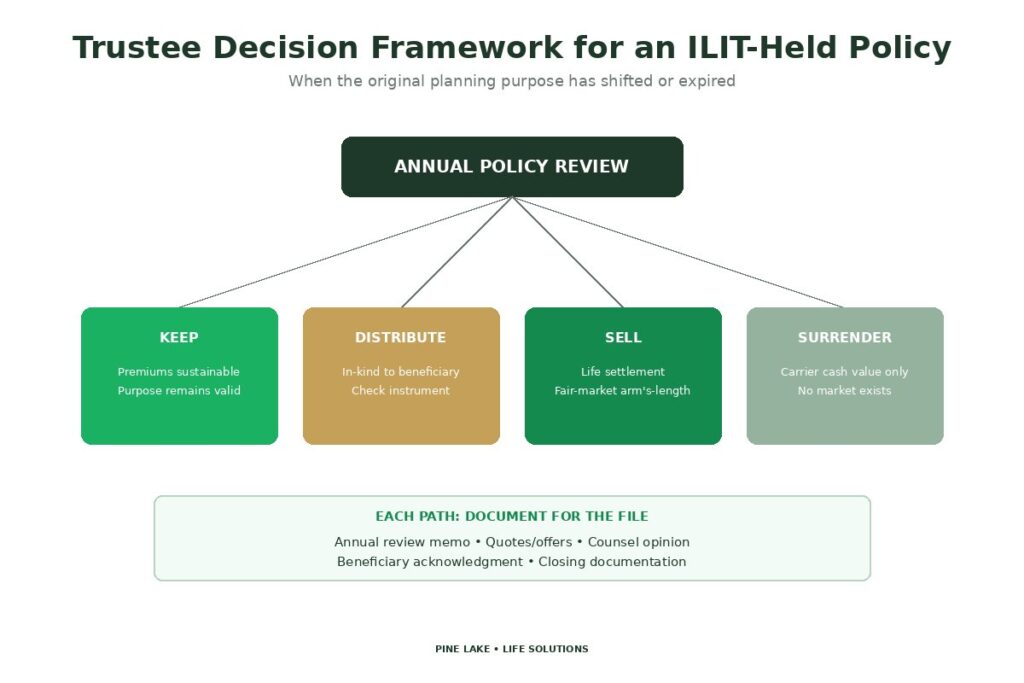
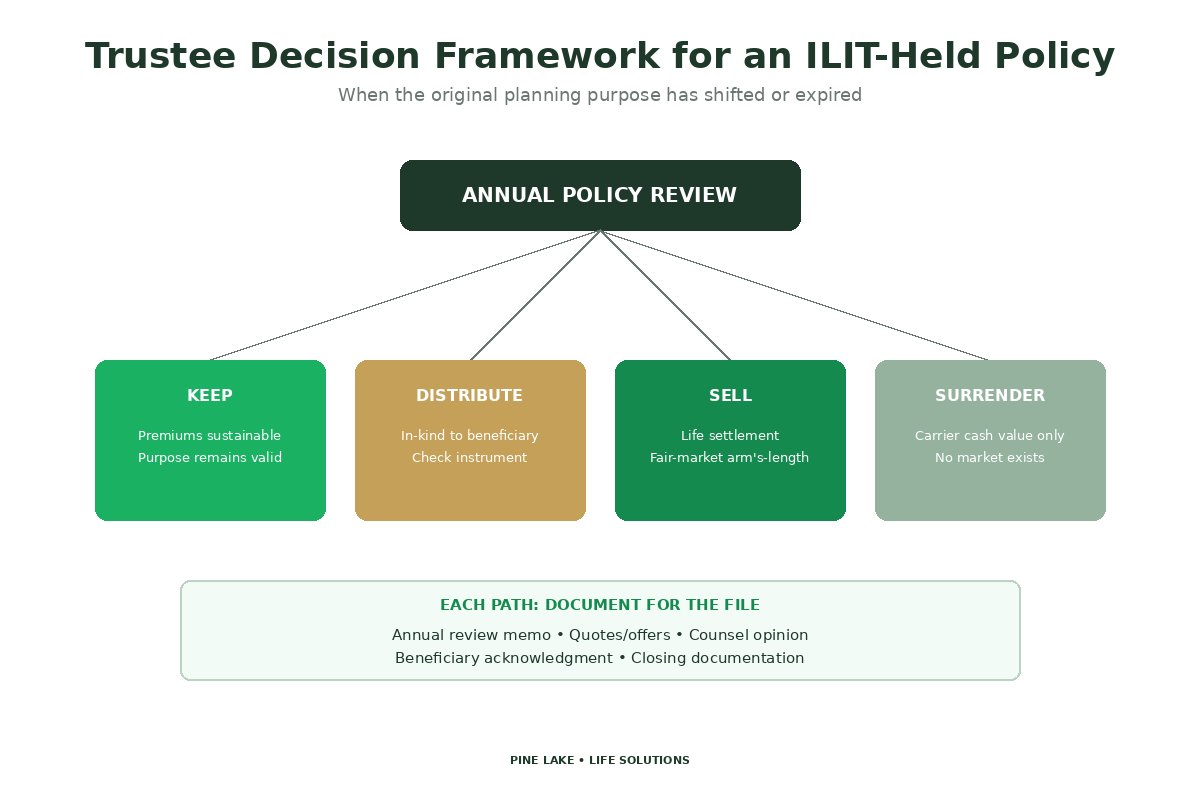
At that point the trustee evaluates the full option set: increase funding, reduce the face amount, elect reduced paid-up, exchange into a more efficient contract, sell the policy, or surrender it. Where the coverage is genuinely no longer needed, the secondary market may pay materially more than surrender; GAO-10-775 found sellers typically received about 10% to 35% of face value, roughly four to eight times cash surrender value, with buyers generally looking for a death benefit of about $100,000 or more on a senior or health-impaired insured.
When to Leave Everything Alone
If the estate is comfortably below the federal exclusion and the state has no separate estate tax, the missing notices may have no dollar consequence at all, and the fix is simply to do it correctly from now on. Do not unwind a functioning trust over a paperwork failure.
Do not surrender or sell a policy because the trust’s administration was sloppy — those are separate questions. And if the insured’s health has declined such that the coverage could not be replaced, or the contract carries a no-lapse guarantee priced under older assumptions, keeping the policy is very likely the right answer regardless of what the Crummey file looks like.
A sale should be considered only when the coverage itself is genuinely unneeded and the trustee, with counsel, has concluded that cash serves the beneficiaries better than the death benefit.
What to Do This Quarter
Ask the trustee for the trust instrument, the last five years of bank statements for the trust account, the premium payment history, and any Crummey notices on file. Ask the CPA which years had gift tax returns. Bring both sets of documents to a tax attorney and get a written assessment of exposure — most families find it is smaller than feared, and knowing the number ends the anxiety.
In the same review, request a current in-force illustration from the carrier at both guaranteed and current assumptions. If the policy turns out to be underfunded and the coverage is no longer needed, a market screening takes days and requires only the policy cover page: the first page showing the insurer, policy number, face amount, and issue date. Pine Lake Legacy provides that review free at (732) 978-9575 and works alongside the trust’s own counsel and tax advisors.
Frequently Asked Questions
What is a Crummey notice?
It is written notice to a trust beneficiary that they have a limited window, commonly 30 days, to withdraw their share of a contribution to the trust. That withdrawal right converts the gift into a present interest so it qualifies for the annual gift tax exclusion. The concept comes from Crummey v. Commissioner, 397 F.2d 82 (9th Cir. 1968).
What happens if the notices were never sent?
The main exposure is that the annual gift tax exclusion claimed on past contributions could be challenged, meaning those gifts would apply against lifetime exemption and past gift tax returns may be wrong. The policy, the trust’s ownership of it, and the death benefit are not affected. Have a tax attorney assess the specific years involved.
Does this make the death benefit taxable in the estate?
Not by itself. Estate inclusion turns on whether the grantor retained incidents of ownership under IRC section 2042 and on the three-year rule of section 2035 for policies transferred into the trust. Missing notices are a gift tax issue rather than an estate inclusion issue. Confirm your specific facts with counsel.
How much is the annual gift tax exclusion?
It was $19,000 per recipient in 2025 and is indexed for inflation, so confirm the 2026 figure with the IRS. A married couple can often double the amount by gift-splitting, which requires filing Form 709. The exclusion is per recipient, so a trust with several beneficiaries holding withdrawal rights can absorb a larger contribution.
Can missing notices be fixed retroactively?
You cannot recreate notices that were never sent, but families commonly reconstruct the contribution record, review the trust’s notice provisions, and consider filing or amending Forms 709 to disclose the gifts adequately and start the limitations period. Then the process is corrected going forward. This work belongs with a tax attorney or CPA.
Should the trust be terminated over this?
Rarely. A paperwork failure is not by itself a reason to unwind a functioning trust, especially where the estate is below the federal exclusion and no state estate tax applies. Fix the administration and keep the structure. Terminating is a decision driven by whether the coverage is still needed.
What administrative habits prevent this?
Send dated written notices for every contribution and collect signed acknowledgments. Keep a separate trust bank account, deposit contributions there, and pay premiums from that account only after the withdrawal window closes. Never have the grantor pay the carrier directly, which is a common and damaging shortcut.
What if the review shows the policy is underfunded?
That is a separate prudence issue for the trustee. Request an in-force illustration at both guaranteed and current assumptions, then evaluate increased funding, a reduced face amount, reduced paid-up status, an exchange, a sale, or surrender. A free market screening needs only the policy cover page; call (732) 978-9575.
Find out what your policy is worth — free, confidential, no obligation.
A 15-minute educational review covers your eligibility, every alternative, and a realistic view of what each path would net you.
Related Reading
- Sell Ilit Trust Owned Policy
- Ilit Termination Policy Disposition
- Trustee Duty Underperforming Policy
- Irrevocable Trust Sell Policy Consent
- Estate Tax Exemption Change Policy
- Life Settlement Vs Ilit Planning
- Can I Sell A Policy Owned By A Trust
- What Is An In Force Illustration
Pine Lake Legacy does not purchase life insurance policies and does not provide legal, tax, or investment advice. Information provided is for educational purposes only. Eligibility for any option, including life settlements, is not guaranteed and depends on individual circumstances, policy terms, underwriting, and market conditions. Consult independent legal, tax, or financial professionals before making decisions regarding a life insurance policy.