

New Hampshire spent two decades deliberately rebuilding its trust law to compete with Delaware and South Dakota, and it succeeded — but the excluded-fiduciary protections that make the state attractive are exactly the provisions trust officers most often over-read when a policy is quietly failing. An excluded trustee still receives the carrier’s mail. What it does with a lapse notice is not an investment decision, and no statute in RSA 564-B relieves it of that.
This guide is written for the corporate trust officer administering New Hampshire trusts that own life insurance — single-policy ILITs, perpetual dynasty trusts holding survivorship contracts, and directed structures where an insurance adviser holds the decision. It covers the governing framework, the practical scope of excluded-fiduciary status, why a state with no rule against perpetuities has an unusually long exposure to rising cost-of-insurance charges, and what an annual monitoring file should actually contain. Pine Lake Legacy is an educational resource; it does not purchase policies, and nothing here is legal, tax, or investment advice.
In This Article
- RSA 564-B and New Hampshire’s Trust Modernization Project
- Excluded Fiduciaries: Article 12 in Practice
- No Rule Against Perpetuities Means a Very Long COI Tail
- The Duty to Monitor: What Each Annual File Should Contain
- Surrender vs. Sell — and the Tax Layer New Hampshire Does Not Have
- The New Hampshire Insurance Department and RSA 408-D
- When a Beneficiary Enters Care
- Frequently Asked Questions

RSA 564-B and New Hampshire’s Trust Modernization Project
New Hampshire adopted the Uniform Trust Code in 2004, codified at RSA chapter 564-B, and has amended it repeatedly since through a series of trust modernization statutes driven by an active bar and a legislature that treats trust administration as an economic development matter. Several features distinguish the New Hampshire framework from a plain-vanilla UTC state:
- Article 12 of RSA 564-B — trust advisors and trust protectors, with the excluded-fiduciary concept. This is the provision that draws directed structures to New Hampshire.
- Noncharitable purpose trusts, permitted under RSA 564-B:4-409 with unusual breadth.
- Private family trust companies, authorized under RSA 383-D, which is why a number of families administer their own trust structures here.
- The New Hampshire Foundation Act, RSA 564-F, enacted in 2017 — a civil-law-style foundation vehicle, and the first of its kind in a U.S. state.
- No rule against perpetuities for trusts where the trustee holds the power to sell, under RSA 564:24. New Hampshire trusts can run indefinitely.
Confirm current section numbering before any of this goes into a memo. New Hampshire amends 564-B often, and the whole point of an active modernization program is that the statute you learned five years ago has moved.
What has not moved are the core duties. RSA 564-B carries the UTC’s structure: administer in good faith in accordance with the terms and purposes of the trust and the interests of the beneficiaries; administer as a prudent person would, exercising reasonable care, skill, and caution; keep qualified beneficiaries reasonably informed of material facts necessary to protect their interests; and — the one most often breached in insurance files — review the trust property within a reasonable time after accepting the trusteeship and decide whether to retain or dispose of it. A trust department that accepts a successor trusteeship of a 1996 ILIT and never orders an in-force illustration has an unremediated breach dating from the day it accepted.
Excluded Fiduciaries: Article 12 in Practice
New Hampshire’s Article 12 provisions let an instrument allocate authority to a trust advisor or trust protector and reduce the directed trustee to an excluded fiduciary with materially narrower exposure. That structure is real, it works, and it is not a blanket.
Four questions a New Hampshire trust officer must answer from the instrument in every directed insurance file:
- Does the advisor’s granted authority actually reach this decision? A power over “investment decisions” may or may not extend to surrendering or selling an insurance contract. Instruments drafted before the secondary market matured routinely do not address it. Ambiguity is not resolved by the label on the file, and it is not resolved in the trustee’s favor by default.
- What is the excluded fiduciary’s residual duty? Read Article 12 alongside the instrument’s exculpation language. Know the standard before a direction arrives.
- What did the trustee receive, and what did it forward? Carrier statements, rate-change notices, premium reminders, and lapse warnings generally arrive at the trustee, not the advisor. Forwarding them in writing with a retained transmittal is the cheapest risk control in the business. Holding a notice showing an imminent lapse while asserting excluded status is a posture that does not improve with time.
- Is there an advisor actually functioning? A named advisor who has not responded in three years is not a functioning advisor, and a trustee that treats an empty chair as a shield is taking a risk no statute addresses.
The instructive failure is Rafert v. Meyer, 290 Neb. 219 (2015): a trustee of an insurance trust did not maintain a current address with the carrier, premium notices went undelivered, and substantial policies lapsed. The Nebraska Supreme Court held a broad exculpatory clause did not shield the trustee from liability for failing to perform basic administrative duties. It does not bind a New Hampshire court, and it describes the risk precisely — these cases turn on administration, not on judgment.
The corresponding controls: confirm annually and in writing that each carrier holds the trustee’s current address of record and servicing contact; log receipt of premium notices; reconcile premiums paid against premiums due annually; and verify ownership and beneficiary designation with the carrier rather than from the trust file, particularly after any trustee succession.
No Rule Against Perpetuities Means a Very Long COI Tail
New Hampshire trusts can last indefinitely, and that is a selling point. It also means a New Hampshire trust department may hold a universal life contract for forty or fifty years on a single insured, and across that horizon the compounding effect of the internal mortality charge is enormous.
The mechanics matter. A universal life policy deducts a monthly cost-of-insurance charge from account value, and that charge is a function of the insured’s attained age. It rises — steeply after 80, and dramatically after 90. A contract illustrated in 1998 at assumptions that never materialized may have been quietly consuming its own account value for two decades, and the first visible symptom is a lapse notice.
Beginning around 2015, several carriers went further and raised non-guaranteed cost-of-insurance rates on entire blocks of in-force universal life. The increases were substantial on some blocks and produced a wave of class litigation; the largest resolution to date is the Feller v. Transamerica Life Insurance Co. settlement approved in the Central District of California in 2018 at approximately $195 million. A COI increase produces no invoice and no bill — it accelerates depletion silently.
For a perpetual trust the practical consequences are these:
- The projection horizon has to be long. Ask the carrier for a solve to age 100 and to age 105, not to age 90. On survivorship contracts, ask for the projection after the first death, which is when the charges change.
- The guaranteed column is the one that matters most. Over forty years, non-guaranteed assumptions are aspirational. The guaranteed lapse age is what the carrier is contractually bound to, and on many contracts it is dramatically earlier.
- A no-lapse guarantee is worth protecting. Where a contract carries one, a single late or short premium can void it irreversibly, converting a durable asset into a fragile one. See no-lapse guarantee risk.
- Successor trustee handoffs are the danger points. A department reorganization, a merger, or an officer change is when the address of record, the illustration cycle, and the funding arrangement all quietly break.
| Item | New Hampshire posture (confirm before relying on it) |
|---|---|
| Trust code | UTC state — RSA ch. 564-B (adopted 2004, amended repeatedly since) |
| Directed trusts | RSA 564-B Article 12 — trust advisors, trust protectors, excluded fiduciaries |
| Purpose trusts | Noncharitable purpose trusts permitted, RSA 564-B:4-409 |
| Family trust companies | Authorized under RSA 383-D |
| Foundations | New Hampshire Foundation Act, RSA 564-F (2017) — first in the U.S. |
| Perpetuities | No RAP for trusts where the trustee holds a power to sell — RSA 564:24 |
| Insurance regulator | New Hampshire Insurance Department, Concord |
| Insurance code | RSA Title XXXVII; viatical settlements historically at RSA ch. 408-D — verify |
| State estate / inheritance tax | None / none |
| State income tax | None — Interest & Dividends Tax fully repealed effective January 1, 2025 |
| Medicaid individual resource limit | $2,500 — higher than the $2,000 used in most states; confirm with DHHS |
| Life insurance face exclusion | $1,500 aggregate face per insured; above that, full cash surrender value counts |
| Skilled nursing cost | Roughly $12,000–$13,500/month semi-private in recent surveys — verify facility rate |
The Duty to Monitor: What Each Annual File Should Contain
A New Hampshire trust department’s annual insurance file should be thin, standard, and identical across every trust-owned contract. Six items:
- A current in-force illustration, ordered from the carrier in writing, run at both guaranteed and current assumptions, with a premium solve to a defined target age. It is free and it is the only document that answers the question that matters. What it shows is discussed at why the in-force illustration matters.
- The prior year’s illustration, for comparison. A projected lapse age that moved more than three years earlier in twelve months is a material adverse event and requires a documented response — even if the response is to take no action.
- Written confirmation of the address of record and servicing contact from the carrier.
- A premium reconciliation: due versus paid, with the no-lapse guarantee status stated explicitly as intact or not.
- A one-paragraph concentration determination, refreshed annually: the trust’s purposes, why holding a single policy continues to serve them, and any change in circumstances that bears on it. The duty to diversify has a special-circumstances exception and an ILIT is the archetypal case, but “it’s an ILIT” is a description, not a determination.
- A record of beneficiary communication, where the year produced anything worth communicating.
Six items, perhaps ninety minutes per trust per year. Set against the exposure on a $3,000,000 contract that lapses because nobody looked, the arithmetic is not close.
One New Hampshire-specific structural note. Because the state hosts a meaningful number of private family trust companies under RSA 383-D and directed structures under Article 12, the person actually doing this monitoring is frequently not the corporate trustee. That does not change the answer — it changes who has to be told. Where a family trust company or an advisor holds the decision, the corporate trustee’s obligation is to route the information promptly, in writing, and to keep the transmittal. Where no one holds the decision because the named advisor has gone quiet, the trustee’s obligation is to say so to the beneficiaries rather than to wait.
Surrender vs. Sell — and the Tax Layer New Hampshire Does Not Have
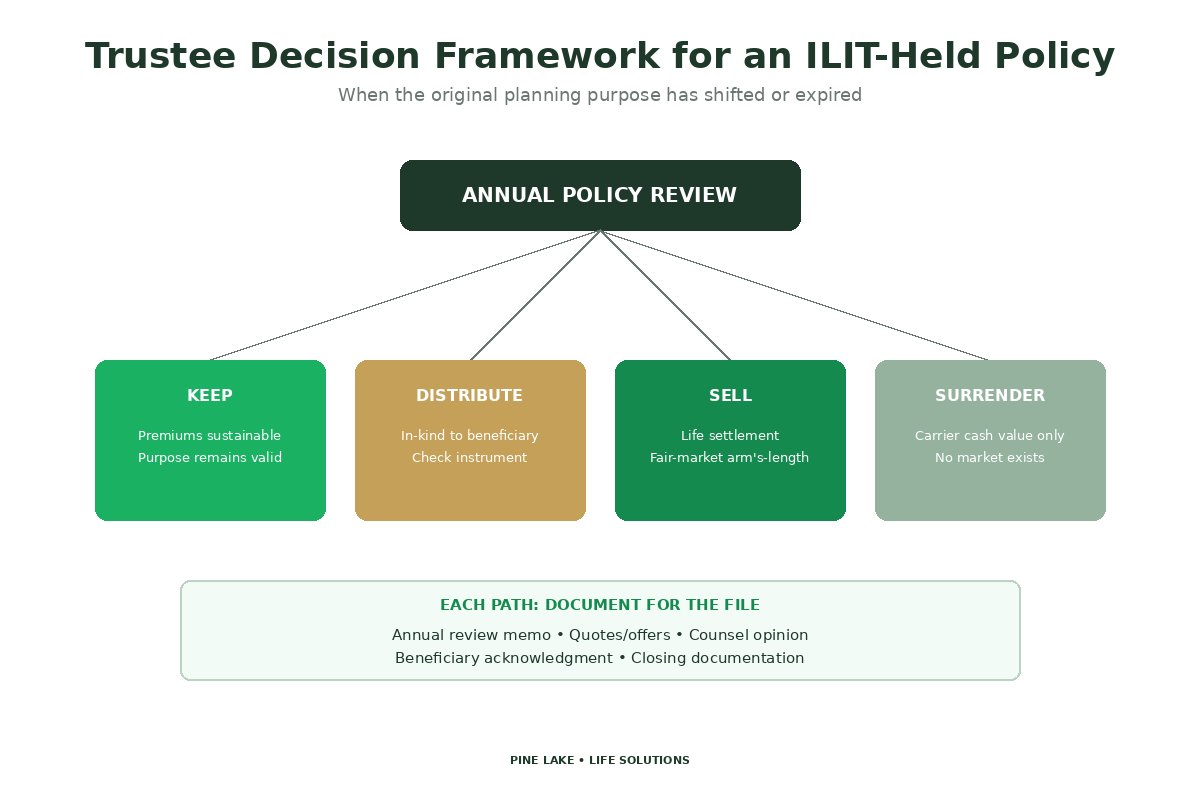
Four options exist when a trust will not continue funding a contract at the current premium, and a defensible file considers all four: continue funding; reduce the death benefit or move to a paid-up posture; surrender for cash value; or dispose of the contract in the regulated secondary market. The disposition mechanics for a trust-owned contract are at selling an ILIT-owned policy.
Three numbers must stay distinct in the memo. Cash surrender value is a contractual formula — what the carrier pays to cancel, net of surrender charges. Fair market value is what an informed buyer would pay, driven by the insured’s actual life expectancy, the premium stream required to keep the contract in force, and the net death benefit. Net death benefit is what the trust collects at maturity, after loans. On an insured whose health has declined since issue, fair market value can exceed surrender value by a multiple, and the divergence runs one way only, because a rational buyer will not pay less than surrender value when the owner could simply surrender.
New Hampshire’s tax posture is genuinely unusual and simplifies one side of the analysis considerably:
- No state estate tax and no inheritance tax.
- No personal income tax of any kind — the Interest and Dividends Tax, New Hampshire’s last remaining individual income levy, was fully repealed effective January 1, 2025. There is now no New Hampshire tax on trust income, which is a substantial part of the situs case.
Which means any tax analysis on a disposition is purely federal, and there is a real federal analysis. Three provisions belong in a memo to counsel before a transaction rather than after one: IRC § 2035, which pulls a policy back into the gross estate on a transfer by the insured within three years of death; IRC § 101(a)(2), the transfer-for-value rule, with exceptions including transfers to the insured and transfers between grantor trusts under Rev. Rul. 2007-13; and IRC § 6050Y reporting, which generates Forms 1099-LS and 1099-SB on a reportable policy sale. On the seller’s side, note that the Tax Cuts and Jobs Act of 2017 reversed the basis-reduction rule of Rev. Rul. 2009-13 for life settlement transactions, retroactive to sales after August 25, 2009, so basis is generally no longer reduced by cost-of-insurance charges — see life settlement tax basis and New Hampshire life settlement tax treatment.
Where a market process is run, keep everything: every offer received, every life expectancy report commissioned, the broker’s engagement, and the compensation disclosure. Two life expectancy reports frequently disagree, and retaining only the favorable one is precisely the appearance a fiduciary should avoid.
The New Hampshire Insurance Department and RSA 408-D
The regulator is the New Hampshire Insurance Department, in Concord, led by the Insurance Commissioner. It licenses producers, brokers, and settlement providers doing business in the state, and its records are what a trustee should check before permitting any intermediary near a trust-owned contract. Its consumer and licensing functions are summarized at New Hampshire Insurance Department consumer help.
New Hampshire’s insurance law sits in Title XXXVII of the Revised Statutes Annotated, and viatical settlement activity has historically been codified at RSA chapter 408-D. Treat that as the chapter to start from rather than a verified current section citation. New Hampshire amends its insurance statutes regularly, and a fiduciary memo citing a superseded provision is worse than one citing none. Pull the current chapter from the General Court’s statute site, or ask the Department which chapter and rule govern the transaction in question. Licensing detail is collected at New Hampshire life settlement licensing.
Four verification steps for the trust department’s written procedure:
- Confirm licensure of both the intermediary and the ultimate purchaser against Department records. An unlicensed counterparty ends the process.
- Obtain the compensation disclosure in writing. In most jurisdictions a settlement broker owes a duty to the policy owner rather than to the buyer, and the commission is disclosable. A trustee that cannot say what the intermediary was paid has an incomplete file and an obvious cross-examination problem.
- Calendar the statutory rescission window that runs after closing, confirming its length against New Hampshire’s current statute rather than borrowing a Massachusetts or Vermont rule.
- Confirm provenance and insurable interest at inception. A contract with a suspect origin raises stranger-originated life insurance questions a trust should not inherit.
And one absolute: nobody in the trust department accepts compensation, referral fees, gifts, or anything else of value from an intermediary in connection with a trust-owned transaction. It is disqualifying, it is discoverable, and it converts a defensible decision into an indefensible one regardless of the outcome.
When a Beneficiary Enters Care
New Hampshire trust departments increasingly administer trusts whose current beneficiary is elderly and may need institutional care, and at that point a set of numbers that never mattered before starts to matter.
Recent surveys have placed New Hampshire semi-private skilled nursing in the range of roughly $12,000 to $13,500 per month, among the higher figures in New England; verify a specific facility’s rate rather than relying on a median. Medicaid long-term services and supports run principally through Choices for Independence, with eligibility determined by the Department of Health and Human Services. Two figures a trust officer should have at hand:
- Individual countable resource limit: $2,500. New Hampshire does not use the $2,000 figure most states apply, and a worksheet borrowed from a neighboring state will be wrong on this line. Confirm with DHHS. Standards are collected at New Hampshire Medicaid asset and income limits.
- Life insurance exclusion: $1,500 of aggregate face value per insured, above which the entire cash surrender value counts. Two $900 burial policies are $1,800 of face and a fully countable cash value.
The distinction a trust officer must never blur: a policy owned by the trust is generally not the beneficiary’s resource; a policy the beneficiary owns personally generally is. Where the trust is a supplemental or special needs trust, both distributions and asset ownership interact with benefit eligibility in ways that require specialist counsel — route it out rather than resolving it internally.
Two closing disciplines. First, when a family arrives asking the trustee to “just cash in the policy” to pay a facility bill, the answer is the process, not the speed: order the in-force illustration, run the four-option grid, determine whether a market indication is available, notify the qualified beneficiaries, document the reasoning, then decide. Speed is not a defense to a surcharge claim. Second, keep the negative recommendation in the file with the same care as the positive one. In a meaningful share of files the correct answer is to keep funding the policy, and documenting why the trustee declined to sell is what makes the decision to sell credible in the files where it is made. The advisory-side view of the same conversation is at the New Hampshire financial advisor guide.
Frequently Asked Questions
Does excluded-fiduciary status under RSA 564-B Article 12 cover a lapsing policy?
Not automatically. Four questions decide it: whether the advisor’s granted authority actually reaches a decision to surrender or sell insurance; what residual duty the instrument and Article 12 leave with the trustee; what the trustee received from the carrier and whether it forwarded it in writing; and whether a named advisor is actually functioning. Holding a lapse notice while asserting excluded status is not a defensible posture.
Why does New Hampshire’s lack of a rule against perpetuities matter to an insurance file?
Because a New Hampshire trust can hold a universal life contract for forty or fifty years, and the internal cost-of-insurance charge rises steeply with the insured’s attained age — sharply after 80 and dramatically after 90. Over that horizon the guaranteed-assumption projection matters more than the current one, and a no-lapse guarantee, once voided by a late premium, is generally irreversible.
What belongs in the annual monitoring file?
Six items: a current in-force illustration at guaranteed and current assumptions with a premium solve to a target age; last year’s illustration for comparison; written confirmation of the carrier’s address of record and servicing contact; a premium reconciliation stating no-lapse guarantee status; a one-paragraph refreshed concentration determination; and a record of any beneficiary communication. About ninety minutes per trust per year.
Does New Hampshire tax the proceeds of a policy disposition?
No. New Hampshire has no estate tax, no inheritance tax, and — since the Interest and Dividends Tax was fully repealed effective January 1, 2025 — no personal income tax of any kind, including on trust income. The analysis is entirely federal: IRC § 101 and its exclusions, § 2035, the transfer-for-value rules, basis as revised by the 2017 tax act, and § 6050Y reporting.
Is New Hampshire’s Medicaid resource limit $2,000?
No. New Hampshire’s individual countable resource limit for aged, blind, and disabled and institutional Medicaid has been $2,500, higher than the figure most states use. Confirm the current amount with DHHS. Separately, life insurance is excluded only where aggregate face value across all policies on the insured is at or below $1,500, above which the entire cash surrender value counts.
A family wants the policy cashed in immediately to pay a facility bill. What is the right response?
Follow the process on the trustee’s timeline. Order a current in-force illustration, run the four-option grid, determine whether a market indication is available, notify the qualified beneficiaries, document the reasoning, then decide. Speed is not a defense to a surcharge claim, and a well-papered decision reached in three weeks is worth more than a fast one reached in three days.
Find out what your policy is worth — free, confidential, no obligation.
A 15-minute educational review covers your eligibility, every alternative, and a realistic view of what each path would net you.
Related Reading
- Sell Ilit Trust Owned Policy
- In Force Illustration Why It Matters
- Gul No Lapse Guarantee Risk
- Life Settlement Tax Basis Explained
- New Hampshire Insurance Department Consumer Help
- Life Settlement Licensing New Hampshire
- Life Settlement Taxes New Hampshire
- New Hampshire Medicaid Asset Income Limits
- Financial Advisor Life Settlement Guide New Hampshire
Pine Lake Legacy does not purchase life insurance policies and does not provide legal, tax, or investment advice. Information provided is for educational purposes only. Eligibility for any option, including life settlements, is not guaranteed and depends on individual circumstances, policy terms, underwriting, and market conditions. Consult independent legal, tax, or financial professionals before making decisions regarding a life insurance policy.