
Iowa’s inheritance tax was fully repealed for deaths on or after January 1, 2025, which quietly removed the reason a significant number of Iowa trusts hold life insurance at all. For decades, farm and closely held business families in this state bought policies inside irrevocable trusts specifically to give heirs liquidity for an Iowa inheritance tax bill on land and equipment they intended to keep. That bill no longer exists. The policies do, and in many cases so do the premium obligations, the Crummey notices, and the beneficiaries who assume the death benefit is still coming.
A trust officer’s job in 2026 is not to unwind those trusts reflexively. Plenty still serve a real purpose — federal estate exposure, buy-sell funding, equalization among on-farm and off-farm children, or support for a beneficiary with a disability. The job is to know which category each file falls into, and to have a documented answer rather than a habit.
This guide is written for trust officers at Iowa bank trust departments and independent trust companies. It covers where the duty comes from under the Iowa Trust Code, what an annual policy review contains, the four reasons a policy is in an Iowa trust and what happens when each reason ends, Iowa’s settlement statute, the consent and tax work that has to precede any disposition, and how proceeds interact with Iowa Medicaid and estate recovery. Nothing here is legal, tax, or investment advice. Pine Lake Life Solutions provides education and a free policy review; it does not purchase policies and is not licensed in every state.
In This Article
- The Four Reasons a Policy Is in an Iowa Trust
- Where the Duty Comes From
- The Annual Review, and the Entity-Ownership Trap
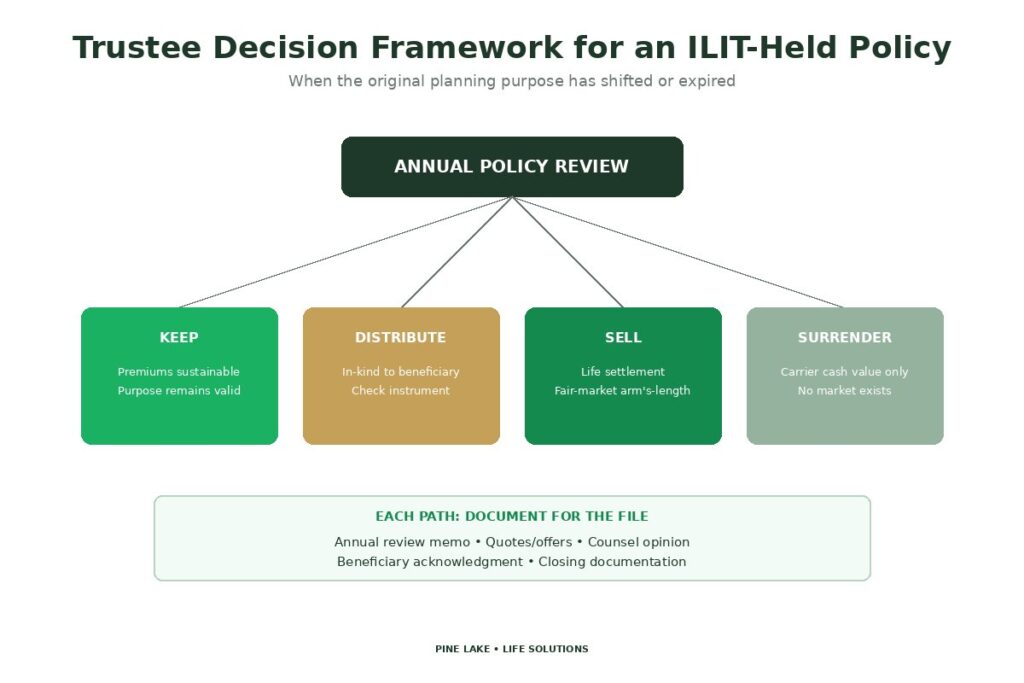
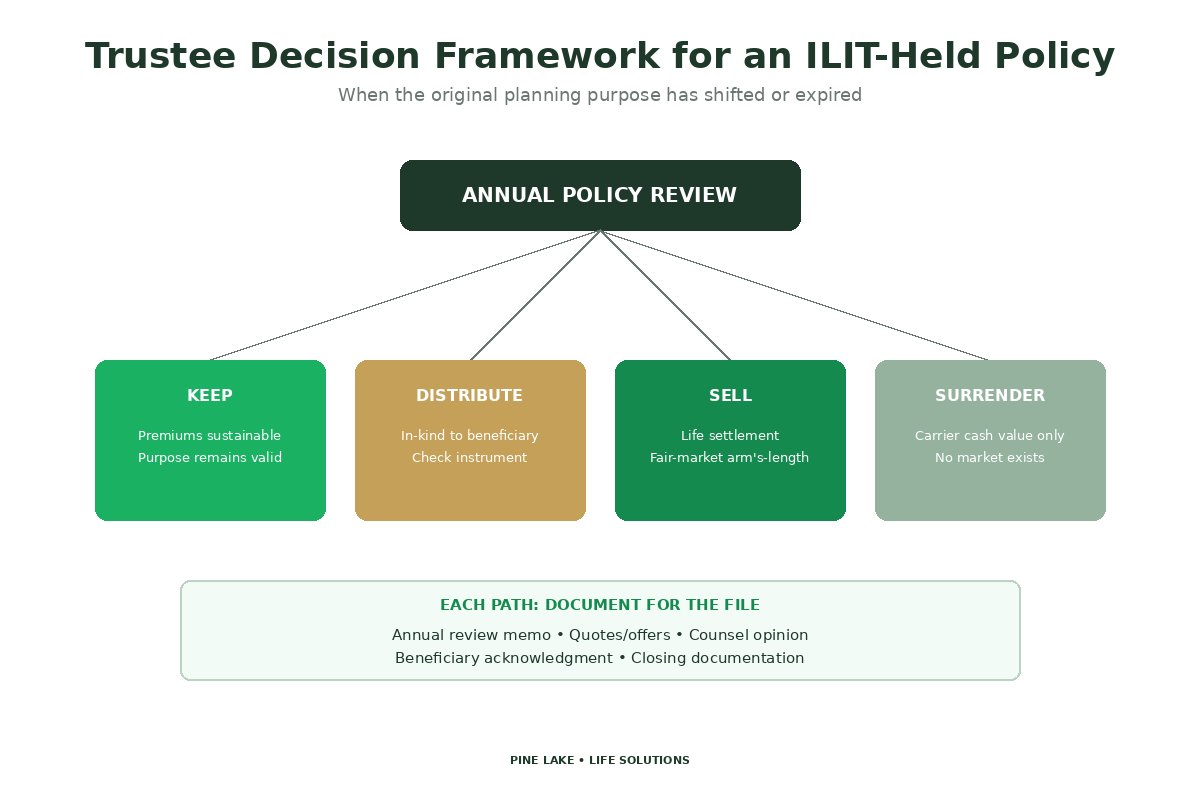
- Disposition Options, Ranked
- Iowa’s Chapter 508E and the Documents the Market Needs
- Consent and the Tax Issues to Route Out
- Care Funding, Iowa Medicaid, and Estate Recovery
- Frequently Asked Questions
The Four Reasons a Policy Is in an Iowa Trust
Sort every file into one of four purposes, because the disposition analysis differs entirely by category.
1. Transfer tax liquidity. Historically the dominant reason in Iowa, and the one most affected by the January 1, 2025 inheritance tax repeal. Where the trust was funded to cover an Iowa inheritance tax bill on farmland passing to nieces, nephews, or non-lineal heirs — the classes that bore the highest Iowa rates — the state-level purpose has ended. Federal estate exposure may or may not remain, and current federal exemption levels mean for most Iowa families it does not.
2. Buy-sell and business succession funding. A policy funding a cross-purchase or entity-purchase agreement among farm or business partners. The question is whether the agreement is still in force and whether the insured is still a party to it. Where a partner has retired or been bought out, the funding purpose is over and the policy is orphaned.
3. Equalization. The on-farm child receives the land; the off-farm children receive the death benefit. This purpose usually survives, and disposing of the policy without addressing the equalization plan creates a family problem the trust department will hear about for years.
4. Support for a beneficiary with a disability. A policy on a parent’s life funding a special needs trust. Lapsing it is not a portfolio event; it is the collapse of the beneficiary’s future support. These files get the tightest review calendar and the most conservative posture, and nothing happens without counsel who handles public benefits.
Write the category on the file. A review that does not state the purpose cannot evaluate whether the purpose still exists.
Where the Duty Comes From
Iowa’s trust law is the Iowa Trust Code at Iowa Code Chapter 633A, which includes the prudent investor rule at Iowa Code § 633A.4302. Confirm current section numbering with counsel before citing it in a memorandum.
The substance is what matters. Under the prudent investor rule a trustee evaluates each asset as part of the overall portfolio and in light of the trust’s purposes rather than in isolation. A trust-owned life policy is a portfolio position with a required funding rate, a mortality-driven return profile, and — uniquely among trust assets — a real prospect of going to zero on a knowable future date. The duty of loyalty requires administering it solely in the beneficiaries’ interest. The duty of impartiality requires balancing current beneficiaries against remainder beneficiaries whose entire interest is the death benefit. The duty to inform requires telling qualified beneficiaries that a policy is projected to lapse while something can still be done about it.
Two out-of-state decisions frame the range of outcomes and belong in the reference file. Rafert v. Meyer, 290 Neb. 219, 859 N.W.2d 332 (2015), arose from ILIT policies that lapsed after premium notices sent to the trustee were not forwarded, and addressed the reach of an exculpatory clause. In re Stuart Cochran Irrevocable Trust, 901 N.E.2d 1128 (Ind. Ct. App. 2009), upheld a corporate trustee’s decision to exchange underperforming policies where the trustee had run and documented a real process. Neither binds an Iowa court. Together they make the point that the file, more than the outcome, determines how a disposition decision is judged. See a trustee’s duty on an underperforming policy.
The Annual Review, and the Entity-Ownership Trap
Six components, produced on a fixed annual date independent of the grantor’s contact schedule: an in-force illustration at current assumptions; a second at guaranteed assumptions, meaning guaranteed maximum cost of insurance and guaranteed minimum credited rate; a premium solve to a target age; carrier financial strength ratings from at least two agencies; the Crummey withdrawal notice history; and a written conclusion with a recommendation and a second sign-off.
The gap between the current and guaranteed illustrations is the risk the trust is actually carrying, and our overview of what an in-force illustration is covers how to read one against the other.
Iowa files carry a specific trap worth naming: entity ownership. A meaningful share of policies in Iowa trust files are owned not by the trust but by a family farm corporation, an LLC, a partnership, or a former employer, with the trust named only as beneficiary. That is a materially different position. The trust cannot direct a disposition of a policy it does not own; it can only exercise whatever rights the beneficiary designation gives it. Confirm ownership from the carrier’s records, not from the family’s description or from an old memorandum. This is the single most common error in Iowa trust-owned policy files, and it surfaces at exactly the wrong moment.
Track two dates that never move: the year the guaranteed-assumption illustration projects lapse, and the conversion deadline on any convertible term policy. Both are contractual and knowable years ahead.
| Original purpose | Still valid in 2026? | What to check | Typical disposition posture |
|---|---|---|---|
| Iowa inheritance tax liquidity | No, repealed for deaths on or after Jan 1, 2025 | Whether any federal estate exposure remains | Disposition analysis appropriate |
| Buy-sell or succession funding | Only if the agreement is in force and the insured is a party | The current agreement, not the 1998 version | Orphaned policy if the party exited |
| Equalization among heirs | Usually yes | Whether the family plan has changed | Preserve; renegotiate before disposing |
| Special needs trust funding | Yes | Funding adequacy and benefit eligibility impact | Most conservative; involve benefits counsel |
| Federal estate tax liquidity | Depends on the family’s exposure | Current exemption versus projected estate | Evaluate with tax counsel |

Disposition Options, Ranked
Work down the intermediate options and document the comparison. A sale is right in a minority of files.
Reduce the face amount to a level the trust can fund. Preserves coverage and removes lapse risk in one move.
Nonforfeiture election. Ends premiums permanently and preserves a smaller paid-up death benefit. Appropriate where gifting has stopped and beneficiaries would prefer a reduced benefit to none.
1035 exchange into a guaranteed product. The right answer where lapse risk rather than the coverage itself is the problem. Confirm the guarantee premium and what happens if a payment is late, because no-lapse guarantees are unforgiving about timing.
Retained death benefit. The trust keeps a portion of the benefit with no further premium obligation. Frequently overlooked and sometimes the cleanest resolution for an equalization trust that cannot fund the full premium.
Sale to a licensed provider. Appropriate when the purpose has ended, funding has stopped, the guaranteed illustration shows early lapse, health has declined since issue, and the face amount is meaningful — generally $250,000 or more attracts competitive trust-owned interest. The U.S. Government Accountability Office’s market study (GAO-10-775) found sellers typically received roughly 10% to 35% of face value and, on average, several times what surrender would have paid. Expect 60 to 120 days to funded closing. See selling an ILIT or trust-owned policy.
Surrender. Only after a market evaluation has been declined or come back empty.
Do not sell when a no-lapse guarantee is intact and current, when the insured is in strong health for their age, when beneficiaries have not been informed and would object, when the instrument does not clearly authorize disposition, or when the equalization plan the policy supports has not been renegotiated with the family.
Iowa’s Chapter 508E and the Documents the Market Needs
Iowa regulates viatical and life settlements under Iowa Code Chapter 508E, with implementing rules at Iowa Administrative Code 191—Chapter 48. Section 508E.5 addresses settlement contracts, the required disclosure statement, and advertising materials, all of which are subject to filing with the regulator. The regulator is the Iowa Insurance Division, which since the 2023 state government realignment sits within the Iowa Department of Insurance and Financial Services.
Providers and brokers must be licensed before transacting with an Iowa owner. Verify a counterparty’s license before engaging, and expect a compliant company to produce its filed disclosure statement before any offer is discussed. A firm that describes its paperwork as a universal national form has told you something about how it operates. See Iowa life settlement licensing and Iowa insurance department consumer help.
The market will require the trust instrument or a certification of trust, documented trustee authority, the policy and all riders, an in-force illustration, verification of coverage from the carrier, and a HIPAA authorization satisfying 45 C.F.R. § 164.508 signed by the insured — not the trustee. Establish the grantor’s willingness to sign before submitting a case, because a refusal ends the process regardless of what the trustee has decided.
Run a competitive process or do not run one at all. A broker owes a duty to the owner and takes the case to multiple licensed providers; a single unsolicited offer accepted without shopping is the fact pattern that reads worst in hindsight. Record which providers received the case, what each offered, and why the accepted offer was selected.
Consent and the Tax Issues to Route Out
Authority. Read the instrument for an express power to sell, exchange, or otherwise dispose of trust property, and for any provision requiring grantor consent or trust protector approval. Older Iowa ILITs were often drafted to hold a policy rather than to trade one.
Beneficiary consent. Qualified beneficiaries have information rights under the Iowa Trust Code, and a prudent trustee notifies them of a proposed disposition of the trust’s principal asset even where consent is not strictly required. Written consents and releases from adult beneficiaries are standard practice. Minor, unborn, or incapacitated beneficiaries may require virtual representation or a court proceeding. In equalization trusts, expect the off-farm children to have strong views and to remember what they were told. See consent issues when an irrevocable trust sells a policy.
Tax issues to identify and hand to counsel and the CPA. Revenue Rulings 2009-13 and 2009-14 address basis and character on surrender and sale of a policy. Section 13521 of the Tax Cuts and Jobs Act of 2017 modified those basis rules by eliminating the cost-of-insurance reduction and added reporting for reportable policy sales under Internal Revenue Code § 6050Y. Internal Revenue Code § 101(a)(2), the transfer-for-value rule, can convert an otherwise tax-free death benefit into taxable income on a transfer for consideration, subject to exceptions — a point that matters as much for intra-family and entity-to-trust transfers as for a market sale. Internal Revenue Code § 2035 pulls certain life insurance transfers made within three years of death back into the gross estate, with an exception for transfers for full and adequate consideration.
And the Iowa-specific point. With the inheritance tax repealed for deaths on or after January 1, 2025, a trust funded solely to pay that tax has outlived its purpose. Confirm with tax counsel whether any federal exposure remains before treating that conclusion as final.
Care Funding, Iowa Medicaid, and Estate Recovery
Some trust-owned policy questions arrive as care-funding problems: the grantor is entering a nursing facility and the family is inventorying assets.
Iowa Medicaid is administered by the Iowa Department of Health and Human Services, with most members enrolled through IA Health Link. The countable resource limit for a single applicant is $2,000. Life insurance is measured by total face value: $1,500 or less on the applicant’s life is excluded outright; above that, the cash surrender value counts. Iowa applies the special income limit for institutional eligibility — 300% of the SSI federal benefit rate, adjusted every January and landing near $2,980 per month for 2026; confirm with Iowa HHS. Residents above the cap use a Medical Assistance Income Trust, Iowa’s version of the qualified income trust.
Two structural distinctions matter to a trustee. A policy owned by a properly structured irrevocable trust is generally not the applicant’s countable resource, which is often the point of the arrangement; a policy owned by a revocable trust generally is. And proceeds paid to an irrevocable trust do not become the grantor’s resource, while proceeds paid to a revocable trust do.
Estate recovery deserves special attention in Iowa. Federal law at 42 U.S.C. § 1396p(b) requires states to recover from the estates of deceased beneficiaries who received nursing facility services, and Iowa implements it under Iowa Code § 249A.53 through a contracted recovery unit that is notably thorough. A death benefit paid to a named beneficiary passes outside the probate estate; unspent proceeds sitting in the grantor’s own account at death generally do not. Where money will land at death is a planning decision made before a check is issued, and it is one of the few places where a trustee’s timing genuinely changes the family’s outcome.
Cost context: 2024 survey data place a semi-private nursing facility room in Iowa at roughly $7,800 to $8,200 a month, below the national median near $9,277. See Iowa Medicaid asset and income limits and the Iowa elder law attorney guide. Where a trustee needs a market read on a specific contract before making a recommendation, a free, no-obligation review starting from the cover page and an in-force illustration will produce one.
Frequently Asked Questions
How does Iowa’s inheritance tax repeal affect trust-owned life insurance?
Iowa’s inheritance tax was fully repealed for deaths on or after January 1, 2025. A trust funded specifically to give heirs liquidity for that bill has outlived its state-level purpose, which was a common reason Iowa farm and business families created irrevocable life insurance trusts. Confirm with tax counsel whether any federal estate exposure remains before treating that as settled.
Who actually owns the policy in an Iowa trust file?
Confirm it from the carrier’s records rather than from the family’s description or an old memorandum. A meaningful share of Iowa policies are owned by a family farm corporation, an LLC, or a former employer, with the trust named only as beneficiary. A trust cannot direct disposition of a policy it does not own, and this error surfaces at the worst possible moment.
Which Iowa statute governs trustee duties on a policy?
The Iowa Trust Code at Iowa Code Chapter 633A, which includes the prudent investor rule at section 633A.4302. Confirm current numbering with counsel before citing it. The practical requirements are to evaluate the policy as part of the overall portfolio, act impartially between current and remainder beneficiaries, and keep qualified beneficiaries informed.
What does Iowa Code Chapter 508E require of a settlement company?
Chapter 508E, with rules at Iowa Administrative Code 191 Chapter 48, governs viatical and life settlements. Section 508E.5 addresses settlement contracts, the required disclosure statement, and advertising materials, all subject to filing with the Iowa Insurance Division. Providers and brokers must be licensed before transacting with an Iowa owner. Verify the license before engaging.
Why does Iowa estate recovery matter to a trustee’s timing?
Iowa implements federally mandated estate recovery under Iowa Code section 249A.53 through a contracted recovery unit that is notably thorough. A death benefit paid to a named beneficiary passes outside the probate estate; unspent settlement proceeds in the grantor’s own account at death generally do not. Deciding where the money will land before a check is issued genuinely changes the outcome.
Should a trustee sell a policy that funds an equalization plan?
Not without renegotiating the plan with the family first. The on-farm child receives the land and the off-farm children receive the death benefit; disposing of the policy without addressing that arrangement creates a family conflict the trust department will hear about for years. Document the conversation and any revised understanding before acting.
Find out what your policy is worth — free, confidential, no obligation.
A 15-minute educational review covers your eligibility, every alternative, and a realistic view of what each path would net you.
Related Reading
- Sell Ilit Trust Owned Policy
- Trustee Duty Underperforming Policy
- Irrevocable Trust Sell Policy Consent
- What Is An In Force Illustration
- What Is A No Lapse Guarantee
- Life Settlement Licensing Iowa
- Iowa Insurance Department Consumer Help
- Iowa Medicaid Asset Income Limits
- Elder Law Attorney Life Settlement Guide Iowa
Pine Lake Life Solutions does not purchase life insurance policies and does not provide legal, tax, or investment advice. Information provided is for educational purposes only. Eligibility for any option, including life settlements, is not guaranteed and depends on individual circumstances, policy terms, underwriting, and market conditions. Consult independent legal, tax, or financial professionals before making decisions regarding a life insurance policy.