

Connecticut is the only state in the country that imposes a gift tax, and since 2023 its unified estate and gift tax exemption has been aligned with the federal basic exclusion amount at a flat 12% rate above it — which means the state-level rationale for many Connecticut irrevocable life insurance trusts changed substantially and recently. Trust officers here are administering a meaningful population of ILITs designed against a Connecticut exemption that was a fraction of today’s, funded by grantors who have since stopped gifting, holding policies nobody has illustrated in a decade.
That is the practical setting for this guide. It is written for trust officers at Connecticut bank trust departments and independent trust companies who administer irrevocable life insurance trusts, revocable trusts holding policies, and special needs trusts. It is not written for the grantor or the beneficiary.
It covers where the duty comes from under the Connecticut Uniform Trust Code and the state’s prudent investor rule, what a defensible annual policy review contains, when a settlement is and is not the right disposition, the consent and notice work that has to happen first, Connecticut’s unusually specific settlement statute, and how proceeds interact with Title 19 when care funding is the real driver. Nothing here is legal, tax, or investment advice. Pine Lake Life Solutions provides education and a free policy review; it does not purchase policies and is not licensed in every state.
In This Article
- The Connecticut Duty Framework
- The Annual Review, and Why the Connecticut Exemption Change Matters to It
- When a Sale Is Right and When It Is Not
- Connecticut’s Settlement Statute Is Unusually Specific
- Consent, Representation, and the Instrument
- When Care Funding Is the Real Driver: Title 19
- A Standing Protocol for the Department
- Frequently Asked Questions

The Connecticut Duty Framework
Connecticut adopted the Connecticut Uniform Trust Code, codified beginning at Conn. Gen. Stat. § 45a-499a, effective January 1, 2020 — a relatively recent modernization that replaced a body of common law with an express statutory framework for trustee duties, notice, representation, and nonjudicial settlement agreements. The state’s prudent investor rule sits separately in the General Statutes at § 45a-541 and following. Confirm current section numbering with counsel before citing it in a memorandum.
Three duties do the work in a trust-owned policy file. Prudence requires evaluating the policy as part of the overall portfolio and in light of the trust’s purposes, not in isolation — a $3,000,000 death benefit is a position with a funding requirement, a mortality-driven return, and a genuine risk of total loss. Impartiality requires balancing a current beneficiary who wants distributions against remainder beneficiaries whose entire interest is the death benefit. The duty to inform and report requires that qualified beneficiaries receive material information — which for an ILIT means telling them a policy is projected to lapse while something can still be done about it.
The CUTC’s representation and nonjudicial settlement provisions are worth knowing specifically, because they are frequently the cleanest path to obtaining beneficiary consent for a disposition without a Probate Court proceeding. Whether a particular consent can be obtained through virtual representation depends on the beneficiary class and the instrument.
Two out-of-state cases belong in the reference file for context. Rafert v. Meyer, 290 Neb. 219, 859 N.W.2d 332 (2015), involved ILIT policies that lapsed after premium notices were not forwarded and addressed the limits of an exculpatory clause. In re Stuart Cochran Irrevocable Trust, 901 N.E.2d 1128 (Ind. Ct. App. 2009), upheld a corporate trustee’s disposition decision where the process was documented. The distinction between the two is largely the quality of the file.
The Annual Review, and Why the Connecticut Exemption Change Matters to It
A defensible review runs on the same annual calendar as any other asset review and produces six things: an in-force illustration at current assumptions; a second illustration at guaranteed assumptions, meaning guaranteed maximum cost of insurance and guaranteed minimum credited rate; a premium solve to carry the policy to a target age; current carrier financial strength ratings from at least two agencies; confirmation of the Crummey withdrawal notice history; and a written conclusion recommending a course of action.
The written conclusion is the component most often missing and the one that converts a file of documents into a review. Our overview of what an in-force illustration is covers how to read the two illustrations against each other, and the gap between them is usually the whole story.
Connecticut adds a specific question to the conclusion. Where an ILIT was created to solve a Connecticut estate tax exposure calculated against a much lower state exemption, and the state exemption has since been aligned with the federal basic exclusion amount, the trustee should be asking whether the trust’s original purpose still exists for this family. That is not a decision the trust officer makes unilaterally — it involves the grantor, tax counsel, and the beneficiaries — but it is a question the review should surface rather than ignore for another year. Where the answer is that the purpose has ended and the grantor has stopped funding, a disposition analysis becomes appropriate. See a trustee’s duty on an underperforming policy.
When a Sale Is Right and When It Is Not
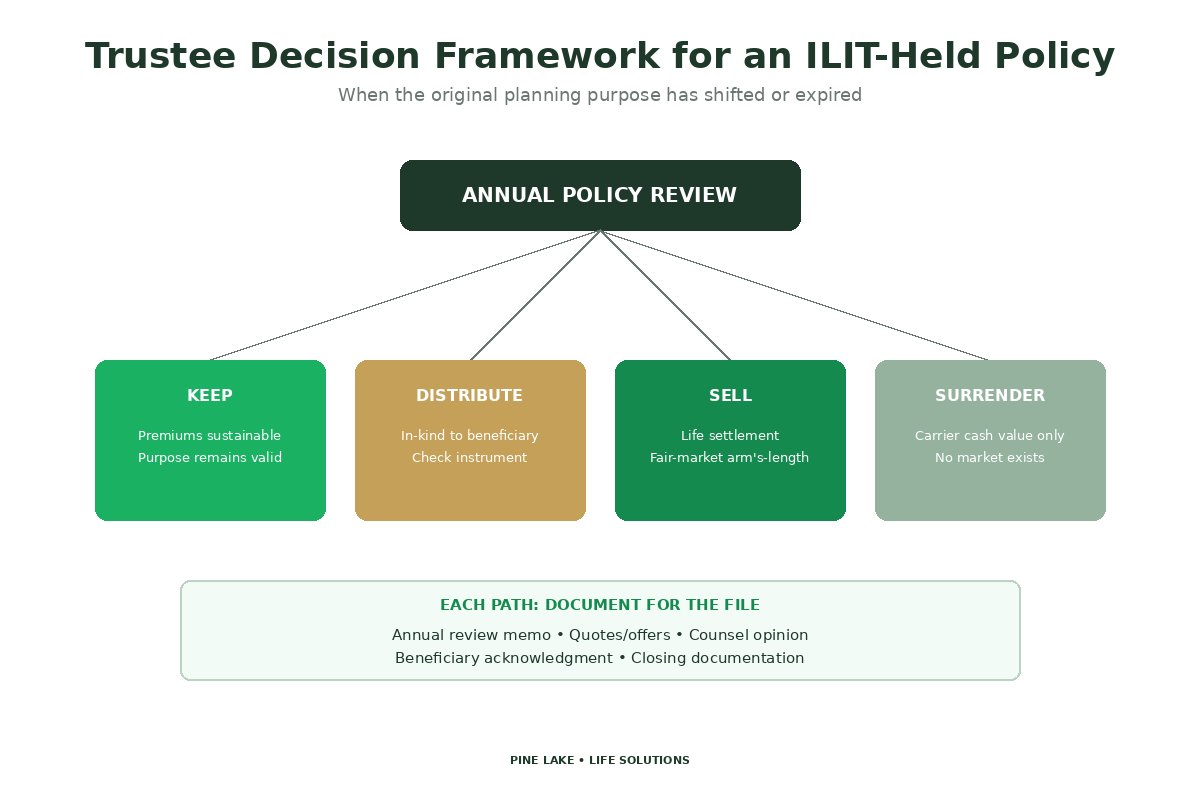
A settlement is the correct disposition in a minority of trust-owned files, and treating it as a default is as indefensible as never considering it.
Evaluate a sale when: the insurance purpose has genuinely ended; gifting has stopped and the trust cannot fund the required premium; the guaranteed-assumption illustration shows lapse well before life expectancy; the insured’s health has declined materially since issue; and the face amount is meaningful — generally $250,000 or more attracts competitive interest in a trust-owned case, though smaller policies do transact.
Do not sell when: a no-lapse guarantee rider is intact and the guarantee premium has been paid on schedule, which frequently makes the contract worth more held than sold; the insured is in strong health for their age, which pushes life expectancy out and compresses offers; the beneficiaries have not been informed and would object; the instrument does not clearly authorize disposition; or a liquidity need exists that a partial solution would meet.
Rank the intermediate options first and put the comparison in writing: reducing the face amount to a level the trust can fund; a nonforfeiture election; a 1035 exchange into a guaranteed universal life contract where lapse risk rather than coverage is the problem; a retained death benefit arrangement in which the trust keeps a portion of the benefit with no further premium obligation; and only then a sale. Our page on selling an ILIT or trust-owned policy covers the mechanics.
On pricing, the reference point remains the U.S. Government Accountability Office’s market study (GAO-10-775), which found sellers typically received roughly 10% to 35% of face value and, on average, several times what surrender would have paid. Expect 60 to 120 days from submission to funded closing.
| Review component | Source | What it tells the trustee |
|---|---|---|
| In-force illustration, current assumptions | Carrier, written request | Projected performance if funding continues unchanged |
| In-force illustration, guaranteed assumptions | Carrier, written request | The contractual floor; the gap versus current is the risk |
| Premium solve to a target age | Carrier or independent analysis | Converts funding from a habit into a number |
| Carrier financial strength ratings | At least two rating agencies | Counterparty risk on a multi-decade obligation |
| Crummey notice history | Trust file | Gift tax exposure independent of policy performance |
| No-lapse guarantee status | Policy and rider schedule | Whether the contract is worth more held than sold |
| Written conclusion | Trust officer, with second sign-off | The component that makes it a review rather than a file |
Connecticut’s Settlement Statute Is Unusually Specific
If the trustee proceeds, Connecticut’s own framework shapes the transaction more than most states’ do. Life settlements sit in the General Statutes at Title 38a, Chapter 700b, Part III, beginning at § 38a-465, administered by the Connecticut Insurance Department.
Three provisions matter directly to a trust officer:
- § 38a-465a requires providers and brokers to be licensed. Verify any counterparty’s license before engaging. See Connecticut life settlement licensing.
- § 38a-465o provides that a life settlement broker is deemed to represent only the owner — here, the trust — and owes a fiduciary duty to act on the owner’s instructions and in the owner’s best interest. That is the structural argument for running a brokered, competitive process rather than accepting an unsolicited offer. A single offer taken without shopping is the fact pattern that reads worst in hindsight.
- § 38a-465g requires, where the insured is terminally or chronically ill, that the provider first obtain a written statement from a licensed attending physician, physician assistant, or advanced practice registered nurse that the owner is of sound mind and under no constraint or undue influence. Where a trustee is the owner, that requirement still turns on the transaction’s structure, and it is worth confirming with counsel how the provider intends to satisfy it.
Separately, the market will require the trust instrument or a certification of trust, evidence of the trustee’s authority, the policy and all riders, an in-force illustration, verification of coverage from the carrier, and a HIPAA authorization satisfying 45 C.F.R. § 164.508 signed by the insured — not the trustee. A grantor who declines to sign ends the process regardless of what the trustee has decided.
Consent, Representation, and the Instrument
Three document questions precede any disposition.
Does the instrument authorize it? Many Connecticut ILITs drafted in the 1990s and 2000s were written to hold a policy rather than to trade one. Look for an express power to sell, exchange, or otherwise dispose of trust property, and for provisions requiring grantor consent or trust protector approval.
Who must be notified, and whose consent is needed? The CUTC gives qualified beneficiaries information rights, and a prudent trustee notifies them of a proposed disposition of the trust’s principal asset even where consent is not strictly required. Written consents and releases from adult beneficiaries are standard practice. Where beneficiaries are minor, unborn, or incapacitated, the CUTC’s representation provisions or a nonjudicial settlement agreement may resolve it; where they do not, a Connecticut Probate Court proceeding may be necessary. See consent issues when an irrevocable trust sells a policy.
What tax issues need routing? Identify them; do not resolve them in your own voice. Revenue Rulings 2009-13 and 2009-14 address basis and character on surrender and sale of a policy; section 13521 of the Tax Cuts and Jobs Act of 2017 modified those basis rules by removing the cost-of-insurance reduction and added reporting for reportable policy sales under Internal Revenue Code § 6050Y. Internal Revenue Code § 101(a)(2), the transfer-for-value rule, can convert an otherwise tax-free death benefit into taxable income on a transfer for consideration, subject to exceptions. Internal Revenue Code § 2035 pulls certain life insurance transfers made within three years of death back into the gross estate, with an exception for transfers for full and adequate consideration. And Connecticut’s own gift tax means intra-family restructuring proposals carry a state-level consequence they would not carry anywhere else in the country.
When Care Funding Is the Real Driver: Title 19
A substantial share of trust-owned policy inquiries in a Connecticut trust department are not portfolio questions. They arrive because the grantor is entering a skilled nursing facility at Connecticut prices and the family is inventorying every asset.
Connecticut Medicaid — Title 19 — is administered by the Connecticut Department of Social Services, with home and community-based alternatives through the Connecticut Home Care Program for Elders. The countable resource limit for a single applicant is $1,600, lower than the $2,000 most states use. Life insurance is measured by total face value: $1,500 or less on the applicant’s life is excluded; above that, the cash surrender value counts. Connecticut does not use the 300%-of-SSI institutional income cap; it operates a medically needy program with an applied-income spend-down, which is why Miller trusts rarely appear in Connecticut planning. Confirm current figures with DSS.
Two structural distinctions matter to a trustee. A policy owned by a properly structured irrevocable trust is generally not the applicant’s countable resource, which is often the point of the arrangement; a policy owned by a revocable trust generally is. And where a resident holds a qualifying Connecticut Partnership for Long-Term Care policy — Connecticut was one of the original four state partnership programs — dollar-for-dollar asset protection against resource limits and estate recovery for benefits paid changes the spend-down analysis entirely. Check for one before recommending liquidation of anything.
Cost sets the urgency: the most recent CareScout (formerly Genworth) Cost of Care Survey figures for 2024 place a semi-private nursing facility room in Connecticut at roughly $13,000 to $14,500 a month, among the highest in the country, against a national median near $9,277. Whether any of this applies to a specific trust is a question for elder law counsel, not for the trust officer. See Connecticut Medicaid asset and income limits and the Connecticut elder law attorney guide. Where a trustee needs a market read on a specific contract before making a recommendation, a free, no-obligation review starting from the cover page and an in-force illustration will produce one.
A Standing Protocol for the Department
The most useful thing a Connecticut trust department can do is turn all of the above into a written protocol that runs without anyone remembering to run it.
Set a fixed annual review date for every trust holding a policy, independent of the grantor’s contact schedule. Request both in-force illustrations 90 days ahead so a slow carrier does not push the review past its date. Record the premium solve, the ratings, and the Crummey history in a standard form so the file is comparable year over year. Require a written conclusion with a recommendation, and require sign-off from someone other than the officer who prepared it.
Track two dates on every file that never move: the date the policy’s guaranteed-assumption illustration projects lapse, and the conversion deadline on any convertible term. Both are contractual, both are knowable years in advance, and both are the kind of deadline a court will treat as having been foreseeable.
Notify qualified beneficiaries annually of the policy’s status, not only when there is a problem. A beneficiary who has received a status letter every year for six years is in a very different posture than one who first learns of a policy when it is being sold.
Finally, keep the counterparty file. If a broker or provider is engaged, record the Connecticut license number and verification date, which providers received the case, what each offered, and why the accepted offer was selected. The Connecticut Insurance Department consumer help page covers the complaint route if a counterparty behaves badly — a route that belongs to the trust as owner, and which a trustee should not hesitate to use.
Frequently Asked Questions
How did Connecticut’s estate and gift tax change affect existing ILITs?
Connecticut is the only state with a gift tax, and since 2023 its unified estate and gift tax exemption has been aligned with the federal basic exclusion amount, with a flat 12 percent rate above it. Many older Connecticut ILITs were funded against a far lower state exemption. Whether the original purpose survives for a given family is a question the annual review should surface.
Which Connecticut statute governs trustee duties on a trust-owned policy?
The Connecticut Uniform Trust Code, effective January 1, 2020 and codified beginning at Conn. Gen. Stat. section 45a-499a, together with the state’s prudent investor rule at section 45a-541 and following. Confirm current numbering with counsel. The CUTC’s representation and nonjudicial settlement provisions are often the cleanest path to beneficiary consent without a Probate Court proceeding.
Why does Conn. Gen. Stat. 38a-465o matter to a trustee?
It provides that a life settlement broker is deemed to represent only the owner and owes a fiduciary duty to act on the owner’s instructions and in the owner’s best interest. For a trustee that is the structural argument for running a competitive brokered process rather than accepting an unsolicited offer. A single offer taken without shopping is difficult to defend afterward.
Who signs the medical release when a trust owns the policy?
The insured, not the trustee. A settlement provider needs medical records for life expectancy underwriting, and that authorization must satisfy 45 C.F.R. section 164.508 and be signed by the person whose records they are. Establish the grantor’s willingness before submitting a case, because a refusal ends the process regardless of the trustee’s decision.
Does a no-lapse guarantee change the analysis?
Substantially. Where a no-lapse guarantee rider is intact and the guarantee premium has been paid on schedule, the contract is frequently worth more held than sold, because the guarantee removes the lapse risk that drives most disposition decisions. Confirm from the rider schedule and the carrier that the guarantee is actually in force before any market evaluation.
What is the Connecticut Partnership for Long-Term Care and why check for it?
Connecticut was one of the original four state partnership programs. A qualifying partnership long-term care policy earns dollar-for-dollar asset protection against Medicaid resource limits and estate recovery for benefits it paid. If a grantor holds one, the spend-down analysis changes materially, so check before recommending that any asset be liquidated for care funding.
Find out what your policy is worth — free, confidential, no obligation.
A 15-minute educational review covers your eligibility, every alternative, and a realistic view of what each path would net you.
Related Reading
- Sell Ilit Trust Owned Policy
- Trustee Duty Underperforming Policy
- Irrevocable Trust Sell Policy Consent
- What Is An In Force Illustration
- Life Settlement Licensing Connecticut
- Connecticut Insurance Department Consumer Help
- Connecticut Medicaid Asset Income Limits
- Elder Law Attorney Life Settlement Guide Connecticut
- What Is A No Lapse Guarantee
Pine Lake Life Solutions does not purchase life insurance policies and does not provide legal, tax, or investment advice. Information provided is for educational purposes only. Eligibility for any option, including life settlements, is not guaranteed and depends on individual circumstances, policy terms, underwriting, and market conditions. Consult independent legal, tax, or financial professionals before making decisions regarding a life insurance policy.