

A life insurance policy you no longer need is a sellable asset — in St. Johns County, get it priced before you surrender it, because a qualifying policy usually brings more than cash surrender value. In a life settlement, an institutional buyer purchases the contract, assumes every future premium, and collects the death benefit later. You take a lump sum now. Settlements across the market commonly land between roughly 10% and 35% of the face amount, and a 2010 U.S. Government Accountability Office review of the secondary market found sellers received about four to eight times what surrendering would have paid.
St. Johns County is one of Florida’s wealthiest and fastest-growing counties. The seat is St. Augustine, with Ponte Vedra Beach and St. Augustine Beach on the coast and agricultural Hastings inland to the southwest. Growth has been driven heavily by retiree in-migration into Ponte Vedra and the World Golf Village corridor — households arriving from the Northeast and Midwest in their late fifties and sixties, carrying policies bought decades earlier under an entirely different set of circumstances.
This page covers what happens to those policies, how Florida’s long-term care Medicaid program treats a lump sum, and how to vet anyone who offers to buy. Pine Lake Legacy offers a free policy review — send the policy cover page or call (732) 978-9575.
In This Article
- Policies That Moved to Florida With Their Owners
- Florida Medicaid — SMMC LTC and the Asset Limit
- The 60-Month Look-Back for Recent Arrivals
- Estate Recovery and Florida Homestead
- Northeast Florida Care Costs (2026 Ballpark)
- What Buyers Look For in a Policy
- Vetting a Provider or Broker
- The Free Policy Review and What Comes After
- Frequently Asked Questions

Policies That Moved to Florida With Their Owners
A recognizable St. Johns County pattern: a couple relocates to Ponte Vedra or World Golf Village at retirement, keeps the agent and the carrier they had up north, and never revisits the coverage. The policy was bought to protect a young family and a mortgage in another state. Both of those obligations ended years ago.
What is left is a recurring premium attached to a purpose that expired. Sometimes the coverage still has a job — protecting a surviving spouse, equalizing an inheritance, funding a charitable intent. Often it does not. Writing down the original reason and asking whether it still applies is a five-minute exercise that changes the whole conversation.
The other complication of moving states is administrative: policies get lost. Carriers merge and rename. Statements go to an old address. If you suspect a parent had coverage but cannot find the paperwork, the state’s unclaimed property office and the NAIC Life Insurance Policy Locator are the free starting points.
Florida Medicaid — SMMC LTC and the Asset Limit
Florida’s long-term care coverage for those who qualify runs through Florida Medicaid — Statewide Medicaid Managed Care Long-Term Care (SMMC LTC). It funds nursing facility care and, through managed care plans, home and community-based services. The Department of Children and Families determines financial eligibility, and a separate screening determines whether the level-of-care requirement is met.
The countable-asset limit for a single applicant has long been $2,000, with a much larger community spouse resource allowance protecting a spouse who remains at home. Verify both for 2026 with DCF or a Florida elder law attorney. High-asset households often assume this is irrelevant, and initially it is — but several years of private-pay care in a high-cost county can change that arithmetic faster than people expect.
The 60-Month Look-Back for Recent Arrivals
Florida applies the federal 60-month look-back to transfers made for less than fair market value in the five years before a long-term care application. Two points matter especially for people who moved here recently.
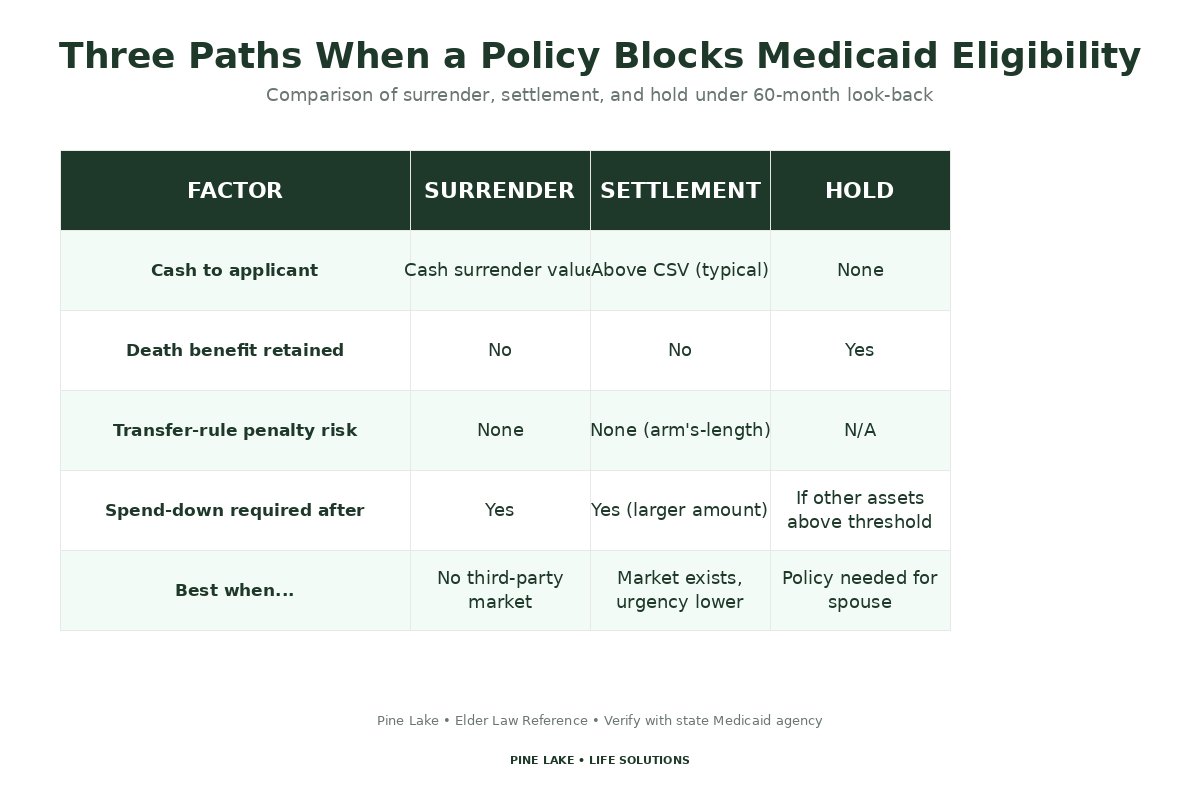
First, the look-back examines transfers, not geography. Gifts made before the move — helping a grandchild with tuition, funding a down payment, transferring a northern property to a child — can still be examined. Second, a sale of a life insurance policy at fair market value to an unrelated buyer is not a gift; you received value in return. It is transferring the policy to a family member for little or nothing that creates a penalty period. Keep documentation of everything either way.
Estate Recovery and Florida Homestead
Florida runs a Medicaid Estate Recovery Program that seeks repayment from the estates of deceased recipients age 55 and older who received long-term care services. Florida’s homestead protections are unusually strong, but they apply to the home, not to cash sitting in an account.
For families with an existing estate plan — and in this county most have one — a policy decision should be run past the estate planning attorney rather than made in isolation. Beneficiary designations, trust ownership and titling all interact with what you do with the policy and with the proceeds.
| Who to call | What they help with | Cost |
|---|---|---|
| Your insurance carrier | In-force illustration, surrender value, reduced paid-up figure | Free |
| Florida elder law attorney | Medicaid timing, look-back, estate recovery planning | Paid |
| CPA | How proceeds are taxed in your situation | Paid |
| Florida SHINE program | Free counseling on Medicare and benefits questions | Free |
| Florida DFS / OIR license lookup | Verifying a provider or broker license | Free |
| NAIC Life Insurance Policy Locator | Finding a policy you cannot locate | Free |
Do the free calls first. They often change what you need from the paid ones.
Northeast Florida Care Costs (2026 Ballpark)
Northeast Florida generally prices near the state average, though the coastal St. Johns County corridor runs toward the higher end of the local range. As a rough 2026 planning ballpark, private-pay assisted living here often falls in the five-thousand-dollar-per-month neighborhood, with memory care higher and skilled nursing higher still. Verify anything you budget against the most recent CareScout (formerly Genworth) Cost of Care survey and against direct quotes you collect.
Rural residents near Hastings face an availability constraint more than a price one: fewer local in-home agencies and longer drives to specialty care. That sometimes pushes a decision earlier than a family wanted, and cash flexibility helps absorb it.
What Buyers Look For in a Policy
The general profile is a death benefit of $100,000 or more on an insured in their senior years, with future premiums that make economic sense against that death benefit. Whole life, universal life, variable universal life and survivorship policies are reviewed. Term generally works only if the conversion privilege is still live, and those deadlines are strict. Employer group certificates typically need converting to individual coverage first.
Health drives price in a way that surprises people: a decline in health since issue generally increases the offer, because it shortens the expected premium-paying period. Excellent health in your late sixties is the most commonly declined profile. This is also why no responsible party quotes a firm number before medical records are reviewed.
Vetting a Provider or Broker
Florida licenses life settlement providers and brokers, and you can check licensure yourself through the Florida Department of Financial Services or Office of Insurance Regulation. Do that before sending documents to anyone.
Then require three written answers: are you a broker shopping the policy to multiple buyers or a provider buying for your own account; exactly how are you compensated and what comes out of my proceeds; and which third-party escrow agent will hold funds until the carrier records the ownership change? Ask for Florida’s rescission period in writing. Decline up-front fees and same-day signing pressure without exception.
The Free Policy Review and What Comes After
It begins with the policy cover page — carrier, policy number, owner, insured, death benefit. If the policy is in range, the next documents are an in-force illustration from the carrier, a current statement showing cash value and any loan, and a signed HIPAA authorization so medical records can be ordered.
From submission to funding, plan on 60 to 120 days. Compare any offer against the carrier’s cash surrender value, the reduced paid-up death benefit, a policy loan, and simply keeping the coverage. If the best answer turns out to be reduced paid-up, that is still a win — you decided with numbers instead of guessing.
This page is educational only and is not legal, tax, medical or investment advice. Florida Medicaid rules change; confirm current 2026 rules with the Department of Children and Families or a Florida elder law attorney before acting.
Frequently Asked Questions
I moved to Florida recently. Does the 60-month look-back cover gifts I made before the move?
The look-back examines transfers made for less than fair market value in the five years before the application, regardless of which state you lived in at the time. Keep records of any large gifts or transfers. A Florida elder law attorney can tell you how they will be treated.
Does selling a policy affect Florida long-term care Medicaid?
It can, because proceeds are countable cash once received. Florida’s SMMC LTC program has used a $2,000 countable-asset limit for a single applicant, which should be verified for 2026. Coordinate the timing with an elder law attorney if an application is likely.
I cannot find my parent’s policy. What now?
Start with the free NAIC Life Insurance Policy Locator and the state’s unclaimed property office, and check old bank statements for premium drafts. Carrier mergers and name changes are the usual reason a policy seems to vanish. A carrier can confirm coverage once you have a policy number or enough identifying detail.
How much is a policy worth?
Market-wide, settlements commonly fall between roughly 10% and 35% of the death benefit, and a GAO review found sellers received about four to eight times cash surrender value. Age, health, carrier and premium cost drive it. Nobody can quote responsibly without the policy and medical records.
Do I need my carrier’s permission to sell?
No. The policy is your property and can generally be sold or transferred. The carrier simply processes the change-of-ownership paperwork after closing.
What if there is a loan against the policy?
That is common and usually not a dealbreaker. The loan reduces the net death benefit and therefore the offer, and it is normally paid off at closing from the proceeds. Bring the current statement so the balance is priced accurately.
How long does the process take?
Typically 60 to 120 days from submission to funding. Medical records and carrier paperwork are the slow steps. Funds sit with a third-party escrow agent until the ownership change is recorded.
What should I send for a free review?
The policy cover page listing carrier, policy number, owner, insured and death benefit. Pine Lake Legacy reviews it at no cost so you can see your options before cancelling anything. Call (732) 978-9575 if you are unsure which page that is.
Find out what your policy is worth — free, confidential, no obligation.
A 15-minute educational review covers your eligibility, every alternative, and a realistic view of what each path would net you.
Related Reading
- What Policies Qualify For Life Settlement
- Cash Surrender Value Life Insurance
- Florida Medicaid Asset Income Limits
- Life Settlement Licensing Florida
- How It Works Policy Options
- Sell Life Insurance Policy Alachua County Fl
Pine Lake Legacy does not purchase life insurance policies and does not provide legal, tax, or investment advice. Information provided is for educational purposes only. Eligibility for any option, including life settlements, is not guaranteed and depends on individual circumstances, policy terms, underwriting, and market conditions. Consult independent legal, tax, or financial professionals before making decisions regarding a life insurance policy.