
If you’re looking to sell a life insurance policy in Illinois, the secondary market will typically pay 4–8× more than surrendering it to the insurance company. Qualifying Illinois policyholders — generally 65+, with permanent coverage of $100,000 or more — receive competing offers from licensed institutional buyers rather than the carrier’s take-it-or-leave-it surrender value.
Here is what your policy may be worth, who qualifies, and exactly how the sale works in Illinois.
In This Article
What Your Policy Is Actually Worth
Your insurance carrier owes you exactly one number when you cancel: the cash surrender value. That figure is the contractual minimum — not the market value of your policy. Licensed buyers in the secondary market routinely pay several times more, because they value the death benefit they will eventually collect, not just the accumulated cash value. The GAO’s study of the industry documented that settlements typically pay several multiples of surrender value.
On qualifying policies the working range is 10–35% of face value. A $250,000 policy: $25,000–$87,500. A $1,000,000 policy: $100,000–$350,000. Where you land in the range depends on age, health, premium load, and the policy’s structure — see our detailed payout guide.
Selling a Policy in Illinois: The Rules That Protect You
Illinois regulates policy sales under Viatical Settlements Act of 2009, 215 ILCS 159 (covers life settlements), overseen by the Illinois Department of Insurance. Illinois licenses viatical settlement providers through the Department of Insurance; brokers must hold an Illinois insurance producer license, register with the Director, and complete a one-time training course. You are entitled to disclosures about your alternatives and the compensation of everyone involved, and to a rescission window — Earlier of 30 calendar days after the contract is executed by all parties or 15 calendar days after the settlement proceeds are sent to the seller — during which you can reverse the sale.
These protections exist because the product being sold is yours: since Grigsby v. Russell (1911), a life insurance policy has been recognized as personal property you may sell.
Do You Qualify?
Run through this list — the more boxes you check, the stronger your case:
- The insured is 65 or older (or younger with a significant health condition)
- The policy’s face value is $100,000+
- It’s permanent coverage — universal life, whole life, or survivorship — or convertible term
- The policy has been in force at least 2 years
- Premiums are becoming a burden, or the original purpose for the coverage has passed
Illinois has about 2 million residents age 65 and older — roughly 17% of its population — with the largest concentration in the Chicago metropolitan area. If you’re among the many Illinois policyholders holding coverage that no longer fits, a 15-minute eligibility conversation answers the threshold question at no cost.
| Face Value | Typical Settlement Range |
|---|---|
| $100,000 | $10,000 – $35,000 |
| $250,000 | $25,000 – $87,500 |
| $500,000 | $50,000 – $175,000 |
| $1,000,000 | $100,000 – $350,000 |

The Sale Process, Step by Step
Selling a policy is a regulated financial transaction with a defined sequence:
- 1. Eligibility review — free, about 15 minutes, no documents required
- 2. Authorizations — HIPAA release and carrier authorization
- 3. Underwriting — two independent life expectancy reports (2–6 weeks)
- 4. Marketing — the case goes to multiple licensed buyers to generate competing offers
- 5. Negotiation and contracts — best offer negotiated; state disclosures delivered; contracts signed
- 6. Closing — carrier processes change of ownership; funds released from escrow
Total: typically 60–120 days. Details in the full process guide.
Mistakes to Avoid When Selling
The most expensive mistakes we see policyholders make:
- Surrendering before getting a settlement quote. The settlement market can only beat the surrender value — checking costs nothing.
- Taking the first offer. Competing bids routinely move offers substantially; a single-buyer process has no competitive pressure.
- Letting the policy lapse mid-process. Keep the policy in force until closing — a lapsed policy is worth nothing to anyone.
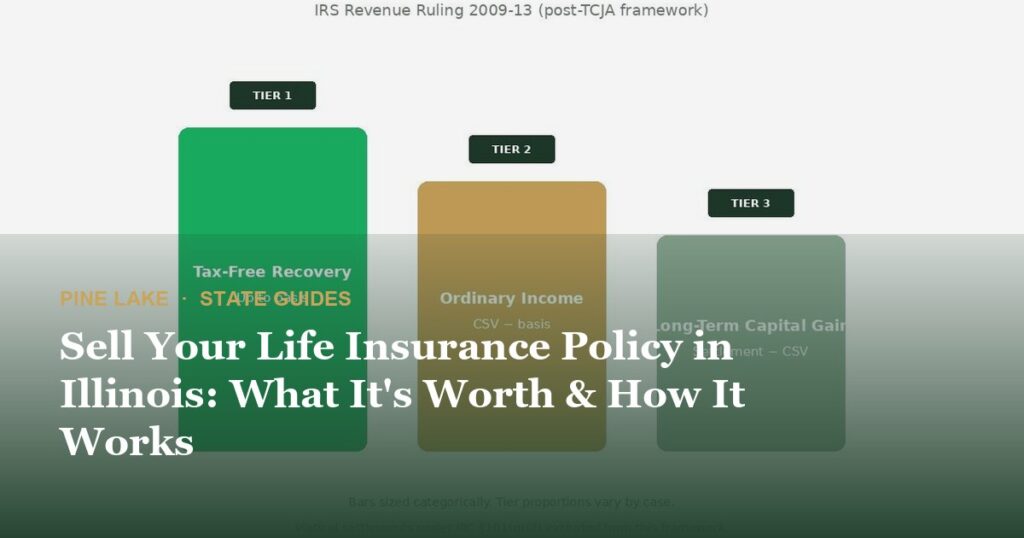
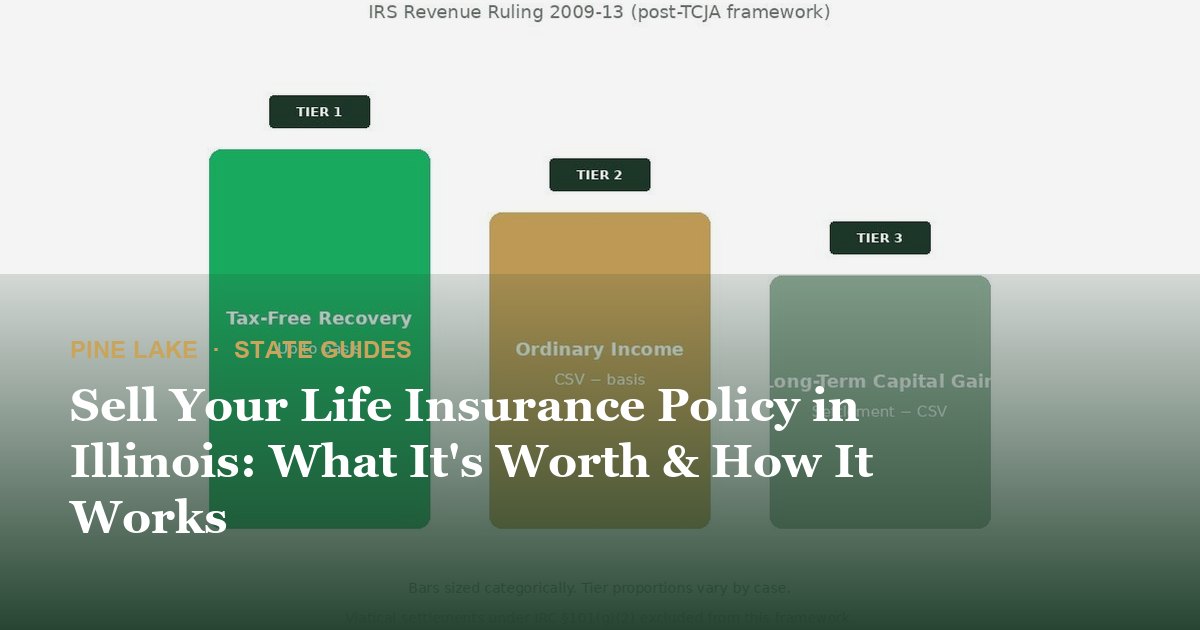
- Ignoring taxes. The after-tax number is the real number. The three-tier treatment under IRS Rev. Rul. 2009-13 usually favors settlements, but run it with a CPA.
- Skipping license checks. Verify everyone with the regulator before signing.
Alternatives Worth Checking First
A sale is permanent — your beneficiaries receive nothing from the policy afterward. Before selling, an honest review should price out: surrender, reduced paid-up insurance, policy loans against cash value, a 1035 exchange into an annuity or LTC product, and — if the insured has a qualifying illness — the accelerated death benefit rider that may already be in the policy. When those alternatives produce less than a settlement offer, the sale decision is made with full information.
Frequently Asked Questions
How do I sell my life insurance policy in Illinois?
Start with a free eligibility review, then sign medical and carrier authorizations so the case can be underwritten. A broker markets the policy to licensed buyers, negotiates competing offers, and manages contracts and escrow. In Illinois, everyone in the chain must comply with Viatical Settlements Act of 2009, 215 ILCS 159 (covers life settlements), and you keep a rescission right after signing.
How much is my life insurance policy worth in Illinois?
Qualifying policies typically bring 10–35% of face value — usually 4–8× the cash surrender value. Exact value depends on the insured’s age and health, premium costs, and policy structure. A free confidential review produces a realistic estimate for your specific policy.
Can I sell a term life insurance policy?
Only if it’s convertible. A term policy with an unexpired conversion privilege can be converted to permanent coverage and then sold — the convert-and-settle strategy. Standard term with no conversion option generally cannot be sold because the coverage expires.
Is selling a life insurance policy legal in Illinois?
Yes — fully legal and regulated. Illinois oversees these transactions through the Illinois Department of Insurance. The right to sell a policy as personal property was established by the U.S. Supreme Court in Grigsby v. Russell (1911).
What happens to my beneficiaries when I sell?
The buyer becomes the new owner and beneficiary, and your original beneficiaries no longer receive the death benefit. That’s why an honest review of whether the coverage is still needed comes before any discussion of price.
How fast can I get money for my policy?
The typical timeline is 60–120 days from authorizations to funding, driven mostly by the 2–6 weeks needed for independent life expectancy reports. If your policy is near lapse, say so immediately — preliminary assessments can move in days, and premium strategies can keep the policy alive during the process.
Find out what your policy is worth — free, confidential, no obligation.
A 15-minute educational review covers your eligibility, every alternative, and a realistic view of what each path would net you.
Related Reading
- Life Settlements Illinois
- Life Settlement Broker Illinois
- How Much Can I Sell My Life Insurance Policy For
- Life Settlement Vs Surrender
Pine Lake Life Solutions does not purchase life insurance policies and does not provide legal, tax, or investment advice. Information provided is for educational purposes only. Eligibility for any option, including life settlements, is not guaranteed and depends on individual circumstances, policy terms, underwriting, and market conditions. Consult independent legal, tax, or financial professionals before making decisions regarding a life insurance policy.