
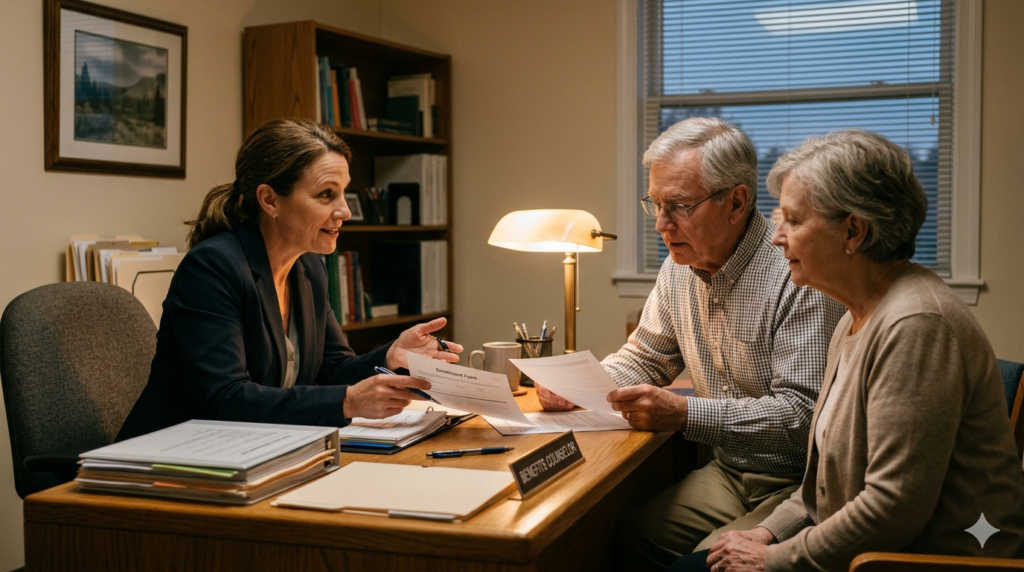
A skilled nursing facility in the northwest Phoenix metro near Sun City West, Arizona will quote you a daily rate — and as of 2026 that rate is realistically somewhere in the range of $230 to $290 a day for a semi-private room, or roughly $7,000 to $8,800 a month. The number the admissions director says out loud is the floor. It is not the price. Almost every family that signs an admission agreement in Maricopa County discovers a second and third layer of charges within the first ninety days, and the gap between the quoted rate and the actual monthly statement is what wrecks the budget they built.
This page takes that quoted rate apart. It goes line by line through what the base rate genuinely covers in an Arizona-licensed nursing care institution, which charges arrive separately, and which bills keep coming from the Sun City West house long after your parent has stopped living in it. Then it does the arithmetic that matters: how many months of care the money actually buys.
Sun City West is not an incorporated city. It is an age-restricted census-designated place in unincorporated Maricopa County, which means there is no city hall to help you and no municipal social services department. Every public-benefits question routes to the county and the state. Pine Lake Life Solutions provides education and a free policy review only — nothing here is legal, tax, or Medicaid-eligibility advice.
In This Article
- Line 1: The Base Daily Rate and What It Genuinely Buys
- Line 2: The Level-of-Care Tier That Reprices You After Admission
- Line 3: The Ancillary Charges Billed Outside the Daily Rate
- Line 4: The Sun City West Bills That Do Not Stop When She Moves
- Where the Application Goes: Maricopa County and ALTCS
- The Runway: Divide the Money by the Real Monthly Number
- Where an In-Force Life Insurance Policy Fits — and Where It Does Not
- Frequently Asked Questions
Line 1: The Base Daily Rate and What It Genuinely Buys
Arizona licenses skilled facilities as nursing care institutions through the Arizona Department of Health Services, and the base daily rate in a licensed facility is expected to cover a defined bundle: the room, three meals plus therapeutic diets, routine nursing care, help with bathing, dressing, toileting and transfers, laundry, housekeeping, activities, and basic medical supplies such as gloves, dressings and bed linens.
As of 2026, private-pay semi-private rates in the northwest Valley — the Surprise, Sun City, Peoria and Sun City West corridor — cluster in the $230 to $290 per day range based on cost-of-care surveys of the Phoenix-Mesa-Chandler metro adjusted forward for recent increases. Private rooms typically run $40 to $80 a day more, or about $1,200 to $2,400 additional per month. Statewide, Arizona’s semi-private median has generally tracked slightly below the national semi-private median, which is why families relocating a parent from California or the Northeast are often relieved and families comparing against Tucson or Yuma are not.
Treat all of these as ranges, not quotes. Two facilities four miles apart on Grand Avenue can differ by $50 a day. Ask each facility for its current private-pay rate sheet in writing, dated, and ask specifically whether the rate is guaranteed for twelve months or subject to change on notice.
Line 2: The Level-of-Care Tier That Reprices You After Admission
Most Arizona facilities do not charge one flat rate. They assign a level of care — often three to five tiers — based on how much hands-on staff time a resident needs, and they reassess it. A parent admitted at the lowest tier because she could still transfer with a walker gets re-tiered when she cannot, and the daily rate moves with her. A one-tier move of $30 a day is $900 a month.
Memory care or a secured unit is generally its own tier or its own building, and in the Phoenix metro as of 2026 a secured dementia unit commonly adds $800 to $2,500 a month over a standard skilled bed. Two-person transfer assistance, behavioral supervision, and one-to-one sitters are usually priced separately again.
The single most useful question at the tour is not “what does it cost.” It is: what tier would you assign my mother today, what would move her to the next tier, and what does each tier cost? Get the answer in writing before admission, because the tier is where a $7,500 month quietly becomes a $9,200 month.
Line 3: The Ancillary Charges Billed Outside the Daily Rate
These are the charges that appear on statement two and three, and families almost never budget for them. Expect some combination of the following:
- Prescription drugs and the pharmacy dispensing fee. If the resident is on Medicare Part D, the facility’s contract pharmacy bills the plan, but non-covered drugs, over-the-counter items and copays are private-pay. This is routinely $100 to $600 a month.
- Incontinence supplies and nutritional supplements. Frequently billed as a per-day supply charge on top of the room rate.
- Therapy after Medicare stops. Physical, occupational and speech therapy are covered under a Medicare Part A skilled stay. Once that stay ends, continued therapy is billed to Part B with coinsurance, or privately.
- Beauty shop, cable television, telephone, guest meals, and transportation to outside appointments. Individually small, collectively $150 to $400 a month.
- Bed-hold days. If your parent is hospitalized, the facility may require you to keep paying the full private rate to hold the bed. Ask what the bed-hold policy costs and how many days it covers.
Add the realistic ancillary load to the base rate before you build any budget. In the northwest Valley as of 2026, a family that budgets the quoted semi-private rate and nothing else is typically 10% to 20% light.
| Cost layer | Sun City West / NW Valley, 2026 range | Included in the quoted daily rate? |
|---|---|---|
| Semi-private skilled nursing base rate | $230-$290/day ($7,000-$8,800/mo) | Yes — room, meals, routine nursing, ADL help |
| Private room upgrade | +$1,200-$2,400/mo | No |
| Level-of-care tier increase | +$600-$1,500/mo per tier | No — reassessed after admission |
| Secured memory care unit | +$800-$2,500/mo | No |
| Pharmacy copays, supplies, supplements | +$150-$700/mo | No |
| Beauty shop, cable, phone, transport | +$150-$400/mo | No |
| Assisted living (comparison) | $4,300-$5,600/mo vs AZ median roughly $4,000-$4,900 | Separate setting |
| Empty Sun City West house carry | +$700-$1,400/mo incl. RCSCW annual assessment, taxes, insurance, utilities | No — and it does not stop at move-in |

Line 4: The Sun City West Bills That Do Not Stop When She Moves
This is the layer specific to Sun City West, and it is the one no national cost calculator captures. Every residential property in Sun City West carries a mandatory annual assessment to the Recreation Centers of Sun City West, the resident-owned nonprofit that operates the community’s recreation centers, golf courses and clubs. The assessment attaches to the property, not to whether anyone is using the facilities. It keeps being owed after your mother moves into skilled nursing, and it keeps being owed while the house sits empty waiting to sell. Confirm the current annual amount and the payment schedule directly with the Recreation Centers of Sun City West, because it is reset periodically.
Stack that with the rest of the empty-house carrying cost: Maricopa County property taxes, homeowner’s insurance (which insurers often reprice or restrict once a home is vacant — tell your carrier, do not hide it), electricity in a Valley summer where you cannot let the interior temperature climb without risking damage, landscaping to satisfy community standards, and any HOA or club dues layered on top of the recreation assessment. In the West Valley as of 2026 that package commonly runs $700 to $1,400 a month on a paid-off Sun City West home.
So the real question is not “can we afford $7,800 a month.” It is “can we afford $8,600 to $9,800 a month for however long it takes to sell the house.” Sun City West’s buyer pool is restricted by the community’s age qualification, which can lengthen a sale relative to a comparable non-age-restricted home in Surprise or Peoria. Build a longer double-carry window than you want to.
Where the Application Goes: Maricopa County and ALTCS
Sun City West sits in Maricopa County, Arizona. The program that pays for long-term nursing facility care is not called Medicaid here — it is ALTCS, the Arizona Long Term Care System, a program of AHCCCS (the Arizona Health Care Cost Containment System). ALTCS eligibility is determined by AHCCCS through its own ALTCS eligibility offices rather than by a Sun City West or Maricopa County department, and applications for Maricopa County residents are handled by the ALTCS office serving the county in the Phoenix area. Because AHCCCS relocates and consolidates offices, call AHCCCS to confirm the current Maricopa County ALTCS office address and whether your application can be started by phone or online before anyone drives across the Valley.
Two eligibility tests apply: a medical/functional test (a pre-admission screening establishing that the applicant needs a nursing-facility level of care) and a financial test. The individual countable-asset figure commonly cited for ALTCS is $2,000, and the income test uses a special-income-limit standard tied to the federal benefit rate that changes annually. Both should be treated as verify for 2026 figures, confirmed with AHCCCS, not with a national blog.
Three mechanics matter before anyone moves money. First, a 60-month look-back: transfers made for less than fair market value in the five years before application can trigger a penalty period during which ALTCS will not pay. Second, estate recovery: Arizona, like every state, must seek recovery from the estate of a deceased member for long-term-care benefits paid, which is why the Sun City West house is rarely as protected as families assume. Third, life insurance is a countable asset once the aggregate face value of the policies you own crosses the small burial-insurance threshold — cashing in or transferring a policy the wrong way inside the look-back is a self-inflicted penalty. Our overview of nursing home Medicaid spend-down and the detail on how life insurance is counted as a Medicaid asset explain the mechanics; the Sun City West-specific walkthrough is on our Sun City West spend-down page. For free one-on-one help, contact Area Agency on Aging, Region One in Phoenix, which serves Maricopa County, or Arizona’s State Health Insurance Assistance Program (SHIP). Take the actual planning questions to your own elder law attorney.
The Runway: Divide the Money by the Real Monthly Number
Runway is the only calculation that changes decisions. Take total liquid and near-liquid assets, subtract what the surviving spouse needs to live on, and divide by the fully loaded monthly cost — base rate plus tier plus ancillaries plus the empty-house carry — not by the quoted rate.
Work an example at $8,800 a month fully loaded, which is a realistic 2026 northwest Valley figure for a semi-private bed with a modest tier and normal ancillaries. Offset it with income: a $2,600 monthly Social Security benefit plus a $400 pension leaves a $5,800 monthly gap. $150,000 in savings covers roughly 26 months. $300,000 covers about 52 months. Add a Sun City West house that nets $300,000 after costs and the runway extends past seven years — but only after it sells, and the double-carry months before the sale burn cash faster than the model above.
Two numbers to write down before you meet anyone: your fully loaded monthly cost, and the month on the calendar when the money runs out. If that month is inside 24 months, you are on the ALTCS path and the planning window is now, not later.
Where an In-Force Life Insurance Policy Fits — and Where It Does Not
Families in Sun City West routinely hold a paid-for-decades universal life or whole life policy that nobody has looked at in fifteen years, while paying a premium out of the same account that now has to fund care. That policy is an asset with more than one exit, and the options are not equally good. Surrendering it pays the cash surrender value. Lapsing it pays nothing at all. A life settlement — selling the policy to a licensed institutional buyer in the secondary market — can pay more than surrender value when the insured is older or in declining health, and the U.S. Government Accountability Office’s study of the market (GAO-10-775) found sellers typically received several times cash surrender value, in a broad range of roughly 10% to 35% of face value. Some policies also carry an accelerated death benefit rider that pays part of the face amount during life at no cost, and that should always be checked first.
Be equally clear about when a policy is the wrong lever. It is the wrong lever when the total face value is small and already sits inside the burial-insurance exclusion, because selling it converts an excluded asset into countable cash and can create the eligibility problem you were trying to solve. It is the wrong lever when a surviving spouse in the Sun City West house genuinely needs the death benefit. It is the wrong lever when the insured is healthy for their age, because that pushes offers down. And any sale inside the ALTCS 60-month look-back needs to be reviewed by an elder law attorney before it happens, not after.
If you want to know which category your policy falls into, a policy valuation review is free and carries no obligation; the commercial-intent detail for this community lives on our Sun City West life settlements page. Pine Lake Life Solutions does not purchase policies and is not licensed in every state — we provide education and a free review, and we will tell you plainly when the answer is that your policy has no market value.
Frequently Asked Questions
What county is Sun City West, Arizona in, and who takes the ALTCS application?
Sun City West is in Maricopa County, and it is unincorporated, so there is no city office to help. ALTCS eligibility is determined by AHCCCS through its ALTCS eligibility offices serving Maricopa County in the Phoenix area, not by a Sun City West department. Call AHCCCS to confirm the current office location and whether you can apply by phone or online first.
How much does a nursing home cost per month in Sun City West as of 2026?
Plan on roughly $7,000 to $8,800 a month for a semi-private skilled nursing bed in the northwest Phoenix metro, with private rooms $1,200 to $2,400 more. Assisted living in the same corridor runs about $4,300 to $5,600. These are survey-based ranges for 2026, not quotes — get each facility’s dated private-pay rate sheet in writing.
Why does the monthly bill come in higher than the rate I was quoted?
Because the quoted rate is the base room-and-board rate. Level-of-care tiers get reassessed upward, pharmacy copays and incontinence supplies bill separately, therapy shifts to Part B coinsurance once the Medicare skilled stay ends, and bed-hold days during a hospitalization may still be charged. Families who budget only the quoted rate are commonly 10% to 20% short.
Does the Sun City West recreation assessment stop when my parent moves into a facility?
No. The Recreation Centers of Sun City West assessment attaches to the property, not to whether anyone uses the amenities, so it continues while the home is occupied by no one and while it is listed for sale. Confirm the current annual amount and due dates with the Recreation Centers of Sun City West directly, since the figure is periodically reset.
Is the ALTCS asset limit really $2,000 in 2026?
$2,000 is the individual countable-asset figure commonly cited for ALTCS, and the income test uses a separate federal-benefit-rate standard that changes annually. Both should be treated as verify-for-2026 numbers and confirmed with AHCCCS before you rely on them. A married couple’s rules differ substantially, which is a question for an elder law attorney.
Can selling a life insurance policy ever hurt an ALTCS application?
Yes. A small policy already sitting inside the burial-insurance exclusion is not counted, and selling it converts an excluded asset into countable cash. Any transfer or sale inside the 60-month look-back can also trigger a penalty period. Have an elder law attorney review the sequence before you move anything, not afterward.
Where can I get free help in Maricopa County that is not a sales call?
Area Agency on Aging, Region One in Phoenix serves Maricopa County and provides benefits counseling and caregiver support at no charge. Arizona’s State Health Insurance Assistance Program handles Medicare questions, and the Arizona Department of Insurance and Financial Institutions handles insurance complaints. For eligibility strategy, use your own elder law attorney.
Find out what your policy is worth — free, confidential, no obligation.
A 15-minute educational review covers your eligibility, every alternative, and a realistic view of what each path would net you.
Related Reading
- Medicaid Spend Down Sun City West Az
- Life Settlements Sun City West Az
- Arizona Medicaid Asset Income Limits
- Life Settlement Taxes Arizona
- Nursing Home Medicaid Spend Down
- Life Insurance Counts Medicaid Asset
- How Much Is My Policy Worth
- Nursing Home Costs Sun City Az
Pine Lake Life Solutions does not purchase life insurance policies and does not provide legal, tax, or investment advice. Information provided is for educational purposes only. Eligibility for any option, including life settlements, is not guaranteed and depends on individual circumstances, policy terms, underwriting, and market conditions. Consult independent legal, tax, or financial professionals before making decisions regarding a life insurance policy.