
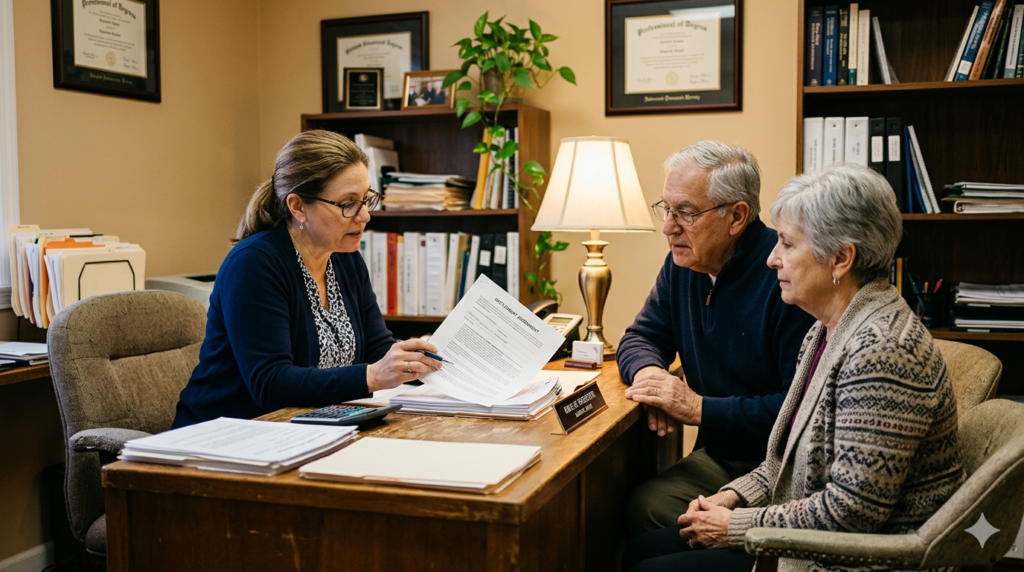
A semi-private skilled nursing room in Rochester Hills, Michigan runs roughly $9,800 to $10,600 a month as of 2026, and the admission agreement you are handed at the door is negotiable in ways almost no family realizes. Several of its most expensive clauses cannot lawfully be required at all, and in Oakland County you have more leverage to say so than families in most of Michigan.
Rochester Hills is a city in Oakland County, Michigan, north of Detroit. The Medicaid application is handled by the Michigan Department of Health and Human Services through its Oakland County offices in Pontiac, not by the city. Area Agency on Aging 1-B, based in Southfield, is the regional aging agency.
This page treats the paperwork as what it is: a draft. It goes clause by clause through what to strike, what to refuse, what to get in writing and what to price, then covers Michigan’s separate assisted living contract, the local numbers, and where an in-force life insurance policy fits. Dollar figures are 2026 estimates from published cost-of-care surveys, given as ranges.
In This Article
- The admission agreement is a draft, and Oakland County gives you leverage
- Strike this: the personal guarantee
- Refuse or rescind this: the arbitration agreement
- Get this in writing: bed hold, transfer and discharge
- Price this: the tier and ancillary clauses
- Michigan’s other contract: the home for the aged residency agreement
- What Rochester Hills pays, and the Oakland County picture
- Michigan Medicaid, MI Choice, and where an in-force policy fits
- Frequently Asked Questions

The admission agreement is a draft, and Oakland County gives you leverage
Families sign nursing facility admission agreements the way they sign a rental car contract: fast, in a hallway, assuming none of it is negotiable. Much of it is.
Two things make that true. First, federal law voids or restricts several of the clauses facilities most want. Second, in a market with genuine supply, a facility that loses an admission over a struck clause loses revenue, and it knows it.
Oakland County is exactly such a market. It has one of Michigan’s deepest concentrations of skilled nursing beds, sits in a metropolitan area with substantial capacity, and includes a large enough set of buildings that a Rochester Hills family working from a hospital discharge usually has real alternatives. Occupancy across Michigan has not returned to pre-2020 levels. A family that says we would like to strike this paragraph in that environment is generally accommodated, and a facility that refuses has told you something useful about how it will handle the next disagreement.
Before you sign anything, do two things. Ask for the complete admission packet forty-eight hours in advance; nothing prevents this and most facilities will comply if asked. Then have it reviewed. A Michigan elder law attorney will read an admission agreement for a modest flat fee, and the regional long-term care ombudsman, reachable through Area Agency on Aging 1-B, will explain what a clause means at no cost and does not work for the facility. Our checklist of what to look for in a nursing home admission agreement covers the same ground in general terms.
Strike this: the personal guarantee
The single most dangerous line in the packet is the signature block labeled responsible party, guarantor, financial agent or sponsor.
Federal nursing home requirements of participation prohibit a facility from requiring a third party to guarantee payment as a condition of admission or continued stay. A facility may require a person who has legal access to the resident’s income and assets, such as an agent under a durable power of attorney, to agree to use those funds to pay. That is a legitimate obligation and a completely different promise from personal liability.
The specific edits, in order:
- Write your capacity next to your signature every time. Your name, then a phrase such as as agent under power of attorney for the resident. Never sign your bare name on a line that reads guarantor.
- Find and strike any sentence obligating you to pay from your own funds, or to be jointly and severally liable. Draw a line, initial it, and have the admissions representative initial it as well.
- Keep a photographed copy of the executed version, including your strikeouts, before you leave the building. Disputes about what was signed are common and the family that has a copy wins them.
- Accept the legitimate obligations, which are to apply the resident’s own resources promptly and to cooperate with a Medicaid application. Those are reasonable and refusing them will not go well.
The failure mode is always the same combination: a signed personal guarantee plus a delayed Medicaid filing. That is how an adult child in Rochester Hills ends up personally sued for a balance that accrued while paperwork sat.
Refuse or rescind this: the arbitration agreement
Nearly every packet includes a pre-dispute binding arbitration agreement. Signing it means that if your parent is later injured through neglect, the claim goes to a private arbitrator rather than a jury, typically with limited discovery and no meaningful appeal.
Under federal rules in effect since 2019, a facility may not require an arbitration agreement as a condition of admission. It must be explained in a form the resident or representative understands, must be acknowledged as understood, must not prohibit communication with federal, state or local officials including surveyors and the ombudsman, and must give the resident at least 30 calendar days to rescind after signing.
So you have two clean paths. Decline it at admission, which the facility must accept, and note that you are declining rather than leaving the page blank. Or, if it was signed in the confusion of move-in day, mail a written rescission within thirty days and keep proof of delivery.
Families forget the second path constantly. Put the rescission deadline on a calendar the day the packet is signed, before anything else. Whether a particular arbitration clause would be enforceable is a question for a Michigan attorney, but the decision about whether to sign belongs to the family, and an admissions coordinator does not get to say otherwise.
Get this in writing: bed hold, transfer and discharge
These clauses decide whether your parent can come back after a hospital stay and under what circumstances the facility can make them leave.
Bed hold. Federal rules require the facility to give written notice of the state bed-hold policy and its own policy at admission and again at the time of any transfer. Michigan Medicaid limits the number of bed-hold days it will pay for. Ask what the current limit is, what the facility charges to hold a bed beyond it, and what happens when the days run out. A resident whose bed-hold expires generally has a right of first refusal for the next appropriate available bed, which is not the same as the room waiting.
Transfer and discharge. Federal law permits an involuntary transfer or discharge only for a short defined list of reasons, requires 30 days’ written notice in most circumstances, requires the facility to state the reason and where the resident is going, and requires it to explain how to appeal to the state. Non-payment is on the list. A family that complains, a resident who is difficult, and conversion to Medicaid are not.
Two clauses to challenge if you see them. Any provision requiring a minimum period of private payment before the facility will accept Michigan Medicaid; a facility with Medicaid-certified beds may not condition admission on private-pay duration, and you should ask directly whether the specific bed being offered is Medicaid-certified. And any clause obligating the family to move a resident out if the facility later decides it cannot meet their needs; that determination has to rest on documented clinical grounds, not on a business preference.
| Clause | Your move | Why it works |
|---|---|---|
| Responsible party / guarantor | Strike the personal guarantee; sign as agent under power of attorney | Federal rules bar requiring a third-party payment guarantee for admission |
| Binding arbitration | Decline it, or rescind in writing within 30 days | Cannot be a condition of admission; rescission right is mandatory |
| Bed hold | Get the state and facility policy in writing at admission | Written notice is required at admission and at any transfer |
| Involuntary discharge | Ask for the reasons list and the appeal process | Limited legal grounds, 30 days’ notice, appeal to the state |
| Minimum private-pay period | Challenge it; ask if the bed is Medicaid-certified | Certified beds may not condition admission on private-pay duration |
| Level-of-care tiers | Get definitions, dollar steps and the reassessment process | Most common cause of a bill rising with no rate change |
| Ancillary exclusions | Price the list against actual use | Commonly several hundred dollars per month |

Price this: the tier and ancillary clauses
The quoted daily rate is an opening figure. Three clauses move it, and all three are knowable in advance.
Level-of-care pricing. Many Michigan facilities price by acuity tier, and a resident who begins needing two-person transfers or extensive feeding assistance moves up. Ask for the tier definitions, the exact dollar step between each tier, who makes the determination, and whether a family may request reassessment if they disagree. This is the most common source of a bill going up with no announced rate change.
Ancillary charges. Ask for the written list of items excluded from the daily rate: incontinence supplies, beauty and barber services, specialized wheelchairs and seating, private-duty sitters, transportation to appointments, cable and telephone. Price that list against what your parent actually uses rather than against an average. Several hundred dollars a month is ordinary.
Rate increase notice. Find the clause specifying how much notice precedes an increase, usually 30 to 60 days, and then ask what the increase was in each of the last three years. Skilled nursing rates across southeast Michigan have risen faster than general inflation since 2021, driven mostly by nursing wage pressure. A building unwilling to answer that question has answered it.
Personal funds. If you deposit money with the facility for your parent’s use, federal rules require it to be held separately from facility funds, covered by a surety bond, and accounted for with quarterly statements. Ask for the statements. Once Michigan Medicaid is paying, the resident keeps only a small monthly personal needs allowance, an amount the state sets; ask the caseworker for the current figure.
Michigan’s other contract: the home for the aged residency agreement
If the setting is assisted living rather than skilled nursing, an entirely different document and regulator apply, and this trips up families who assume the federal protections above carry over. They do not.
Michigan does not use the term assisted living as a license category. Depending on size and population served, a community is licensed either as a home for the aged or as an adult foster care facility, through the Michigan Department of Licensing and Regulatory Affairs. Those licenses carry different requirements, and the residency agreement is a private contract without the federal nursing home protections around guarantees, arbitration and discharge notice.
So ask a different set of questions:
- Which license does this building hold, and for how many residents? Ask to see it.
- What is the licensing inspection record for this specific address? Assisted living settings do not appear on Medicare’s Care Compare in any state, so the state licensing file is the substitute. Request the two most recent reports.
- What notice do I get if you decide you can no longer meet my parent’s needs? Get the number of days in writing, because the federal 30-day nursing home standard does not apply here.
- What happens when private funds are exhausted? Michigan’s MI Choice waiver can pay for services in some community settings, but participation is not universal and room and board is generally not covered. The honest answer is frequently that the resident moves.
What Rochester Hills pays, and the Oakland County picture
As of 2026, published cost-of-care surveys and metro pricing put a semi-private skilled nursing room in the Rochester Hills and greater Detroit market at roughly $9,800 to $10,600 per month, a private room at roughly $10,800 to $11,600, and assisted living at roughly $5,200 to $5,900 per month.
Michigan’s statewide medians as of 2026 run roughly $9,600 to $10,300 for semi-private skilled nursing and roughly $5,000 to $5,600 for assisted living. Southeast Michigan therefore prices modestly above the state on both. Skilled nursing here sits roughly at the national median of about $9,800, while assisted living runs well under the national figure of about $6,300.
Three Oakland County facts shape the decision.
Supply is deep, which is your leverage. Oakland County holds one of Michigan’s largest concentrations of skilled nursing beds, and statewide occupancy remains below pre-2020 levels. That is precisely why the clause negotiations above are realistic here rather than theoretical.
The population is older and wealthier than the state. Oakland County’s share of residents aged 65 and over runs above the Michigan average and its absolute older population is among the largest in the state. It is also Michigan’s wealthiest large county, and providers price to that.
Rochester Hills equity is strong by Michigan standards. Home values here run well above the Michigan median, commonly in the low-to-mid $400,000s as of 2026. At roughly $10,200 a month that converts to somewhere around three and a half years of semi-private skilled nursing, a longer runway than most Michigan families get from a house.
Michigan Medicaid, MI Choice, and where an in-force policy fits
Long-term care in Michigan is paid by Michigan Medicaid, with nursing facility coverage for those who qualify financially and clinically and home and community-based services through the MI Choice waiver, which is capacity-limited and worth asking about by name early rather than after a long-stay admission.
Applications for Rochester Hills residents go to the Michigan Department of Health and Human Services, Oakland County, with offices in Pontiac. Filing through the MI Bridges portal is possible, but a county specialist verifies a long-term care application; call first for the current checklist.
The rules as of 2026, each to be confirmed with MDHHS: countable assets of roughly $2,000 for an individual applicant, with a separate and far larger allowance protecting a spouse who remains at home; a 60-month look-back reviewing five years of transfers, with penalty periods for gifts and below-market sales; and estate recovery against the estates of deceased long-term care recipients, subject to exceptions. A policy is excluded only when the combined face value of all policies on one insured stays at or under the applicable threshold, above which the entire cash surrender value counts. See how life insurance counts as a Medicaid asset and Michigan Medicaid asset and income limits.
Runway, at roughly $10,200 a month: $100,000 buys about ten months, $250,000 about twenty-five months, and $450,000 about forty-four months. At assisted living of roughly $5,550, $250,000 stretches to about forty-five months.
The asset most often left unpriced is an in-force life insurance policy. Premiums keep arriving after a parent enters care, and surrendering or lapsing gives up value nobody measured. A life settlement is a regulated sale of the policy to a licensed institutional buyer for more than surrender value and less than the death benefit. Pine Lake Life Solutions does not purchase policies. We provide a free policy review that prices each outcome so a family can compare, and the tax treatment of proceeds follows its own rules, covered in Michigan life settlement taxes.
It tends to help with an individually owned universal life or convertible term policy of roughly $100,000 or more, an insured typically 65 or older with meaningful health changes, an unaffordable premium and a beneficiary need that has passed. It does not help with small face amounts that may fall inside burial-related exclusions, where a spouse remaining at home needs the death benefit, with employer or union group life coverage, which is common among southeast Michigan retirees and is generally not saleable, with a relatively healthy insured, or where a Medicaid application is already pending, since proceeds count in the month received and a below-market transfer can trigger a penalty. Read nursing home Medicaid spend-down first. Nothing here is legal, tax or eligibility advice; take the facts to a Michigan elder law attorney, and use MMAP, Michigan’s free Medicare counseling program, for coverage questions.
Frequently Asked Questions
What county is Rochester Hills, Michigan in, and where is the Medicaid application filed?
Rochester Hills is a city in Oakland County, Michigan, north of Detroit. Long-term care Medicaid applications are handled by the Michigan Department of Health and Human Services through its Oakland County offices in Pontiac. Area Agency on Aging 1-B, based in Southfield, is the regional aging agency and runs the long-term care ombudsman program.
Can I really strike clauses from a nursing home admission agreement?
Yes, and several of them cannot lawfully be required at all. Federal rules bar requiring a third-party payment guarantee and bar making arbitration a condition of admission. In a well-supplied market like Oakland County, facilities generally accept struck language rather than lose an admission. A facility that refuses has told you something useful.
How much does a nursing home cost in Rochester Hills as of 2026?
Cost-of-care surveys and metro pricing put a semi-private skilled nursing room in the Rochester Hills and greater Detroit market at roughly $9,800 to $10,600 a month as of 2026, a private room at roughly $10,800 to $11,600, and assisted living at roughly $5,200 to $5,900. Ask each facility for its current rate in writing.
Am I personally liable for my father’s nursing home bill in Michigan?
Not automatically. Federal nursing home rules prohibit requiring a third-party guarantee of payment as a condition of admission. Liability risk comes from signing your bare name on a guarantor line. Sign in a representative capacity, strike personal guarantee language, initial the strike, keep a copy, and have a Michigan attorney review the agreement.
How is assisted living licensed in Michigan?
Michigan does not use assisted living as a license category. Depending on size and population, a community is licensed as a home for the aged or as an adult foster care facility through the Department of Licensing and Regulatory Affairs. The federal nursing home protections around guarantees, arbitration and 30-day discharge notice do not apply to those residency agreements.
Can a facility require months of private payment before accepting Michigan Medicaid?
A facility with Medicaid-certified beds may not condition admission on a period of private payment. If you see such a clause, challenge it and ask directly whether the specific bed being offered is Medicaid-certified. Raise the issue with the long-term care ombudsman through Area Agency on Aging 1-B if the facility insists.
Can we sell employer or union group life insurance to help pay for care?
Generally no. Group life coverage, which is common among southeast Michigan retirees from large employers and union plans, is not a life settlement candidate. Some group plans permit conversion to an individual policy within a limited window after retirement, and only a converted individual policy could be evaluated. Check the conversion terms with the plan.
Find out what your policy is worth — free, confidential, no obligation.
A 15-minute educational review covers your eligibility, every alternative, and a realistic view of what each path would net you.
Related Reading
- Medicaid Spend Down Rochester Hills Mi
- Life Settlements Rochester Hills Mi
- Michigan Medicaid Asset Income Limits
- Life Settlement Taxes Michigan
- Sell Life Insurance Policy Genesee County Mi
- Nursing Home Medicaid Spend Down
- Life Insurance Counts Medicaid Asset
- Nursing Home Admission Agreement
Pine Lake Life Solutions does not purchase life insurance policies and does not provide legal, tax, or investment advice. Information provided is for educational purposes only. Eligibility for any option, including life settlements, is not guaranteed and depends on individual circumstances, policy terms, underwriting, and market conditions. Consult independent legal, tax, or financial professionals before making decisions regarding a life insurance policy.