
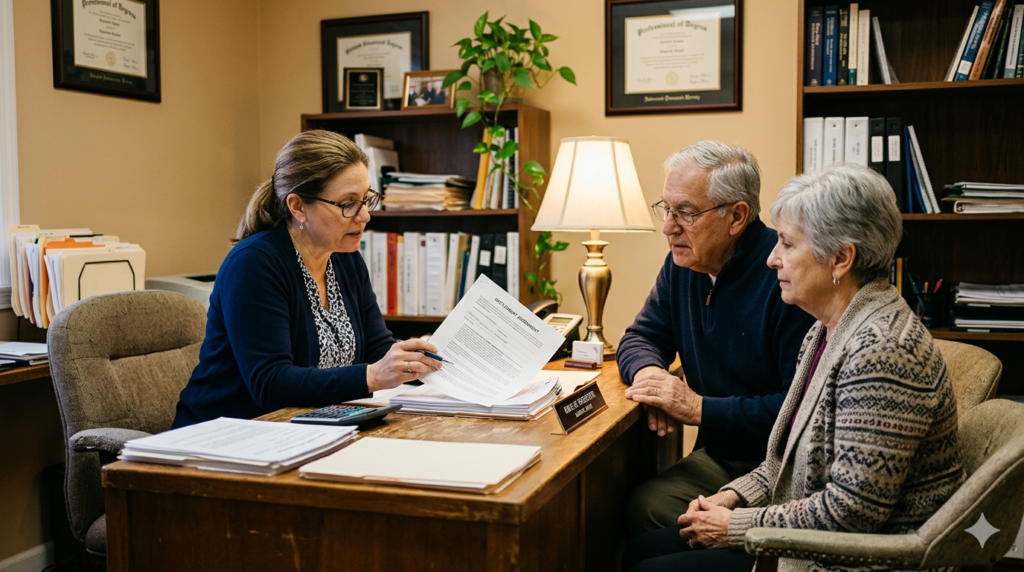
A semi-private skilled nursing room in Maryville, Tennessee and the surrounding Knoxville metro runs roughly $7,200 to $8,600 a month as of 2026, and assisted living roughly $4,300 to $5,400 — and the single most useful thing a family can do before signing anything is check whether the more expensive building in Blount County actually scores better on the federal quality measures, because in this market it often does not. Price and quality are only loosely connected in skilled nursing, and Blount County is small enough that you can check every certified building in an afternoon.
Those figures are ranges, not quoted rates. They are drawn from the pattern that Genworth-style cost-of-care surveys and state cost reports have shown for the Knoxville metropolitan area, which sits at or slightly below the Tennessee median for skilled nursing and close to it for assisted living. A specific building will quote you a specific daily rate, and that rate will differ by room type, by whether the stay is rehabilitative or long-term, and by whether the resident needs memory care.
This page does three things in order: it prices the local market, it shows you how to test whether paying more here buys better care, and it walks the arithmetic of how long a family’s money lasts at Maryville rates — including where an existing life insurance policy fits as a funding source and, honestly, where it does not. Pine Lake Life Solutions provides education and a free policy review only; nothing here is legal, tax, or Medicaid-eligibility advice.
In This Article
- What a Month of Care Costs in Maryville and the Knoxville Metro
- Does Paying More Buy Better Care in Blount County? How to Test It
- The Three Quality Signals Worth More Than the Price Tag
- Where Blount County Families Actually Apply, and Who Helps
- The Runway: What Your Parent’s Money Buys at Maryville Rates
- TennCare CHOICES: The One Medicaid Section
- Where a Life Insurance Policy Helps, and Four Times It Does Not
- Frequently Asked Questions
What a Month of Care Costs in Maryville and the Knoxville Metro
Blount County sits inside the Knoxville metropolitan statistical area, and the cost surveys that publish sub-state figures treat Maryville as part of that market rather than pricing it separately. That matters, because the Knoxville metro has historically priced below the Nashville metro and slightly below the Tennessee statewide median for skilled nursing. As of 2026, a reasonable planning range is $7,200 to $8,600 per month for a semi-private skilled nursing room, $8,200 to $9,800 for a private room, and $4,300 to $5,400 for assisted living. Memory care typically adds $800 to $1,400 a month on top of an assisted living base rate.
Compare that to the Tennessee median, which recent survey cycles have put in the high $7,000s to low $8,000s per month semi-private, and to the national figure, which has run in the $9,000s. Tennessee is a comparatively inexpensive state for long-term care, and East Tennessee is inexpensive within Tennessee. A family in Maryville is paying meaningfully less per month than a family in Nashville, and dramatically less than a family in the Northeast or on the West Coast.
Do not treat the range as a quote. Ask every building for the current daily private-pay rate in writing, ask which level-of-care tier that rate assumes, and ask what triggers a move to a higher tier. Then confirm the current published survey figure with the Tennessee Commission on Aging and Disability or with the East Tennessee Area Agency on Aging and Disability, which tracks local pricing as part of its options counseling.
Does Paying More Buy Better Care in Blount County? How to Test It
This is the question the price ranges above cannot answer, and it is the one worth an hour of your time. The federal government publishes a five-star rating for every Medicare- and Medicaid-certified nursing home on CMS Care Compare, and the rating has three components: health inspections, staffing, and quality measures. Those components are public, free, and updated on a rolling basis.
Here is the test. Pull every certified skilled nursing facility within a twenty-mile radius of Maryville — that will include buildings in Blount County and several in Knox County that Maryville families realistically use. For each one, write down three numbers: the overall star rating, the staffing star rating, and the reported total nurse staffing hours per resident per day. Then write down the quoted private-pay daily rate. Sort by rate.
In most small Southern markets, that sorted list does not line up. The highest-priced building is frequently not the highest-staffed one, and a mid-priced building with four or five staffing stars often outperforms a premium-priced building with two. The reason is that private-pay rates are set by real estate, amenities, and local competition, while staffing is set by ownership decisions and by how much Medicaid revenue the building carries. Amenities you can see on a tour — a nice lobby, a bistro, a courtyard — are the things that raise the rate. Nurse hours at 2 a.m. are the thing that determines outcomes.
The Three Quality Signals Worth More Than the Price Tag
Registered nurse hours per resident day. CMS reports this separately from total nurse staffing, and it is the number with the strongest research support. A building can hit an acceptable total staffing figure while carrying very few RN hours. Ask for the current figure and ask whether the facility has an RN on site overnight and on weekends.
Staff turnover. CMS publishes annual nursing staff turnover on Care Compare. High turnover in a skilled nursing building means your parent will be helped by a different aide most weeks, which shows up in missed care plans, missed changes in condition, and falls. A building charging a premium rate with turnover well above the state average is charging you for something other than continuity.
The inspection narrative, not just the star. The star rating compresses years of survey results into one digit. The actual statements of deficiency are public and readable. Look for repeated citations in the same domain — if a building has been cited three cycles running for the same medication-administration problem, that is a management pattern, not bad luck.
Bring those three numbers to every tour. A family that walks in and asks about RN coverage overnight and current turnover is treated differently from one that asks about the dining room.
| Care setting | Maryville / Knoxville metro, monthly (2026 range) | Tennessee median | What the extra money usually buys |
|---|---|---|---|
| Skilled nursing, semi-private | $7,200 – $8,600 | High $7,000s – low $8,000s | Newer building, private bath, amenities — not necessarily higher RN hours |
| Skilled nursing, private room | $8,200 – $9,800 | Low to mid $8,000s | Privacy and infection-control advantage; same nursing staff |
| Assisted living | $4,300 – $5,400 | Mid $4,000s | Apartment size, dining program, activity staffing |
| Memory care add-on | +$800 – $1,400 | +$900 – $1,300 | Secured unit, higher aide ratio, trained staff |
| Home health aide (44 hrs/wk) | $4,800 – $5,900 | $4,700 – $5,600 | Agency supervision, backup coverage, bonding |

Where Blount County Families Actually Apply, and Who Helps
Maryville is the county seat of Blount County, but the city does not run long-term care eligibility. In Tennessee, financial eligibility for TennCare long-term services and supports is determined at the state level through TennCare Connect, with the Tennessee Department of Human Services operating the county-level offices that accept paper applications and provide in-person help. Blount County has a Department of Human Services office located in Maryville; call before you go, because the office that takes the application and the office that does the level-of-care assessment are not always the same door.
The functional side — whether your parent meets nursing facility level of care, and what home and community-based alternatives exist — runs through the East Tennessee Area Agency on Aging and Disability, which is housed at the East Tennessee Human Resource Agency and serves the sixteen-county East Tennessee region including Blount County from its base in the Knoxville area. That agency also delivers Tennessee’s State Health Insurance Assistance Program counseling, which is free, unbiased, and the right first call before you buy anything or sign anything.
For anything involving an insurance policy, an annuity, or a company that has approached you about one, the regulator is the Tennessee Department of Commerce and Insurance, Insurance Division. Verify licensure there before you talk numbers with anyone. For legal questions about transfers, trusts, or protecting a spouse, retain your own Tennessee elder law attorney — the county office cannot give you that advice and neither can we.
One genuinely local pressure point: Blount County has drawn substantial retiree in-migration for two decades, pulled by the Great Smoky Mountains and by the lake communities just over the county lines. Its share of residents aged 65 and older runs above the Tennessee statewide share, while its certified skilled nursing bed count has not grown proportionally. In practice that means shorter waiting lists in Knox County than in Blount County for the better-rated buildings, and it means a Maryville family should widen the search radius early rather than after a hospital discharge clock is already running.
The Runway: What Your Parent’s Money Buys at Maryville Rates
The arithmetic is simple and it is the whole game. Take total liquid assets, divide by the local monthly rate, and you have the number of months of private pay before Medicaid becomes the only remaining answer.
At $7,900 a month — the middle of the Maryville semi-private range as of 2026 — $100,000 in liquid assets buys about twelve and a half months. $250,000 buys about thirty-one months. $500,000 buys about sixty-three months, which is just past the five-year mark where the transfer look-back stops mattering. Assisted living at $4,800 stretches those same numbers roughly 65 percent further: $100,000 buys about twenty-one months.
Two adjustments almost every family forgets. First, Social Security and any pension income offset part of the monthly cost, so the drawdown is the gap, not the full rate. A parent with $2,400 a month in combined benefits facing a $7,900 rate is burning $5,500 a month, not $7,900 — and $100,000 then buys about eighteen months instead of twelve. Second, rates rise. Skilled nursing pricing has escalated faster than general inflation for most of the past decade. Build in four to six percent a year, or your five-year projection will be short by close to a year of care.
Run the number honestly, because it determines which conversation you are actually having. Under twelve months of runway, you are planning a Medicaid application. Over sixty months, you are managing a portfolio. In between is where the real decisions live, and where an in-force life insurance policy occasionally changes the answer. Our Maryville spend-down guide takes the eligibility side of that in detail.
TennCare CHOICES: The One Medicaid Section
Tennessee’s long-term care Medicaid program is TennCare CHOICES in Long-Term Services and Supports. It covers nursing facility care and, through its home and community-based groups, care delivered in a person’s own home or in an assisted living residence, though the home-based groups have their own enrollment limits.
Three mechanics matter to the cost math on this page. As of 2026 the countable-asset limit for a single applicant is commonly cited at $2,000, and the figure moves — confirm the current number with TennCare Connect or the Blount County Department of Human Services office before you rely on it. There is a 60-month look-back on asset transfers, meaning gifts and below-market sales in the five years before application can create a penalty period during which TennCare will not pay. And Tennessee, like every state, operates an estate recovery program that seeks repayment from the estate after death, with the home the usual target.
For life insurance specifically: term policies with no cash value are generally not countable, but permanent policies with cash value are, and states aggregate face value across policies when applying the burial-exclusion threshold. That aggregation rule catches families off guard constantly. The mechanics are laid out in how life insurance counts as a Medicaid asset and in our general nursing home spend-down guide. Do not act on any of it without your own elder law attorney.
Where a Life Insurance Policy Helps, and Four Times It Does Not
A permanent life insurance policy the family no longer needs is one of the few assets that can be converted to cash without selling the house. In the Maryville market, where a month costs under $8,000, a settlement of even modest size buys a meaningful number of months — a $60,000 net settlement is roughly seven and a half months of skilled nursing, or thirteen months of assisted living, at 2026 rates. That is often exactly the bridge a family needs between a hospital discharge and a Medicaid approval.
Now the honest cases where it is the wrong move. Small face amounts. A $15,000 policy will not clear the market and may sit inside the burial exclusion anyway, where it is already protected. A healthy insured. Secondary-market pricing is driven by life expectancy; a genuinely healthy 70-year-old will be offered very little. A surviving spouse who needs the death benefit. If the at-home spouse depends on that money, converting it to twelve months of nursing care solves the near problem and creates a worse one. A policy that could be restructured instead. Reduced paid-up status, an accelerated death benefit rider already in the contract, or simply surrendering for cash value may net more than a settlement after costs — see surrender versus sell before assuming a sale is the best route.
The right sequence is: get the policy’s in-force illustration and current cash value from the carrier, get a written opinion from your elder law attorney about how the policy is treated under TennCare rules, and only then price the secondary market. A free policy review will tell you what the policy is worth and, just as often, that it should not be sold at all. Families comparing the commercial side of that decision can start with our Maryville life settlement page.
Frequently Asked Questions
How much does a nursing home cost per month in Maryville, Tennessee in 2026?
Plan on roughly $7,200 to $8,600 a month for a semi-private skilled nursing room in Maryville and the wider Knoxville metro as of 2026, and $8,200 to $9,800 for a private room. Assisted living runs about $4,300 to $5,400. These are survey-based ranges, not quotes. Ask each Blount County building for its current written daily private-pay rate and the level-of-care tier it assumes.
Which county is Maryville in, and where does the Medicaid application go?
Maryville is the county seat of Blount County. Tennessee determines TennCare long-term care eligibility through TennCare Connect at the state level, with Department of Human Services offices, including one in Maryville, accepting applications and giving in-person help. The functional assessment and options counseling run through the East Tennessee Area Agency on Aging and Disability, based in the Knoxville area.
Does a more expensive nursing home in Blount County mean better care?
Not reliably. Private-pay rates track real estate, amenities and local competition; outcomes track registered nurse hours per resident day, staff turnover and inspection history. All of those are published free on CMS Care Compare. Pull the rate and the staffing star rating for every certified building within twenty miles of Maryville and sort the list. The two orders rarely match.
How long will $200,000 last at Maryville nursing home rates?
At the middle of the 2026 range, about $7,900 a month, $200,000 buys roughly twenty-five months of private pay before any income offset. Subtract Social Security and pension income first, because you are only funding the gap. A parent with $2,400 a month in benefits burns about $5,500, which stretches $200,000 to roughly thirty-six months. Then add four to six percent annual rate escalation.
What is the TennCare CHOICES asset limit, and does life insurance count?
As of 2026 the countable-asset limit for a single TennCare applicant is commonly cited at $2,000, but confirm the current figure with TennCare Connect or the Blount County DHS office. Term policies with no cash value are generally not countable; permanent policies with cash value usually are, and states aggregate face value across all policies when applying the burial exclusion. Ask an elder law attorney.
When is selling a life insurance policy the wrong way to pay for care?
Four common cases. The face amount is too small to attract an offer. The insured is genuinely healthy, so secondary-market pricing will be poor. A surviving spouse actually needs the death benefit. Or the contract already has a better option inside it, such as an accelerated death benefit rider or reduced paid-up status. Get the in-force illustration first, then decide.
Find out what your policy is worth — free, confidential, no obligation.
A 15-minute educational review covers your eligibility, every alternative, and a realistic view of what each path would net you.
Related Reading
- Medicaid Spend Down Maryville Tn
- Life Settlements Maryville Tn
- Tennessee Medicaid Asset Income Limits
- Life Settlement Taxes Tennessee
- Sell Life Insurance Policy Hamilton County Tn
- Nursing Home Medicaid Spend Down
- Life Insurance Counts Medicaid Asset
- Surrender Vs Sell Policy
Pine Lake Life Solutions does not purchase life insurance policies and does not provide legal, tax, or investment advice. Information provided is for educational purposes only. Eligibility for any option, including life settlements, is not guaranteed and depends on individual circumstances, policy terms, underwriting, and market conditions. Consult independent legal, tax, or financial professionals before making decisions regarding a life insurance policy.