
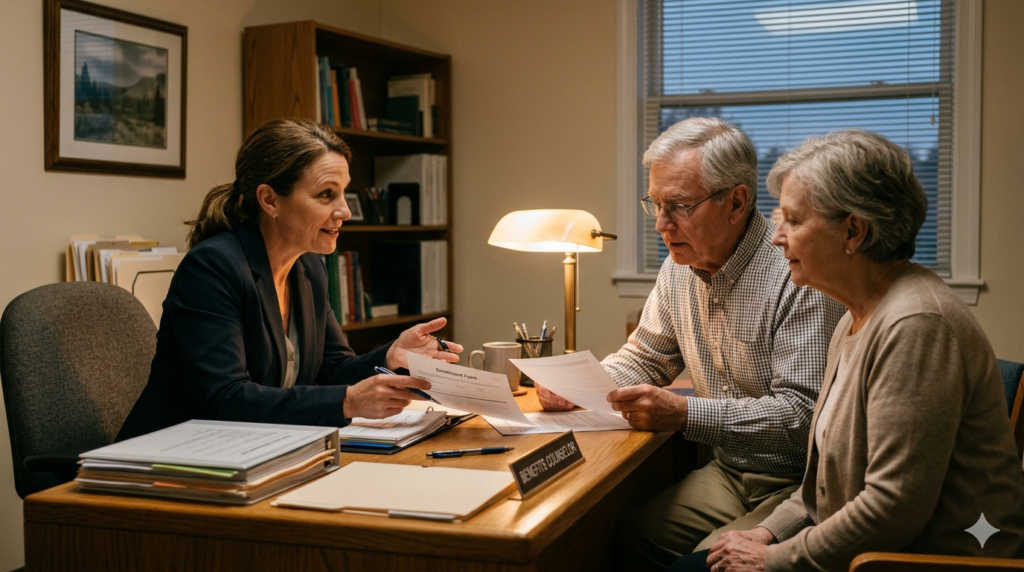
Lawrenceville, Georgia has an advantage most Georgia cities do not: it is the county seat of Gwinnett County, so the office that actually takes a long-term care Medicaid application — the Gwinnett County Division of Family and Children Services office — is in town rather than an hour’s drive away. That matters more than it sounds like it should, because a Georgia Medicaid application involves documents that get returned, verifications that get requested twice, and questions that are answered far better in person than on hold.
It is also a city inside the most institutionally dense suburban county in Georgia. Gwinnett has more than a million residents, making it the state’s second most populous county, and its 65-and-over population has grown far faster than the county as a whole — a wave arriving against a bed supply the state controls through a Certificate of Need process. This page maps the actual landscape a Lawrenceville family will be choosing from: who operates the buildings and how that changes your bill, what languages and cultures the staff can actually accommodate, what a month costs, and where the pressure points are — and then covers the application and the money at the end.
In This Article
Being the County Seat Changes the Map
Lawrenceville is a city of roughly 30,000 to 35,000 people that functions as the administrative center for a county of more than a million. Three consequences follow for a family in this situation.
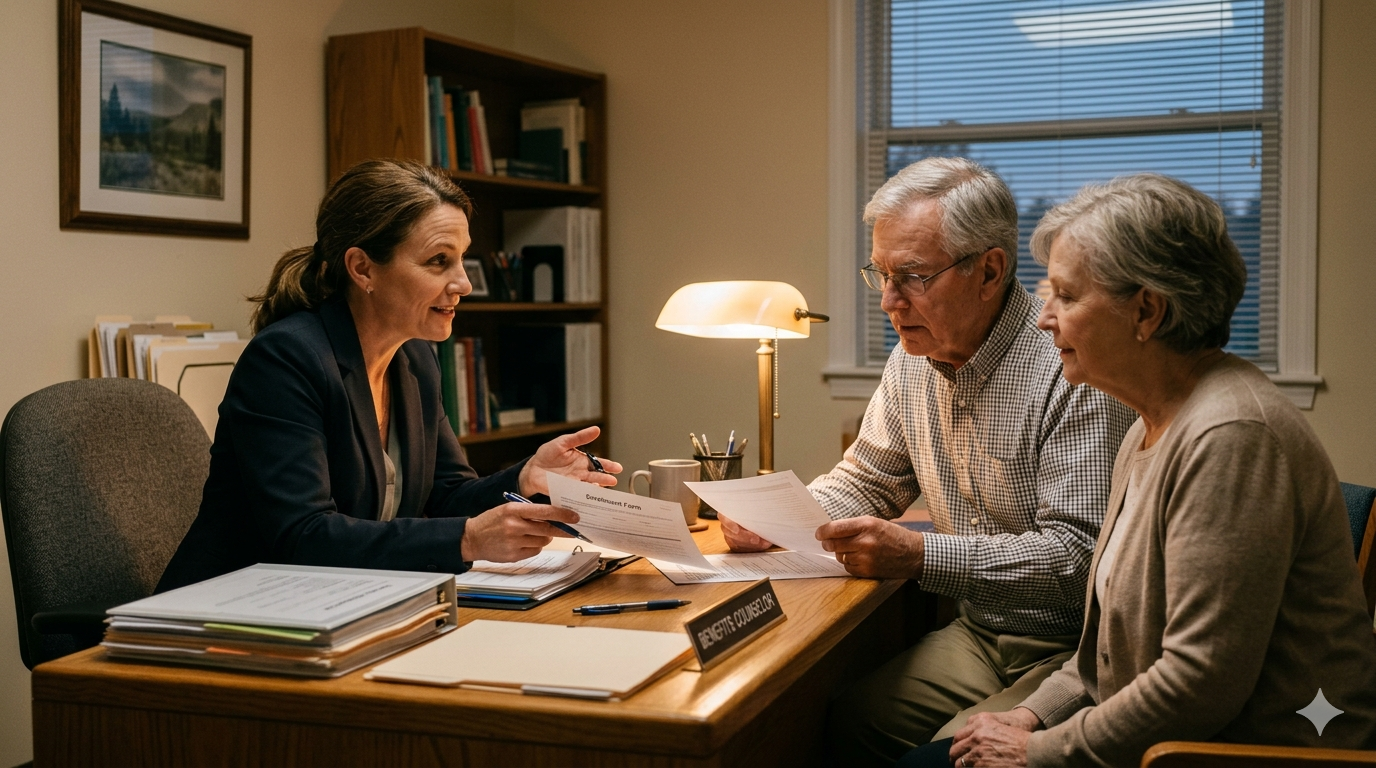
The application office is here. Georgia Medicaid is administered by the Department of Community Health, but financial eligibility for aged, blind and disabled Medicaid is determined by the Division of Family and Children Services, and the Gwinnett County DFCS office is located in Lawrenceville. You can also apply online through Georgia Gateway. Confirm the current address and hours with DFCS before going in person, but the ability to walk a document in and get a receipt for it is worth real time in a process where lost paperwork is the leading cause of delay.
The hospital pipeline is here. A new hospital opened in Lawrenceville in 2021, adding acute-care capacity in a city that had relied on facilities elsewhere in the county. For long-term care that matters because hospital discharge referrals are the main channel through which people enter skilled nursing facilities. More local acute capacity means more local post-acute referral volume, which means the nearby buildings are busier, better connected to discharge planners, and more accustomed to Medicare rehabilitation stays. If your parent is currently hospitalized, the discharge planner is the most useful person in this process; talk to them daily and hand them your prioritized list of buildings.
The court and probate infrastructure is here. Guardianship and conservatorship petitions, if it ever comes to that, are filed in the county’s probate court, in Lawrenceville. Most families never need this, and the ones who do are usually the ones who did not get a durable power of attorney signed while their parent still had capacity. If that document does not exist yet, that is this week’s task, not next year’s.
The free, neutral regional resource is the Atlanta Regional Commission Area Agency on Aging, based in Atlanta, which serves Gwinnett along with the rest of the ten-county metro region through its aging and disability resource service. It provides information and assistance without selling placements — unlike referral agencies, which are typically paid a commission by whichever community admits your parent. Ask any advisor how they are compensated.
The Ownership Map, and Why It Changes Your Bill
Gwinnett’s long-term care buildings fall into four ownership types, and the type predicts things the brochure will not tell you.
Regional and national for-profit chains. The largest share of skilled nursing capacity. Typically an all-in daily rate with separately billed therapies and supplies, professional admissions processes, and consistent corporate policies. Quality varies widely across buildings within the same chain, so evaluate the building, not the brand.
Nonprofit and faith-based communities. Gwinnett and the broader metro have a meaningful nonprofit and faith-based presence, some with denominational affiliation and some with historical ties to a particular community. These sometimes hold benevolence funds that can help a long-standing resident who exhausts assets — a genuine advantage, but ask explicitly whether such a fund exists, how it is applied for, and whether it is discretionary, because most are.
Hospital-affiliated post-acute units. Oriented toward Medicare rehabilitation stays rather than indefinite custodial care. Good therapy resources; a poor fit for a resident who will be there for years, and some will not keep a long-stay Medicaid resident at all.
Continuing care retirement communities. Require a substantial entrance fee in exchange for a continuum of care. Sometimes an excellent arrangement for a couple planning ahead; almost never a solution for a family in a crisis this week, because entrance requires health screening and money up front.
Whatever the ownership, ask three questions of every building. How many of your beds are Medicaid-certified, and how many are currently occupied by residents on Georgia Medicaid? Certification without an open Medicaid bed is not availability. What is your total nurse and CNA staffing per resident day, including weekends? The federal CMS Care Compare tool publishes this from payroll data, so you can check the answer. And what specifically happens when a resident’s private funds run out? Get that one in writing. Facility inspection and complaint records come from the Georgia Department of Community Health’s healthcare facility regulation function.
Language and Culture Are Part of This Landscape
This is the local factor that most distinguishes placement in Gwinnett County from placement anywhere else in Georgia, and it is a care-quality issue rather than a preference.
Gwinnett is among the most linguistically and culturally diverse counties in the Southeast. Roughly a quarter of residents are foreign-born, and the county’s school system has long reported students speaking well over a hundred languages. For an older adult, the practical consequence is direct: many Gwinnett seniors are more comfortable, and in later dementia may be exclusively able to communicate, in a language other than English. Someone who cannot tell a caregiver that she is in pain, is frightened, or needs the bathroom will be recorded as agitated or non-compliant rather than as unheard.
What to ask, concretely:
- What languages do your direct-care staff speak? Not the administrator, not a translation phone line — the certified nursing assistants who will be in the room at 3 a.m.
- How do you handle dietary requirements? Halal, kosher, vegetarian, and specific regional cuisines. Food refusal in a frail elder becomes a weight-loss problem quickly, and unfamiliar food is a common cause.
- How do you accommodate religious practice? Prayer times and space, visits from clergy, observances.
- How do you communicate with family? If the primary contact is more comfortable in another language, how does the care-plan meeting actually work?
Buildings vary enormously on all of this, and some Gwinnett communities have built genuine expertise around particular populations while others have not thought about it at all. It is worth weighting heavily — a well-rated building where nobody can talk to your mother is a worse placement than a modestly rated one where someone can.
One related practical point: get the durable power of attorney, advance directive and any health care agent designation translated and executed properly if the family’s primary language is not English. A document nobody at the facility can read at 2 a.m. does not function.
| Ownership type in Gwinnett | Typical orientation | How the rate is structured | When private funds run out |
|---|---|---|---|
| Regional or national for-profit chain | Mixed rehab and long stay | All-in daily rate plus billed extras | Medicaid if a certified bed is open |
| Nonprofit or faith-based community | Long stay; mission-driven | Monthly rate, sometimes tiered | May have a discretionary benevolence fund; ask |
| Hospital-affiliated post-acute unit | Medicare rehabilitation stays | Per-diem, Medicare-oriented | Often will not keep a long-stay Medicaid resident |
| Continuing care retirement community | Planned continuum for couples | Entrance fee plus monthly fee | Depends on the contract type; read it closely |
| Assisted living, private pay only | Standard or memory care | Base rent plus level-of-care tier | Discharge; get the policy in writing at admission |

What a Month Costs in Gwinnett as of 2026
These are survey-based planning ranges for Lawrenceville and Gwinnett County as of 2026, trended from Genworth-style annual cost-of-care survey data and current local quotes. They are ranges, not quotes, and cost surveys report at metro rather than city level.
- Semi-private skilled nursing room: roughly $7,700 to $8,700 per month.
- Private skilled nursing room: roughly $8,700 to $9,800 per month.
- Assisted living: roughly $4,300 to $5,300 per month before level-of-care charges.
- Memory care: commonly $1,300 to $2,400 above assisted living.
- Home health aide, about 44 hours a week: roughly $5,000 to $6,100 per month.
Against Georgia’s statewide medians — roughly $7,600 to $8,200 for a semi-private nursing home room and roughly $4,000 to $4,600 for assisted living — Gwinnett runs modestly above the state median and clearly below north Fulton, where the same semi-private room can cost several hundred dollars a month more. For a Lawrenceville family that is a real reason to look locally before searching into Alpharetta or Johns Creek.
Two local facts shape the arithmetic. Lawrenceville’s median home value has been running roughly $370,000 to $420,000 as of 2026, above the Georgia statewide median in the $320,000s to $340,000s but a long way below the north metro. A paid-off Lawrenceville house is meaningful money and it is not unlimited money — against an $8,200 monthly bill it represents roughly four to five years of the gap, and only if it is actually sold. And Gwinnett’s older population has grown far faster than the county overall since 2010, which means demand is rising against a supply the state constrains through Certificate of Need. Verify every figure in writing with each facility before you build a budget on it.
Where the Pressure Points Are
Three constraints will shape what is actually available to you, in descending order of importance.
Staffing, not licensed beds. A building licensed for 150 beds may be operating 110 because it cannot hire and retain nurses and certified nursing assistants. Ask directly: "How many of your licensed beds are you operating this month?" Licensed capacity is public; operating capacity determines whether your parent gets in, and it changes month to month. Ask also what percentage of shifts this month were filled by agency staff, because a high figure predicts both a coming rate increase and inconsistent care.
Certificate of Need. Georgia regulates nursing facility bed capacity through a CON process administered by the Department of Community Health, and the state has historically been restrictive on new nursing home beds. Confirm the current posture with DCH, but the practical effect is that a fast-growing county does not receive proportional new capacity, so relief is not coming on your timeline.
Medicaid-bed allocation. A facility certified for Georgia Medicaid still limits how many residents it carries at the Medicaid rate, because that rate generally sits below its private-pay rate. The consequence is one nobody puts in writing but which governs the market: a resident who enters as private pay or on a Medicare-covered rehabilitation stay and converts to Medicaid later is in a stronger position than one seeking a Medicaid bed from outside.
The tactical response to all three: build a list of eight to twelve buildings across Lawrenceville, Duluth, Snellville, Suwanee and Buford rather than three; ask each what it cannot accept clinically, which saves weeks of unexplained rejections; and file the DFCS application before you have a bed, since Georgia Medicaid coverage can be retroactive up to three months before the application month if criteria were met, and an application on file makes a family a more admissible candidate.
Georgia Medicaid, and the Runway It Ends
The program is Georgia Medicaid, administered by the Department of Community Health, paying for nursing facility care for institutional residents and delivering community alternatives through the Elderly and Disabled Waiver Program as CCSP (Community Care Services Program) and SOURCE. Financial eligibility is determined by DFCS — for a Lawrenceville resident, the Gwinnett County office in town, or online through Georgia Gateway.
On the rules as of 2026: the individual countable-asset limit for institutional Medicaid in Georgia is generally cited at $2,000 — verify with DFCS, since these figures are periodically revised. Georgia applies the federal 60-month look-back to asset transfers, so gifts inside five years of application can generate a penalty period of ineligibility. Georgia also operates Medicaid estate recovery and may seek reimbursement from the estate after death, which is why a house should not be assumed to pass cleanly. Life insurance is treated by aggregated face value: once the combined face amount of all policies on one person exceeds the small burial-exclusion threshold, cash value becomes countable, while term coverage with no cash value generally is not. See how life insurance counts as a Medicaid asset and the Gwinnett walkthrough in the Lawrenceville spend-down guide. This is not eligibility advice — take your facts to a Georgia elder law attorney, to the Gwinnett DFCS office, or to GeorgiaCares, the state’s free State Health Insurance Assistance Program (SHIP).
Now the arithmetic that determines when you need any of that. Take the all-in monthly rate, subtract the income that follows the resident, divide liquid assets by the gap. A widow in Lawrenceville receives $2,200 a month in Social Security. A semi-private bed at $8,200 leaves a gap of $6,000 a month. With $130,000 in liquid assets the runway is roughly 22 months, and about 20 after 4% to 6% annual escalation. Her paid-off house, worth about $390,000, contributes nothing until it is sold or borrowed against, and a sale started in month eighteen does not close in time.
Twenty months means the DFCS application should be filed around month eleven or twelve, and an elder law consultation should happen in the first sixty days. It also means every remaining asset gets examined, including life insurance. There are four things you can do with an in-force policy. Keep paying it, correct when a surviving spouse depends on the death benefit, when the premium is small relative to the face amount, or when the contract already contains a living-benefit rider such as an accelerated death benefit, chronic illness, or long-term care rider — read the policy and rider schedule first. Surrender it for the insurer’s formula cash value, fast and usually the lowest-value outcome. Let it lapse, which converts an asset into nothing and is the default when premiums stop — what to do when a policy is about to lapse covers the alternatives. Or sell it in a regulated life settlement, in which a licensed buyer pays more than surrender value and less than the death benefit and takes over the premiums; what a policy is actually worth explains how offers are built. Georgia regulates life settlements through the Office of Commissioner of Insurance and Safety Fire.
The honest limits. A settlement generally does not help when the face amount is small, when the insured is healthy for their age, or when a surviving spouse needs the benefit. It can hurt when the policy already sits inside a Georgia burial exclusion, because converting an excluded asset into countable cash creates a spend-down problem. Timing interacts with the 60-month look-back. If you only want to know whether market value exists at all, a free policy review answers that at no cost and with no obligation.
Frequently Asked Questions
Where do I apply for long-term care Medicaid in Lawrenceville, Georgia?
Lawrenceville is the county seat of Gwinnett County, and the Gwinnett County Division of Family and Children Services office is located in town. You can also apply online through Georgia Gateway. Confirm the current address and hours with DFCS before going in person. Being able to hand documents in and get a receipt saves real time in a slow process.
How much does a nursing home cost in Lawrenceville in 2026?
Survey-based ranges put a semi-private skilled nursing room at roughly $7,700 to $8,700 a month and a private room at roughly $8,700 to $9,800 in Gwinnett County. Assisted living runs about $4,300 to $5,300. That is modestly above the Georgia median and clearly below north Fulton, so looking locally before searching Alpharetta usually saves money.
How do I find a facility that can care for a non-English-speaking parent?
Ask each building what languages its direct-care staff speak, not the administrator or a phone translation line, plus how it handles dietary and religious requirements. Gwinnett is among the most linguistically diverse counties in the Southeast and buildings vary enormously. A well-rated facility where nobody can talk to your mother is a worse placement than a modestly rated one where someone can.
Why do facilities say they have beds but never admit us?
Because licensed beds and operating beds are different numbers, and Medicaid-certified beds are a third. Staffing shortages mean a building licensed for 150 may operate 110, and it still caps how many residents it carries at the Medicaid rate. Ask how many licensed beds it is operating this month and what percentage of shifts are filled by agency staff.
Is it easier to be admitted as a private-pay resident?
Generally yes. Facilities favor private-pay admissions and Medicare-covered rehabilitation stays over Medicaid long-stay admissions because the reimbursement is higher. Entering privately or on a covered rehab stay and converting to Georgia Medicaid later is usually an easier path than seeking a Medicaid bed from outside, which is a strong argument for filing the DFCS application early.
How long will $130,000 last in a Lawrenceville nursing home?
Divide by the gap rather than the rate. At an $8,200 monthly bed against $2,200 of Social Security, the gap is $6,000, so $130,000 lasts about 22 months, or roughly 20 with typical annual increases. A paid-off house does not extend that unless it is actually sold, and a sale started at month eighteen will not close in time.
Do we need a power of attorney before this gets worse?
Yes, and it is this week’s task rather than next year’s. Without a durable power of attorney signed while your parent still has capacity, the family may face a guardianship or conservatorship petition in Gwinnett County probate court, which is slower, public, and expensive. If the family’s primary language is not English, have the documents properly translated and executed too.
Find out what your policy is worth — free, confidential, no obligation.
A 15-minute educational review covers your eligibility, every alternative, and a realistic view of what each path would net you.
Related Reading
- Medicaid Spend Down Lawrenceville Ga
- Life Settlements Lawrenceville Ga
- Georgia Medicaid Asset Income Limits
- Nursing Home Medicaid Spend Down
- Life Insurance Counts Medicaid Asset
- Sell Life Insurance Policy Chatham County Ga
- Policy Lapsing What To Do
- How Much Is My Policy Worth
Pine Lake Life Solutions does not purchase life insurance policies and does not provide legal, tax, or investment advice. Information provided is for educational purposes only. Eligibility for any option, including life settlements, is not guaranteed and depends on individual circumstances, policy terms, underwriting, and market conditions. Consult independent legal, tax, or financial professionals before making decisions regarding a life insurance policy.