
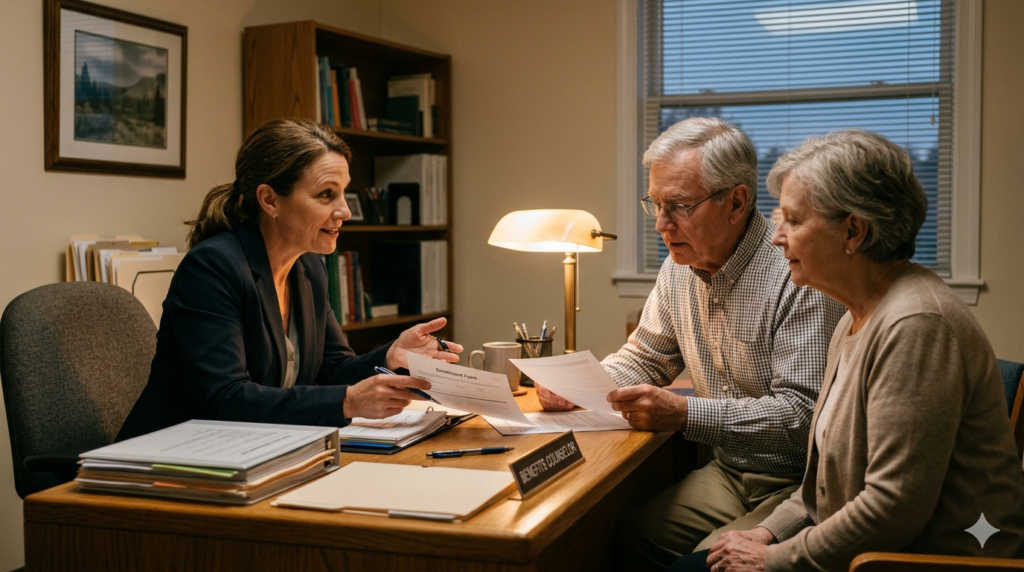
The first surprise for a Shelby County family is that a nursing home Medicaid application in Alabama does not go to the county human resources office – it goes to the Alabama Medicaid Agency itself, and the questions that agency asks are not the questions families have prepared for. The one that catches people is about the community spouse’s age, because Alabama has not expanded Medicaid, and a 62-year-old wife who quits work to care for her husband can find she has no coverage at all.
This page walks the intake questions in the order they get asked, and says what each answer sets in motion. It is written for Shelby County specifically: the highest-income county in Alabama, with a fast-growing over-65 population spread across Alabaster, Pelham, Chelsea and Calera, sitting next door to Birmingham’s hospital system. That means local households have more home equity and more insurance than the Alabama average, and less skilled nursing capacity inside their own county than they expect.
The program is Alabama Medicaid – institutional Medicaid for nursing facility care, and the Elderly and Disabled Waiver for services delivered at home instead. The two run on different tracks with different gatekeepers, and choosing the wrong one at intake is the most common way months get lost.
Every figure below is stamped as of 2026 and should be confirmed with the agency named next to it. Nothing here is legal, tax, or Medicaid-eligibility advice; those questions belong with an Alabama elder law attorney or the agencies listed at the end. Pine Lake Life Solutions provides education and a free policy review only.
In This Article
- “Who Is the Applicant, and Who Is Filing This?”
- “Is the Applicant in a Facility, or Still at Home?”
- “What Is the Monthly Income?”
- “What Do You Own?” The Resource Test and Shelby County Home Equity
- “Any Life Insurance? What Is the Total Face Value?”
- “Have You Given Anything Away in the Last Five Years?”
- “Is There a Spouse, and How Old Is She?” The Alabama Non-Expansion Trap
- When Selling the Policy Is the Wrong Answer in Shelby County
- Where to File, What a Month Costs, and Who to Call
- Frequently Asked Questions
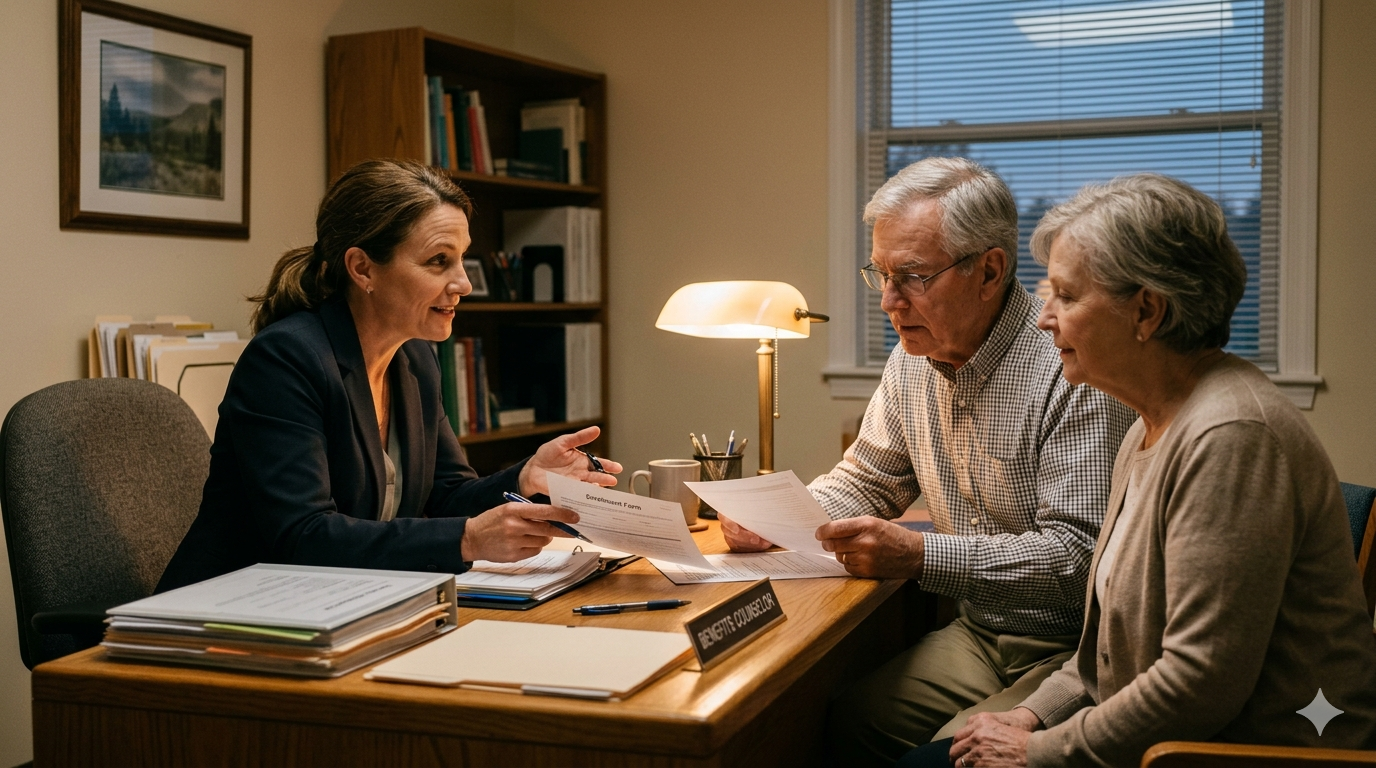
“Who Is the Applicant, and Who Is Filing This?”
Alabama is unusual in how long-term care Medicaid is administered. The Alabama Medicaid Agency determines eligibility for nursing home Medicaid directly, through its district office structure, rather than routing it through the county department that handles other public assistance programs. For a Shelby County resident that means the file lands with the Medicaid Agency district office serving this part of the state. Confirm the current district office, its address, and whether the application can be filed by mail or online before you drive anywhere.
In practice, the nursing facility’s business office often prepares the application. That is genuinely helpful – they do this every week – and it is also worth watching, because the facility’s interest is in getting paid for the bed, which is not always the same as optimizing the family’s position. Three protections:
- Designate a family member as the authorized representative in writing, and keep your own copy of every document submitted.
- Ask for the caseworker’s name and the application number, and ask for written confirmation of each submission.
- Get a durable power of attorney drafted for Alabama before it is needed. Without one, a family whose parent can no longer sign may face a conservatorship proceeding in probate court in the middle of a crisis – slow, public, and expensive.
The general framework for how the financial side works is on our nursing home Medicaid spend-down overview.
“Is the Applicant in a Facility, or Still at Home?”
This question routes the file, and the two routes are not equally available.
Institutional Medicaid covers nursing facility care once a medical determination establishes that level of need. It is an entitlement in the sense that there is no waiting list: if you meet the medical and financial tests, coverage follows.
The Elderly and Disabled Waiver pays for aides, personal care, respite and adult day services so a parent can stay home in Chelsea or Alabaster. It is administered through the Alabama Department of Senior Services and delivered locally by the Area Agency on Aging – for Shelby County, the Middle Alabama Area Agency on Aging, which also covers Blount, Chilton, St. Clair and Walker counties. Critically, waiver programs operate under enrollment limits. There may be a waiting list, and the availability of a slot is not something a family can control.
What that means practically: apply for the waiver early, before a crisis forces a placement, because a slot that is not available in March may be available in September – and because a family that never asked will never be offered one. If a parent is still at home and the family wants aides rather than placement, say “Elderly and Disabled Waiver” out loud at the first phone call, and ask whether a waiting list exists and where you would sit on it.
“What Is the Monthly Income?”
Alabama applies a hard monthly income cap for nursing home Medicaid, set as a multiple of the federal benefit rate and adjusted annually. Above that cap, the applicant is over-income – and unlike a state with a monthly buy-in, being over-income in a cap state is a bar rather than a co-payment.
Ask the Alabama Medicaid Agency directly what options exist when income exceeds the cap in your specific case. States handle this differently, and the answer determines whether a household with a substantial pension can get coverage at all. Do not assume a particular instrument is available or unavailable in Alabama based on an article about another state; get it from the agency and from an Alabama elder law attorney.
The Shelby County wrinkle is that income here is higher than the Alabama norm. This is the wealthiest county in the state, and its retirees include former utility, steel, banking, healthcare and university employees with real defined-benefit pensions on top of Social Security. A household at $4,200 a month is common in Pelham and unusual in most of Alabama. That makes the income question a live obstacle here in a way it is not statewide.
Once eligible, most of the resident’s income goes to the facility each month as the patient-pay amount, with a small personal needs allowance retained and an allowance for health insurance premiums.
“What Do You Own?” The Resource Test and Shelby County Home Equity
The countable resource limit for a single applicant is $2,000 as of 2026 – confirm with the Alabama Medicaid Agency, since resource standards are administrative. Countable means liquid and available: checking and savings, CDs, brokerage accounts, a second vehicle, burial funds above the excluded amount, and the cash surrender value of life insurance.
Generally excluded: the home the applicant lives in or intends to return to, subject to a federal home equity cap; one vehicle; household goods and personal effects; and irrevocable burial arrangements within the limits Alabama sets.
Two Shelby County specifics.
Home values are the highest in the state. A long-held house in Chelsea, Mt Laurel or Greystone can carry $330,000 to $450,000 of equity as of 2026. That is below the federal equity cap, so the homestead exclusion generally still applies during the applicant’s lifetime – but it makes Alabama’s estate recovery program a much larger claim here than in most Alabama counties. The house is excluded, not protected. Read how estate recovery works before assuming anything about what passes to the children.
The gifting pattern here is exurban and specific. Shelby County grew by families moving out from Jefferson County, which means a lot of intergenerational property help: a parent who put $60,000 toward a daughter’s house in Calera, or deeded a lot to a son, or added a child to a deed “to keep it simple.” Every one of those is a transfer, and they are covered two sections below.
| Where Shelby County families actually place a parent | Typical monthly private-pay cost, 2026 | Alabama Medicaid coverage | Practical note |
|---|---|---|---|
| In-home aides, ~20 hours a week | roughly $2,300 to $3,000 | Elderly and Disabled Waiver, subject to enrollment limits | Ask about the waiting list early, before a crisis |
| Assisted living, Alabaster or Pelham | roughly $4,000 to $5,500 | Generally not covered as room and board | Ask in writing what happens when private funds run out |
| Assisted living, Hoover private-pay market | roughly $5,000 to $6,500 | Generally not covered | Care-level tiers add $600 to $1,400 a month |
| Memory care | generally $1,000 to $1,800 above assisted living | Generally not covered as room and board | Where most runways break |
| Skilled nursing, Shelby County | roughly $7,500 to $9,000 semi-private | Covered once medical and financial tests are met | Limited bed supply; ask about waiting lists |
| Skilled nursing, Jefferson County and Birmingham | roughly $7,800 to $9,500 semi-private | Covered | More capacity and specialists; longer drive for a spouse |
“Any Life Insurance? What Is the Total Face Value?”
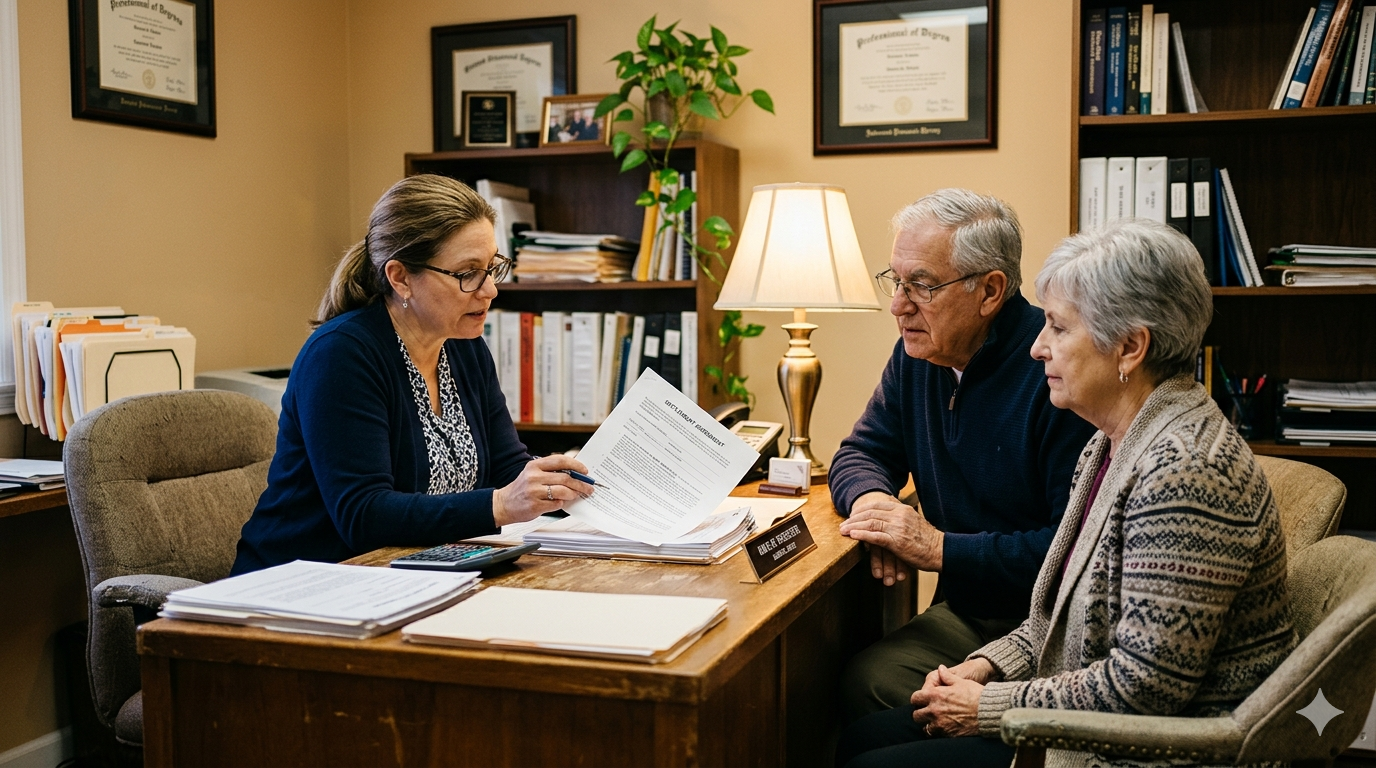
Note the exact form of the question. The caseworker asks about face value, not cash value, and the reason is the aggregation rule.
Total the face value of all policies on one person’s life. If that total is at or under the state’s small-policy threshold, the cash value of those policies is disregarded entirely. If the total exceeds the threshold by any amount, the entire cash surrender value becomes a countable resource. Alabama sets its own threshold and it is not necessarily the $1,500 figure used in many states – confirm the current Alabama figure with the Alabama Medicaid Agency rather than assuming in either direction. Getting this wrong is expensive both ways: families surrender policies that were already excluded, and families assume policies are excluded that in fact put them over the limit.
Shelby County households tend to hold larger policies than the Alabama average – a $100,000 or $250,000 whole life or universal life policy bought in the 1990s when the household was raising children and carrying a mortgage. A $150,000 policy with $34,000 of cash surrender value puts an applicant seventeen times over a $2,000 limit by itself. See how life insurance counts as a Medicaid asset.
What to bring: the policy pages showing face amount and the named owner – which is not always the insured – plus the carrier’s written statement of current cash surrender value. Carriers can take weeks to produce that statement, so request it the day you decide to apply, not when the caseworker asks for it.
Where a policy’s cash value does have to be dealt with, there are four routes: surrender, a life settlement, a reduced paid-up election that stops the premium while keeping a smaller guaranteed death benefit, and an irrevocable burial arrangement within Alabama’s limits. Which is best is fact-specific. Surrender versus sell compares the first two.
“Have You Given Anything Away in the Last Five Years?”
Alabama applies a 60-month look-back and the agency will request five years of records, valuing every transfer for less than fair market value. In Shelby County the transfers that turn up are usually property-related rather than cash gifts: help with a child’s down payment, a deeded lot, a vehicle signed over, a name added to a deed or a bank account.
Alabama converts the total into months of ineligibility by dividing it by an average monthly private-pay nursing facility cost figure the agency publishes for this purpose. As of 2026 that divisor sits somewhere in the range of roughly $7,000 to $8,500 a month; the agency revises it, so get the current published figure rather than relying on any article. Worked at $7,800: a $60,000 down-payment gift produces roughly 7.7 months of ineligibility. At Shelby County private-pay rates of about $8,200 a month, that is about $63,000 of bills the family covers with money it no longer has.
Two mechanics do the damage. Adding a child to a deed transfers a partial interest, valued as of the date it happened – and it usually costs the child the step-up in basis they would have received at death, so it is a tax mistake as well as an eligibility one. And the penalty period begins on the later of the transfer date or the date the applicant would otherwise be eligible and is receiving the covered level of care, which means a 2023 gift produces a bill starting in 2026.
Cures exist. Returning the transferred asset in full or in part reduces the penalty proportionally, and an undue hardship waiver is a separate route with its own standard. Both require documentation and disclosure, and both are attorney work. And paying a daughter for caregiving is not automatically a divestment – but without a written, dated caregiver agreement signed before the care began, at a documented reasonable rate, it will usually be treated as one.
“Is There a Spouse, and How Old Is She?” The Alabama Non-Expansion Trap
The first half of this question is routine. If a spouse remains at home, federal spousal impoverishment rules apply: a community spouse resource allowance protects a share of the couple’s combined countable resources for her, and a minimum monthly maintenance needs allowance protects her monthly income. Both are federal figures adjusted annually – ask the agency for the current numbers, and request a resource assessment before spending anything.
The second half is where Alabama differs from most of the country, and it is the single most important thing on this page for a couple in their early sixties.
Alabama has not expanded Medicaid. That means adults under 65 who are not disabled, not pregnant, and not caring for a dependent child generally have no Medicaid eligibility category available to them regardless of how low their income falls. So consider the very common Shelby County scenario: a 63-year-old wife leaves her job to care for her 71-year-old husband. She loses her employer health coverage. She is two years from Medicare. Her husband’s income is being applied to his nursing home care. And Alabama Medicaid has no category for her.
What to do instead, and this needs to happen before she resigns, not after:
- Price coverage through the federal Health Insurance Marketplace. Because household income will drop, she may qualify for substantial premium assistance – but the enrollment timing rules matter, and losing job-based coverage is a qualifying event with a limited window.
- Price COBRA continuation from her employer and compare it against a marketplace plan; COBRA is often far more expensive but preserves the same network and deductible progress.
- Factor her premiums into the minimum monthly maintenance needs allowance conversation with the caseworker, and document them.
- Do not let her drop the couple’s life insurance to free up cash. She is the one who will need liquidity if she is widowed at 64 with no income and no Medicare.
This is a coverage-planning problem, not a Medicaid-planning problem, and it needs a marketplace navigator or a licensed health agent alongside the elder law attorney.
When Selling the Policy Is the Wrong Answer in Shelby County
Four cases, and here the first one carries the most weight because of the section above.
A younger community spouse will need the death benefit. A 63-year-old wife facing two uninsured years, then a widowhood on a reduced survivor benefit, in a $360,000 house with taxes and insurance to carry, needs that death benefit more than her husband needs a few extra months of private pay that Medicaid would have covered anyway. This is the most common bad trade made in this county.
The policy is already excluded. If total face value on that life is at or under Alabama’s small-policy threshold, the cash value is already being disregarded. A sale converts an ignored asset into counted cash – strictly worse. Confirm the threshold before doing anything.
The face amount is small. Below roughly $100,000 of death benefit the secondary market is generally not interested. A $15,000 final expense policy is worth more inside an irrevocable burial arrangement, where it may be excludable, than as a sale that draws no bids.
The insured is genuinely healthy. Offers in the secondary market track shortened life expectancy. A 72-year-old in Hoover with well-controlled conditions who needs help with two activities of daily living will see weak numbers, and the better conversation is about the Elderly and Disabled Waiver and in-home care.
Where a sale is worth exploring – a larger permanent policy, an insured in their eighties with a real health history, a premium the household can no longer carry – the honest comparison is against cash surrender value, not against zero. The federal GAO study of the market (GAO-10-775) found sellers typically received substantially more than surrender value, but that is a market average, not a promise about any specific contract. Our page on selling a policy after 65 covers what drives an offer. Pine Lake Life Solutions does not purchase policies; a free review produces both numbers at no cost and no obligation, and says plainly when the answer is that a policy has no market value. Call (305) 209-7183.
Where to File, What a Month Costs, and Who to Call
By real name, as of 2026:
- Alabama Medicaid Agency – determines eligibility for nursing home Medicaid directly, through its district office structure, and publishes the resource standards, the income cap and the transfer divisor used above. Confirm the district office serving Shelby County and the current filing route.
- Alabama Department of Senior Services – the state aging agency, responsible for the Elderly and Disabled Waiver and the home of Alabama’s State Health Insurance Assistance Program, which provides free, unbiased Medicare counseling and sells nothing.
- Middle Alabama Area Agency on Aging – the regional aging agency covering Shelby, Blount, Chilton, St. Clair and Walker counties. This is the practical first call for waiver screening, in-home services, meals, and caregiver support.
- Alabama Department of Insurance – the insurance regulator. Whether a life settlement provider or broker is licensed in Alabama, and where a complaint is filed, belongs here. Our Alabama licensing summary is a starting point, not a substitute for the department’s own license lookup.
- CMS Care Compare – federal inspection results, staffing levels and quality ratings for every certified facility. Read it before touring, and compare Shelby County facilities against the Birmingham options.
What a month costs. Cost-of-care survey data puts semi-private skilled nursing in the Shelby County and Birmingham market in the range of roughly $7,500 to $9,000 a month as of 2026, above the Alabama statewide median and well below the national one. Assisted living in Hoover, Pelham and Alabaster generally runs $4,000 to $6,500, with the private-pay communities serving this affluent market pricing at the top of that band, and memory care above it. Those are ranges, not quotes.
One structural local fact to plan around. Shelby County has grown fast, and Alabama’s certificate-of-need framework constrains the addition of new nursing facility beds, so the county’s skilled nursing capacity has not kept pace with its over-65 population. Families in Chelsea and Calera routinely end up placing a parent in Jefferson County, near the Birmingham hospital systems. That is often clinically sensible – the specialists are there – but it widens the search, lengthens the timeline, and means the drive for a spouse who no longer drives at night becomes a real factor. Ask about waiting lists on the first call, and ask every facility whether it accepts Alabama Medicaid and whether it holds a bed during a pending application. A private-pay-only placement is a dead end.
Frequently Asked Questions
Where does a nursing home Medicaid application go in Alabama?
To the Alabama Medicaid Agency, which determines eligibility for nursing home Medicaid directly through its district office structure rather than through the county office that handles other public assistance. Confirm the district office serving Shelby County and the current filing route. The facility’s business office often assists, but designate a family member as authorized representative in writing.
Is there a waiting list for in-home care in Shelby County?
There can be. Institutional Medicaid has no waiting list if the medical and financial tests are met, but the Elderly and Disabled Waiver operates under enrollment limits. Ask the Middle Alabama Area Agency on Aging whether a list exists and where you would sit on it, and apply before a crisis rather than after a placement.
My wife is 63 and quitting work to care for me. Can she get Medicaid?
Generally no. Alabama has not expanded Medicaid, so adults under 65 who are not disabled, pregnant, or caring for a dependent child usually have no eligibility category regardless of income. Price a federal Marketplace plan and COBRA before she resigns – losing job-based coverage is a qualifying event with a limited enrollment window.
How much does a transfer cost us in penalty months?
Alabama divides the total transferred inside the 60-month look-back by an average monthly private-pay nursing facility cost – in the range of roughly $7,000 to $8,500 as of 2026. A $60,000 gift is therefore about seven to eight months of ineligibility. Get the current published divisor from the Alabama Medicaid Agency before calculating anything.
Does my father’s $150,000 policy have to be cashed in?
Something must happen to the cash value if total face value on his life exceeds Alabama’s small-policy threshold, because then the entire cash surrender value counts. Alabama sets its own threshold – confirm it, since it is not necessarily the $1,500 many states use. Surrender is one of four routes alongside a settlement, a reduced paid-up election, and a burial arrangement.
Will Alabama take the house in Chelsea?
During the applicant’s lifetime an owner-occupied home is generally excluded, subject to a federal equity cap well above typical Shelby County values. Afterward, Alabama operates a Medicaid estate recovery program, and because home equity here is the highest in the state, the claim is larger than in most Alabama counties. Ask an Alabama elder law attorney about the exceptions.
What does care cost in Shelby County?
Cost-of-care survey data puts semi-private skilled nursing in the Shelby and Birmingham market in the range of roughly $7,500 to $9,000 a month as of 2026, with assisted living generally $4,000 to $6,500 and memory care above that. These are ranges. Ask three facilities for their current private-pay daily rate and their tier pricing schedule in writing.
Find out what your policy is worth — free, confidential, no obligation.
A 15-minute educational review covers your eligibility, every alternative, and a realistic view of what each path would net you.
Related Reading
- Nursing Home Costs Shelby County Al
- Sell Life Insurance Policy Shelby County Al
- Alabama Medicaid Asset Income Limits
- Life Settlement Licensing Alabama
- Nursing Home Medicaid Spend Down
- Life Insurance Counts Medicaid Asset
- What Is Medicaid Estate Recovery
- Surrender Vs Sell Policy
- Over 65 Sell Policy
Pine Lake Life Solutions does not purchase life insurance policies and does not provide legal, tax, or investment advice. Information provided is for educational purposes only. Eligibility for any option, including life settlements, is not guaranteed and depends on individual circumstances, policy terms, underwriting, and market conditions. Consult independent legal, tax, or financial professionals before making decisions regarding a life insurance policy.