
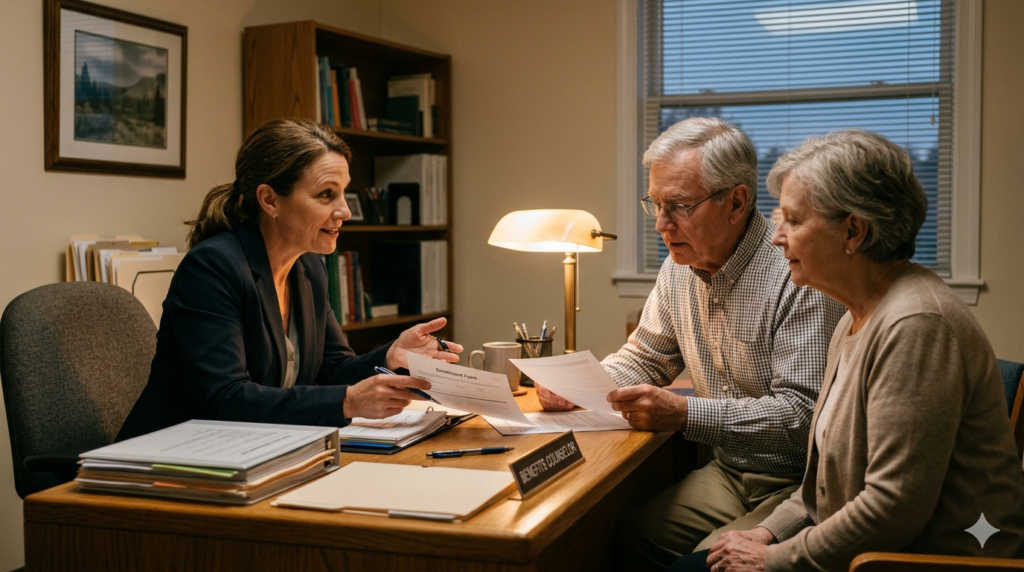
Long-term care in Arizona does not come from the Medicaid program most families apply to, it comes from ALTCS, which has its own application, its own eligibility office and its own medical screening. A Pinal County family that applies for regular AHCCCS coverage and waits has not applied for long-term care at all. The Arizona Long Term Care System is the program that pays for nursing facility care, assisted living and in-home care, and getting into it requires clearing two separate tracks: a financial determination and a Pre-Admission Screening that establishes the person medically and functionally needs that level of care. Both have to succeed. Neither substitutes for the other.
ALTCS applies a $2,000 countable-asset limit to a single applicant as of 2026; verify the current figure with AHCCCS. The look-back reaches 60 months. What follows is the packet organized by track, with a section on the documents that are specific to a county built around large age-restricted retirement communities, where a substantial share of applicants arrived from somewhere else within the last fifteen years and still own property, accounts and policies in another state.
In This Article
- ALTCS Is Its Own Program, With Its Own Office
- Track One: The Financial File
- Track Two: The Pre-Admission Screening
- The Snowbird Problem: Residency and Two Sets of Records
- The Retirement-Community Items Nobody Anticipates
- Life Insurance: Face Value First, Cash Value Second
- The 60-Month Look-Back in a County of Recent Arrivals
- What a Month Costs in Casa Grande, Florence and San Tan Valley
- Estate Recovery, and When Selling Is the Wrong Answer
- Frequently Asked Questions
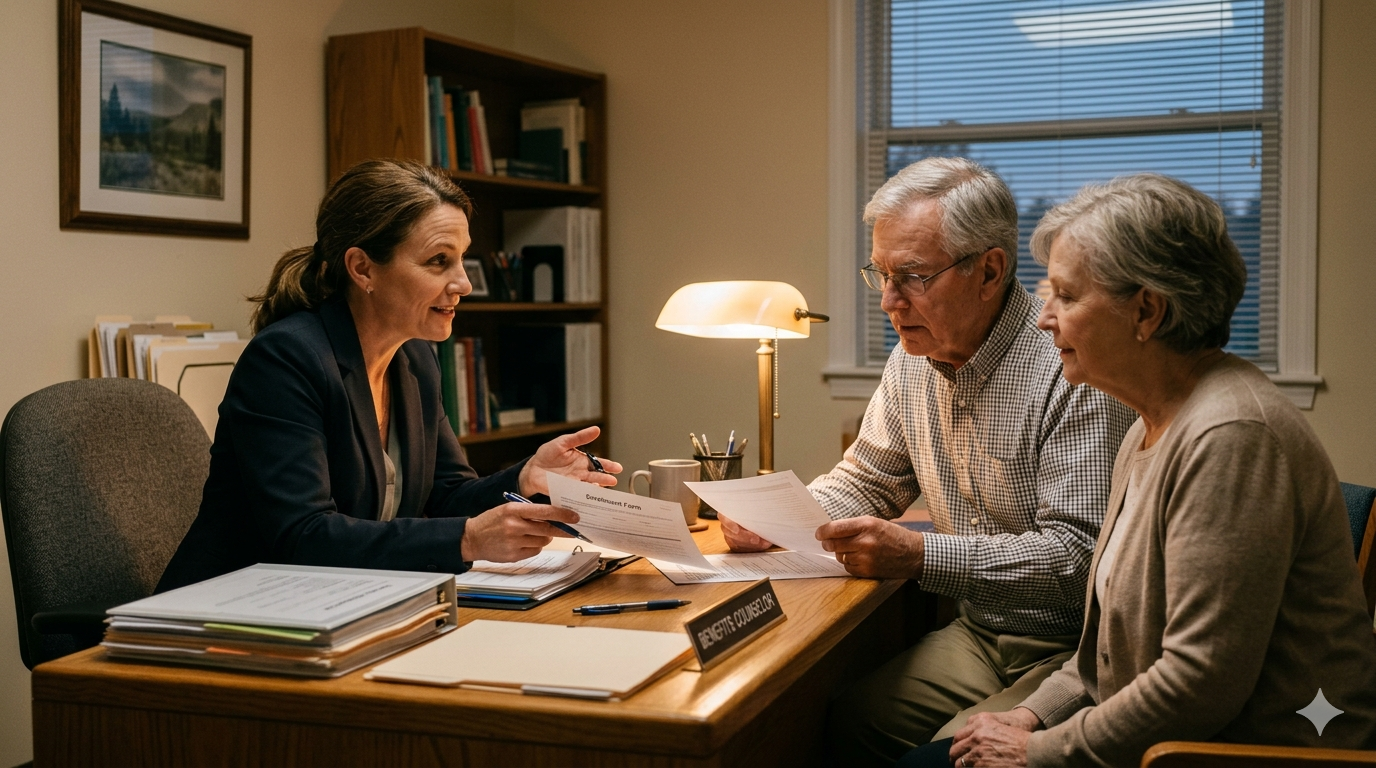
ALTCS Is Its Own Program, With Its Own Office
Apply to ALTCS directly. AHCCCS operates ALTCS eligibility separately from its general Medicaid eligibility function, and applications are taken by ALTCS eligibility offices rather than by a county human services department. Ask AHCCCS which ALTCS office serves your address; Pinal County residents are commonly served through an office in the Casa Grande area, but the county’s geography means coverage assignments vary and San Tan Valley, an unincorporated community on the Maricopa County line, is frequently served differently from Florence or Oracle. Confirm before you drive anywhere.
Once approved, services are delivered through a contracted ALTCS program contractor, a managed care organization that coordinates the care plan, and the setting can be a nursing facility, an assisted living or residential setting, or the person’s own home. Arizona is comparatively generous about paying for care outside a nursing facility, which matters a great deal in a county where assisted living is the realistic destination for most applicants.
Two other doors. The Pinal-Gila Council for Senior Citizens, the area agency on aging serving the region from Casa Grande, is the local resource for care options, caregiver support and benefits counseling, including Arizona’s free health insurance counseling program for Medicare questions. And for anything about a life insurance carrier, a policy or a producer, the regulator is the Arizona Department of Insurance and Financial Institutions.
Track One: The Financial File
Everything here is a request to a third party, so send them all on the same day.
Sixty months of statements for every bank, credit union and brokerage account, including accounts closed inside the window and joint accounts. One to three weeks, and expect a fee. Funds in a jointly titled account are generally treated as available to the applicant unless the family can establish whose deposits funded them.
Current statements for every pension, annuity, IRA and retirement account, including payout status and any survivor election. Retirement account treatment varies by payout status and ownership, so do not assume.
Deeds and assessed values for every parcel the applicant’s name has touched in five years, in every state.
Titles for every vehicle, and this county needs the list spelled out: cars, pickups, a fifth-wheel or motorhome, a utility trailer, a boat, and, yes, a titled golf cart or neighborhood electric vehicle in an age-restricted community. Only one vehicle is generally excluded; the rest count at equity value.
Any prepaid funeral contract, with revocable or irrevocable status visible on its face. Only a properly structured irrevocable arrangement is generally excluded.
In-force statements from every life insurance carrier, covered in its own section below because it is the item most often missing.
Plus the applicant-side items: identification, proof of citizenship or qualified alien status, the Medicare card and any supplement or Advantage plan, Social Security and pension award letters, marriage and divorce records, and the document establishing who may act for the applicant.
Track Two: The Pre-Admission Screening
The medical and functional track is where families lose the most time, because they treat it as a formality that follows the financial approval. It does not. It is a separate assessment, performed by an ALTCS assessor, that establishes whether the person needs the level of care ALTCS pays for. A perfect financial file with a failed or unscheduled screening produces no coverage.
Prepare for it deliberately. The screening captures the person on the day it happens, and older adults very frequently present better in a single interview than they function across a week, particularly where cognition is the issue. Bring documentation: recent physician notes, a hospital discharge summary if there is one, a current medication list, and a two-week log kept by whoever provides day-to-day help, recording actual difficulty with bathing, dressing, transfers, toileting, medication management, meals and supervision needs. Family observations carry weight when they are specific and dated.
Ask three questions when you schedule: who performs the screening for your address, how long the queue is, and whether it can be done where the person currently is, whether that is a hospital, a rehabilitation facility, an assisted living community or their own home in Sun City Anthem or Robson Ranch. Coordinate the two tracks so they finish near the same time rather than in sequence.
The Snowbird Problem: Residency and Two Sets of Records
Pinal County has one of Arizona’s fastest-growing populations over 65, and a large share of those residents arrived from the Midwest, the Northeast, the Pacific Northwest or Canada. Many kept property, accounts, or a seasonal arrangement in the place they came from. That produces two documentation problems that a lifelong Arizona family never faces.
Residency. Arizona will want proof that the applicant is an Arizona resident, and a household that spends part of the year elsewhere, or that has recently relocated, needs to establish it with documents: a driver’s license, voter registration, utility bills, a lease or deed, and a state tax filing history. Sort this out before filing rather than in response to a notice.
Out-of-state assets. A house still owned in another state is countable real property, not an excluded residence, once the Arizona home is the primary residence. A bank account in a former home state still needs sixty months of statements. A property sold to a relative below market in the last five years is a transfer regardless of which state it sat in. And for non-citizens, including long-time Canadian residents, immigration status documentation drives eligibility in ways that need to be answered accurately rather than approximately.
None of this changes the rules. It changes the calendar. Out-of-state records requests run three to eight weeks, so they go out first.
| Track | What it decides | Key documents | Typical lead time |
|---|---|---|---|
| Financial eligibility | Assets and income against ALTCS limits | 60 months of statements, deeds, titles, carrier in-force statements | 4 to 8 weeks to assemble |
| Pre-Admission Screening | Whether the person needs this level of care | Physician notes, discharge summary, medication list, two-week care log | Scheduling queue varies; ask |
| Residency | Whether Arizona is the state of residence | License, voter registration, utility bills, deed or lease | Days if organized |
| Out-of-state assets | Whether other property or accounts count | Out-of-state deeds, settlement statements, account statements | 3 to 8 weeks |
| Authority to act | Who may sign and transact | Durable power of attorney or guardianship order | Days, or months for guardianship |

The Retirement-Community Items Nobody Anticipates
Pinal County contains several very large age-restricted communities, and living in one produces packet items that surprise families and their out-of-state advisors.
The home itself. The primary residence is generally excluded while there is an intent to return or a spouse or certain relatives live there, subject to a federal home equity limit indexed annually that sat in the low $700,000s for 2025. Most homes in these communities are comfortably under it. Confirm the 2026 figure anyway.
Ongoing carrying costs. Homeowner association dues, community fees, property taxes and insurance continue while a resident is in care, and they come out of a household whose income is now largely committed to the cost of care. If a spouse is remaining in the home, those costs belong in the budget conversation from the beginning.
Age restrictions and resale. Deed restrictions in age-restricted communities limit who may occupy the home, which can affect how quickly it sells and who can live there in the interim. That is a real constraint on treating the house as a liquid funding source.
Recreational property with titles. The motorhome, the trailer, the boat, the second golf cart. These are countable at equity value and they are the most commonly omitted assets in this county’s files.
Do not solve any of these by transferring title to a child. That is a transfer inside the look-back, and it converts a paperwork problem into a penalty period.
Life Insurance: Face Value First, Cash Value Second
Two separate tests apply to the same contract, and families report the wrong number constantly.
Face value decides exclusion. Arizona excludes life insurance as a burial resource only if the total face amount of all policies on the same insured stays at or under the state threshold, a figure derived from federal SSI rules that most states set at $1,500. Confirm Arizona’s current number with AHCCCS. The test aggregates: two $1,000 policies do not each get excluded, their combined face amount is measured, and exceeding the threshold destroys the exclusion for all of them.
Cash surrender value counts if the exclusion is lost. A $50,000 whole life policy with $9,400 of cash value and a $1,600 loan is a $7,800 countable asset, not a $50,000 one. Ask the carrier for an in-force statement showing owner, insured, current face amount, current cash surrender value, any outstanding loan, the paid-to date and the beneficiary designation. Two to four weeks, longer where the insurer has merged, which is common with policies bought decades ago in another state from a regional carrier that no longer exists under that name.
If the cash value puts the household over the limit, four exits exist: absorb it in documented allowable spending, surrender the policy, elect reduced paid-up coverage so a smaller face amount may fall inside the burial exclusion, or sell it in a life settlement, which can exceed surrender value for an older insured with health impairments and takes roughly two to four months from application to funding. Proceeds are countable cash and still subject to spend-down. See how Medicaid treats life insurance as an asset and, for how age affects value, policy options after 65.
The 60-Month Look-Back in a County of Recent Arrivals
Arizona reviews the 60 months before the application date for transfers made for less than fair market value. A disqualifying transfer creates a penalty period during which ALTCS will not pay for long-term care, computed by dividing the transferred value by a statewide average monthly private-pay figure. Confirm the current divisor with AHCCCS, because the number of penalty months moves with it.
The Pinal County pattern is specific. Households that relocated here in the last decade often sold a home in another state, moved a large sum, helped a child with a down payment out of the proceeds, and bought a smaller house here. Every step of that is visible in five years of statements, and the gift to the child is a transfer even though it came out of what everyone thought of as the family’s own money. Similarly, a former home left in a child’s name for convenience, or a car given to a grandchild at the move, is a transfer.
Arizona recognizes exceptions, including certain transfers involving a spouse, a blind or disabled child, and a caregiver child who met residence and care requirements, and a full return of transferred value can potentially cure a transfer. Every exception requires documentation, not narrative, and an elder law attorney promptly. A life insurance sale documented at arm’s length for fair market value is not a penalized transfer; a discounted sale to a relative is.
What a Month Costs in Casa Grande, Florence and San Tan Valley
As of 2026, semi-private skilled nursing in Pinal County generally runs about $8,000 to $9,500 a month with private rooms roughly $9,500 to $11,000, and assisted living about $4,500 to $5,600, with memory care higher, based on Genworth-style cost-of-care survey data for Arizona trended forward. These are ranges; ask each facility for its current private-pay rate in writing.
Two local facts shape the decision. First, facility supply in Pinal County is thinner than the population would suggest, because the county’s growth has outpaced the development of skilled nursing capacity and much of the region’s specialty care sits in the Phoenix and Tucson metropolitan areas at either end of the county. Distance is a practical constraint: a family in Oracle and a family in San Tan Valley are looking at completely different sets of facilities. Second, because Arizona’s ALTCS program supports care in assisted living and at home, the realistic monthly figure for many applicants is the assisted living number rather than the nursing figure, which changes the runway substantially.
Run the arithmetic before deciding anything about insurance: liquid assets divided by the applicable monthly rate is the number of months before ALTCS becomes the question. At $8,800 a month, $70,000 is about eight months; at $5,000 a month for assisted living, the same money is fourteen. Our Pinal County cost breakdown works it with local figures, and our spend-down overview covers documenting allowable spending.
Estate Recovery, and When Selling Is the Wrong Answer
Arizona, like every state, is required to seek recovery of long-term care Medicaid costs from the estates of deceased recipients, and AHCCCS operates an estate recovery function. Exceptions and hardship provisions exist, including protections while a surviving spouse or a disabled child is living, and the treatment of jointly held property and property passing outside probate is fact-specific. Ask AHCCCS or your own attorney what applies in 2026 rather than relying on what happened in another state.
The insurance connection is structural: a death benefit paid to a named individual beneficiary is generally outside the probate estate, while cash in the decedent’s account at death generally is not. Confirm beneficiary designations while requesting the in-force statement, because designations made decades ago in another state are frequently out of date.
Four situations make selling the policy the wrong move. A small face amount in the $5,000 to $10,000 range will not draw a competitive third-party offer; surrender or a reduced paid-up election is simpler. A policy already inside the burial exclusion is not counting against the $2,000 limit, so selling it converts an excluded asset into countable cash and creates a problem out of nothing. A healthy insured draws weak offers because pricing tracks life expectancy, and the family gives up a full death benefit cheaply. And a surviving spouse who needs the coverage changes the analysis: Arizona protects a share of assets and income for the spouse remaining at home, and in an age-restricted community where housing costs continue regardless, that spouse’s plan may depend on the death benefit. Model both households with an elder law attorney first.
Pine Lake Life Solutions does not purchase policies and is not licensed in every state. We read the contract, tell you what it is worth held and what the market would pay, and put it in writing for the ALTCS office and your attorney. If you want that number before either track forces a decision, ask for a free policy review.
Frequently Asked Questions
What is ALTCS and why can’t I just apply for AHCCCS?
ALTCS, the Arizona Long Term Care System, is the program that pays for nursing facility, assisted living and in-home long-term care. It is administered separately from general AHCCCS coverage, with its own application, its own eligibility offices and its own medical Pre-Admission Screening. Applying for regular AHCCCS coverage does not put you in the queue for long-term care. Apply to ALTCS directly.
What is the Pre-Admission Screening?
A separate medical and functional assessment performed by an ALTCS assessor to establish that the person needs the level of care ALTCS pays for. It is not a formality and it does not follow automatically from financial approval. Bring physician notes, a medication list, any discharge summary, and a dated two-week log of actual difficulty with bathing, dressing, transfers, medication and supervision.
Does ALTCS pay for assisted living?
Arizona is comparatively generous here: once approved, ALTCS services can be delivered in a nursing facility, in an assisted living or residential setting, or in the person’s own home, coordinated by a contracted program contractor. That matters in Pinal County, where assisted living is the realistic destination for many applicants and the monthly cost is thousands of dollars lower than skilled nursing.
We still own a house in another state. Does it count?
Generally yes, as countable real property, once the Arizona home is the primary residence. Only the primary residence is excluded, and only while there is an intent to return or a spouse or certain relatives live there. You will also need sixty months of statements for any out-of-state bank account, and out-of-state records requests run three to eight weeks, so send them first.
Does a golf cart or motorhome count as an asset?
Titled recreational vehicles generally count at equity value. Only one vehicle is typically excluded, so a motorhome, fifth-wheel, utility trailer, boat or titled neighborhood electric vehicle beyond that one is countable. These are the most commonly omitted assets in Pinal County files. Do not transfer them to a relative to simplify the application, because that creates a transfer penalty.
How much does care cost in Pinal County?
As of 2026, semi-private skilled nursing generally runs about $8,000 to $9,500 a month, private rooms roughly $9,500 to $11,000, and assisted living about $4,500 to $5,600, with memory care higher, based on Arizona cost-of-care survey data. Facility supply is thinner than the population suggests and distances are long. Get each facility’s current private-pay rate in writing.
Find out what your policy is worth — free, confidential, no obligation.
A 15-minute educational review covers your eligibility, every alternative, and a realistic view of what each path would net you.
Related Reading
- Nursing Home Costs Pinal County Az
- Sell Life Insurance Policy Pinal County Az
- Arizona Medicaid Asset Income Limits
- Life Settlement Licensing Arizona
- Life Settlement Taxes Arizona
- Sell Life Insurance Policy Yavapai County Az
- Nursing Home Medicaid Spend Down
- Life Insurance Counts Medicaid Asset
- Over 65 Sell Policy
Pine Lake Life Solutions does not purchase life insurance policies and does not provide legal, tax, or investment advice. Information provided is for educational purposes only. Eligibility for any option, including life settlements, is not guaranteed and depends on individual circumstances, policy terms, underwriting, and market conditions. Consult independent legal, tax, or financial professionals before making decisions regarding a life insurance policy.