
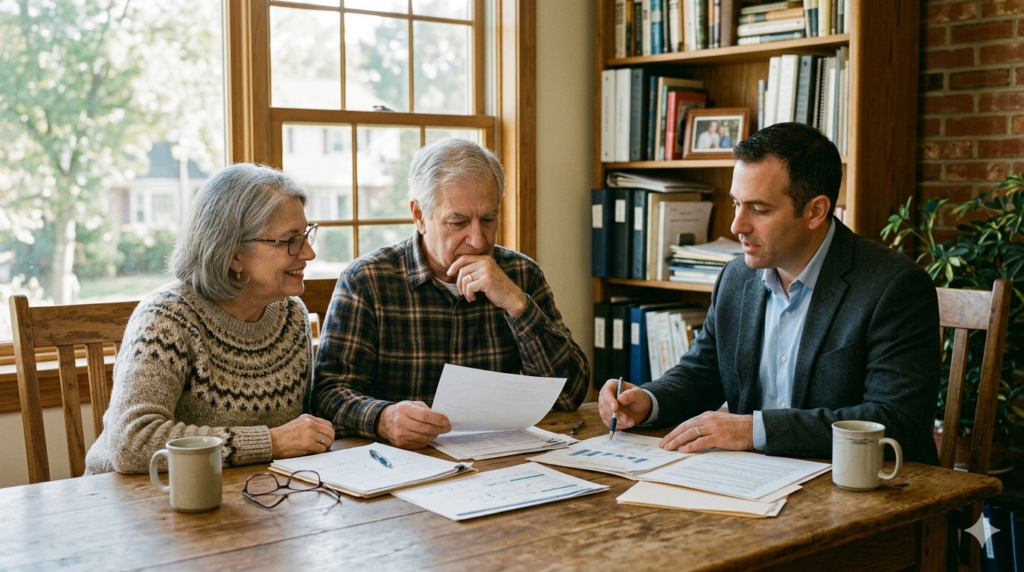
Palm Desert, California is in Riverside County, and because the Medi-Cal resource limit reinstated on January 1, 2026 sits at $130,000 for one applicant — with $65,000 added per additional household member — a long-term care application here is still rarely won by spending money down. It is won or lost on documents. Verify the current figures with Riverside County, but your parent will not be asked to reduce a bank account to $2,000, only to come in under a ceiling most permanent households clear. What they will be asked for is proof — of identity, of California residency, of income, of level of care — and in a city where a third or more of the permanent population is over 65 and tens of thousands more are seasonal, residency proof is the tab that fails.
So this page is built as the file itself, tab by tab, with a note at each one about what Coachella Valley households characteristically do not have on hand: a California resident tax return, a bank with a local branch, a released property tax exemption from another state, or a physician who has seen the applicant more than twice.
This is education, not legal, tax or eligibility advice. Riverside County determines eligibility and a California elder law attorney should handle the estate-plan side. Pine Lake Life Solutions provides education and a free policy review.
In This Article
- Where the File Goes, and Why the Valley Is 75 Miles From the County Seat
- Tab One: Identity, Citizenship and Social Security
- Tab Two: Residency — the Seasonal Household’s Weakest Tab
- Tab Three: Income, Which Is Now the Whole Ballgame
- Tab Four: Assets — Provide Them, Do Not Liquidate Them
- Tab Five: Level of Care and the Transfer Question
- Tab Six: The Estate Plan Documents Nobody Brings
- Tab Seven: Life Insurance — the Documents, Then the Decision
- What a Month Costs in Palm Desert (2026)
- Frequently Asked Questions
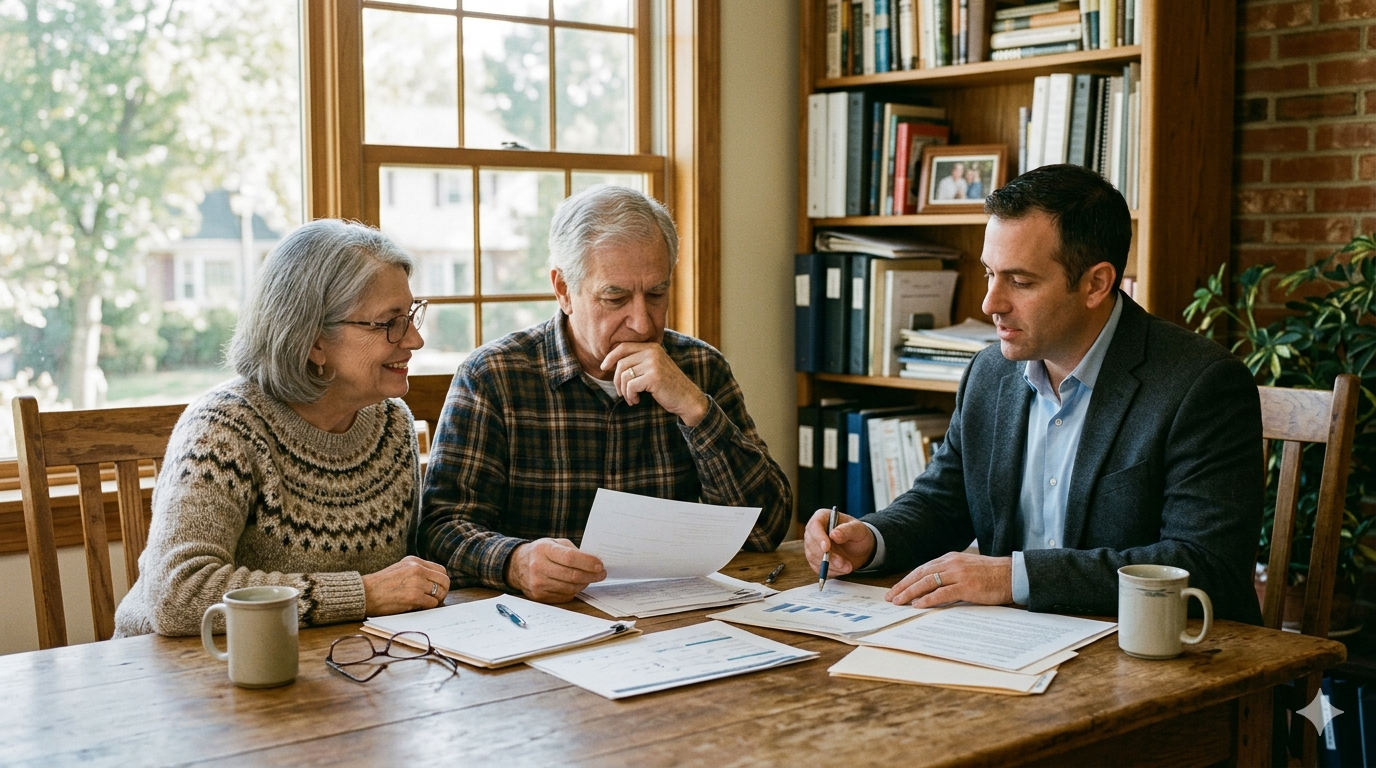
Where the File Goes, and Why the Valley Is 75 Miles From the County Seat
Medi-Cal is California Medicaid, administered by the state Department of Health Care Services and determined at the county level. For Palm Desert that is the Riverside County Department of Public Social Services (DPSS), Self-Sufficiency Division. Riverside is the county seat — roughly 75 miles west of Palm Desert, over the pass. Nobody in the Coachella Valley should be driving there for this. DPSS operates offices serving the valley, with Indio as the principal valley location, and much of the intake now runs online through BenefitsCal or by phone. Confirm the current valley office locations and hours before you go anywhere, because county service points have moved.
Riverside County is one of the largest counties in the United States by area, and that geography is the practical reason so much of this process is now remote. Plan on submitting the file electronically and keeping a complete duplicate copy yourself.
Three more real agencies belong on your list. The Riverside County Office on Aging is the federally designated Area Agency on Aging and the free front door for options counseling, In-Home Supportive Services questions and caregiver support. HICAP — the Health Insurance Counseling and Advocacy Program, California’s State Health Insurance Assistance Program, coordinated through the California Department of Aging — provides free unbiased Medicare and long-term care insurance counseling locally. And the California Department of Insurance regulates insurance products in this state, including life settlements.
One Riverside County opportunity worth asking about early: California’s Assisted Living Waiver lets Medi-Cal pay the care component of assisted living rather than only nursing facility care, and it operates in a limited set of California counties that has included Riverside. Room and board is still owed from the resident’s income, and the waiver has operated under enrollment caps and waitlists. Verify current availability with the Riverside County Office on Aging. Most Californians do not have this option; if your family does, it can change the entire plan.
Tab One: Identity, Citizenship and Social Security
The most basic tab, and it still stalls files.
Provide: a photo ID; the Social Security card or an acceptable substitute; and proof of citizenship or satisfactory immigration status — a birth certificate, passport, naturalization certificate, or immigration documents.
What Coachella Valley households often lack: an original birth certificate for someone born in the 1930s or 1940s in another state, which can take six to ten weeks to order from a distant vital records office. Order it the week you start, not the week DPSS asks. If the applicant has changed names through marriage more than once, gather the connecting documents too — the chain has to be legible.
Note also that California has broadened eligibility for full-scope Medi-Cal across immigration categories in recent years. Do not assume ineligibility based on status; ask DPSS, and ask a legal aid organization or an immigration-competent attorney if the answer is not obvious.
Tab Two: Residency — the Seasonal Household’s Weakest Tab
Medi-Cal requires California residency — physical presence with intent to remain. There is no durational requirement and no waiting period. What exists is an evidentiary burden, and in Palm Desert it is the single most likely place a file gets stuck.
Provide: a California driver’s license or ID; the deed or lease at the Palm Desert address; utility accounts in your parent’s name here; voter registration in Riverside County; a California resident income tax return; and local physicians and pharmacies.
What Palm Desert households characteristically do not have:
- A California resident tax return. A household that has filed as a nonresident, or filed a resident return in another state, has created the exact record DPSS will read against them. This is the most common single problem in this valley.
- A released property tax exemption elsewhere. A homestead exemption or senior freeze still claimed in Illinois, Minnesota, Washington or anywhere else is direct evidence against California residency. Resolve it before applying and expect to be asked.
- A surrendered out-of-state driver’s license.
- Utility accounts that run year-round. Seasonally suspended service is not fatal but it prompts questions.
- A local physician relationship of any depth. Which is also Tab Five’s problem.
The Canadian and cross-border case is genuinely separate. The Coachella Valley has a substantial seasonal Canadian population, and eligibility for a non-citizen turns on immigration category, not on how many winters someone has spent here. Ask DPSS and a competent attorney; do not guess in either direction.
The practical instruction: pick a domicile and make the paper match it, well before there is a crisis. A household that spends four months arguing residency with DPSS spends roughly $40,000 in the meantime at local nursing rates.
Tab Three: Income, Which Is Now the Whole Ballgame
Resources are counted again but generously, so income is the tab that usually determines money. Medi-Cal long-term care computes a share of cost: countable monthly income, minus a personal needs allowance, minus Medicare and other health insurance premiums, minus certain deductions and any allowance protected for a spouse at home, is what your parent owes the facility every month. Medi-Cal pays the balance.
For a nursing facility resident the personal needs allowance is small — a few dozen dollars a month historically; verify the current figure with DPSS. In practical terms, nearly all of your parent’s Social Security and pension goes to the facility. That means the Palm Desert house cannot pay its own property taxes, HOA dues and insurance out of their income once they are institutionalized, and in a valley where HOA and country club dues are a real monthly line item, that is not a small point.
Provide: the Social Security award letter or current benefit statement; pension statements; VA benefit award letters; annuity payment schedules; the most recent federal and California tax returns; rental income documentation if a second property is rented; and required minimum distribution documentation from retirement accounts.
What Palm Desert households often lack: clean documentation of income from a closely held business, a partnership, or royalties — common in a community of retired professionals and business owners. Also common: an annuity in payout status that nobody thought of as income. It is income, and it counts.
The spousal piece. Federal spousal impoverishment rules still apply in California, and a community spouse is entitled to a protected monthly income allowance. The resource side of that analysis now runs against California’s reinstated ceiling as well as the federal allowance; the income side has not changed at all. Ask DPSS specifically how the community spouse monthly allowance is being computed in your case, and involve a California elder law attorney if the at-home spouse has little income of their own.
| Tab | What to Provide | What Palm Desert Households Often Lack |
|---|---|---|
| 1. Identity and status | Photo ID, Social Security card, citizenship or immigration documents | An original out-of-state birth certificate; the name-change chain |
| 2. Residency | CA license, deed or lease, utilities, voter registration, CA resident tax return | A California resident return; a released out-of-state tax exemption |
| 3. Income | Social Security and pension statements, VA letters, annuity schedules, tax returns | Clean documentation of business, partnership or royalty income |
| 4. Assets | Account statements, deeds, titles, policy in-force statements | Paperwork on a second home in another state – provide, do not sell |
| 5. Level of care | Physician statement, records, discharge summaries, ADL documentation | A longitudinal local medical record for a seasonal resident |
| 6. Estate plan | Durable POA, advance directive, funded trust, deeds with vesting, beneficiary designations | A trust that was actually funded; a POA broad enough to cover insurance |
| 7. Life insurance | Current in-force statement per policy; in-force illustration for UL | Anything current at all – most files contain a 1980s policy jacket |
| Asset limit (2026, verify) | Reinstated 1/1/2026: $130,000, plus $65,000 per extra member | Total the accounts against it; do not liquidate on the strength of a national article |
| Local cost (2026 range) | Semi-private approx. $9,500-$11,000/mo; assisted living approx. $4,800-$6,500/mo | CA medians approx. $10,500-$11,500 and $5,500-$6,000 |

Tab Four: Assets — Provide Them, Do Not Liquidate Them
DPSS will still ask what your parent owns. The question is now largely informational rather than disqualifying, and understanding that distinction is what keeps a family from destroying value for nothing.
With the limit reinstated at $130,000 as of January 1, 2026 — verify — a checking account, a brokerage account, a certificate of deposit and the cash surrender value of a life insurance policy are counted, but against that ceiling rather than the $2,000 governing most of the country. A second property is the item that most often changes the answer here, because it is countable and Coachella Valley real estate is not cheap. Total everything first. The most damaging thing a Palm Desert family can do is read a national Medicaid article, panic about a $2,000 limit that has never applied in this state, and sell a policy or liquidate an account it did not need to touch.
Three things matter about what your parent owns:
Income thrown off by assets counts on top of the resource count. A brokerage account paying dividends, a rented second home, an annuity in payout — all of that flows into the share-of-cost calculation. The principal is measured once against the ceiling; the yield is measured every month.
The house matters at the end, not the beginning. California’s estate recovery program was substantially narrowed effective January 1, 2017: recovery is limited to assets passing through the deceased member’s probate estate, and there is no recovery where a surviving spouse or registered domestic partner survives. Assets that pass outside probate — through a properly funded living trust, joint tenancy, a transfer-on-death deed, or a beneficiary designation — are generally beyond its reach. At Palm Desert property values, typically in the range of roughly $650,000 to $750,000 in recent years, that is the largest single planning fact in the whole file. Implement it with a California attorney, not from a website.
Provide: account statements, deeds and current assessments for all real property, vehicle titles, and life insurance in-force statements. What Palm Desert households often lack: documentation for a property in another state that was never sold, and a clear paper trail for a second home used seasonally. Both are countable now, so they belong in the arithmetic as well as in the file — provide the paperwork, take the valuation question to a California elder law attorney, and do not sell anything in a panic.
Tab Five: Level of Care and the Transfer Question
Level of care. A financial file with no clinical file goes nowhere. Medi-Cal long-term care requires documentation that your parent needs the level of care being sought, and that comes from physicians and, for institutional care, from the facility’s own assessment.
Provide: a physician’s statement and current medical records; hospital discharge summaries; a medication list; documentation of functional limitations in activities of daily living; and any dementia diagnosis and cognitive testing results.
What seasonal Palm Desert households characteristically do not have: a longitudinal local medical record. A parent who sees a cardiologist in Minneapolis for six months of the year and an urgent care clinic in the valley for the other six has no single physician who can document a year of decline. That gap delays files. Establish care with a local primary care physician now, ahead of any application, and request records from out-of-state providers in writing early — they are slow.
The transfer question, honestly stated. Federal law authorizes a 60-month look-back on uncompensated transfers, and most states apply it. California applies a shorter period — 30 months — for nursing facility transfers, and never fully implemented the federal 60-month regime. That 30-month window was restored on January 1, 2026 alongside the resource limit, which means a gift made in 2024 or 2025 is reviewable on a file opened now. Confirm the operative transfer rules directly with DPSS and a California elder law attorney before making or relying on any transfer, and do not import a rule from a national article written for a 60-month state.
One thing that is not unsettled: paying a family member for care without a written, fair-value, contemporaneous caregiver agreement is a bad idea in every state, including this one. If a daughter is providing care in Palm Desert and being paid, have a California attorney paper it properly.
Tab Six: The Estate Plan Documents Nobody Brings
This tab is not on the county’s checklist and it is the one that most changes outcomes. Assemble it anyway, because the person handling the application needs authority to act and the family needs to know whether the house passes through probate.
Provide, to yourself and your attorney:
- The durable power of attorney for finances. Read it. Does it expressly authorize dealing with insurance policies, opening and closing accounts, and transferring real property? A POA that is silent on insurance will stop a policy transaction cold, and a carrier’s legal department is not flexible about it.
- The advance health care directive.
- The living trust, if there is one — and the schedule of assets. An unfunded trust is a piece of paper. A trust that was drafted in 1998 and never had the Palm Desert deed transferred into it does not keep the house out of probate, which is exactly what California estate recovery reaches.
- Every deed, with the vesting language. Joint tenancy, community property with right of survivorship, tenancy in common, a transfer-on-death deed — each has different consequences for probate and therefore for recovery.
- Beneficiary designations on retirement accounts, annuities and life insurance. These pass outside probate.
What Palm Desert households often lack: a trust that was actually funded, and a POA broad enough to handle insurance. Both are fixable while the applicant still has capacity and impossible afterward — at which point the family is looking at a conservatorship, which is slow, public and expensive. Do this tab first if capacity is in question at all.
Tab Seven: Life Insurance — the Documents, Then the Decision
The documents. For every policy your parent owns, request a current in-force statement from the carrier — not the policy jacket from 1987 — showing the face amount, the current cash surrender value, any outstanding policy loan, and the premium being paid. For a universal life or variable universal life policy, request a current in-force illustration as well, which projects how long the policy will actually stay in force at the premium being paid. Read what an in-force illustration shows. Carriers take two to four weeks, and carriers that changed corporate names through mergers take longer.
Why bother, when the cash value almost never decides a Palm Desert case? Because the policy can still be lost for reasons that have nothing to do with eligibility:
- Premiums. If the premium is unaffordable and the policy is drifting toward lapse, the family is about to lose the asset for nothing. A lapsed policy is worth nothing to anyone.
- Riders. An accelerated death benefit or chronic illness rider can pay a portion of the death benefit to a qualifying insured at no transaction cost. Always check this before considering anything else.
- Estate planning. A death benefit paid to a named beneficiary passes outside probate — which, given that California recovery reaches only the probate estate, is a structurally meaningful point worth discussing with your attorney.
The rule in most other states, for contrast. Elsewhere, eligibility staff look at face value aggregated across every policy the applicant owns on their own life: at or under the small-policy threshold, historically $1,500 in aggregate face value, the policies are excluded and cash value is ignored; over it, the full cash surrender value of every policy becomes countable. That is the rule described on how life insurance counts as a Medicaid asset, and it is why families in other states surrender policies at a loss. In California as of 2026 the same cash value is counted against $130,000 rather than $1,500, so that pressure is far weaker here — present, but rarely decisive. Verify with DPSS how a specific contract is being treated, then put the question in proportion.
The decision, if there is one. If a policy genuinely needs to be dealt with — an unaffordable premium, nobody needing the coverage — the routes are surrender to the carrier, a reduced paid-up election that keeps a smaller permanent death benefit with no further premium, or a life settlement: the sale of an in-force policy to a licensed institutional buyer, which typically pays materially more than surrender value. The tax treatment of proceeds is its own question — see how California treats settlement proceeds and ask your own tax advisor — and see life settlements in Palm Desert.
Selling is the wrong answer when the face amount is under roughly $100,000, where the secondary market generally will not bid; when the insured is in good health for their age, which stretches projected life expectancy and compresses any offer below what the benefit is worth; when a surviving spouse or a disabled adult child genuinely needs that death benefit; when a rider could deliver cash without giving up the contract; and — specifically in California — when the only reason anyone suggested selling was a $2,000 asset limit that has never applied here. That last case is the most common bad advice a Palm Desert family receives. A free policy review will tell you what an in-force policy is genuinely worth, including when the honest answer is to keep it exactly as it is.
What a Month Costs in Palm Desert (2026)
Cost-of-care surveys report by metro area, so treat these as ranges for Palm Desert, Rancho Mirage, Indian Wells and the Coachella Valley, and get a written dated rate sheet from any facility you tour.
As of 2026, surveys of the Genworth/CareScout type put a semi-private skilled nursing room in the Riverside-San Bernardino-Ontario metro, including the Coachella Valley, at roughly $9,500 to $11,000 a month, a private room at roughly $11,000 to $13,000, and assisted living in the valley at roughly $4,800 to $6,500 a month, with memory care above that and a very wide spread between modest and luxury properties here. California statewide medians run roughly $10,500 to $11,500 semi-private and roughly $5,500 to $6,000 for assisted living.
Read that comparison carefully, because it is the genuinely useful local finding: skilled nursing in the Coachella Valley prices at or below the California median, unlike the coastal metros. Inland Riverside County is a materially cheaper long-term care market than San Diego, Orange County or the Bay Area. Assisted living, by contrast, has an unusually wide local range because Palm Desert and its neighbors contain both modest properties and resort-priced ones. Shop it.
Two closing local facts that shape the file. Palm Desert’s share of permanent residents aged 65 and older runs roughly 30 to 35 percent — among the highest of any California city of its size — while the valley’s total population swings by tens of thousands seasonally. And the valley’s licensed skilled nursing capacity is concentrated in Palm Springs, Rancho Mirage and Indio rather than in Palm Desert itself, so verify current facility counts, ownership and quality ratings on CMS Care Compare across valley zip codes, read the staffing rating rather than only the overall stars, and ask every facility on the first call whether it admits residents as Medi-Cal pending. Our page on nursing home costs in Palm Desert works the private-pay arithmetic month by month.
Frequently Asked Questions
Where does a Palm Desert family file a Medi-Cal application?
With the Riverside County Department of Public Social Services, Self-Sufficiency Division. Riverside, the county seat, is roughly 75 miles west, so use the valley offices — Indio is the principal one — or file online through BenefitsCal. Confirm current valley locations and hours first, and keep a complete duplicate copy of everything you submit.
Does California have a Medi-Cal asset limit in 2026?
Yes. It was eliminated on January 1, 2024 and reinstated on January 1, 2026 at $130,000 for one applicant, with $65,000 more per additional household member, for non-MAGI Medi-Cal including long-term care. Verify with Riverside County. Income, residency, level-of-care requirements and estate recovery apply on top, which is why a Palm Desert file still turns mostly on documents.
Why is residency the hardest part here?
Because Palm Desert is a seasonal community. Households that filed nonresident tax returns, kept an out-of-state license, or still claim a property tax exemption elsewhere have built a record against California residency without meaning to. There is no waiting period, but the evidence has to point one way. Fix it before applying, not after a denial.
What does care cost in the Coachella Valley?
As of 2026, cost-of-care surveys put a semi-private nursing room in the Riverside-San Bernardino-Ontario metro at roughly $9,500 to $11,000 a month and a private room at roughly $11,000 to $13,000. Valley assisted living runs roughly $4,800 to $6,500 with a very wide spread. Skilled nursing here prices at or below the California median.
Can California take the Palm Desert house?
Estate recovery still exists but was substantially narrowed effective January 1, 2017. Recovery is limited to assets passing through the deceased member’s probate estate, and there is none where a surviving spouse or registered domestic partner survives. Assets passing outside probate are generally beyond its reach. Implement any structure with a California attorney.
Does California apply a 60-month look-back?
Not in the standard form. Federal law authorizes 60 months, but California applies a shorter 30-month period for nursing facility transfers and never fully implemented the federal regime. That 30-month window came back into force on January 1, 2026 with the asset limit, so recent transfers are reviewable. Confirm the current rules with DPSS and an attorney before making or relying on any transfer.
Should we cash in a life insurance policy for this application?
Almost certainly not, in California. Families elsewhere liquidate because of a $2,000 limit, which has never been the figure here; the ceiling reinstated in 2026 is $130,000 and most policies clear it easily. Do request a current in-force statement, and an in-force illustration for a universal life policy, because an unaffordable premium can still cause a lapse, and a lapsed policy is worth nothing to anyone.
Find out what your policy is worth — free, confidential, no obligation.
A 15-minute educational review covers your eligibility, every alternative, and a realistic view of what each path would net you.
Related Reading
- Nursing Home Costs Palm Desert Ca
- Life Settlements Palm Desert Ca
- California Medicaid Asset Income Limits
- Life Settlement Taxes California
- Sell Life Insurance Policy El Dorado County Ca
- Nursing Home Medicaid Spend Down
- Life Insurance Counts Medicaid Asset
- What Is An In Force Illustration
Pine Lake Life Solutions does not purchase life insurance policies and does not provide legal, tax, or investment advice. Information provided is for educational purposes only. Eligibility for any option, including life settlements, is not guaranteed and depends on individual circumstances, policy terms, underwriting, and market conditions. Consult independent legal, tax, or financial professionals before making decisions regarding a life insurance policy.