
A long-term-care Medicaid application from McDonough, Georgia is taken by the Henry County office of the Georgia Division of Family and Children Services, which is located in McDonough itself – and for a household that moved here from another state in retirement, the office is the easy part. The hard part is that Georgia’s program is structured differently from most of the states people move here from, and the differences are not cosmetic.
Georgia Medicaid pays for long-term care through two distinct doors. Institutional Medicaid pays for a nursing facility. The community alternatives – the Elderly and Disabled Waiver Program, delivered as the Community Care Services Program and as SOURCE – pay for care that keeps someone at home, and unlike nursing facility coverage they are capacity-limited. A family arriving from a state with a medically needy spend-down and an open-ended home care benefit will find both of those assumptions wrong here.
As of 2026 the countable-asset limit for a single applicant is $2,000, and Georgia caps monthly income at 300 percent of the federal SSI benefit rate. Confirm both figures with Henry County DFCS or the Georgia Department of Community Health, because the numbers are adjusted. Applications are filed through the Georgia Gateway portal or at the county office, and functional eligibility runs through the aging network rather than through DFCS.
In This Article
- The Two Agencies That Have to Agree
- Georgia Residency When You Still Have Roots Up North
- Nursing Facility Medicaid Versus CCSP and SOURCE
- What Follows You From the State You Left
- The Look-Back and the Metro Atlanta Down Payment
- The Life Insurance Policy in the File Cabinet
- What Care Costs in McDonough Against the Georgia Median
- Frequently Asked Questions

The Two Agencies That Have to Agree
Money and care are decided separately, and a family that only works one side of that waits twice.
DFCS decides financial eligibility. The Henry County DFCS office in McDonough takes the application, verifies assets and income, applies the look-back, and issues the approval or denial. Applications can also be started in Georgia Gateway, the state’s benefits portal, which is the faster route for a household that can assemble documents electronically.
The care determination runs through the aging network. The Georgia Department of Human Services Division of Aging Services administers the elderly and disabled waivers, and the front door in Henry County is the Atlanta Regional Commission Area Agency on Aging, which serves Henry County as one of the ten counties in its region, through its Aging and Disability Resource Connection. That is where a level-of-care screening is requested, where waiver slot availability is checked, and where a family gets free options counseling before spending a dollar on advice.
Two more names worth writing down. GeorgiaCares is Georgia’s State Health Insurance Assistance Program, providing free Medicare and coverage counseling through the area agencies. The Office of Commissioner of Insurance and Safety Fire is Georgia’s insurance regulator, and it is the right place to verify that anyone soliciting a transaction involving a life insurance policy is licensed in Georgia.
Ask each agency for the name of the worker assigned and a written list of what is still outstanding. In a county growing as fast as Henry, caseloads are the constraint, and a file that answers questions before they are asked moves faster.
Georgia Residency When You Still Have Roots Up North
Georgia imposes no waiting period. Eligibility requires that the applicant live in Georgia and intend to remain, and DFCS proves that with documents rather than statements.
The strongest single item is a homestead exemption on the McDonough property, filed with the Henry County Tax Commissioner. Georgia layers additional age-based exemptions on top of the basic homestead for older homeowners, and the school-tax relief available to seniors in several metro counties is generous enough that most retirees here have already claimed something – which conveniently produces the county record DFCS wants. Add a Georgia driver’s license, Henry County voter registration, Georgia vehicle registration, and utility accounts in the applicant’s name.
The trap is a residency-based benefit still running in the former state: a New York or New Jersey property-tax break tied to primary residence, a Michigan homestead credit, an Illinois senior freeze. Claiming one of those while asserting Georgia residency is a contradiction that surfaces at the worst moment. Resolve it before filing, and expect that resolving it may have tax consequences worth asking your own accountant about.
One Georgia-specific note that helps: Georgia does not tax Social Security and provides a substantial retirement income exclusion for older taxpayers, which is part of why so many households moved here. That exclusion has nothing to do with Medicaid income counting. Medicaid counts gross income regardless of what Georgia taxes.
Nursing Facility Medicaid Versus CCSP and SOURCE
This is the structural difference that catches relocated families, and it changes what you should apply for.
Institutional Medicaid – coverage of a nursing facility – is an entitlement for someone who meets the financial and level-of-care tests. There is no slot limit and no waitlist for the coverage itself, though finding a bed is a separate problem.
The community alternatives are different. The Community Care Services Program and SOURCE are waiver programs operating under capacity limits, which means slots and, at times, waiting lists managed through the area agency. SOURCE is built around a primary care case management model and requires enrollment with a participating provider; CCSP delivers a package of in-home services. A family whose goal is to keep a parent at home in McDonough rather than move them into a facility needs to get into the aging network’s queue early, because the waiver slot is the constraint, not the diagnosis.
The practical consequence is a sequencing decision. If home care is the goal, contact the Atlanta Regional Commission’s aging and disability resource line months before the crisis. If a facility is already inevitable after a hospital discharge, the institutional application is the one to file, and the waiver conversation can happen later if the person improves enough to go home.
Georgia also caps income at 300 percent of the federal SSI benefit rate – roughly $2,900 to $3,000 a month as of 2026, verify with DFCS – and permits a Qualified Income Trust, often called a Miller trust, to route excess income to the cost of care. The trust has to be drafted properly and funded every month. A month it is not funded is a month that can be lost.
| Question | Nursing Facility Medicaid | CCSP / SOURCE Waiver |
|---|---|---|
| Who decides the money | Henry County DFCS, McDonough | Henry County DFCS, McDonough |
| Who decides the care | Level-of-care review for facility placement | Atlanta Regional Commission Area Agency on Aging screening |
| Capacity limit | No slot limit on the coverage itself | Yes – slots are limited and can carry a wait |
| Where care is delivered | Licensed nursing facility | The applicant’s home or community setting |
| 2026 asset limit, single applicant | $2,000 countable (verify) | $2,000 countable (verify) |
| Income above 300% of the SSI rate | Qualified Income Trust, funded monthly | Qualified Income Trust, funded monthly |
| Best time to start | At hospital discharge, if a facility is inevitable | Months before the crisis, to get in the queue |
What Follows You From the State You Left
Georgia counts assets wherever they sit. The recurring problems in relocated Henry County households are specific.
The house that has not sold. If the former residence is still owned, it is a countable second property at its equity value. A slow market up north does not make it exempt, though genuine unavailability is worth documenting rather than ignoring.
Deferred compensation and old employer accounts. Retirees from northern manufacturing and public-sector employment often hold a 457 plan, a small pension lump-sum account, or a legacy annuity contract nobody has looked at in fifteen years. Annuities are treated according to their terms, and whether a contract is countable can turn on whether it is irrevocable and actuarially sound – a question for a Georgia elder law attorney and not for guesswork.
Jointly titled accounts. A checking account carrying an adult child’s name for convenience is generally presumed to belong entirely to the applicant unless the child can document their own contributions. Documenting that after the fact is very hard.
Records. Georgia reviews 60 months of financial history. Request archived statements from closed out-of-state accounts three to six months before filing; four to eight weeks is a normal turnaround, longer when the bank has been acquired. Also order the closing package from the sale of the former home, because DFCS will want the proceeds traced from the closing to their current location. Our summary of Georgia Medicaid asset and income limits covers the framework the county applies to all of it.
The Look-Back and the Metro Atlanta Down Payment
Georgia applies a 60-month look-back measured backward from the application date. Uncompensated transfers inside that window create a penalty period computed by dividing the amount transferred by a state average private-pay rate. Because Georgia’s average private-pay rate is lower than in the Northeast, a given gift buys a longer penalty here than the same gift would have bought in Connecticut or Massachusetts. That is counterintuitive and it matters.
The transfer that appears most often in Henry County files is help with a house. Grandparents who moved south in 2020, sold up north into a strong market, and put $40,000 toward a grandchild’s down payment in Stockbridge or Locust Grove created a penalty period, not a legacy – if the application comes within five years. Others: a vehicle signed over, a name added to a deed so an adult child could manage repairs, and cash withdrawals nobody can explain, which a caseworker may treat as transfers by default.
Some of this is curable. Returning the transferred funds generally reduces or eliminates the penalty. Payments to a caregiving child under a written personal care agreement executed before the care began may be compensated rather than gifted. Transfers to a disabled child, and a home transfer to a caretaker child who lived in the home providing care for at least two years, are recognized exceptions. See how the look-back treats a policy sale for the related point that cash spent on care is not a transfer while cash given away is.
This paragraph is a description of how the rules generally work, not advice about your family. Take the facts to a Georgia elder law attorney.
The Life Insurance Policy in the File Cabinet
The asset most likely to be missed and most likely to disqualify is a life insurance policy with accumulated cash value – typically whole life bought decades ago through a union, an employer, or a hometown agent in the state the family left.
Medicaid uses a face-value aggregation rule. Add the face amounts of all policies on the applicant’s life. If the total is at or under the small burial-insurance threshold – $1,500 in most states; confirm Georgia’s current figure with DFCS – the cash value is disregarded. Above it, the entire cash surrender value of every policy becomes countable. A $45,000 whole life policy holding $14,000 of value does not add $1,500 against a $2,000 limit. It adds $14,000. The mechanics are in how life insurance counts as a Medicaid asset.
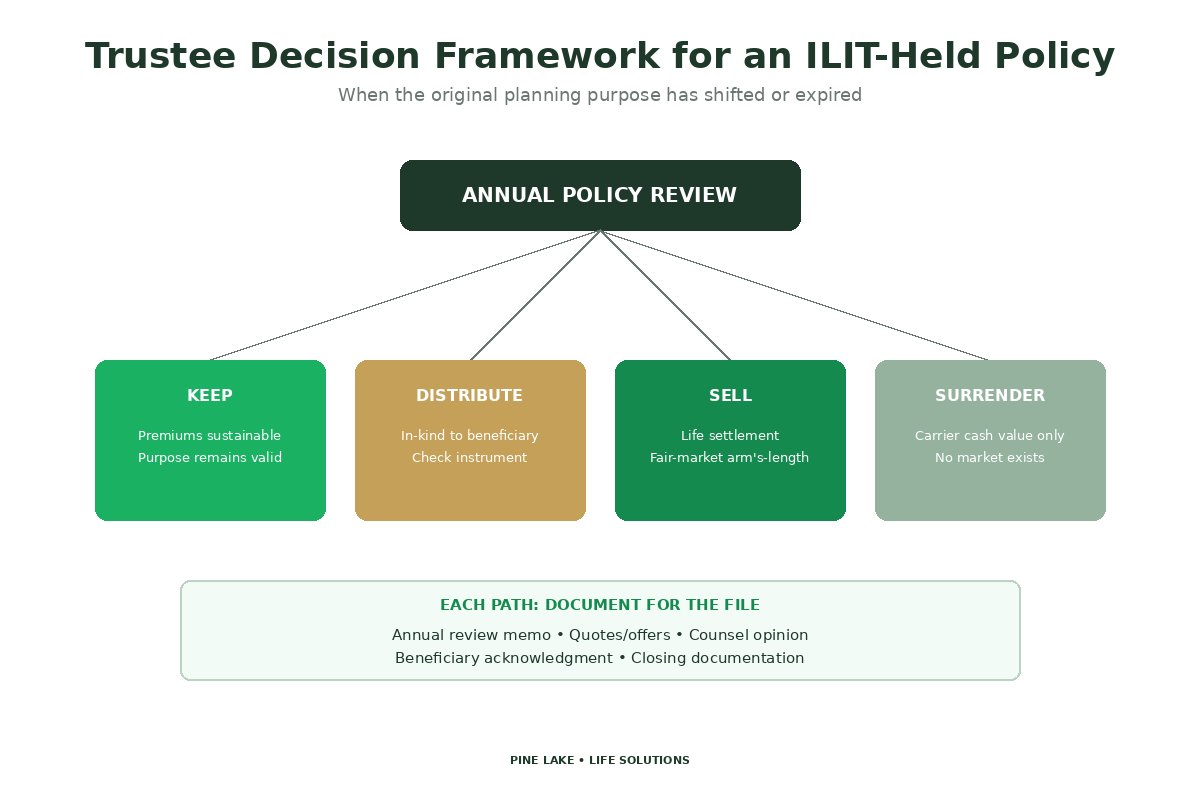
Four exits, in ascending order of how often families overlook them. Surrender to the carrier, which is fastest and pays least. A reduced paid-up election, which cuts face amount to what existing cash value supports, ends premiums, and occasionally drops the total under the burial threshold – see reduced paid-up versus a settlement. Assignment to an irrevocable funeral arrangement, which can move value into an excluded category. And a life settlement, a sale to a licensed institutional buyer that for a qualifying policy pays more than surrender value. Pine Lake Life Solutions does not purchase policies; we provide education and a free policy review.
Selling is wrong when the face amount is under roughly $100,000 and no institutional buyer will bid; when total face value is already under the burial threshold, so the value is already protected and a sale would create countable cash; when the insured is in good health, which produces weak offers or none; when a surviving spouse needs the death benefit; and when the policy is trust-owned or names an irrevocable beneficiary whose consent cannot be obtained in time.
What Care Costs in McDonough Against the Georgia Median
Henry County has been among Georgia’s fastest-growing counties for two decades, and its population aged 65 and over has grown faster than the county as a whole – a wave of residents who arrived in their forties in the 1990s and 2000s and are now aging in place, joined by out-of-state retirees. Median home values in McDonough ran in the low-to-mid $300,000s as of 2026, roughly double the mid-2010s level. That appreciation is the reason many Henry County households have real equity and thin cash, which is the same squeeze in a very different price band from the coastal markets people moved from.
As ranges from cost-of-care survey data of the Genworth and CareScout type carried toward 2026: skilled nursing in the south metro Atlanta corridor that includes McDonough has run roughly $8,500 to $10,000 a month for a semi-private room and roughly $9,500 to $11,500 for a private room, against a Georgia statewide median in the range of $7,800 to $9,000 semi-private. Assisted living in the McDonough and Stockbridge area has run roughly $4,000 to $5,200 a month, near a Georgia median of roughly $4,000 to $4,700, with memory care adding $900 to $1,800. Confirm current pricing with facilities and check quality ratings on the federal Care Compare site.
The supply fact that changes the math: skilled nursing bed capacity in Henry County has not kept pace with the county’s growth, so placement frequently means Stockbridge, Jonesboro, or further into south Atlanta – adding a daily drive for the spouse who visits and narrowing the choices available on 48 hours’ notice from a hospital. Work the arithmetic in nursing home costs in McDonough before assuming a private-pay bridge is survivable.
None of this is legal, tax, or eligibility advice. Send eligibility questions to Henry County DFCS, coverage questions to GeorgiaCares, planning questions to your own elder law attorney, and policy questions to a free review.
Frequently Asked Questions
Where does a McDonough, Georgia family file a long-term-care Medicaid application?
With the Henry County office of the Georgia Division of Family and Children Services, located in McDonough, or online through Georgia Gateway. DFCS decides financial eligibility. The care determination and any waiver slot run separately through the Atlanta Regional Commission Area Agency on Aging, which serves Henry County. Both tracks have to be worked at once.
How long do we have to live in Georgia before we can apply?
There is no waiting period. Georgia requires present residence plus intent to remain, documented with a Georgia license, Henry County voter registration, Georgia vehicle registration, utility accounts, and a homestead exemption filed with the Henry County Tax Commissioner. Still claiming a residency-based property tax break in your former state undercuts that proof and should be resolved first.
What is the difference between CCSP, SOURCE and nursing home Medicaid?
Nursing facility Medicaid pays for institutional care and has no slot limit on the coverage. CCSP and SOURCE are Georgia’s elderly and disabled waiver programs that pay for care at home, and they operate under capacity limits that can mean a wait. If home care is the goal, contact the area agency on aging months before you need it.
Our income is $3,300 a month. Is that too much for Georgia Medicaid?
Georgia caps countable monthly income at 300 percent of the federal SSI benefit rate, roughly $2,900 to $3,000 as of 2026. Income above the cap can be routed through a Qualified Income Trust, sometimes called a Miller trust, and directed to the cost of care. The trust must be properly drafted and funded every single month without a gap.
Why would a gift create a longer penalty in Georgia than up north?
Because the penalty period is calculated by dividing the transferred amount by a state average private-pay nursing home rate, and Georgia’s average rate is lower than in the Northeast. The same $40,000 gift therefore divides into more months of penalty here. It is one of the least intuitive consequences of moving south, and it is worth understanding before helping family financially.
Should we cash in Dad’s old whole life policy to get under $2,000?
Price the alternatives first. Surrender pays the least. A reduced paid-up election stops premiums and can sometimes bring total face value under the burial threshold, which protects the value instead of spending it. An irrevocable funeral assignment can move value into an excluded category. For a larger policy on an insured whose health has declined, a settlement may pay more than surrender.
Find out what your policy is worth — free, confidential, no obligation.
A 15-minute educational review covers your eligibility, every alternative, and a realistic view of what each path would net you.
Related Reading
- Nursing Home Costs Mcdonough Ga
- Life Settlements Mcdonough Ga
- Georgia Medicaid Asset Income Limits
- Sell Life Insurance Policy Clayton County Ga
- Nursing Home Medicaid Spend Down
- Life Insurance Counts Medicaid Asset
- Medicaid Lookback Selling Policy
- Reduced Paid Up Vs Settlement
Pine Lake Life Solutions does not purchase life insurance policies and does not provide legal, tax, or investment advice. Information provided is for educational purposes only. Eligibility for any option, including life settlements, is not guaranteed and depends on individual circumstances, policy terms, underwriting, and market conditions. Consult independent legal, tax, or financial professionals before making decisions regarding a life insurance policy.