
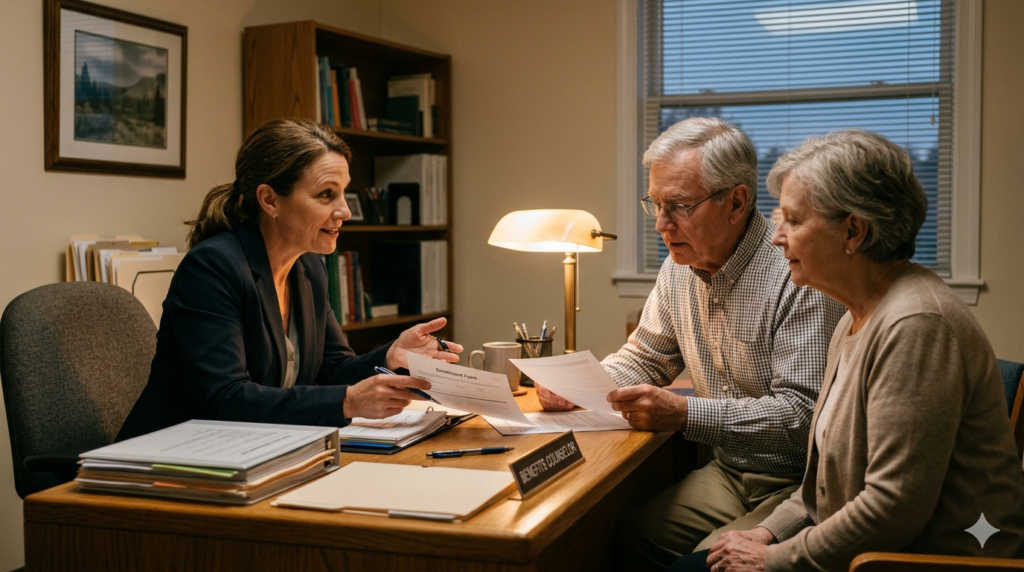
If a veteran with no spouse or dependent child enters a nursing home that Florida Medicaid is paying for, federal law reduces their VA pension to a small monthly amount — historically $90 — and that amount is protected as personal spending money rather than being turned over to the facility. Verify the current figure with the Department of Veterans Affairs, because it is set by federal law and worth confirming. That single rule reshapes the arithmetic for a veteran household, and it is one of several places where VA benefits and Florida Medicaid interact in ways that a general spend-down guide gets wrong. In Leon County — Tallahassee, plus Woodville and Chaires — those interactions come up constantly, because this is a state-capital and university county with a substantial veteran and retired-federal population and comparatively thin retiree infrastructure.
The program you are dealing with is Florida Medicaid, and long-term care runs through Statewide Medicaid Managed Care Long-Term Care — SMMC LTC — overseen by the Agency for Health Care Administration, with financial eligibility determined by the Department of Children and Families and the level-of-care determination handled through the state’s CARES process. This page is organized around the veteran or surviving-spouse case. Every dollar figure is year-stamped as of 2026 and should be confirmed with the named agency. Nothing here is legal, tax, VA-claims or eligibility advice; take those questions to an accredited VA claims representative and a Florida elder law attorney.
In This Article
- Start With the Rule That Changes the Math
- Two Different Asset Tests and Two Different Look-Backs
- The Surviving Spouse Case, Which Is Different Again
- Where You Actually File in Tallahassee: DCF, the ADRC and CARES
- The State Veterans’ Nursing Homes, and Why There Isn’t One Here
- State-Employee Group Life: The Leon County Conversion Problem
- Cost of Care in Leon County, and When Selling a Policy Is Wrong
- Frequently Asked Questions
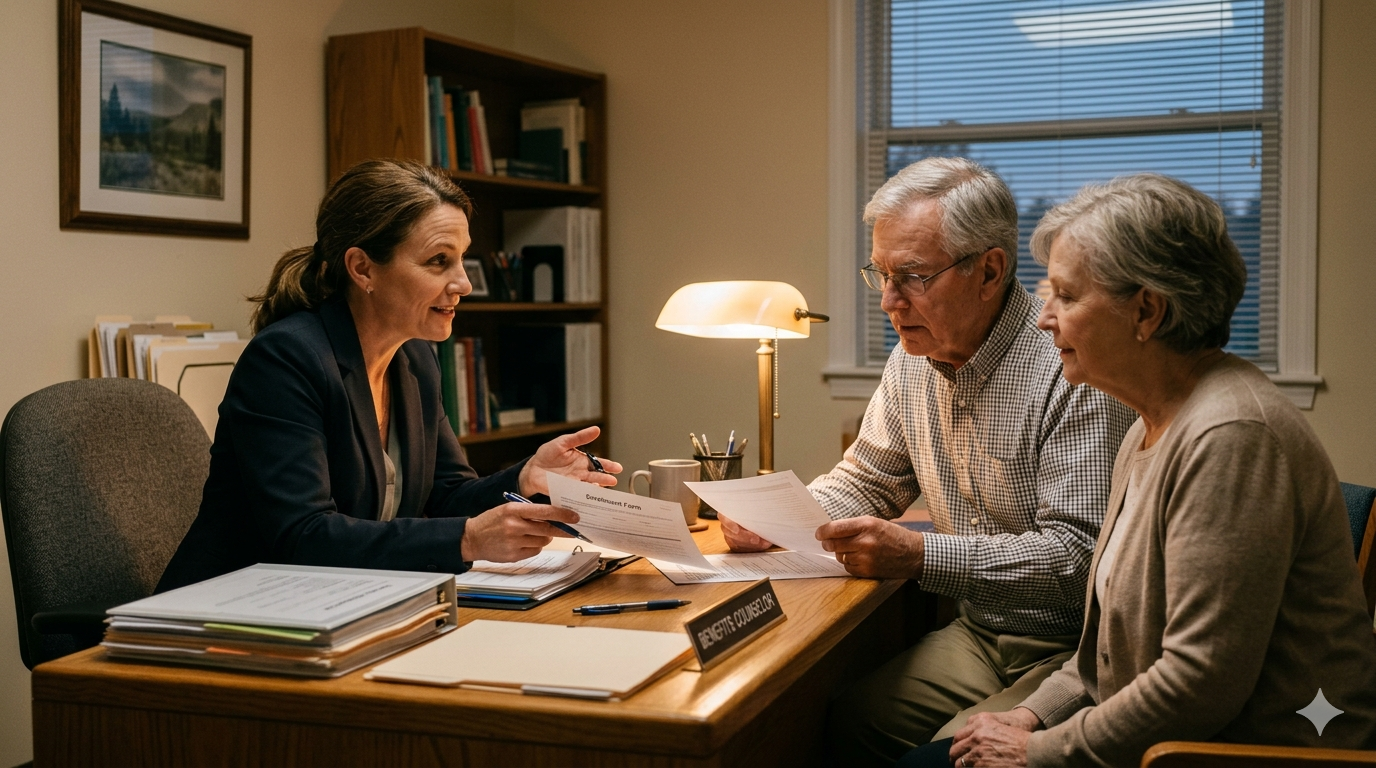
Start With the Rule That Changes the Math
Families plan around the assumption that a VA pension is money the household keeps. Once Medicaid is paying for nursing facility care, that stops being true in a specific way. Under federal law governing VA pension, a veteran with no spouse or dependent child who is in a nursing home for which Medicaid is paying has their pension reduced to a small monthly amount — the figure has been $90 — and that amount is not counted as income for Medicaid purposes and is not applied to the cost of care. It stays with the veteran as personal funds.
Two consequences follow, and both are practical rather than theoretical. First, the veteran in a Medicaid-covered facility ends up with materially more personal spending money than a non-veteran resident, whose personal needs allowance under Florida’s rules is a smaller figure. Over a year that is real money for clothing, a phone, a haircut, or anything the facility does not provide. Second, and more importantly for planning: the strategy of maximizing VA pension income to fund a nursing home stay does not work once Medicaid takes over, because the pension gets reduced. VA pension with Aid and Attendance is a tool for funding care at home or in assisted living, before Medicaid institutional coverage begins. Sequence it accordingly.
If the veteran has a spouse or a dependent child, the reduction rule works differently, and if the benefit is compensation for a service-connected disability rather than a needs-based pension, it is a different program entirely and is not subject to this reduction. Compensation and pension are frequently conflated by families and even by facility staff. Establish which one your parent receives before doing any arithmetic, and confirm the current treatment with the VA and with the DCF caseworker.
Two Different Asset Tests and Two Different Look-Backs
The most common error in veteran households is assuming that qualifying for one program means qualifying for the other. VA pension eligibility and Florida Medicaid eligibility use different tests, different numbers and different look-back periods, and a transfer that helps with one can hurt with the other.
Florida Medicaid applies a $2,000 individual countable-asset limit as of 2026 (verify with DCF), an income cap for institutional and SMMC LTC eligibility set at a multiple of the federal benefit rate — in the neighborhood of $2,900 monthly, verify — above which Florida requires a Qualified Income Trust into which excess income is deposited every month; see how a Qualified Income Trust works. It applies a 60-month look-back on uncompensated transfers, with penalty months calculated from a state divisor tied to average private-pay nursing facility cost.
VA pension applies a net worth limit that combines assets and annual income, indexed each year and sitting in the mid-six figures in recent years — verify the current figure with the VA. It excludes the claimant’s primary residence and a reasonable lot area from that net worth calculation. And it applies its own look-back on asset transfers, which is 36 months rather than sixty, with its own penalty methodology. See the Aid and Attendance asset test, which is the provision most often misunderstood.
The planning collision is direct. A transfer made to get under the VA net worth limit is a transfer Florida Medicaid will see for five years. A structure that satisfies Medicaid may put a veteran over the VA net worth limit. There is no general rule that resolves this — it depends on which program is needed first, how long before the other is needed, and the household’s actual numbers. This is precisely the situation where an accredited VA representative and a Florida elder law attorney need to be talking to each other, and where acting on general internet advice does measurable harm.
The Surviving Spouse Case, Which Is Different Again
A surviving spouse of a wartime veteran may qualify for a VA survivors pension, and with Aid and Attendance if they need help with daily activities. The service requirements attach to the deceased veteran’s service, and there are marriage duration and remarriage rules that determine eligibility. The benefit amount is lower than a veteran’s pension, and the net worth test still applies.
Two features matter for a Leon County household. First, this is the most underclaimed benefit in the whole system. A widow in her eighties living in Tallahassee whose husband served in Korea or Vietnam frequently has no idea she may be eligible, because nobody ever told her, and because she assumes the benefit ended with him. The gating item is documentation: the veteran’s DD-214 or equivalent separation record, the marriage certificate, the death certificate, and current medical evidence of the need for assistance. Reconstructing a separation record for a service member discharged sixty years ago takes time, so start that request before it is urgent.
Second, the survivor’s case creates the sharpest version of the “do not sell the policy” caution on this page. If the surviving spouse is the one who needs care, and there is a life insurance policy on her life, the analysis is one thing. If the veteran is the one needing care and the policy is on his life, the death benefit is very likely the surviving spouse’s principal financial cushion — and in a household where the survivors pension is a few thousand dollars a month at most, selling that death benefit to buy a few months of nursing home care is usually the wrong trade. Run the widow’s or widower’s budget through to the end before anyone considers touching the policy. County veterans service officers assist with these claims at no charge, and using one is the right first step.
| Question | VA pension with Aid and Attendance | Florida Medicaid (SMMC LTC / institutional) |
|---|---|---|
| Who determines eligibility | Department of Veterans Affairs, via an accredited representative or county veterans service officer | Financial: Department of Children and Families. Level of care: CARES, through the ADRC |
| Asset test | A combined net worth limit, indexed annually, excluding the primary residence and a reasonable lot | $2,000 individual countable-asset limit (verify 2026) |
| Income test | Income is part of the net worth calculation; unreimbursed medical expenses reduce countable income | Income cap near 300% of the federal benefit rate; a Qualified Income Trust is required above it |
| Transfer look-back | 36 months, with its own penalty methodology | 60 months, penalty months = amount ÷ state divisor |
| Best used for | Care at home or in assisted living, before institutional Medicaid | Nursing facility care, and ALF or home services through SMMC LTC |
| What happens to the VA pension once Medicaid pays the nursing home | Reduced to a small monthly amount — historically $90 — for a veteran with no spouse or child | That reduced amount is not counted as income and is not applied to care costs |
| Waiting | Claim processing time; documentation is the gating item | ADRC screening and a real SMMC LTC waitlist — call early |

Where You Actually File in Tallahassee: DCF, the ADRC and CARES
Florida splits the process across agencies and families lose weeks not knowing that. Here is the sequence.
Financial eligibility is determined by the Florida Department of Children and Families. Applications are filed through the state’s ACCESS Florida online system, by mail, or with help at a DCF service location; for Leon County residents that means the Tallahassee-area DCF operation. The facility’s business office deals with DCF routinely and is often the most efficient route.
Level of care and program enrollment run through a different door. For SMMC LTC — the managed long-term care program that covers nursing facility care, assisted living facility services and home-based care — a person must be screened through the Aging and Disability Resource Center, which for Leon County and the surrounding North Florida counties is operated by the regional aging services organization headquartered in Tallahassee. The screening establishes priority and places the person on the program’s waitlist, and the state’s CARES program conducts the assessment determining whether nursing facility level of care is met. Call the ADRC first, and call early, because the waitlist is real and position on it depends on when you called and how the priority score was set.
Two Florida facts worth knowing while you wait. Florida’s constitutional homestead protection is strong, and Florida’s Medicaid estate recovery is correspondingly narrow in practice compared with many states, particularly regarding homestead property — confirm the current position with AHCA rather than assuming, and discuss it with a Florida elder law attorney. And Florida has no state income tax, which changes the arithmetic of liquidating a retirement account to fund care compared with doing so in a state that taxes the withdrawal. For free counseling, Florida’s health insurance assistance program is SHINE — Serving Health Insurance Needs of Elders — administered by the Department of Elder Affairs and delivered locally. See our Florida limits page and the spend-down overview.
The State Veterans’ Nursing Homes, and Why There Isn’t One Here
Florida operates a network of state veterans’ nursing homes through the Florida Department of Veterans’ Affairs, and they are a genuinely distinct payment and admission channel — not Medicaid, not ordinary private pay, but a state program with its own eligibility criteria and per-diem structure, typically drawing on VA per diem support plus a resident contribution.
The Leon County problem is geographic: there is no state veterans’ nursing home in Tallahassee. The nearest facilities are to the west in the Panama City area and to the east in the Lake City area, each a substantial drive from Tallahassee. For a family in Woodville or Chaires that means a veteran admitted to a state home is one to two hours from the people who would visit. That is a real cost, because visit frequency is the primary mechanism by which families notice problems, and it should be weighed against the payment advantage rather than ignored.
Availability is also limited and waitlists are real. Contact the Florida Department of Veterans’ Affairs and the Leon County veterans service office directly for current admission criteria and waitlist status. And note the same documentation gate as everywhere else in the VA system: the DD-214 or equivalent, the disability rating history if any, and current medical documentation. Requesting a replacement separation record from the National Archives can take weeks to months, so make that request the day the conversation starts.
The other VA channels are separate again: VA community living centers, and VA-contracted community nursing homes, both with eligibility tied to service-connected disability ratings and clinical need. Those run through the VA health care system rather than the state. Ask the VA social worker at the facility where your parent receives care which channels they may qualify for; the answer is fact-specific and the VA is the only authoritative source for it.
State-Employee Group Life: The Leon County Conversion Problem
Leon County’s economy is dominated by state government and higher education, which produces a distinctive insurance profile: an unusually high share of retirees here hold a group life certificate through the state employee benefits program or a university, rather than an individually owned policy. Group coverage does not behave like an individual policy and the differences decide whether any value exists.
Group certificates generally cannot be sold in their group form. Many reduce sharply at retirement or at a specified age, and some terminate entirely when employment ends. What sometimes creates transferable value is a conversion right — a contractual option to convert the group coverage into an individual permanent policy issued by the carrier, usually without new medical underwriting, within a short window after coverage ends or reduces. Those windows are commonly measured in weeks, they are stated in the certificate, and they are unforgiving once missed. Read what group life conversion means, then find the certificate and read its conversion provision before anything else.
Two related items. If your parent is a retired federal employee — and Tallahassee has a federal workforce alongside the state one — the coverage may be Federal Employees’ Group Life Insurance, which operates under Office of Personnel Management rules including a retirement reduction election and specific rules on whether ownership may be assigned. Those must be confirmed with OPM. And if the coverage is Servicemembers’ or Veterans’ Group Life Insurance, VA rules restrict assignment; confirm the current restrictions with the VA directly rather than with anyone offering to buy something.
Meanwhile, for Medicaid purposes, what matters about any policy is aggregate face value. Florida Medicaid totals the face amounts of every policy the applicant owns, and if that total exceeds the small-policy exclusion threshold — commonly the SSI-derived $1,500 figure, confirm the current Florida number with DCF — the cash surrender value of all of them becomes countable. See how life insurance counts as a Medicaid asset.
Cost of Care in Leon County, and When Selling a Policy Is Wrong
The numbers behind all of it. As of 2026, private-pay skilled nursing in Leon County generally runs in the range of roughly $9,000 to $10,500 a month for a semi-private room and roughly $10,000 to $11,500 for a private room; assisted living generally runs roughly $3,800 to $5,200 monthly at base rate before care add-ons, with memory care commonly $1,200 to $1,800 above that. These are ranges from Genworth-style cost-of-care survey methodology and Florida facility rate data rather than a published county statistic — verify against written quotes. Leon County prices near the Florida median. See our Leon County nursing home costs page.
A supply fact that shapes choice here: Leon County has one of the lower shares of residents over 65 in Florida, because Florida State University, Florida A&M University and Tallahassee Community College hold the median age down. Florida’s dense retiree infrastructure sits in Central and Southwest Florida, not the Big Bend. So the facility supply in Leon County is thinner than a family relocating from Sarasota or Naples would expect, and Tallahassee’s facilities serve a wide rural North Florida draw area — Gadsden, Jefferson, Wakulla, Madison, Taylor and Liberty counties among them — because Tallahassee is the regional medical hub for the Big Bend. Practically: fewer options, and secured memory care is the scarcest of them. Run every candidate through the county filter on CMS Care Compare for staffing hours per resident day, registered nurse coverage and inspection history.
Where a life insurance policy fits is as private-pay months, particularly valuable in Florida because the SMMC LTC waitlist means there is often a gap between needing care and having it funded. A permanent policy has four exits: keep paying, lapse it for nothing, surrender it for cash value, or sell it in a regulated life settlement to a licensed institutional buyer for potentially more than surrender value when the insured’s health has declined materially since issue. Florida regulates life settlements through the Office of Insurance Regulation and has detailed disclosure and rescission requirements; see our Florida licensing page. Pine Lake Life Solutions does not purchase policies — we provide a free policy review that establishes what the contract is worth on each path.
And plainly, when selling is the wrong answer. When a surviving spouse needs the death benefit — the sharpest case in a veteran household, where a survivors pension is modest and the policy is the widow’s or widower’s cushion. Small face amounts: institutional buyers carry fixed underwriting costs, so policies under roughly $100,000 rarely draw a competitive bid, and a burial-sized policy may belong inside a burial exclusion or an irrevocable funeral contract. A policy already inside the exclusion: selling it converts a protected asset into countable cash. A healthy insured: settlement pricing tracks life expectancy, so a robust parent will be quoted little. An unconverted group certificate: not sellable as such; the conversion right is the only path and it expires quickly. A pending application, or an active Qualified Income Trust: proceeds arriving mid-process can create a resource overage in the month they land and interact with the trust in ways requiring an attorney’s attention. And where a VA claim is pending: a lump sum changes VA net worth, and the VA’s 36-month transfer look-back is separate from Medicaid’s — sequence any sale with your accredited VA representative and your Florida elder law attorney, not around them.
Frequently Asked Questions
What happens to my father’s VA pension if Medicaid pays for his nursing home?
Under federal law governing VA pension, a veteran with no spouse or dependent child in a nursing home Medicaid is paying for has the pension reduced to a small monthly amount — the figure has been $90 — and that amount is not counted as income for Medicaid and is not applied to the cost of care. It stays with him as personal funds. Verify the current figure with the VA.
Can he qualify for both Aid and Attendance and Florida Medicaid?
Potentially, but they use different tests and the sequencing matters. VA pension applies a combined net worth limit that excludes the primary residence and a 36-month transfer look-back. Florida Medicaid applies a $2,000 countable-asset limit, an income cap requiring a Qualified Income Trust above it, and a 60-month look-back. A transfer that helps one can hurt the other. Coordinate an accredited VA representative with a Florida elder law attorney.
Where do we actually apply in Tallahassee?
Two places. Financial eligibility goes to the Florida Department of Children and Families, through the ACCESS Florida system or a DCF service location. Level of care and program enrollment go through the Aging and Disability Resource Center serving Leon County and North Florida from Tallahassee, which screens you for the SMMC LTC waitlist, with the state’s CARES program conducting the assessment. Call the ADRC early — the waitlist is real.
Is there a state veterans’ nursing home in Leon County?
No. Florida operates a network of state veterans’ nursing homes, but the nearest to Tallahassee are in the Panama City area to the west and the Lake City area to the east — each a substantial drive. That distance is a real cost, since visit frequency is how families notice problems. Contact the Florida Department of Veterans’ Affairs and the county veterans service office for current criteria and waitlist status.
My mother is a veteran’s widow. Could she qualify for anything?
Possibly a VA survivors pension, with Aid and Attendance if she needs help with daily activities. Eligibility attaches to her late husband’s service, with marriage duration and remarriage rules, and the net worth test still applies. It is among the most underclaimed benefits in the system. The gating items are the DD-214 or equivalent, marriage and death certificates, and current medical evidence. County veterans service officers help at no charge.
Can a Florida state-employee group life certificate be sold?
Not in its group form. Many state and university group certificates reduce sharply at retirement or terminate when employment ends. What sometimes creates transferable value is a conversion right — converting the group coverage to an individual permanent policy, usually without new underwriting, within a short window stated in the certificate. Those windows are commonly weeks. Find the certificate and read the conversion provision first.
What does nursing home care cost in Leon County in 2026?
Plan on roughly $9,000 to $10,500 a month for a semi-private room and roughly $10,000 to $11,500 for a private room, with assisted living generally $3,800 to $5,200 at base rate. These are ranges from cost-of-care survey methodology and Florida facility rate data rather than a published county figure. Leon County prices near the Florida median, and its facility supply is thinner than Florida’s retirement-heavy regions.
Find out what your policy is worth — free, confidential, no obligation.
A 15-minute educational review covers your eligibility, every alternative, and a realistic view of what each path would net you.
Related Reading
- Nursing Home Costs Leon County Fl
- Sell Life Insurance Policy Leon County Fl
- Florida Medicaid Asset Income Limits
- Life Settlement Licensing Florida
- Life Insurance Counts Medicaid Asset
- Nursing Home Medicaid Spend Down
- Veterans Aid Attendance Asset Test
- What Is Group Life Conversion
- Qualified Income Trust Miller
Pine Lake Life Solutions does not purchase life insurance policies and does not provide legal, tax, or investment advice. Information provided is for educational purposes only. Eligibility for any option, including life settlements, is not guaranteed and depends on individual circumstances, policy terms, underwriting, and market conditions. Consult independent legal, tax, or financial professionals before making decisions regarding a life insurance policy.