
Hershey, Pennsylvania is not a city and has no government of its own – it is an unincorporated community in Derry Township, Dauphin County – so the Medical Assistance application for a Hershey resident is filed with the Dauphin County Assistance Office in Harrisburg. Families lose weeks looking for a Hershey borough office that does not exist, and the township building cannot help either. Township government handles roads and zoning. Medical Assistance eligibility is a state function delivered through county assistance offices.
The program is Pennsylvania Medical Assistance. For long-term services and supports, Pennsylvania delivers care through Community HealthChoices, a managed care program covering nursing facility residents and people receiving services at home who meet a nursing-facility level of care. Financial eligibility is still determined by the county assistance office; the managed care organization comes after.
What follows is the interview in the order the caseworker asks it, the document that answers each question, and one Pennsylvania rule that no other state on this list has and that families in Derry Township should understand before a parent is admitted anywhere. This page is education only, not legal, tax, or eligibility advice.
In This Article
- Where the application goes, and the three offices to have on hand
- Question: what level of care, and does Community HealthChoices apply?
- Question: what are the countable resources? Pennsylvania has more than one limit
- Question: how much life insurance is there?
- Question: what was transferred in the last sixty months?
- Question: what is the income, and what will the family actually be billed?
- The question the caseworker will not ask: Pennsylvania’s filial support law
- Estate recovery and the Derry Township house
- Frequently Asked Questions
Where the application goes, and the three offices to have on hand
The Dauphin County Assistance Office, part of the Pennsylvania Department of Human Services and located in Harrisburg, takes the Medical Assistance application for anyone with a Derry Township or Hershey address. Applications can also be submitted through COMPASS, Pennsylvania’s online benefits system, but the county assistance office still owns the case and still issues the document requests.
The Dauphin County Area Agency on Aging, also in Harrisburg, runs the county’s aging services network and performs assessments and care management functions in the long-term services system. It is the first call for a family weighing home care against a facility.
APPRISE is Pennsylvania’s State Health Insurance Assistance Program, delivered through the Area Agencies on Aging. It provides free, independent counseling on Medicare, Medigap and the interaction between Medicare and Medical Assistance. It sells nothing.
For anything involving an insurance product, the Pennsylvania Insurance Department is the regulator that licenses carriers, producers, and life settlement providers and brokers operating in the Commonwealth. Verifying a license is free; see Pennsylvania life settlement licensing for what to look for.
One local reality shapes how most Hershey families enter this system: Penn State Health Milton S. Hershey Medical Center, an academic medical center located in Hershey itself, is the region’s dominant hospital. A very large share of Derry Township families hear the words “skilled nursing placement” for the first time from a Hershey Medical Center case manager during a discharge conversation, on short notice, with a bed available somewhere and a decision expected that afternoon. Knowing the questions in advance is how you avoid deciding under that pressure.
Question: what level of care, and does Community HealthChoices apply?
The caseworker establishes the setting first. Nursing facility care and home and community-based services both run through Community HealthChoices for eligible adults, but the financial determination, the level-of-care determination and the enrollment steps are separate processes that proceed on separate clocks.
The document that answers this is a level-of-care assessment. For a facility admission, the nursing home initiates it. For services at home, an independent assessment is arranged through the state’s enrollment process. The financial determination from the Dauphin County Assistance Office runs in parallel, and a case can clear one and stall on the other.
Ask about the requested effective date. Pennsylvania allows retroactive Medical Assistance coverage for a limited period preceding the application month when the applicant would have been eligible during it. A Hershey Medical Center bill or a nursing facility bill from the prior month is precisely what that retroactive window exists for, and it is routinely left unclaimed because nobody asked.
Question: what are the countable resources? Pennsylvania has more than one limit
For long-term care Medical Assistance, Pennsylvania applies a countable-resource limit of $2,000 for a single applicant as of 2026. Certain non-long-term-care Medical Assistance categories use a different and somewhat higher resource standard – a figure commonly cited around $2,400 for one person. Confirm both figures with the Dauphin County Assistance Office, because which limit applies depends on which category the case is filed under, and the wrong assumption changes the entire spend-down plan.
Countable: checking and savings, certificates of deposit, brokerage accounts, savings bonds, a second vehicle, real property other than the homestead, and the cash surrender value of life insurance above the exclusion line. Retirement account treatment depends on whether the account is in payout status.
Excluded: the home while the applicant intends to return or a spouse or dependent lives there, subject to the home equity ceiling; one vehicle; household goods and personal effects; and an irrevocable burial reserve or prepaid funeral arrangement within Pennsylvania’s limits.
Derry Township changes the equity picture relative to the county as a whole. Dauphin County’s countywide median home value is held down by the City of Harrisburg; Derry Township and the Hershey area sit well above that county median, closer to the values in the affluent West Shore suburbs across the river. A paid-off Hershey house is therefore a bigger equity number than the county statistics suggest, and it is worth having the assessed value and a realistic market estimate in hand before the first appointment.
Documents: twelve months of statements on every account, the most recent Derry Township and Dauphin County tax bills, vehicle titles, and burial reserve documentation.
Question: how much life insurance is there?
The caseworker asks for the face value of every life insurance policy on the applicant’s life, from every carrier, added together. Pennsylvania, like most states, disregards cash surrender value when that aggregate face amount is at or below the exclusion threshold – commonly $1,500. Confirm the figure the Dauphin County Assistance Office applies in 2026. Above the threshold, the entire cash surrender value of every policy counts as an available resource against a $2,000 limit.
That aggregation catches people who think they are fine. Two $5,000 policies bought decades apart are a $10,000 aggregate face value, over the line, and every dollar of accumulated cash value in both is countable.
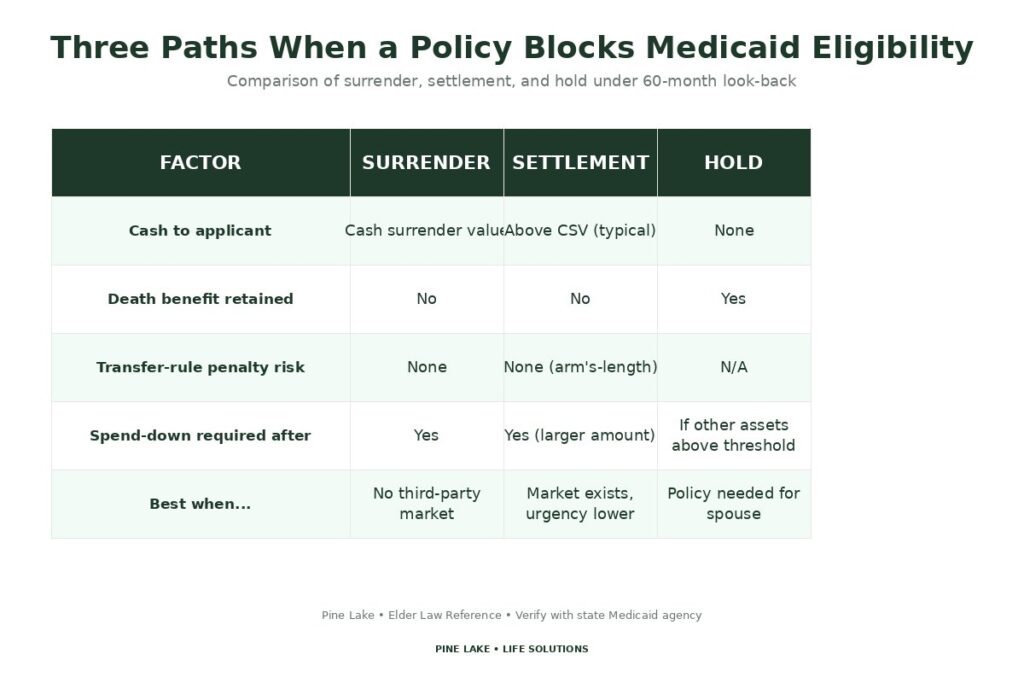
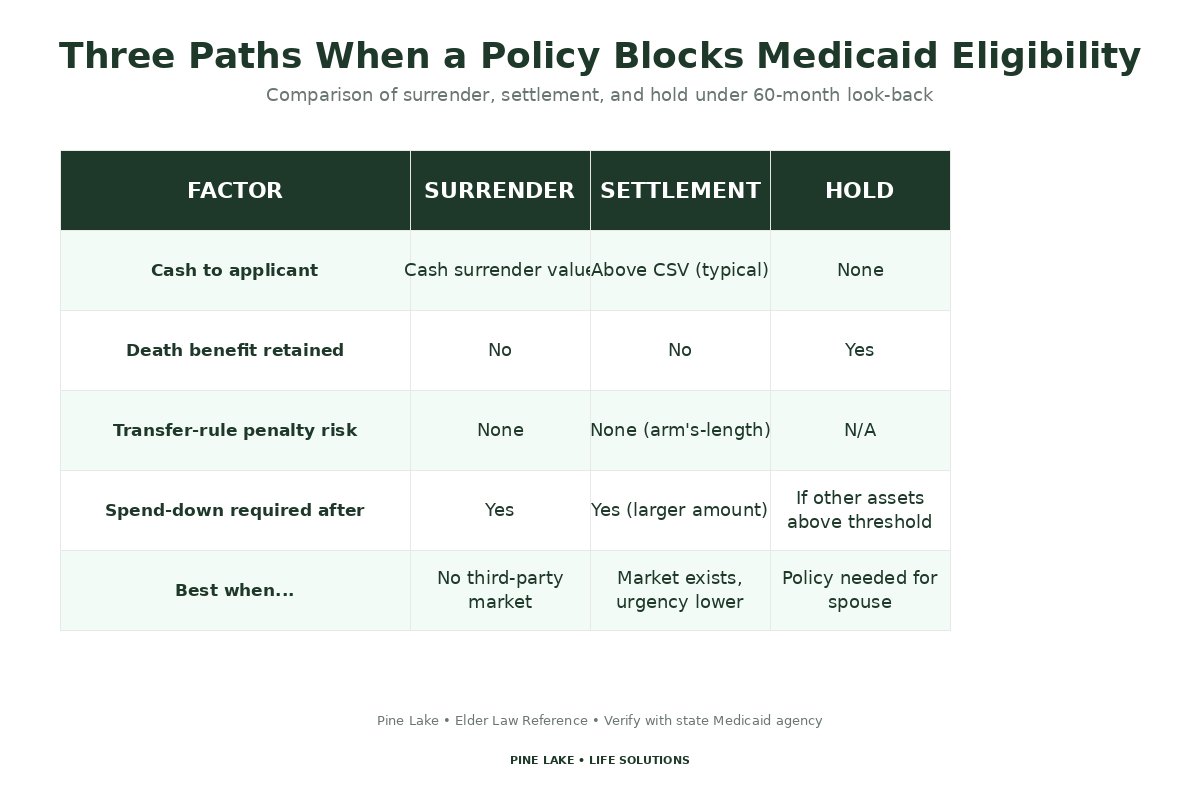
Four ways out, and they are not equivalent:
- Surrender. The carrier’s cash value, in cash, immediately countable. Simple and usually the least valuable option on a policy insuring someone in poor health.
- Reduced paid-up. Converts to a smaller fully paid permanent death benefit with no further premiums, preserving something for a beneficiary.
- Irrevocable burial reserve or funeral trust. Converts countable value into an excluded burial arrangement within Pennsylvania’s limits – money the family will spend anyway.
- Life settlement. A sale of the policy to a Pennsylvania-licensed provider. On an insured age 65 or older whose health has declined, this frequently produces more than surrender value. Our page on what a policy can actually sell for explains the pricing drivers, and selling a policy after 65 covers who qualifies.
Do not sell when: the aggregate face value is small enough that the policy already sits inside the burial exclusion, since selling converts an excluded asset into countable cash; the insured is in good health, because settlement pricing follows life expectancy; a surviving spouse depends on the death benefit; or the proceeds would arrive as countable cash in a month that damages the case. Timing relative to the application date is the entire game, and it is a Pennsylvania elder law attorney’s question, not a website’s.
| Care setting | Hershey / Harrisburg area monthly (2026) | Pennsylvania median (2026) | Months $110,000 covers |
|---|---|---|---|
| Skilled nursing, semi-private room | $11,000 – $12,400 | $11,200 – $12,600 | 9 – 10 |
| Skilled nursing, private room | $11,800 – $13,400 | $12,000 – $13,600 | 8 – 9 |
| Personal care home / assisted living | $4,800 – $6,000 | $5,000 – $6,000 | 18 – 22 |
| Home health aide, about 44 hours per week | $5,600 – $6,800 | $5,600 – $6,800 | 16 – 19 |

Question: what was transferred in the last sixty months?
Pennsylvania applies the 60-month look-back. The caseworker requests five years of records and reads them against the current asset picture. An uncompensated transfer inside that window creates a period of ineligibility for long-term care payment, calculated by dividing the transferred value by a state-published average daily or monthly private-pay nursing facility rate. Ask the county assistance office for the current 2026 figure.
Documents: sixty months of statements on every account, any deed recorded with the Dauphin County Recorder of Deeds, vehicle title transfers, and an explanation of any large withdrawal. Ordinary living expenses need no defense; undocumented cash does.
Patterns that cause Pennsylvania denials: deeding the house to a child, which transfers the full value; paying a relative for care without a written personal care agreement executed in advance; and cashing in a policy and distributing the proceeds among the children, which converts a resource problem into a transfer penalty. The look-back and selling a policy covers why a sale at fair market value is not a gift, even though the resulting cash is countable.
Question: what is the income, and what will the family actually be billed?
Pennsylvania is not an income-cap state for nursing facility Medical Assistance, but income determines the resident’s monthly cost-of-care contribution: nearly all of it goes to the facility, minus a personal needs allowance and, if a spouse remains at home, a monthly maintenance needs allowance.
Award letters, not estimates: Social Security, pension, annuity payments, VA benefits, and rental income. In the Harrisburg region a large share of applicants have Commonwealth of Pennsylvania or school district pensions with survivor elections attached, and those elections change the spousal calculation.
The runway arithmetic matters because determinations take weeks. As of 2026, a semi-private skilled nursing room in the Hershey and greater Harrisburg market generally runs in the range of $11,000 to $12,400 per month, with a private room roughly $11,800 to $13,400. Pennsylvania’s licensure structure is worth understanding here: much of what other states call assisted living is licensed in Pennsylvania as a personal care home, a distinct category with different staffing and service requirements, and personal care homes in the Hershey area typically run $4,800 to $6,000 per month. Pennsylvania statewide medians as of 2026 sit at roughly $11,200 to $12,600 for a semi-private nursing room and $5,000 to $6,000 for assisted living or personal care. These are survey-derived ranges, not quotes. Our page on nursing home costs in Hershey, Pennsylvania walks the month-by-month math.
The question the caseworker will not ask: Pennsylvania’s filial support law
This belongs on a Pennsylvania page and on almost no other state’s. Pennsylvania has a filial support law – a statute making certain family members, including adult children, potentially responsible for an indigent parent’s care costs. Unlike most states with similar statutes on the books, Pennsylvania courts have actually enforced it. The best-known example is the Pennsylvania Superior Court’s 2012 decision in Health Care and Retirement Corporation of America v. Pittas, in which a nursing home successfully pursued an adult son for his mother’s unpaid bill.
What that means practically for a Derry Township family: an unpaid nursing facility balance is not automatically the resident’s problem alone. A facility that is not being paid, and that sees a Medical Assistance application that was filed late or denied for a transfer penalty, has a legal avenue in Pennsylvania that it does not have in Ohio or Michigan. This is not a reason to panic. It is a reason to file the application promptly, to document every transfer, and to get a Pennsylvania elder law attorney involved before a penalty period is imposed rather than after.
It is also a reason not to treat a life insurance policy as a spare part. Preserving a death benefit that pays a named beneficiary outside probate can be exactly the liquidity a family needs to settle a balance that would otherwise sit unpaid. If you want a plain read on what an in-force policy is worth before making any decision, Pine Lake Life Solutions offers a free policy review – education only. We do not determine eligibility and we do not give legal advice.
Estate recovery and the Derry Township house
Pennsylvania operates a Medical Assistance estate recovery program administered through the Department of Human Services. After the death of a person who received long-term care services at 55 or older, the Commonwealth may present a claim against the probate estate. Pennsylvania’s program has generally been limited to probate assets rather than expanded to non-probate transfers, but the claim is real and it is asserted in the estate administration.
Recovery is deferred while a surviving spouse is living and while a minor or disabled child survives, and hardship waiver provisions exist. Certain transfers of a home – to a caregiver child whose care delayed institutionalization, or to a sibling with an equity interest – are recognized exceptions rather than penalized transfers. Whether any of them fit a particular Hershey property is a legal question with a Dauphin County Orphans’ Court answer, not a checklist answer.
Carry one structural fact into that meeting. A life insurance death benefit paid to a named living beneficiary passes outside the probate estate and is therefore generally beyond a probate estate claim. Cash sitting in a bank account at death is inside the estate and is not. That asymmetry, combined with Pennsylvania’s filial support exposure, is a genuine argument for looking hard at preserving a policy rather than surrendering it reflexively – and for having that conversation with counsel before anyone signs a surrender form.
Frequently Asked Questions
Where does a Hershey, Pennsylvania resident file a Medical Assistance application?
With the Dauphin County Assistance Office in Harrisburg. Hershey is an unincorporated community in Derry Township, Dauphin County, with no municipal government of its own, so there is no Hershey office to apply at. Applications can also be filed through COMPASS, Pennsylvania’s online benefits system, but the county assistance office processes the long-term care case.
What county is Hershey, Pennsylvania in?
Dauphin County. Hershey is a census-designated place within Derry Township in Dauphin County, roughly a dozen miles east of Harrisburg. Because Hershey is not an incorporated borough or city, the offices that matter for Medicaid are the Dauphin County Assistance Office in Harrisburg and the Dauphin County Area Agency on Aging, also in Harrisburg.
What is Pennsylvania’s Medicaid asset limit for long-term care in 2026?
As of 2026 the countable-resource limit for a single long-term care applicant is $2,000. Certain non-long-term-care Medical Assistance categories use a different and somewhat higher resource standard, commonly cited around $2,400 for one person. Which limit applies depends on the category the case is filed under, so confirm both figures with the Dauphin County Assistance Office.
Can adult children be billed for a parent’s nursing home bill in Pennsylvania?
Pennsylvania has a filial support law that can make adult children responsible for an indigent parent’s care costs, and Pennsylvania courts have enforced it, most visibly in the Superior Court’s 2012 Pittas decision. That makes prompt, well-documented Medical Assistance filing more urgent in Pennsylvania than in most states. Consult a Pennsylvania elder law attorney rather than assuming exposure or safety.
Does life insurance count against Pennsylvania Medical Assistance?
It can. Pennsylvania aggregates the face value of all policies on the applicant’s life. If the combined face amount exceeds the exclusion threshold, commonly $1,500, the entire cash surrender value of every policy becomes a countable resource. Two modest policies bought decades apart can easily total over the line together even though neither would alone.
What is a personal care home in Pennsylvania?
Pennsylvania licenses much of what other states call assisted living as a personal care home, a distinct category with its own staffing and service requirements, alongside a separate assisted living residence license. Personal care homes in the Hershey area typically run $4,800 to $6,000 per month as of 2026. The licensure difference affects what services are provided, so ask which license a building holds.
What does skilled nursing cost in the Hershey area in 2026?
As of 2026 a semi-private skilled nursing room in the Hershey and greater Harrisburg market generally runs in the range of $11,000 to $12,400 per month, with a private room roughly $11,800 to $13,400. Those figures sit close to Pennsylvania statewide medians. These are survey-derived ranges, so contact specific facilities for binding pricing.
Find out what your policy is worth — free, confidential, no obligation.
A 15-minute educational review covers your eligibility, every alternative, and a realistic view of what each path would net you.
Related Reading
- Nursing Home Costs Hershey Pa
- Life Settlements Hershey Pa
- Pennsylvania Medicaid Asset Income Limits
- Life Settlement Licensing Pennsylvania
- Sell Life Insurance Policy Berks County Pa
- Nursing Home Medicaid Spend Down
- Life Insurance Counts Medicaid Asset
- How Much Can I Get For My Life Insurance Policy
- Over 65 Sell Policy
- Medicaid Lookback Selling Policy
Pine Lake Life Solutions does not purchase life insurance policies and does not provide legal, tax, or investment advice. Information provided is for educational purposes only. Eligibility for any option, including life settlements, is not guaranteed and depends on individual circumstances, policy terms, underwriting, and market conditions. Consult independent legal, tax, or financial professionals before making decisions regarding a life insurance policy.