

Nearly every assumption a family in Essex, Connecticut brings to a nursing home spend-down is wrong in a specific, costly way – starting with the belief that a county office handles it. Connecticut abolished county government in 1960. No county in this state runs Medicaid eligibility, and Middlesex County has no employees to call. The application goes to the Connecticut Department of Social Services (DSS), which serves Essex through its regional office in Middletown, or online through the state’s ConneCT portal.
The program you are applying for is HUSKY C, the Medicaid coverage group for people who are aged, blind or disabled, which is what pays for long-term care. The home care alternative is the Connecticut Home Care Program for Elders (CHCPE). Both are administered by DSS, and Connecticut sets one of the tightest asset limits in the country – about $1,600 for a single applicant as of 2026, not the $2,000 quoted in national articles. Verify that figure with DSS before you rely on it.
What follows is organized as corrections, because in a town this small the same eight beliefs circulate at every gathering and each one has cost somebody money. Nothing here is legal, tax or eligibility advice; a Connecticut elder law attorney and the free CHOICES counselors at the Area Agency on Aging are the right people to check your specific facts against.
In This Article
- Myth 1: “Middlesex County Handles It”
- Myth 2: “The Asset Limit Is $2,000”
- Myth 3: “I Can Give Away $19,000 a Year – That’s the Legal Limit”
- Myth 4: “Medicare Will Pay for the Nursing Home”
- Myth 5: “The House Is Safe”
- Myth 6: “Life Insurance Doesn’t Count”
- Myth 7: “Essex Costs About What the Rest of Connecticut Costs”
- Myth 8: “If the Policy Counts, We Should Just Sell It”
- Frequently Asked Questions

Myth 1: “Middlesex County Handles It”
Connecticut is one of only two states with no functioning county government. The counties were dissolved in 1960 and survive only as geographic and judicial labels; since 2022 the federal government has used Connecticut’s nine planning regions instead of counties for statistical purposes, and Essex falls in the Lower Connecticut River Valley Planning Region. None of those entities determines Medicaid eligibility.
Everything is state-run. The Connecticut Department of Social Services takes the long-term-care application and does the financial determination; the DSS regional office serving Essex is in Middletown, about 20 miles up Route 9. Level-of-care and home-care assessments run through the Connecticut Home Care Program for Elders and the regional Area Agency on Aging rather than a town office. Essex Town Hall can point you to the senior center and to the town’s social services contact, but it cannot approve anything.
The Area Agency on Aging for Essex is Senior Resources Agency on Aging, based in Norwich, which covers the Middlesex and New London county towns of southeastern Connecticut. It is also where the free CHOICES counselors sit – CHOICES is Connecticut’s State Health Insurance Assistance Program. Use it; it costs nothing and the counselors see these cases daily.
Myth 2: “The Asset Limit Is $2,000”
It is lower in Connecticut. The HUSKY C countable-asset limit for a single applicant has been about $1,600 as of 2026 – among the lowest in the nation, and $400 tighter than the figure almost every national spend-down article quotes. A married couple with both spouses applying has its own limit, and a couple with one spouse at home falls under the federal spousal impoverishment rules instead, which protect a Community Spouse Resource Allowance measured in the tens of thousands. Confirm all three figures with DSS.
Two corrections ride along with this. First, “countable” is doing a lot of work: the home you live in, one vehicle, household goods, a burial plot and a properly structured irrevocable funeral contract are generally excluded, so the $1,600 test is not applied to everything you own. Second, being over the limit is not the same as being ineligible. Connecticut applies a spend-down: excess resources can be spent on the applicant’s own legitimate needs – unpaid medical bills, dental work, hearing aids, home repairs, an accessible vehicle – and eligibility begins when the excess is gone. See our overview of how a nursing home spend-down works.
A third correction that saves households real money: CHCPE has both a Medicaid-funded portion and a state-funded portion, and the state-funded portion uses substantially higher asset limits with a cost share. Being over $1,600 does not automatically shut you out of home care. Ask DSS or Senior Resources for the current state-funded limits.
Myth 3: “I Can Give Away $19,000 a Year – That’s the Legal Limit”
This is the single most expensive confusion in elder care, and it comes from mixing two unrelated bodies of law. The annual figure people remember is the federal gift tax annual exclusion, an IRS rule about whether a gift has to be reported on a gift tax return. Medicaid has nothing to do with it.
For HUSKY C long-term care, DSS reviews 60 months of financial history before the application date. Any gift, any sale below fair market value, adding a child to a deed, forgiving a loan, or paying a grandchild’s tuition can be treated as an improper transfer. The penalty is a period of ineligibility computed by dividing the transferred amount by Connecticut’s published average monthly private-pay nursing facility cost, and the penalty period does not start when the gift was made – it starts when the applicant would otherwise have qualified. That is the cruelty of the design: the ineligibility lands after the money is already gone. Read how the look-back period works before you move a dollar.
Connecticut is known among elder law practitioners for scrutinizing transfers closely and for a high rate of transfer-related denials and appeals. Documentation of every large withdrawal over five years – not just the ones you think matter – is the practical defense.
Myth 4: “Medicare Will Pay for the Nursing Home”
Medicare pays for a maximum of 100 days of skilled nursing facility care per benefit period, and only after a qualifying hospital stay, and only while the resident continues to need and benefit from daily skilled care. Days 1 through 20 have no coinsurance; from day 21 onward there is a substantial daily coinsurance amount that Medicare adjusts every year. Custodial care – help with bathing, dressing, eating, moving, memory supervision – is not skilled care and Medicare does not cover it at all.
In practice, families in Essex discover this around week three, when the facility’s discharge planner explains that Medicare coverage is ending because the resident has “plateaued.” At Connecticut prices the switch from Medicare to private pay costs a household roughly $500 a day overnight.
A Medicare Advantage plan does not change the underlying rule, though it changes the authorization process. A long-term care insurance policy, if one exists, is the thing to find immediately – along with any life insurance policy that might carry an accelerated death benefit or chronic illness rider, which can pay while the insured is alive and costs nothing to invoke. Free CHOICES counseling through Senior Resources will read the Medicare side with you.
| What families believe | What actually applies in Essex, CT (2026 – verify) |
|---|---|
| Middlesex County processes the application | Connecticut has no county government; DSS does, via its Middletown regional office |
| Asset limit is $2,000 | About $1,600 for a single HUSKY C applicant |
| Gifts under the annual gift tax figure are safe | Unrelated rule; DSS reviews 60 months of transfers |
| Medicare covers the nursing home | Up to 100 days after a qualifying stay, with coinsurance from day 21 |
| The house is protected forever | Excluded while occupied; subject to estate recovery later |
| Life insurance is not counted | Excluded only if combined face value is $1,500 or less |
| Essex costs the state average | Shoreline assisted living commonly $6,500 – $9,000/month |
| Selling the policy is always best | Wrong for small face amounts, healthy insureds, or a spouse who needs it |
Myth 5: “The House Is Safe”
Half true, and the half that is false is the half that matters to the children. The principal residence is generally an excluded asset while the applicant lives there or documents an intent to return, and it stays protected while a spouse, a minor child, or a disabled child lives in it. That is the true half.
The false half is what happens later. Connecticut, like every state, is required to operate a Medicaid estate recovery program, and Connecticut also uses liens in certain circumstances. After the resident’s death – and after a surviving spouse’s death, in many fact patterns – the state can assert a claim against the estate for what it paid. In Essex that exposure is unusually large in dollar terms, because Essex home values run well above the Connecticut median: figures in the range of roughly $600,000 to $750,000 for Essex as of 2026 against a Connecticut median closer to $400,000. See how estate recovery works.
Do not “just put the house in the kids’ names.” That is a transfer, it triggers the 60-month look-back, it can destroy the step-up in basis for capital gains, and it exposes the house to the children’s creditors and divorces. A Connecticut elder law attorney can tell you which of the narrow, legitimate structures – a life estate, an irrevocable trust funded early, a caretaker child transfer – actually applies to your facts.
Myth 6: “Life Insurance Doesn’t Count”
This one is false in a very specific and easy-to-trip-over way. Medicaid programs aggregate the face value of every life insurance policy on the insured. If the combined face value is at or under a small threshold – $1,500 in Connecticut as of 2026 – the policies are excluded entirely and their cash value is ignored. Go one dollar over, and the entire cash surrender value of all of them becomes a countable resource, measured against a $1,600 asset limit. Two small $1,000 burial policies bought decades apart are enough to cross the line. Our page on whether life insurance counts as a Medicaid asset works the arithmetic.
Term insurance has no cash value and so is generally not a countable resource, though DSS will still ask about it. Whole life and universal life are where the problem lives.
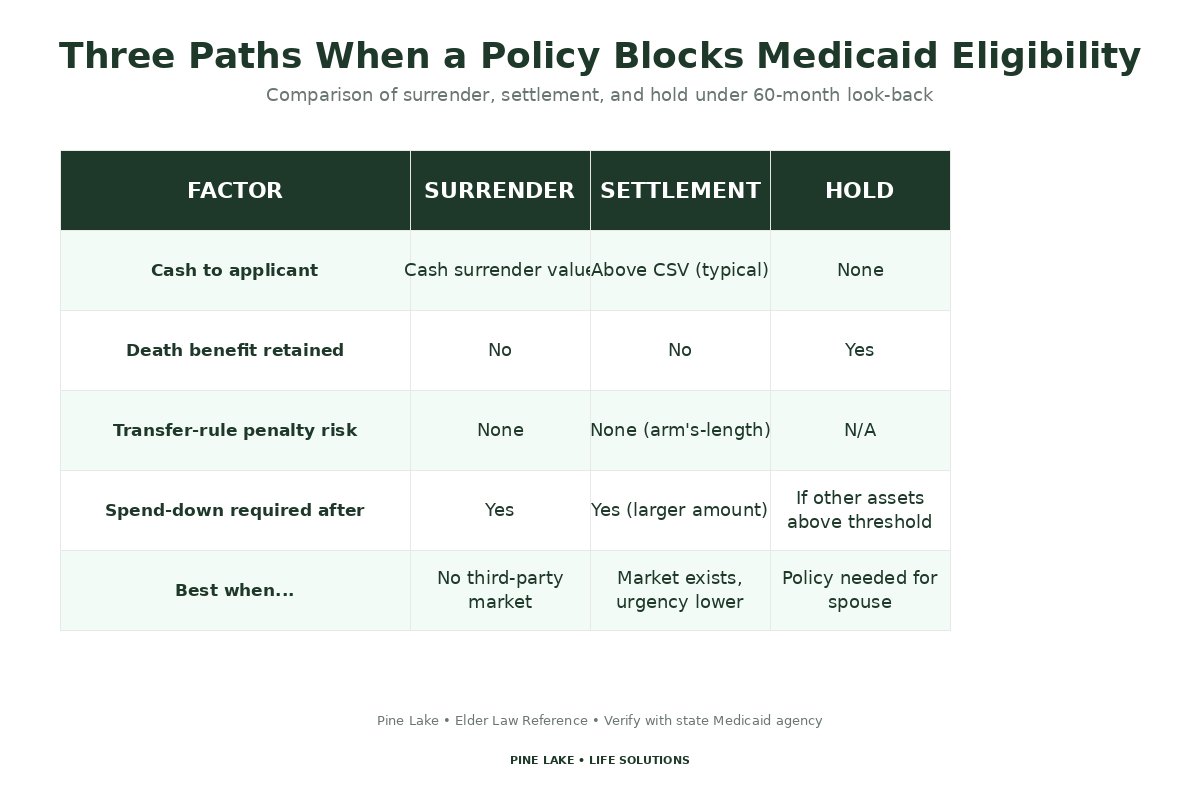
Surrendering the policy to the carrier is only one of four exits, and it is usually the worst one, because cash surrender value is typically a small fraction of what a policy is worth. A reduced paid-up election keeps a smaller death benefit with no further premiums and shrinks countable cash value. An irrevocable funeral trust converts cash into an exempt burial purpose. A life settlement – selling the policy to a licensed institutional buyer – has historically paid multiples of surrender value. Compare the first against the last in reduced paid-up versus a settlement.
Myth 7: “Essex Costs About What the Rest of Connecticut Costs”
Connecticut is one of the most expensive long-term care markets in the United States, and the shoreline is at the top of it. The last widely published national cost-of-care survey put Connecticut near $13,200 a month for a semi-private nursing home room and near $14,600 for a private room. Carried forward at the 4% to 6% annual increases that series has shown, that implies roughly $15,500 to $17,500 semi-private and $17,000 to $18,500 private as of 2026. Assisted living statewide lands in the range of roughly $6,200 to $7,000, and shoreline and continuing-care communities in the Essex, Old Saybrook and Old Lyme corridor commonly price above that, in the $6,500 to $9,000 range. Treat all of these as ranges and get written pricing.
Two Essex-specific facts change the math. First, this is one of the oldest towns in Connecticut by age structure – median age around 55, with roughly a third of residents 65 or older, against a statewide share near 18%. Demand for a small number of beds is intense. Second, there is no skilled nursing facility inside Essex itself, which is a town of three villages – Essex Village, Centerbrook and Ivoryton – so placement realistically means Old Saybrook, Westbrook, Middletown or further. For the month-by-month runway, see nursing home costs in Essex.
Myth 8: “If the Policy Counts, We Should Just Sell It”
Not always, and here are the four cases where selling is the wrong answer. The face amount is small. Below roughly $100,000 the secondary market generally will not make an offer worth the paperwork, and a reduced paid-up election or a funeral trust is a better use of the same asset. The combined face value already sits inside the $1,500 exclusion. Selling converts an excluded asset into countable cash – exactly backwards. The insured is in good health for their age. Offers are driven by life expectancy; a healthy 78-year-old will see compressed or no offers. A surviving spouse needs the death benefit. If her income after his death drops to one Social Security check and a reduced survivor pension while the Essex property taxes keep coming, the policy is the plan, not a surplus asset.
Where a sale does fit: a large policy with premiums the household can no longer carry, an insured whose health has declined materially since issue, and no one who needs the death benefit. In that case the alternative to a sale is usually lapse, and lapse pays nothing to anyone.
Pine Lake Life Solutions provides education and a free, no-obligation policy review. We do not purchase policies and are not licensed in every state. Connecticut life settlement providers and brokers are licensed by the Connecticut Insurance Department; verify any party’s license there before signing. See Connecticut licensing, Connecticut settlement taxes, and life settlements in Essex. Call (305) 209-7183.
Frequently Asked Questions
Which office takes a Medicaid application from Essex, Connecticut?
The Connecticut Department of Social Services, not a county office – Connecticut abolished county government in 1960. Essex is served by the DSS regional office in Middletown, and applications can also be filed through the state’s online portal. Senior Resources Agency on Aging in Norwich is the Area Agency on Aging and provides free CHOICES counseling for Essex residents.
Is Connecticut’s asset limit really lower than other states?
Yes. The HUSKY C countable-asset limit for a single applicant has been about $1,600, one of the lowest in the country, against the $2,000 most states use. Married couples fall under different rules, including federal spousal impoverishment protections when one spouse stays home. Confirm the current 2026 figures directly with the Department of Social Services.
Can I give money to my children before applying?
Not safely. DSS reviews 60 months of financial history, and gifts or below-market sales in that window create a penalty period calculated from Connecticut’s average private-pay nursing facility cost. The penalty starts when the applicant would otherwise qualify, meaning after the money is spent. The federal gift tax annual exclusion is a tax rule and offers no Medicaid protection.
How much does a nursing home cost near Essex in 2026?
Carrying the last published national cost-of-care survey for Connecticut forward at its historical rate of increase suggests roughly $15,500 to $17,500 a month for a semi-private room and $17,000 to $18,500 private as of 2026. Shoreline assisted living commonly runs $6,500 to $9,000. These are ranges – request written pricing from each facility.
Does my mother’s small burial policy count against her?
It depends on the total. Connecticut aggregates the face value of every policy on the insured and excludes them only if the combined face value is $1,500 or less. Two $1,000 policies together exceed that, which makes the entire cash surrender value of both countable against an asset limit near $1,600. Get in-force illustrations for every policy.
Can Connecticut take the Essex house after she dies?
The state operates a Medicaid estate recovery program and can assert a claim against the estate for benefits paid, and it uses liens in some situations. The residence is excluded while she lives there or intends to return, and while a spouse or disabled child occupies it. Because Essex property values are high, ask a Connecticut elder law attorney about the exposure.
Does Pine Lake buy life insurance policies in Connecticut?
No. Pine Lake Life Solutions does not purchase policies and is not licensed in every state. We provide education and a free, no-obligation review that tells you whether a policy has secondary-market value and how that compares with a reduced paid-up election, a funeral trust, or keeping it. Connecticut licenses providers through the Connecticut Insurance Department.
Find out what your policy is worth — free, confidential, no obligation.
A 15-minute educational review covers your eligibility, every alternative, and a realistic view of what each path would net you.
Related Reading
- Nursing Home Costs Essex Ct
- Life Settlements Essex Ct
- What Is Medicaid Estate Recovery
- Life Settlement Licensing Connecticut
- Life Settlement Taxes Connecticut
- Nursing Home Medicaid Spend Down
- Life Insurance Counts Medicaid Asset
- What Is The Medicaid Look Back Period
- Reduced Paid Up Vs Settlement
Pine Lake Life Solutions does not purchase life insurance policies and does not provide legal, tax, or investment advice. Information provided is for educational purposes only. Eligibility for any option, including life settlements, is not guaranteed and depends on individual circumstances, policy terms, underwriting, and market conditions. Consult independent legal, tax, or financial professionals before making decisions regarding a life insurance policy.