
Spend-down is a countdown, and it has exactly two numbers: the balance you have today and the target you have to reach. Everything else — the 60-month look-back, the homestead exclusion, the face-value aggregation rule for life insurance — is a constraint on how you are allowed to get from the first number to the second. Erie County families lose money on this in one of two ways: they spend down far faster than required by handing money to family, which creates a penalty, or they drift for six months at $10,500 a month without a plan and arrive at the target having wasted the runway.
Set the target first. For Pennsylvania Medical Assistance long-term care, the countable resource limit for a single applicant is $2,000 as of 2026. Pennsylvania also applies a different, higher resource limit to some Medical Assistance categories that are not long-term care — which is a genuine source of confusion, because a family reads a Pennsylvania figure that is not $2,000 and plans against the wrong number. Verify both current figures directly with the Pennsylvania Department of Human Services before you act on either.
Then count down deliberately. Erie County has a specific reason to move early: this is one of the snowiest cities in the country, and the practical decision to leave a two-story house with a driveway is often made in December rather than in June. Families here get pushed into a care decision on a weather timeline, not a financial one. Planning the countdown in advance is how you keep the weather from making the decision. This page is education only; Pine Lake Life Solutions does not determine eligibility and gives no legal or tax advice.
In This Article
- Number One: Establish the Balance Honestly
- Counting Down the Right Way: What Legitimately Reduces the Balance
- Counting Down the Wrong Way: What Creates a Penalty Instead
- Where the Life Insurance Policy Sits on the Countdown
- Erie’s Local Numbers, and What They Do to the Countdown Speed
- Community HealthChoices, and Where the Application Goes
- Estate Recovery, and an Order of Operations for the Countdown
- Frequently Asked Questions
Number One: Establish the Balance Honestly
Write down every countable resource, and be complete, because the caseworker will be. Checking and savings at every institution, including credit unions with small dormant balances. Certificates of deposit. Brokerage accounts. Savings bonds. The cash surrender value of any permanent life insurance, net of loans. Vehicles beyond one excluded vehicle. Any second property. Any interest in a business. Any account where your parent’s name appears as a joint owner, even if the money is somebody else’s — joint accounts are presumed available and require documentation to rebut.
Then write down what is not countable, and confirm each with the county: the primary residence while occupied or with a stated intent to return, subject to a federal home-equity ceiling; one vehicle; household goods and personal effects; certain irrevocably committed burial funds; and, for a married couple, the resource allowance protected for the community spouse — which is far larger than $2,000 and is the single most commonly missed protection in Pennsylvania. Never assume a married couple must spend to $2,000 between them. See Pennsylvania Medicaid asset and income limits for the framework.
The balance minus the target is your spend-down amount. If your father has $71,400 in countable resources and the target is $2,000, the spend-down is $69,400. That is the number to plan against, and there is a right and a wrong way to reduce it.
Counting Down the Right Way: What Legitimately Reduces the Balance
The permitted categories are broader than most families realize, and using them is the difference between spending $69,400 on things your parent benefits from and spending it on a nursing facility bill alone.
The care itself. Private-pay nursing facility, assisted living, in-home care and personal care home charges all spend down the balance, dollar for dollar, and they are the default route.
Medical and dental expenses. Unpaid medical bills, dental work, hearing aids, eyeglasses, podiatry, and medical equipment not covered by Medicare. Older adults frequently have deferred dental and hearing needs precisely because they were saving money. This is the correct time to address them.
Home repairs and modifications on an excluded homestead. A new roof, a furnace, a ramp, a walk-in shower, electrical work. In an Erie County house that has been deferring maintenance, this can absorb a large portion of the spend-down while genuinely improving an asset the family may keep.
Paying off debt. A mortgage, a home equity line, credit card balances, or a car loan owed by your parent. Paying a legitimate debt is not a gift.
Irrevocable burial and funeral arrangements. Pennsylvania permits funds to be irrevocably committed to funeral and burial expenses, and properly structured those funds are generally not treated as available. This is a well-established Pennsylvania route and often the cleanest place for a mid-sized life insurance policy to go.
A caregiver agreement — but only in writing. Paying an adult child for care can be legitimate if there is a written agreement executed before services are rendered, at a documented fair market rate, with records of hours and payments, and with the income reported. Without those elements it is a gift. This is one of the most common Erie County mistakes and it is entirely fixable in advance.
Replacing an unreliable vehicle that a community spouse depends on, and prepaying real estate taxes and insurance on an excluded home.
Counting Down the Wrong Way: What Creates a Penalty Instead
Pennsylvania reviews 60 months of financial history before a long-term care application. A transfer for less than fair market value inside that window can create a penalty period — a stretch of months during which your parent is otherwise eligible and Medical Assistance pays nothing toward the facility. The penalty is calculated by dividing the value transferred by a state-published average private-pay cost, so the length moves with that figure.
The transfers that cause the damage are almost never the dramatic ones. Adding a daughter to the deed of a Millcreek house. Writing $10,000 of Christmas checks to grandchildren over two years. Buying a car for a grandson at Edinboro. Paying a son for two years of driving to appointments with no written agreement. Forgiving money a child borrowed. Each is a normal family decision and each can be treated as an uncompensated transfer.
The crucial distinction: selling an asset for fair value is not a transfer. You converted a resource into cash, which is neutral for penalty purposes even though the cash is countable. Giving an asset away is a transfer. That single asymmetry is why a policy sale and a policy gift are treated so differently, and why nothing should be signed over to anyone until an Erie County elder law attorney has reviewed five years of statements. Our explainer on how the Medicaid look-back period works covers the mechanics, including the narrow exceptions for a spouse, a disabled child, a qualifying sibling and a caregiver child.
One Pennsylvania-specific point that belongs in the same conversation: Pennsylvania imposes an inheritance tax on transfers at death, with rates that depend on the recipient’s relationship to the decedent, and it can reach certain transfers made shortly before death. That means a gifting strategy aimed at Medicaid can also carry a Pennsylvania tax consequence. Have both issues reviewed together rather than separately.
| Use of money | Counts as legitimate spend-down? | Notes for an Erie County household |
|---|---|---|
| Private-pay nursing facility or personal care | Yes | The default route at roughly $9,800 – $11,800 per month |
| Deferred dental, hearing aids, glasses, medical equipment | Yes | Frequently deferred for years; the right time to address it |
| Roof, furnace, ramp, walk-in shower on an excluded home | Yes | Absorbs real dollars and improves an asset the family may keep |
| Paying off your parent’s mortgage, HELOC or credit cards | Yes | Paying a legitimate debt is not a gift |
| Irrevocable pre-need funeral arrangement | Generally treated as unavailable if properly structured | Often the best destination for a mid-sized permanent policy |
| Paying an adult child for caregiving | Only with a written agreement, fair rate and records | Without documentation it is treated as a gift |
| Gifts to children or grandchildren | No, creates a penalty period | Also potentially relevant to Pennsylvania inheritance tax |
| Adding a child to the deed | No, treated as an uncompensated transfer | At $10,800 per month a penalty is extremely expensive |
| Selling an asset at fair market value | Not a transfer; proceeds are countable cash | Changes eligibility timing, not penalty exposure |

Where the Life Insurance Policy Sits on the Countdown
Pennsylvania follows the standard federal treatment: life insurance is examined by total face value across all policies on the applicant, added together. If the combined face value is at or below $1,500, the cash value inside those policies is generally excluded as a burial resource. Once the combined total exceeds $1,500, the net cash surrender value of every permanent policy becomes a countable resource and goes onto the balance you are counting down.
The aggregation cliff catches people. A $1,000 policy bought through an Erie funeral home, a $500 fraternal certificate and an $18,000 whole life policy total $19,500 of face value. The two small policies were excluded standing alone; together with the third, all cash value counts. Term insurance has no cash value and contributes nothing countable, but its face amount still counts toward aggregation — so a large term policy strips the exclusion from the small permanent ones. Get a written in-force illustration from each carrier stating current net cash surrender value after loans and surrender charges. Loans taken decades ago and quietly accruing interest routinely cut the countable figure in half, and nobody in the family knows they exist.
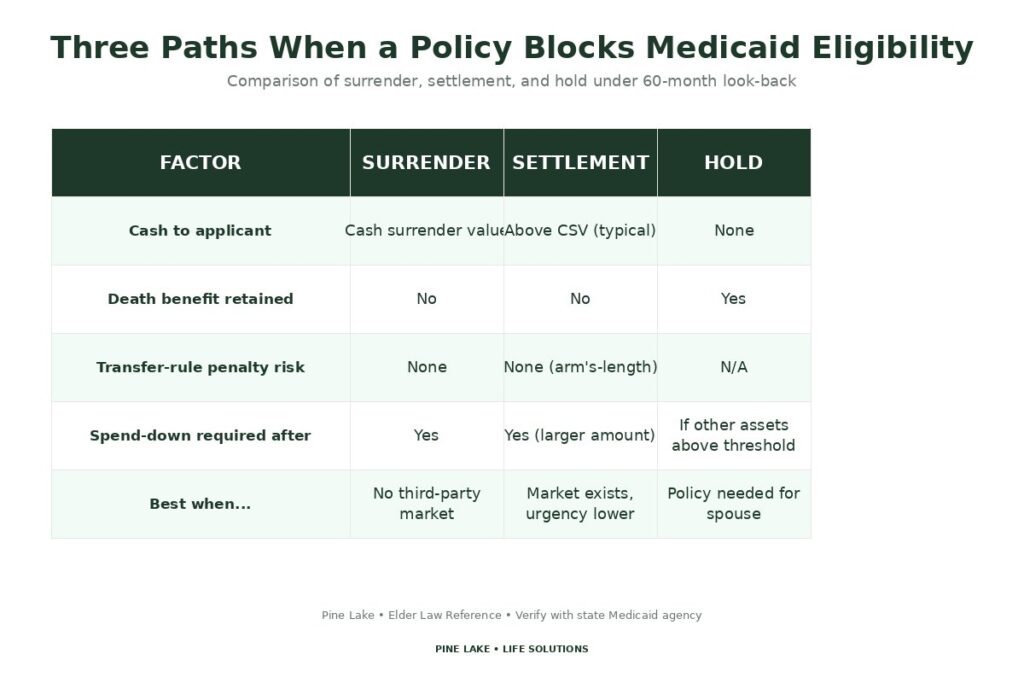
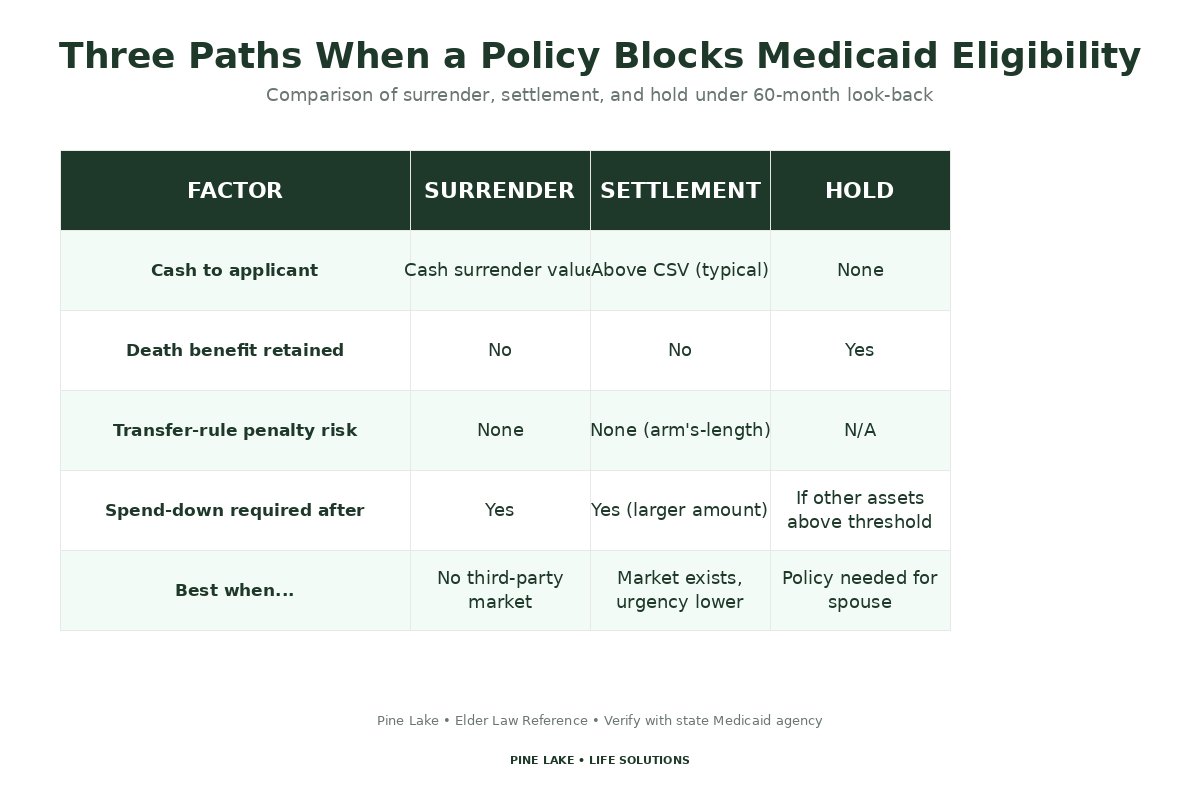
Now the choice, and it matters because these four paths pay materially different amounts. Surrender pays net cash value: fast, irreversible, usually right for a small amount, and frequently the option that leaves the most money on the table on a larger policy. Reduced paid-up stops the premium and keeps a smaller permanent death benefit, which does not remove the resource but preserves a benefit for a surviving spouse and stops a premium draining a fixed income. Irrevocable funeral assignment — transferring ownership to a licensed Pennsylvania funeral establishment under an irrevocable pre-need contract — is generally not treated as an available resource when properly structured, and for a mid-sized policy it is often the best available answer because nothing is sold at a discount. A secondary-market sale transfers the in-force policy to a licensed institutional buyer for a lump sum; the federal Government Accountability Office’s study of the market (GAO-10-775) found sellers typically received roughly 10% to 35% of face value, and on average several times what the same policies would have paid on surrender. Our side-by-side on a settlement versus surrendering the policy works through the comparison.
When selling is the wrong answer. When aggregate face value is already inside the $1,500 exclusion and nothing needed solving. When the death benefit is under roughly $100,000, below which institutional buyers rarely engage — which describes many Erie County policies honestly. When the insured is in good health for their age, so life expectancy pushes offers toward nothing. When the coverage is a non-assignable employer, union or federal group certificate — and Erie has plenty of those, from the locomotive works at Lawrence Park and from Erie Insurance, one of the county’s largest employers. And when a community spouse genuinely needs the death benefit and another countable resource could be spent instead. Mind the timing too: proceeds are countable cash, which changes when eligibility can begin.
Erie’s Local Numbers, and What They Do to the Countdown Speed
Based on the most recent published cost-of-care surveys of the Genworth and CareScout type, trended forward, a semi-private nursing facility room in Erie County plausibly runs in the range of $9,800 to $11,800 per month as of 2026, with private rooms higher, and assisted living or personal care in the range of roughly $4,200 to $5,800 per month. Erie prices below the Philadelphia and suburban southeastern Pennsylvania market, which pulls the statewide median up, so a Pennsylvania average overstates the local rate. UPMC Hamot and Saint Vincent Hospital anchor the county’s post-acute referral flow, which keeps the stronger skilled buildings busy. These are survey-derived ranges, not quotes — ask each facility for its current private-pay daily rate in writing. Our companion page on nursing home costs in Erie County works the cost side.
Two genuinely local factors change the arithmetic here. First, median home values in Erie County are among the lowest of Pennsylvania’s metropolitan counties. That is helpful on one rule and unhelpful on another: the federal home-equity ceiling almost never binds on an Erie or Harborcreek property, so families here rarely have an equity problem — but the house is also frequently the only asset of consequence, which means the entire inheritance sits in one item subject to estate recovery. Second, median household income runs below the state average, so the countable balance is often modest and the countdown is short. A household with $38,000 in countable resources against a $10,800 monthly bill reaches the target in roughly three and a half months. There is no room for drift.
Third, and specific to this county: the winter timeline. Erie sits in the lake-effect snowbelt off Lake Erie and routinely records among the highest annual snowfall totals of any American city its size. In practical terms, older residents in Millcreek, Harborcreek and Edinboro make the decision to leave a house with stairs and a driveway in November or December, under pressure, rather than in a planned way. If you begin the countdown planning in the spring, you get to make a financial decision. If you begin it during a January storm, the facility with an open bed makes it for you.
Community HealthChoices, and Where the Application Goes
Pennsylvania’s Medicaid program is Medical Assistance, and long-term services and supports for older adults are delivered through Community HealthChoices (CHC), the state’s managed long-term services and supports program, which operates statewide. Understand that CHC is a two-step structure: eligibility is determined first, then the participant is enrolled in a managed care organization that authorizes and coordinates services. Approval on eligibility is not the same as having services in place.
The application is taken by the Erie County Assistance Office, a County Assistance Office of the Pennsylvania Department of Human Services located in the city of Erie, and applications can also be filed through the state’s COMPASS online portal. Call the office to confirm the current address, hours and the correct intake path for a long-term care application specifically. Pennsylvania uses an independent enrollment broker to conduct the functional eligibility assessment for CHC long-term services, which is a separate appointment from the financial eligibility determination — schedule both, and do not assume one triggers the other.
For local assessment, options counseling and aging services, the Erie County Area Agency on Aging is the county agency to contact. Free one-on-one benefits counseling comes from APPRISE, Pennsylvania’s State Health Insurance Assistance Program, and the Pennsylvania Insurance Department regulates insurance and life settlement activity in the commonwealth.
Estate Recovery, and an Order of Operations for the Countdown
Pennsylvania operates a Medicaid estate recovery program administered by the Department of Human Services, and it generally asserts a claim in the deceased beneficiary’s estate for long-term care services provided. Recovery is ordinarily deferred while a surviving spouse is living, with protections where a surviving child is a minor or has a disability, and there is a hardship waiver process. Ask the department for the current scope, the categories of assets reached, and how a waiver is requested — in writing, and specific to your parent’s situation.
The trade families weigh: transfer the house now to keep it out of the estate, or accept the claim later. Do the arithmetic before you decide. A penalty period at roughly $10,800 a month costs cash the family must produce while a parent is alive and needs care; estate recovery costs the heirs after death. In almost every Erie County fact pattern the second problem is the cheaper one.
The sequence that works. Establish the balance and the target, in writing. Ask the County Assistance Office about the community spouse resource allowance if your parent is married. Schedule both the financial application and the independent enrollment broker’s functional assessment. Inventory every life insurance policy — type, owner, beneficiary, face amount, written net cash surrender value — and add the face amounts together to see whether the burial exclusion applies. Build a list of legitimate spend-down expenditures: deferred dental and hearing work, medical equipment, home repairs on the house, debt payoff, an irrevocable funeral arrangement. Assemble five years of statements before the caseworker asks. Then take the whole package to an Erie County elder law attorney before you gift, retitle, surrender or liquidate anything. If the inventory turns up a permanent policy with real face value, get a free, no-obligation policy review before surrender makes the choice permanent — send the policy cover page showing carrier, policy number, face amount and issue date, or call (305) 209-7183. If the honest answer is that the policy has no market value, that is what you will hear.
Frequently Asked Questions
What is Pennsylvania’s asset limit for nursing home Medical Assistance?
For long-term care Medical Assistance the countable resource limit for a single applicant is $2,000 as of 2026. Pennsylvania applies a different, higher resource limit to some categories that are not long-term care, which causes confusion. Verify both current figures with the Pennsylvania Department of Human Services before planning.
What can we legitimately spend the money on?
Care itself, unpaid medical and dental expenses, hearing aids and equipment, home repairs and accessibility modifications on an excluded home, paying off your parent’s debts, prepaying taxes and insurance on the home, and an irrevocable pre-need funeral arrangement. Paying a child for care requires a written agreement at a fair rate.
Can we pay my sister for taking care of Dad?
Only with the right paperwork. A caregiver agreement must generally be in writing and executed before services are rendered, at a documented fair market rate, with records of hours and payments and the income reported. Without those elements Pennsylvania will treat the payments as gifts and apply a penalty.
Where do we file the application in Erie County?
With the Erie County Assistance Office, a County Assistance Office of the Pennsylvania Department of Human Services located in the city of Erie, or through the state’s COMPASS online portal. Separately, an independent enrollment broker conducts the functional assessment for Community HealthChoices long-term services.
How much does a nursing home cost in Erie County as of 2026?
Plan on roughly $9,800 to $11,800 a month for a semi-private room and roughly $4,200 to $5,800 a month for assisted living or personal care. Erie prices below the southeastern Pennsylvania market, so a statewide average overstates the local rate. Get each facility’s private-pay daily rate in writing.
Does Erie County’s low home value help or hurt us?
Both. The federal home-equity ceiling rarely binds on a typical Erie or Harborcreek property, so equity is usually not a barrier to eligibility. But the house is frequently the household’s only asset of consequence, which concentrates the entire inheritance in one item exposed to estate recovery after death.
Is my father’s Erie Insurance or locomotive plant group life worth anything to us now?
Usually not as cash. Employer and union group life is typically term coverage with no cash surrender value and is generally non-assignable, so there is nothing to surrender and no secondary market. It does not count against the asset limit, but the face amount still counts toward the $1,500 aggregation test.
Find out what your policy is worth — free, confidential, no obligation.
A 15-minute educational review covers your eligibility, every alternative, and a realistic view of what each path would net you.
Related Reading
- Nursing Home Costs Erie County Pa
- Sell Life Insurance Policy Erie County Pa
- Pennsylvania Medicaid Asset Income Limits
- Life Settlement Taxes Pennsylvania
- Nursing Home Medicaid Spend Down
- Life Insurance Counts Medicaid Asset
- What Is The Medicaid Look Back Period
- Life Settlement Vs Surrendering Your Policy
Pine Lake Life Solutions does not purchase life insurance policies and does not provide legal, tax, or investment advice. Information provided is for educational purposes only. Eligibility for any option, including life settlements, is not guaranteed and depends on individual circumstances, policy terms, underwriting, and market conditions. Consult independent legal, tax, or financial professionals before making decisions regarding a life insurance policy.