
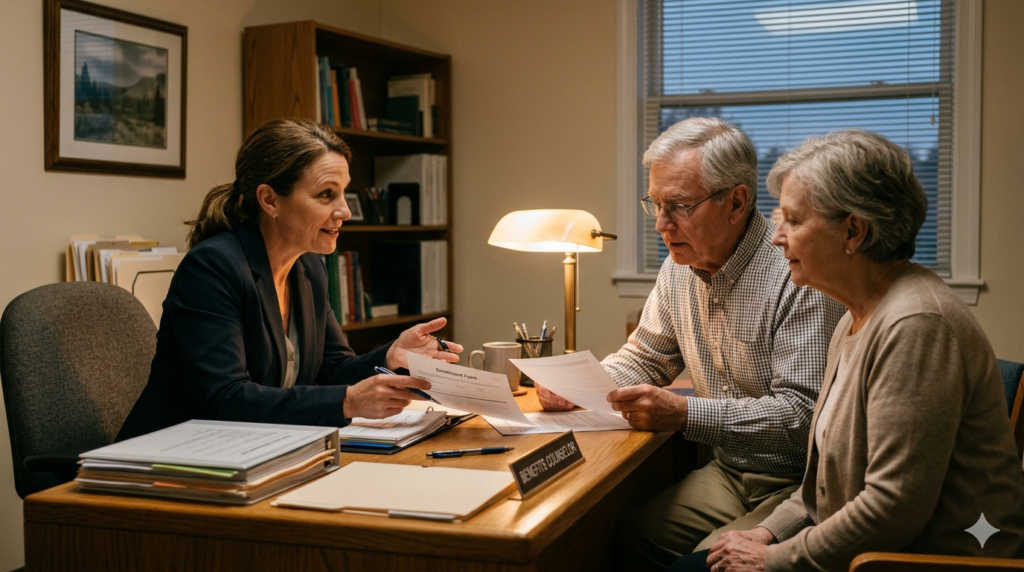
In Casa Grande, Arizona, the spouse who stays in the house is the person the rules are actually built around: Arizona’s ALTCS program lets the community spouse keep a protected share of the couple’s assets and claim part of the institutionalized spouse’s income, and getting those two numbers right matters more than anything else you will do in the first month. Casa Grande sits in Pinal County, but Pinal County does not run this program. Arizona is one of the states where Medicaid long-term care eligibility is handled entirely by a state agency, so no county human services department in Casa Grande, Florence or Coolidge can approve or deny the application.
That single structural fact reroutes everything. A family in Casa Grande who spends three weeks at the wrong counter loses three weeks of a 60-month look-back clock that is already running. And in a household where one spouse is going into care and the other is not, three weeks matters, because almost every protective step available to the at-home spouse has to be taken in a specific order relative to the application date.
This page walks the community spouse’s side of the ledger from the top: who takes the application and where, the four numbers that determine what the spouse at home keeps, what a Casa Grande month of care actually costs against the Arizona median, and where an in-force life insurance policy fits — including the cases where selling it is the wrong move for the survivor. Pine Lake Life Solutions provides education and a free policy review only; nothing here is legal, tax or Medicaid-eligibility advice.
In This Article
- Who Takes the Casa Grande Application, and Why It Is Not Pinal County
- The Four Numbers That Decide What the Casa Grande Spouse at Home Keeps
- Turning the Resource Snapshot Into an Actual Plan
- The House, the Equity Limit, and Why Casa Grande Values Change the Answer
- What a Month of Care Costs in Casa Grande, Against the Arizona Median
- The Life Insurance Policy: The $1,500 Face-Value Rule and the Surviving Spouse
- When Selling the Policy Is the Wrong Answer for a Casa Grande Couple
- Frequently Asked Questions
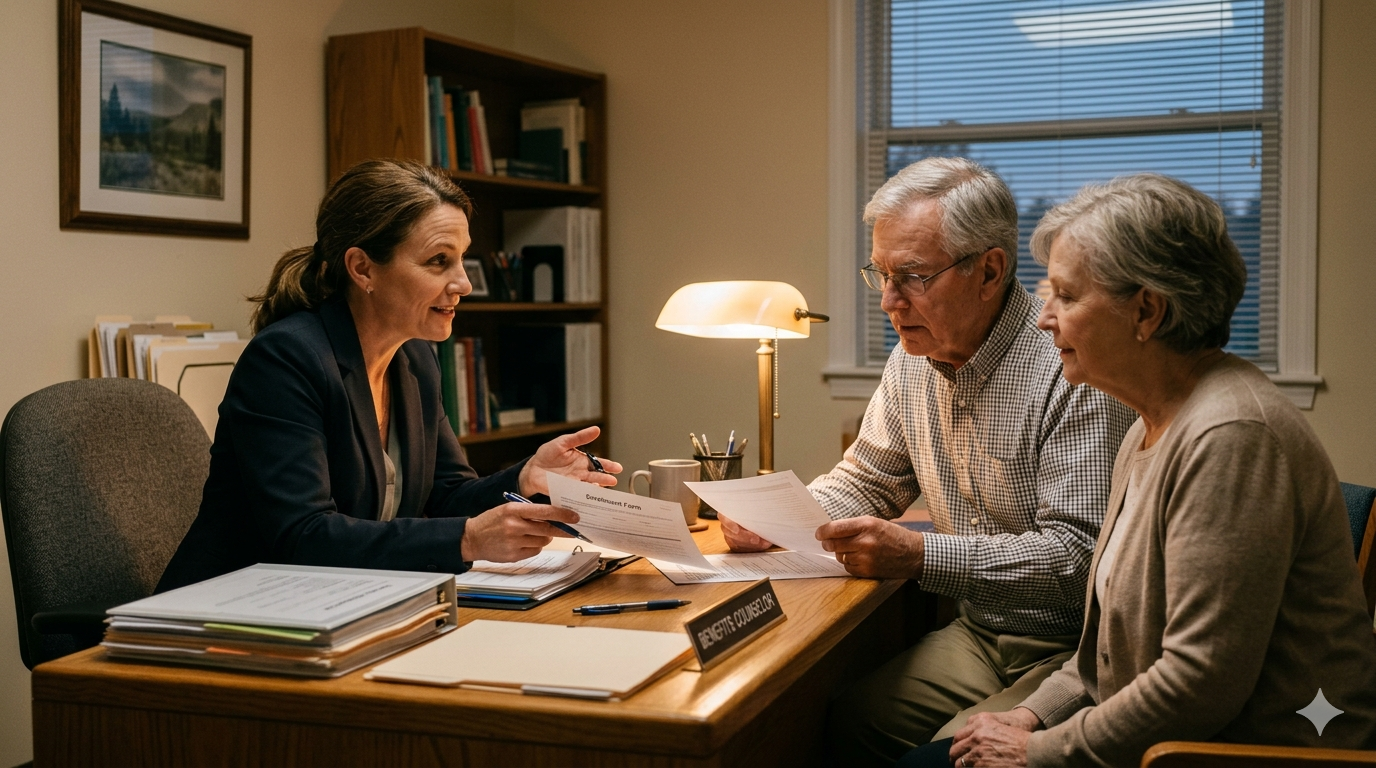
Who Takes the Casa Grande Application, and Why It Is Not Pinal County
The program is the Arizona Long Term Care System, ALTCS, which is the long-term-care arm of AHCCCS — the Arizona Health Care Cost Containment System, Arizona’s Medicaid agency. AHCCCS operates ALTCS eligibility offices regionally through its Division of Member Services. Pinal County residents, including everyone with a Casa Grande address, are served by the ALTCS office that covers Pinal County, and in recent years that office has operated in Casa Grande itself. Call the ALTCS statewide line and confirm the current office location, hours, and whether you can file by mail or phone before anyone drives across the county — AHCCCS has consolidated and relocated offices more than once, and as of 2026 the intake channels are not the same in every region.
Two separate determinations have to clear. An ALTCS assessor performs a pre-admission screening for functional eligibility — whether the applicant medically needs a nursing-facility level of care. Separately, an eligibility interviewer works through income and resources. Families routinely assume the financial approval is the whole job and are surprised when a financially eligible parent is turned down on the functional screen, or the reverse. Ask at the first contact which of the two is still outstanding, every time you call.
Two other names belong in your phone before you start. The Area Agency on Aging for Pinal County is the Pinal-Gila Council for Senior Citizens, the designated Region V agency serving Pinal and Gila counties; it is the right call for caregiver support, home-delivered meals, and options counseling that has nothing to do with eligibility paperwork. Arizona’s State Health Insurance Assistance Program, delivered through the Arizona Department of Economic Security’s aging division, gives free one-on-one Medicare and coverage counseling. For anything touching insurance company conduct, the regulator is the Arizona Department of Insurance and Financial Institutions. For the legal structuring described further down this page, you need your own Arizona elder law attorney — our Arizona elder law reference explains what these attorneys handle and what they charge for.
The Four Numbers That Decide What the Casa Grande Spouse at Home Keeps
Spousal impoverishment protections are federal, applied through Arizona’s rules, and they come down to four figures. Write them on one sheet of paper and keep the sheet.
One: the Community Spouse Resource Allowance (CSRA) — the countable assets the at-home spouse may keep. Two: the applicant’s own resource limit — roughly $2,000 in countable resources for an individual as of 2026, which you should verify with ALTCS because it is set in program rules, not in a brochure. Three: the Minimum Monthly Maintenance Needs Allowance (MMMNA) — the floor income the community spouse is entitled to, funded if necessary by a transfer of the institutionalized spouse’s income. Four: the home equity limit — the ceiling above which the house stops being an exempt resource.
Every one of these is a moving number. The CSRA and MMMNA are set by federal minimums and maximums that the Centers for Medicare & Medicaid Services adjusts annually. For 2025 the published CSRA range ran from roughly $31,500 at the minimum to roughly $157,900 at the maximum, and the MMMNA minimum was in the neighborhood of $2,550 a month with a maximum near $3,950. Treat those as last year’s anchors, not this year’s rules: confirm the 2026 figures with the ALTCS office directly, and put the date of that call in your notes. The single most damaging mistake in a spousal case is planning around a figure someone read on a national website eighteen months ago.
The mechanics matter as much as the numbers. Arizona takes a snapshot of the couple’s countable resources as of the first day of the month of continuous institutionalization. Everything is counted together — his accounts, her accounts, joint accounts, the CDs at a Casa Grande credit union, the brokerage account nobody has looked at in five years. From that combined pool the CSRA is carved out for the community spouse and the rest is the applicant’s, and it is the rest that has to come down to the individual limit before eligibility begins.
Turning the Resource Snapshot Into an Actual Plan
Once the snapshot number exists, the excess above the CSRA plus the individual limit is what has to be dealt with. Spend-down is not the same as spending money badly, and in a married case there are usually more legitimate options than in a single case.
Assets can be converted rather than consumed. Paying off the mortgage on the Casa Grande house moves countable cash into an exempt asset the community spouse continues to live in. So does replacing a fifteen-year-old vehicle the at-home spouse depends on in a city where nearly every errand is a car trip. So do genuine home repairs — a failed evaporative cooler or a roof that will not survive another monsoon season is a real expense, not a maneuver, and in Pinal County summer heat a working cooling system is not optional.
An irrevocable funeral trust, funded within the limits Arizona recognizes, converts countable dollars into a prepaid, non-countable burial arrangement for both spouses. A Medicaid-compliant annuity can convert a lump sum into an income stream for the community spouse, but the structural requirements are technical and an annuity that misses one of them is treated as a disqualifying transfer. Do not attempt either from a template. Both are attorney work, and our comparison of a settlement against a Medicaid-compliant annuity lays out how differently the two tools behave.
What does not work is giving money away. Every uncompensated transfer in the 60 months before the application is examined, and one that has no defensible explanation produces a penalty period during which ALTCS pays nothing even though the money is gone. There is no hardship exception you can count on. The kitchen-table gift to a grandchild for a truck down payment in 2023 is exactly the transaction that surfaces in a five-year bank statement review.
| The Four Community-Spouse Numbers | What It Controls | Last Published Anchor (2025) | Who Confirms the 2026 Figure |
|---|---|---|---|
| Community Spouse Resource Allowance (CSRA) | Countable assets the Casa Grande spouse at home keeps | Federal band roughly $31,500 minimum to $157,900 maximum | ALTCS eligibility office serving Pinal County |
| Applicant resource limit | What the institutionalized spouse may still own at approval | About $2,000 in countable resources | ALTCS / AHCCCS Division of Member Services |
| Minimum Monthly Maintenance Needs Allowance (MMMNA) | Income floor the at-home spouse can claim from the applicant’s income | Roughly $2,550 minimum to $3,950 maximum per month | ALTCS eligibility interviewer |
| Home equity limit | When the house stops being exempt (not applied while a spouse lives there) | Federal minimum roughly $730,000; Arizona applies the minimum | ALTCS; compare to Casa Grande values in the low-to-mid $300,000s |
| Life insurance face-value threshold | Whether cash surrender value counts at all | $1,500 total face value, aggregated across policies | ALTCS; carrier statement of face and cash value |

The House, the Equity Limit, and Why Casa Grande Values Change the Answer
While the community spouse lives in the home, the home is generally an exempt resource, and the equity limit does not apply to a home occupied by a spouse. The limit matters when nobody is left in it. Federal law sets a home equity ceiling that states adjust annually within a federal band; the low end of that band was roughly $730,000 in 2025 and Arizona applies the minimum. Confirm the 2026 figure with ALTCS.
Here the local number does real work. Casa Grande home values, as of 2026, run substantially below Maricopa County and below the Arizona statewide median — Casa Grande’s typical home value has tracked in the low-to-mid $300,000s while the state median has sat well above $400,000, a gap that reflects Pinal County’s supply of newer subdivision housing and its large inventory of manufactured and age-restricted park homes. Two consequences follow. First, a Casa Grande homestead almost never approaches the equity ceiling, so the house is very unlikely to be the thing that blocks eligibility. Second, and less comfortably, there is less home equity available to fund private-pay care, which is why the life insurance policy in the filing cabinet is often the largest liquid asset the household actually has.
Estate recovery is the other side of the house. Arizona, like every state, is required to seek reimbursement from the estates of people who received long-term-care Medicaid, and AHCCCS operates an estate recovery program. Recovery is generally deferred while a surviving spouse is alive, and Arizona’s rules include exemptions and hardship waivers. Ask AHCCCS for its current written estate recovery policy rather than relying on a summary — including a summary on this page — and have your attorney read it against the deed as it is actually titled today.
What a Month of Care Costs in Casa Grande, Against the Arizona Median
The numbers below are ranges compiled from national cost-of-care survey data of the Genworth/CareScout type and from Arizona provider rate reporting, adjusted forward to 2026. They are ranges on purpose, because a single invented figure is worse than an honest band. Verify against actual quotes from facilities you are considering, and check quality ratings on the Medicare Care Compare tool before you sign anything.
Pinal County generally prices below the Phoenix metro. Skilled nursing in and around Casa Grande has run roughly $7,800 to $8,900 a month for a semi-private room as of 2026, against an Arizona statewide band of roughly $8,000 to $9,000, with private rooms $1,000 to $1,500 higher. Assisted living in the Casa Grande area has run roughly $4,000 to $4,800 a month, against an Arizona median band of roughly $4,400 to $5,000. Arizona also has an unusually deep supply of small licensed adult care homes — residences of ten beds or fewer — which frequently price below large assisted living communities and are a genuine option Pinal County families overlook.
Run the arithmetic before you do anything else. A household with $190,000 in countable assets facing $8,300 a month of skilled nursing has roughly 23 months of runway if it spends every dollar — but it cannot spend every dollar, because the community spouse has to live on something. That is the whole reason the CSRA exists, and the reason the runway a spousal household actually has is far shorter than the raw division suggests. Our page on nursing home costs in Casa Grande carries the month-by-month version of this math.
The Life Insurance Policy: The $1,500 Face-Value Rule and the Surviving Spouse
Life insurance is where Medicaid rules surprise people, and where a decision made in a hurry is hardest to undo. The rule is an aggregation rule, and it is a cliff rather than a slope. Add up the total face value of all life insurance policies owned by the applicant on the applicant’s own life. If that total is at or below $1,500, the cash surrender value is excluded as a burial resource. If the total face value exceeds $1,500 by a single dollar, the entire cash surrender value of those policies becomes a countable resource.
The consequence is counterintuitive: a $50,000 whole life policy with $14,000 of cash value does not add $50,000 to the resource pool, it adds $14,000 — and it is the $50,000 face figure, not the $14,000, that triggers the counting. Term insurance normally has no cash surrender value at all and therefore normally adds nothing countable, which is why a family can hold substantial term coverage and still be within the limit. Our explainer on how life insurance is counted as a Medicaid asset works through the variations, and how cash value is treated covers the surrender-value side.
Surrendering the policy to the carrier is the reflex, and it is usually the worst of the available choices. Surrender pays cash surrender value, which is a formula the carrier controls. On an older policy insuring someone in declining health, the secondary market may value the same contract at a multiple of surrender value — federal research on the settlement market has found sellers typically received well above cash surrender value, with proceeds commonly cited in the range of 10% to 35% of face amount depending on age and health. There are other routes as well: a reduced paid-up election can shrink the policy to a smaller permanent death benefit with no further premiums, which sometimes brings the face value close enough to matter; and an irrevocable funeral trust can hold value in an excluded form. Compare reduced paid-up against a settlement before anyone signs a surrender form, because a surrender is irreversible.
When Selling the Policy Is the Wrong Answer for a Casa Grande Couple
Being honest about this is more useful than being enthusiastic. Selling is the wrong answer in at least four situations, and three of them are common in married households.
The face amount is small. Policies below roughly $100,000 of death benefit rarely attract secondary-market interest at all. A $25,000 final-expense policy is not a settlement candidate; it is a burial plan, and it may be better restructured than sold.
The policy already sits inside the burial exclusion. If total face value is at or under $1,500, the cash value is already excluded and selling converts an excluded asset into countable cash. That is moving backwards.
The insured is in good health for their age. Settlement pricing is driven by life expectancy. A healthy 74-year-old will see thin offers or none, and the offer that does arrive may be worth less than keeping the coverage.
The surviving spouse needs the death benefit. This is the one that matters most in a Casa Grande spousal case. When one spouse enters a facility, that spouse’s Social Security and pension income largely goes to the cost of care, and at death some of that income stops. If the at-home spouse’s own retirement income is thin, the death benefit may be the thing that keeps her in the house. Sell it and the eligibility problem is solved for one year and created for the next ten. Work the survivor’s post-death budget first, with an attorney, and only then decide what the policy is for.
If you do want to know what a policy is worth before making any of these choices, a review is free and commits you to nothing. Send the policy cover page and the most recent annual statement and ask for a plain answer, including the answer that it has no market value. Pine Lake Life Solutions does not purchase policies, is not licensed in every state, and provides education and policy review only — for eligibility decisions, go to the ALTCS office, the Pinal-Gila Council for Senior Citizens, Arizona’s SHIP counselors, or your own elder law attorney.
Frequently Asked Questions
Does the Pinal County office in Florence handle my mother’s Medicaid application?
No. Arizona long-term-care Medicaid is state-administered through ALTCS, part of AHCCCS, so no Pinal County department approves or denies it. ALTCS runs regional eligibility offices, and the one serving Pinal County has operated in Casa Grande in recent years. Call the ALTCS statewide line first to confirm the current location and whether mail or phone filing is available in 2026.
Will my husband’s nursing home costs take all of our savings if I stay in our Casa Grande house?
Not all of it. Spousal impoverishment rules let the community spouse keep a protected Community Spouse Resource Allowance out of the couple’s combined countable assets, plus the house you live in. The protected amount sits inside a federal band that changed for 2026, so confirm the current figure with ALTCS and talk to an Arizona elder law attorney before you spend anything down.
Does my $60,000 whole life policy disqualify my spouse from ALTCS?
The face amount itself is not counted as a resource, but because total face value exceeds $1,500 the policy’s cash surrender value becomes countable in full. A $60,000 policy with $16,000 of cash value adds $16,000 to the resource pool. Term coverage with no cash value generally adds nothing. Get a written carrier statement showing both figures before you assume either way.
Should I just cash in the policy to spend down faster?
Surrendering is fast and usually the weakest option financially, because surrender value is a carrier formula while the secondary market prices on age and health. A reduced paid-up election, an irrevocable funeral trust, or a settlement review may each produce a better result. Surrender is irreversible, so price the alternatives first with your attorney and a free policy review.
What does a nursing home actually cost in the Casa Grande area in 2026?
Semi-private skilled nursing around Casa Grande has run roughly $7,800 to $8,900 a month as of 2026, modestly below the Arizona band of about $8,000 to $9,000, with private rooms $1,000 to $1,500 more. Assisted living has run roughly $4,000 to $4,800. These are ranges from cost-of-care survey data; get written quotes from the specific facilities you are considering.
Can I give the grandchildren money now and apply for ALTCS later?
Transfers made in the 60 months before the application are reviewed, and an uncompensated gift generally produces a penalty period during which ALTCS pays nothing. The money is gone and the coverage has not started, which is the worst of both outcomes. Never make a transfer of any size without running it past an Arizona elder law attorney first.
Is the Casa Grande house at risk from Arizona estate recovery?
AHCCCS operates an estate recovery program, as federal law requires, but recovery is generally deferred while a surviving spouse is alive and Arizona’s rules contain exemptions and hardship waivers. How your deed is titled matters. Ask AHCCCS for its current written policy and have your own attorney review it against the deed rather than relying on any summary.
Find out what your policy is worth — free, confidential, no obligation.
A 15-minute educational review covers your eligibility, every alternative, and a realistic view of what each path would net you.
Related Reading
- Nursing Home Costs Casa Grande Az
- Life Settlements Casa Grande Az
- Arizona Medicaid Asset Income Limits
- Sell Life Insurance Policy Pinal County Az
- Life Insurance Counts Medicaid Asset
- Cash Value Counts Toward Medicaid
- Reduced Paid Up Vs Settlement
- Life Settlement Vs Medicaid Compliant Annuity
- Elder Law Attorney Life Settlement Guide Arizona
Pine Lake Life Solutions does not purchase life insurance policies and does not provide legal, tax, or investment advice. Information provided is for educational purposes only. Eligibility for any option, including life settlements, is not guaranteed and depends on individual circumstances, policy terms, underwriting, and market conditions. Consult independent legal, tax, or financial professionals before making decisions regarding a life insurance policy.