
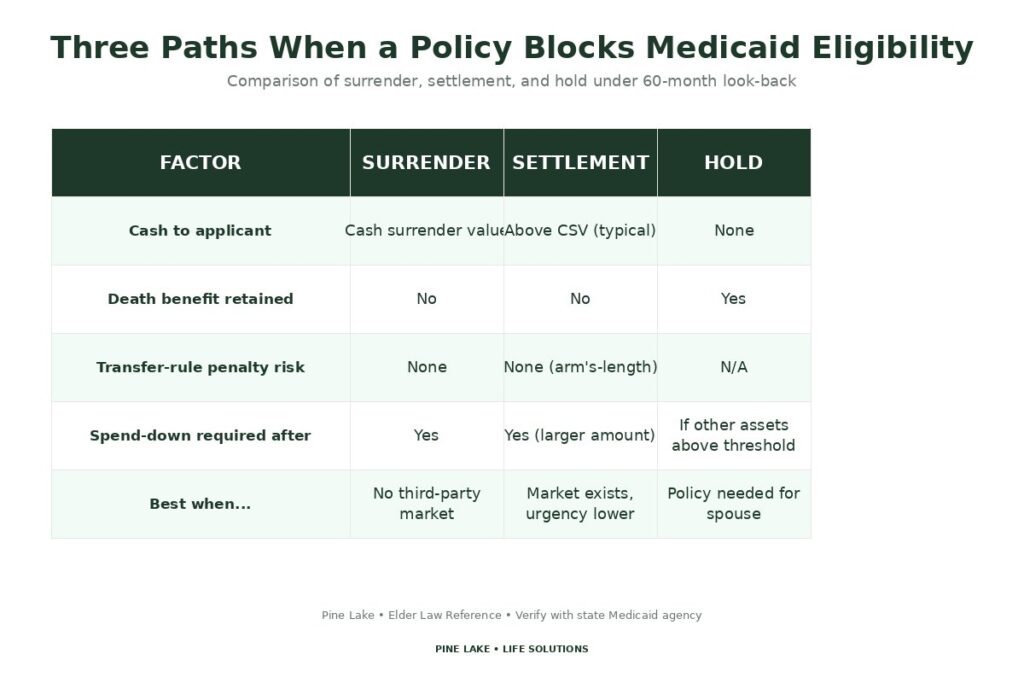
In Boerne, Texas, the question is almost never “do we qualify” – it is “which line on the balance sheet is the one that disqualifies us.” Texas Medicaid, delivered through STAR+PLUS for managed long-term services and through the Medicaid nursing facility program for institutional care, applies a countable-resource limit of $2,000 for a single applicant as of 2026. That figure has been stable for years, but it is set at the federal SSI level and Texas Health and Human Services (HHSC) is the only office that can confirm the number in force on the day you apply.
Boerne sits in Kendall County, in the Texas Hill Country just northwest of San Antonio. Kendall County does not run Medicaid eligibility – Texas is one of the states where eligibility is state-administered, so the application goes to HHSC through YourTexasBenefits.com, by phone, or in person at an HHSC benefits office. There is no HHSC office inside Boerne city limits; Kendall County residents are served by the nearest HHSC benefits offices in Kerrville and in San Antonio’s Bexar County network. The county-level help that does exist locally is the Alamo Area Agency on Aging, operated by the Alamo Area Council of Governments, which covers Kendall County and can walk a family through the paperwork at no cost.
This page walks the household balance sheet one asset class at a time and tells you how each is treated. The life insurance policy comes last, because that is where it usually belongs in the order of operations – and because it is the asset families most often handle wrong.
In This Article
- The line you are trying to get under, and who draws it
- Asset one: the Boerne homestead
- Asset two: cash, checking, CDs and the accounts nobody remembers
- Asset three: vehicles, personal property and burial arrangements
- Asset four: IRAs, 401(k)s, annuities and the spouse at home
- Asset five: the life insurance policy, and the aggregation rule that surprises people
- What a month of care costs in Boerne, and where to get help
- Frequently Asked Questions
The line you are trying to get under, and who draws it
Two separate tests decide a Texas long-term care Medicaid application, and Boerne families routinely pass one and fail the other without realizing there were two.
The resource test. As of 2026, a single applicant may keep $2,000 in countable resources. A married applicant whose spouse remains at home is measured differently: the couple’s combined countable resources are counted on the date of institutionalization, and the at-home spouse is allowed to keep a Community Spouse Resource Allowance – roughly $160,000 at the 2026 federal maximum, with a floor near $32,000. Both numbers are indexed and both move. Confirm the current figures with HHSC before you move a dollar.
The income test. Texas is an income-cap state. Unlike Maryland or North Carolina, Texas does not let an applicant simply spend excess income down to a limit. If monthly income exceeds the cap – roughly three times the SSI federal benefit rate, in the neighborhood of $2,900 a month as of 2026 – the applicant is over the line no matter how sick they are, unless a Qualified Income Trust (a Miller Trust) is established and the excess income is routed through it every single month. A retired Kendall County couple with two pensions and two Social Security checks can clear the resource test easily and still be denied for income. That trust must be drafted by a lawyer and funded correctly; this is one of the few places where the do-it-yourself route reliably fails.
Behind both tests sits the 60-month look-back. HHSC will ask for five full years of statements on every account and will treat uncompensated transfers in that window as gifts, converting them into a penalty period of ineligibility. And after the beneficiary dies, the Texas Medicaid Estate Recovery Program may seek repayment from the probate estate – which in Kendall County usually means the house.
Asset one: the Boerne homestead
The home is exempt while the applicant lives there, or intends to return, or while a spouse, a minor child, or a disabled adult child lives in it. But the exemption is capped by equity. Texas uses the lower federal home equity limit, which as of 2026 sits in the neighborhood of $750,000 and rises each year; equity above that line makes the homestead a countable resource. HHSC publishes the current figure, and it is worth checking rather than assuming.
This matters more in Boerne than in most Texas towns. Kendall County has been one of the fastest-growing counties in Texas for over a decade, and Boerne home values run substantially above the statewide median – a paid-off house on acreage on the west side of town can sit uncomfortably close to the equity cap even though the family has almost no cash. A mortgage reduces equity; a paid-off house does not.
The bigger Boerne problem is on the back end. The homestead is exempt during the applicant’s life, and then estate recovery arrives. Families in Kendall County are frequently surprised that the house they carefully protected is the exact asset the state comes back for. There are exceptions – a surviving spouse, a surviving child under 21 or disabled, an undue-hardship claim, and Texas’s rule that recovery is not pursued when the estate value or the recoverable amount is small – but they are exceptions, not the default. An elder law attorney licensed in Texas is the right person to map this, not a website. The related mechanics are covered in more depth on our nursing home Medicaid spend-down guide.
Asset two: cash, checking, CDs and the accounts nobody remembers
Everything liquid counts: checking, savings, money market, certificates of deposit, brokerage accounts, savings bonds, and the credit union account opened for a grandchild that still has the applicant’s name on it. A joint account is presumed to belong entirely to the applicant unless the other owner can document their contributions – this catches Boerne families constantly, because adding an adult child to a parent’s account for convenience is the single most common informal estate plan in Texas.
Two moves that families make and should not:
- Emptying the account into a child’s account. That is a gift, it sits inside the 60-month look-back, and it produces a penalty period measured in months of ineligibility at exactly the moment the parent needs coverage.
- Paying an adult child for caregiving without a written personal services agreement. Paid caregiving by family can be legitimate, but without a contract signed in advance at a documented fair rate, HHSC treats the payments as gifts.
Legitimate spend-down of countable cash is different from a gift. Paying off the mortgage on the exempt homestead, making needed repairs to it, buying a replacement vehicle, prepaying funeral and burial arrangements, paying real medical and legal bills, and paying off legitimate debt all convert countable resources into exempt ones without creating a transfer penalty. The word “spend-down” is misleading: nothing is wasted, the money is moved from a countable column to an exempt one.
| Asset a Boerne household owns | Texas Medicaid treatment (as of 2026 – confirm with HHSC) | First move |
|---|---|---|
| Boerne homestead, occupied | Exempt while occupied or intent to return; equity above roughly $750,000 counts | Check equity against the current cap; plan for estate recovery |
| Checking, savings, CDs, brokerage | Fully countable; joint accounts presumed 100% the applicant’s | Document every joint owner’s contributions |
| One vehicle | Excluded regardless of value if used for the household | Do not sell it to raise cash |
| Second vehicle, boat, collections | Countable at fair market value | Sell at arm’s length, keep the paperwork |
| Irrevocable prepaid funeral contract | Excluded, no dollar cap on reasonable goods and services | Must be irrevocable; revocable plans still count |
| Designated burial fund | Excluded up to $1,500 | Designate it in writing |
| IRA / 401(k) | Generally countable for the applicant; treatment varies with RMD status | Get HHSC’s written treatment before liquidating |
| Term life insurance | No cash value, generally not a countable resource | Still ask what it is worth before lapsing it |
| Permanent life, total face value $1,500 or less | Excluded as burial insurance | Leave it alone |
| Permanent life, total face value over $1,500 | Entire cash surrender value is countable | Price settlement, reduced paid-up and funeral trust before surrendering |

Asset three: vehicles, personal property and burial arrangements
One vehicle is excluded regardless of value if it is used for the transportation of the applicant or a household member. In Kendall County, where there is no meaningful public transit and the drive to specialty care in San Antonio is a real trip, this exclusion is not academic – a family should not sell the truck to raise cash. A second vehicle is countable at its fair market value.
Ordinary household goods and personal effects are excluded. Wedding and engagement rings are excluded. Collections held as investments – coins, firearms held for value, a boat on Canyon Lake – are countable, and HHSC will ask.
Burial arrangements are the most useful exclusion Texas families underuse. An irrevocable prepaid funeral contract with a licensed Texas funeral provider is excluded entirely, with no dollar cap on the reasonable cost of the goods and services purchased. Separately, a designated burial fund of up to $1,500 is excluded, and burial spaces for the applicant and immediate family are excluded without limit. A family with $18,000 in a savings account and no funeral plan can, in a single afternoon and entirely lawfully, move most of that into an irrevocable funeral contract – which is both a legitimate spend-down and a thing the family was going to have to pay for anyway.
The irrevocability is the point. A revocable prepaid plan is still countable, because the applicant can cash it in.
Asset four: IRAs, 401(k)s, annuities and the spouse at home
Texas does not treat a retirement account as automatically exempt. As a general matter HHSC counts the balance of an IRA or 401(k) owned by the applicant, though treatment can change if the account is in required minimum distribution status – and the rules differ for the applicant versus the community spouse. This is one of the areas where written HHSC policy and what a family assumes diverge most sharply, so get the treatment confirmed in writing for your specific account type before liquidating anything. Cashing out an IRA to “spend down” can trigger an income tax bill in the same year, and in an income-cap state it can also push the applicant over the income line.
Annuities are a specialized tool. A properly structured, immediate, irrevocable, non-assignable annuity that is actuarially sound and names the State of Texas as remainder beneficiary can convert a countable lump sum into an income stream for a community spouse. Structured wrong, it is a gift with a penalty attached. Do not buy one from a salesperson; have it reviewed by an elder law attorney.
If the applicant is married and the spouse stays in the Boerne house, the community spouse also has a monthly income floor – the Minimum Monthly Maintenance Needs Allowance, in the neighborhood of $2,600 to $4,000 a month depending on shelter costs as of 2026 – that can divert some of the institutionalized spouse’s income to the at-home spouse. That figure is indexed annually. Ask HHSC for the current numbers.
Asset five: the life insurance policy, and the aggregation rule that surprises people
Now the last line on the balance sheet. Life insurance is treated by face value in aggregate, and that phrasing does the work.
If the total face value of all permanent life insurance policies on the applicant’s life is $1,500 or less, the policies are excluded as burial insurance and the cash value does not count. The moment the combined face value crosses $1,500 – not each policy separately, all of them added together – the exclusion disappears and the entire cash surrender value of those policies becomes a countable resource. A $30,000 whole life policy with $9,000 of cash value is $9,000 of countable assets standing between a Boerne parent and coverage. Term life has no cash value and is generally not a countable resource, though it is still an asset with real economic value. Our guide to how life insurance counts as a Medicaid asset works through the arithmetic.
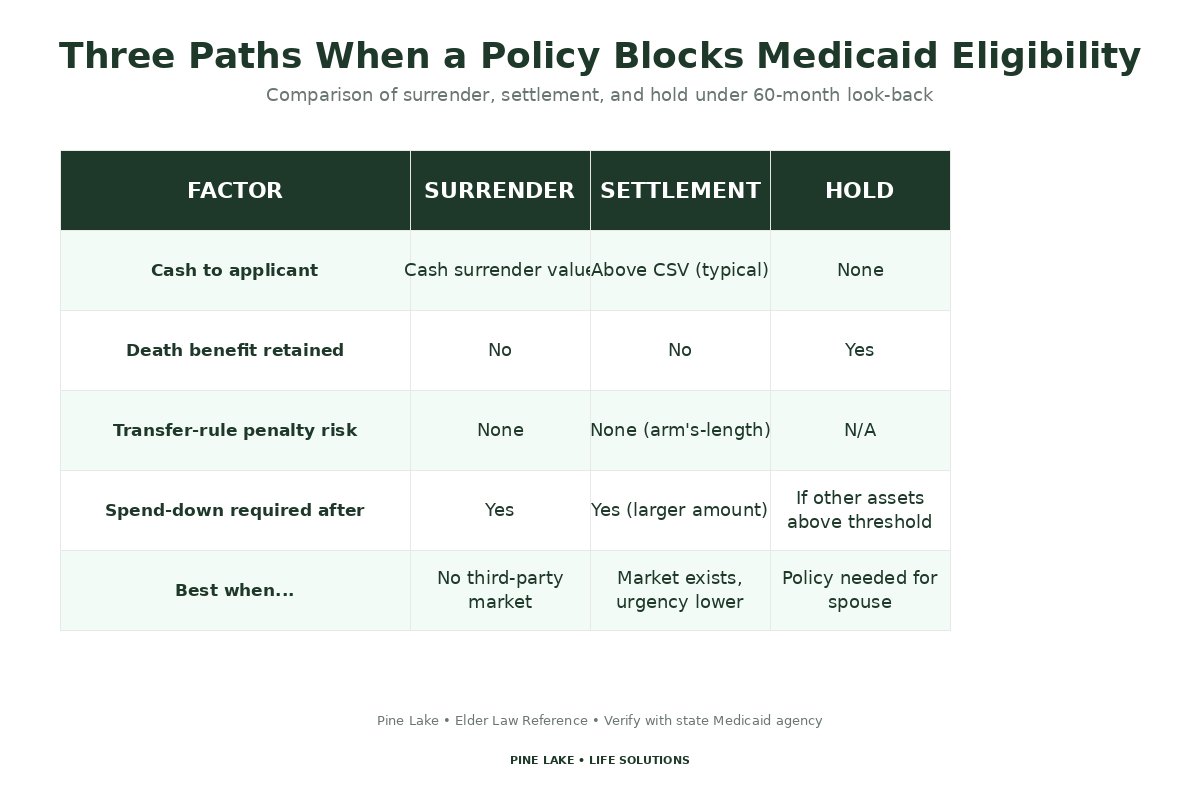
Surrendering is not the only option, and it is often the worst one. Realistic alternatives, each of which should be priced before anything is signed:
- A life settlement – selling the policy to a licensed institutional buyer for more than the surrender value. Proceeds are countable cash, so timing relative to the application matters enormously, and the transaction must be documented as an arm’s-length sale for fair market value or the look-back will treat the shortfall as a gift.
- A reduced paid-up election – keeping a smaller death benefit with no further premiums. This does not raise cash but stops the bleeding.
- An irrevocable funeral trust – assigning the policy to fund burial, which can move it into the exclusion.
- An accelerated death benefit rider, if the policy already carries one.
Selling is the wrong answer when the face amount is small enough to sit inside the burial exclusion; when the policy has already been irrevocably assigned to a funeral provider; when the insured is healthy, because life expectancy underwriting will produce a low offer; and when a surviving spouse will genuinely need the death benefit to live on after the applicant dies. In that last case, protecting the spouse is worth more than qualifying two months earlier. A neutral policy review for Boerne families should tell you which of these five paths your specific policy fits – and quite often the answer is “keep it.”
What a month of care costs in Boerne, and where to get help
The reason the balance sheet matters is that the meter is running. Cost-of-care survey data for the San Antonio-New Braunfels metropolitan area, which includes Kendall County, puts a private room in a skilled nursing facility in the range of $6,500 to $7,800 a month as of 2026, with semi-private rooms running roughly $1,000 less, and assisted living in the range of $4,500 to $5,400 a month. These are survey ranges, not quotes, and they move; call three facilities and ask for their current private-pay daily rate. Texas as a whole remains one of the least expensive states in the country for nursing care – the statewide median private room figure sits below the metro range above, and both sit far below the national median of roughly $10,000 to $11,000 a month.
Two Boerne-specific facts change the arithmetic. First, Kendall County has a very thin supply of skilled nursing beds for its population – most Boerne families end up placing a parent in Kerrville or in San Antonio, which means a 30-to-60-minute drive for every visit and, more practically, that the family’s short list of facilities is not local and their Medicaid-bed availability differs. Second, Kendall County’s growth has been driven substantially by retiree in-migration from San Antonio and out of state, so a large share of Boerne households are asset-rich and income-modest – exactly the profile that fails the resource test while feeling broke.
Where to go: apply to Texas HHSC through YourTexasBenefits.com or an HHSC benefits office (Kerrville and San Antonio are the nearest to Boerne). For free one-on-one help, contact the Alamo Area Agency on Aging at the Alamo Area Council of Governments, which covers Kendall County, or the Texas Health Information, Counseling and Advocacy Program (HICAP), the state’s SHIP. For questions about an insurance company’s conduct or a settlement provider’s license, the Texas Department of Insurance is the regulator. For the legal work – the Miller Trust, the deed, the personal services agreement – retain a Texas elder law attorney. Nothing on this page is legal, tax or eligibility advice, and Pine Lake Life Solutions does not purchase policies; what we offer is a free policy review so you know what the policy is actually worth before anyone decides what to do with it.
Frequently Asked Questions
Which office takes a Medicaid long-term care application for a Boerne, Texas resident?
Texas Health and Human Services (HHSC) does. Texas runs Medicaid eligibility at the state level, so Kendall County itself does not process applications. Apply online at YourTexasBenefits.com, by phone, or in person at an HHSC benefits office – the closest to Boerne are in Kerrville and in San Antonio. The Alamo Area Agency on Aging, which covers Kendall County, will help you assemble the file at no charge.
Does a life insurance policy have to be cashed in before Texas Medicaid will approve a Boerne applicant?
No. What matters is the total face value of all permanent policies on the insured. At $1,500 or less combined, they are excluded as burial insurance. Above that, the cash surrender value becomes countable – but you can address it with a life settlement, a reduced paid-up election, an accelerated death benefit rider, or by assigning the policy into an irrevocable funeral trust. Surrender is only one option and rarely the best-paying one.
Why did a Kendall County application get denied when the family had almost no savings?
Almost always income, not assets. Texas is an income-cap state, so an applicant whose monthly income exceeds the cap – roughly $2,900 as of 2026 – is ineligible regardless of how little they have in the bank, unless a Qualified Income Trust, also called a Miller Trust, is established and the excess is routed through it every month. Two pensions plus Social Security clears the cap easily. An elder law attorney must draft it.
How much does nursing home care actually cost in the Boerne area in 2026?
Cost-of-care survey ranges for the San Antonio-New Braunfels metro, which includes Kendall County, put a private skilled nursing room at roughly $6,500 to $7,800 a month as of 2026 and assisted living at roughly $4,500 to $5,400. Texas runs well below the national median of about $10,000 to $11,000. Kendall County has few skilled nursing beds, so most Boerne families place a parent in Kerrville or San Antonio.
Can the Boerne house be given to the children to protect it from estate recovery?
Not safely, and not inside five years. An uncompensated transfer of the homestead falls in the 60-month look-back and creates a penalty period of ineligibility calculated from the value transferred. There are narrow exemptions, including transfers to a spouse, a disabled child, or a caretaker child who meets specific residence and care requirements. Whether any applies to your deed is a question for a Texas elder law attorney, not a form.
Is selling a policy ever the wrong move for a Boerne family?
Frequently. It is wrong when total face value already sits inside the $1,500 burial exclusion, when the policy has been irrevocably assigned to a funeral provider, when the insured is in good health and life expectancy underwriting will produce a weak offer, and when a surviving spouse will need the death benefit to live on. Cash proceeds also become countable, so timing against the application date matters.
Find out what your policy is worth — free, confidential, no obligation.
A 15-minute educational review covers your eligibility, every alternative, and a realistic view of what each path would net you.
Related Reading
- Nursing Home Costs Boerne Tx
- Life Settlements Boerne Tx
- Texas Medicaid Asset Income Limits
- Life Settlement Taxes Texas
- Nursing Home Medicaid Spend Down
- Life Insurance Counts Medicaid Asset
- Medicaid Lookback Selling Policy
- Surrender Vs Sell Policy
Pine Lake Life Solutions does not purchase life insurance policies and does not provide legal, tax, or investment advice. Information provided is for educational purposes only. Eligibility for any option, including life settlements, is not guaranteed and depends on individual circumstances, policy terms, underwriting, and market conditions. Consult independent legal, tax, or financial professionals before making decisions regarding a life insurance policy.