

If your parent lives in Banning, California and needs nursing home care, discard two pieces of stale advice at once: the $2,000 figure other states use, and the more recent claim that California has no asset limit at all. Effective January 1, 2026 the state again applies a resource test to aged, blind, disabled and long-term-care Medi-Cal, set at $130,000 for one applicant with $65,000 added for each further household member. Those are the pre-2024 amounts, restored after two years with no limit whatsoever. Verify them with Riverside County DPSS or the Department of Health Care Services before acting. Then read the rest of this page knowing the ceiling is high — high enough that most Banning households clear it on liquid savings alone, which is why the property, not the passbook, is what this page is built around.
What is your problem is the house. Income rules still apply, share of cost still applies, and Medi-Cal estate recovery still applies after death. Banning sits in Riverside County, and the county’s Department of Public Social Services (DPSS) is the agency that actually takes and processes the Medi-Cal application — not the City of Banning. DPSS runs self-sufficiency offices across Riverside County, including in the San Gorgonio Pass area and larger offices in Hemet and the Coachella Valley; confirm the current filing location and hours with DPSS before driving anywhere.
This page is organized around the property, because in Banning the property is usually the largest thing on the balance sheet and the only thing that survives the applicant. Everything else — the pension, the CDs, the small whole life policy in the file cabinet — gets decided in reference to it. Pine Lake Life Solutions provides education and a free policy review only; nothing here is legal, tax, or Medi-Cal eligibility advice.
In This Article
- The Asset Test Came Back in 2026. The House Rules Never Left.
- The Banning Homestead While Your Parent Is Living
- Estate Recovery After 2016: What California Can Actually Reach
- Where the Life Insurance Policy Fits in the Property Question
- What Care Costs in Banning and the Pass Area
- Share of Cost: The Rule That Outlasted Every Version of the Asset Rule
- Who to Call in Riverside County
- A Sequence That Works for a Banning Household
- Frequently Asked Questions
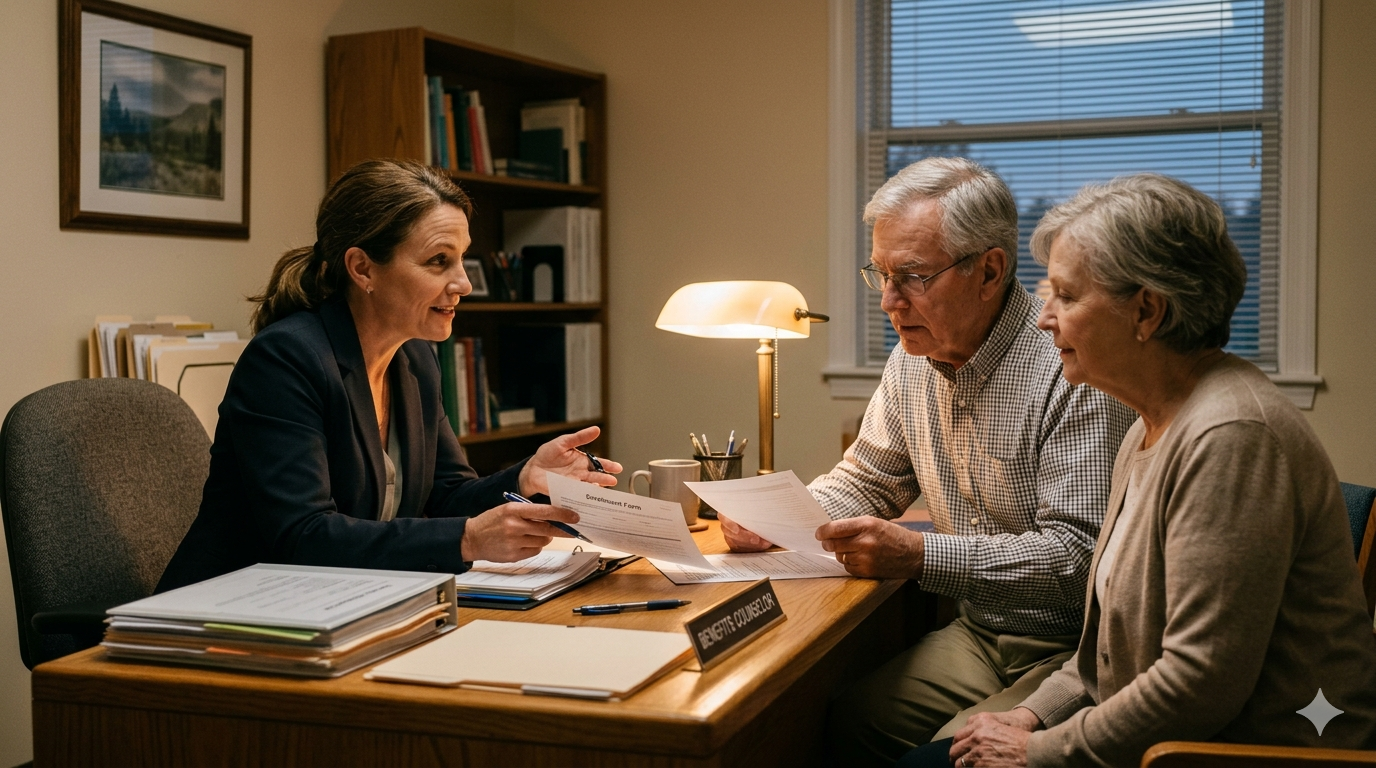
The Asset Test Came Back in 2026. The House Rules Never Left.
California moved this limit three times in four years. It raised the figure sharply in July 2022, eliminated the test altogether for non-MAGI Medi-Cal — Long-Term Care and the Assisted Living Waiver population included — on January 1, 2024, then brought it back on January 1, 2026 at the July 2022 amounts: $130,000 for a single applicant, $65,000 for each further person in the household. It governs the non-expansion programs, meaning Long-Term Care, Aged and Disabled, share-of-cost Medi-Cal, the 250% Working Disabled Program and the Medicare Savings Programs. What counts toward it is ordinary enough — bank accounts, investments, property other than the home lived in — and that home is generally still excluded. Beneficiaries already enrolled document their resources at the first annual renewal during 2026 rather than on day one. Confirm the current figures with Riverside County DPSS or the California Department of Health Care Services, and do not take them from an older article, including one written last year.
Three things did not change, and each of them touches the property:
- Income counts. An institutionalized Medi-Cal recipient generally pays nearly all of their monthly income to the facility as a share of cost, retaining only a small personal needs allowance and certain deductions. That is what funds the property tax and insurance question below.
- Estate recovery survives. California may seek repayment from a deceased beneficiary’s estate for long-term care services it paid.
- Transfer rules are back with teeth. California applies a 30-month look-back for nursing-facility-level care, its own period rather than the longer window most states adopted, and it was restored on the same date as the asset limit. A gift or below-market transfer inside those 30 months produces a stretch when Medi-Cal will not pay for care. Verify the current Department of Health Care Services policy — this is the single most misreported area of California Medi-Cal rules, and quoting another state’s number here costs families money.
Because the ceiling is $130,000 rather than $2,000, the reason to look at a life insurance policy in California is usually different from the reason in other states. A modest cash surrender value is counted and then swallowed by the headroom, so it seldom decides eligibility by itself; ask DPSS how they will treat yours. What it does decide is cash flow, and what the estate looks like when recovery comes. Our page on how life insurance is counted as a Medicaid asset explains the rule most states still apply, which is useful context for anyone comparing California to a relative’s situation elsewhere.
The Banning Homestead While Your Parent Is Living
A principal residence is generally treated as exempt while the Medi-Cal beneficiary is living, and California has long recognized a written intent to return home statement as the mechanism that preserves that treatment even after a permanent move into a facility. The statement is short, it belongs in the application file, and it should be signed by the beneficiary or by an agent under a power of attorney. Do not skip it because the move looks permanent.
What the exemption does not do is pay the bills on the house. Property taxes, homeowners insurance, utilities and maintenance keep coming due while nearly all of the beneficiary’s income is going to the facility as share of cost. In a Banning household with a paid-off home, an annual property tax bill and a homeowners premium still land, and no one has an income stream left to pay them. This is the concrete cash-flow gap where an in-force life insurance policy sometimes matters — less because of eligibility, where California’s $130,000 ceiling usually leaves room to spare, than because premiums on a policy no one can afford compete directly with the property tax bill on a house the family wants to keep.
Families in the San Gorgonio Pass also have a specific advantage worth naming: Banning home values sit well below the Riverside County and California medians. As of 2026, typical Banning single-family values run in the mid-hundreds of thousands while the statewide median is roughly double that. Lower equity means a smaller estate-recovery exposure than a coastal California family faces on the same care plan — and it also means a home equity line is a thinner rescue than families assume.
Estate Recovery After 2016: What California Can Actually Reach
This is the single most important thing for a Banning family to understand, and it is where most out-of-state advice is wrong. California substantially narrowed Medi-Cal estate recovery for beneficiaries who died on or after January 1, 2017. Recovery is limited to the probate estate. Assets that pass outside probate — by a properly funded living trust, by joint tenancy with right of survivorship, by a beneficiary designation, by a transfer-on-death instrument — are generally outside the reach of recovery. California also does not recover from the estate of a surviving spouse, and limits recovery to the amount actually paid for the beneficiary’s care.
Read that again in practical terms: in California, whether the family keeps the Banning house frequently turns on how title is held and whether a trust was actually funded, not on how much Medi-Cal paid. A house sitting in a properly funded revocable living trust is treated differently at death than the identical house held in the parent’s sole name with a will. That is a legal question with a legal answer, and it is exactly the question to bring to a California elder law attorney — ideally before a placement, because retitling decisions made under pressure create their own problems.
Recovery claims also come with statutory hardship waivers and with limits when a surviving spouse, a minor child, or a disabled child is involved. Verify current Department of Health Care Services procedures; the rules were rewritten within the last decade and older guides describe the pre-2017 regime.
Where the Life Insurance Policy Fits in the Property Question
California counts resources again, but at $130,000 rather than $2,000, so for most Banning households a permanent life insurance policy is counted and then comfortably absorbed rather than standing between a parent and Medi-Cal. Confirm with the county how the cash value is treated in your file. Even where it clears easily, the policy can still be the wrong asset to be holding, for two reasons.
The first is premium drag. A universal life policy with rising internal costs, or a whole life policy whose premium was comfortable on two incomes and is not on one, competes with the property tax bill on the house the family is trying to preserve. Letting it lapse produces nothing. Surrendering produces the cash surrender value, which converts a counted resource into cash that is then spent and gone — and for a household with plenty of room under the $130,000 line, that conversion changes nothing about eligibility while permanently ending the contract.
The second is what the policy does at death. A death benefit paid to a named beneficiary passes outside probate — and California’s post-2016 recovery reaches the probate estate. A policy left payable to the estate, by contrast, lands squarely inside it. Whether a beneficiary designation is current is therefore a genuine estate-recovery question in California, not an afterthought. Check every designation, including contingent beneficiaries and any designation naming an ex-spouse.
The alternatives to surrender are worth knowing even where eligibility is not the driver:
- Reduced paid-up election. Stop premiums, keep a smaller guaranteed death benefit. Solves the cash-flow problem without giving up coverage entirely.
- Irrevocable funeral trust. Prepays a cost the family will face regardless, within California’s limits, and takes the decision off the table at a difficult moment.
- Life settlement. For a larger policy on an insured whose health has declined, the secondary market may pay materially more than surrender value. The GAO’s study of the market (GAO-10-775) found sellers typically received roughly 10% to 35% of face value, and several times what surrender would have paid. Comparing a reduced paid-up election against a settlement is the right first exercise.
When selling is the wrong answer. Do not sell when the policy’s aggregate face value is small — a modest burial policy is doing exactly the job it was bought for. Do not sell a policy a surviving spouse will need to keep the Banning house; that death benefit may be the only thing that pays off a reverse mortgage or covers a recovery claim. Do not expect offers on face amounts under roughly $100,000, which is generally below the size the market engages. And do not sell when the insured is in good health for their age, because life expectancy underwriting will compress the offer to something close to insulting.
| How the Banning property is titled | Passes through probate? | Exposure to Medi-Cal estate recovery (deaths on/after 1/1/2017) | Who to ask |
|---|---|---|---|
| Sole name, with a will | Yes | Highest — the probate estate is what recovery reaches | California elder law attorney |
| Properly funded revocable living trust | No | Generally outside the probate estate; confirm funding is complete | Attorney who drafted the trust |
| Joint tenancy with right of survivorship | No | Generally passes to survivor outside probate; other tax consequences apply | Attorney plus tax advisor |
| Community property with right of survivorship (spouse) | No | No recovery from a surviving spouse’s estate under California rules | DPSS and attorney |
| Life insurance payable to a named person | No | Generally outside the probate estate | Carrier — verify the designation is current |
| Life insurance payable to the estate | Yes | Lands inside the probate estate | Carrier — consider changing the designation |

What Care Costs in Banning and the Pass Area
Escalated cost-of-care survey figures for the Riverside-San Bernardino metropolitan area, as of 2026, put a semi-private skilled nursing room at roughly $10,000 to $12,000 per month and a private room several hundred to a thousand higher. Standard assisted living in the Pass and Hemet-Banning corridor runs roughly $5,000 to $6,500 per month, with memory care adding $1,200 or more. Treat all of these as ranges; a facility quote depends on room type, acuity level, and whether therapy and incontinence care are billed separately.
The comparison that matters: the Inland Empire prices below the California statewide medians on both skilled nursing and assisted living, and well below Los Angeles, Orange County and Bay Area figures that pull the state average up. A Banning family shopping locally is buying at some of the lower end of California’s cost curve — which is a real advantage, and one reason families from higher-cost counties sometimes place a parent in the Pass area.
The genuinely local fact that changes the math in Banning specifically: Banning contains Sun Lakes Country Club, one of the larger age-restricted communities in the region, and the city’s population skews significantly older than Riverside County as a whole. That concentration of retirees in a modest-cost housing market produces a distinctive profile — households with meaningful home equity relative to Banning prices, limited liquid savings, and often a decades-old whole life policy from a carrier that no longer sells in California. It also means demand for Pass-area senior housing is steady. Verify current availability on Medicare’s Care Compare rather than assuming a bed is open. Our page on nursing home costs in Banning works through the months-of-care runway.
Share of Cost: The Rule That Outlasted Every Version of the Asset Rule
Income is where California families get surprised, whatever the resource limit happens to be in a given year. A Medi-Cal beneficiary in a nursing facility generally contributes almost all monthly income toward the cost of care, keeping a small personal needs allowance and certain permitted deductions such as health insurance premiums and, where applicable, a maintenance allowance for a community spouse.
Two consequences follow. First, a community spouse still living in the Banning house is not simply left with nothing — federal spousal impoverishment protections allow income and resources to be allocated to the spouse at home, and those figures are updated annually. Verify the 2026 amounts with DPSS. Second, if the beneficiary’s income is what has been paying a life insurance premium, that premium generally stops being payable once share of cost takes the income. Deciding in advance what happens to the policy — lapse, reduced paid-up, funeral trust, or sale — is better than discovering it through a lapse notice six months later. Our guide to what to do when a policy is about to lapse lays out the deadlines.
Who to Call in Riverside County
Riverside County Department of Public Social Services (DPSS) takes and processes the Medi-Cal application, including Long-Term Care Medi-Cal. Ask specifically for long-term care Medi-Cal, not general Medi-Cal, and ask for the worker’s name and a written filing date.
Riverside County Office on Aging is the Area Agency on Aging for Riverside County and the access point for free counseling, caregiver support, and the Health Insurance Counseling and Advocacy Program (HICAP), which is California’s State Health Insurance Assistance Program. HICAP counseling is free and unbiased; use it before you pay anyone for advice about Medicare or coverage.
California Department of Insurance licenses insurers, agents, and life settlement providers and brokers in California. Verify the license of anyone who calls you about a policy. Life settlement solicitations aimed at older Californians attract bad actors, and a five-minute license check is the cheapest protection available.
For the legal questions — title, trust funding, estate recovery exposure, transfer consequences — retain a California elder law attorney. The Riverside County Bar Association and the National Academy of Elder Law Attorneys both maintain referral resources.
A Sequence That Works for a Banning Household
First, confirm with DPSS what resource limit and look-back they are applying right now — $130,000 for one applicant and 30 months as this page is written — and get the answer in writing or from the department’s current published notice. Second, sign and file an intent-to-return statement if the beneficiary is entering a facility and the family wants the homestead treated as exempt. Third, pull a current title report and find out how the Banning property is actually held — sole name, joint tenancy, community property with right of survivorship, or trust. That single fact drives estate-recovery exposure more than anything else you will do.
Fourth, inventory the life insurance: carrier, policy number, face amount, current premium, cash surrender value, and every beneficiary designation. Fifth, take the title report and the policy inventory to a California elder law attorney together, because the right answer on the policy depends on the answer on the house. Sixth, and only then, decide whether the policy should be kept, reduced, converted into a funeral trust, or reviewed for secondary-market value.
If you want to know whether a policy has any market value, a free policy review answers that question at no cost and tells you plainly when the answer is no. Send the policy cover page showing carrier, policy number, face amount and issue date. Pine Lake Life Solutions provides educational information and policy reviews only; we are not a law firm, not a Medi-Cal planner, and not a tax advisor.
Frequently Asked Questions
What is the Medi-Cal asset limit for a Banning applicant in 2026?
$130,000 for a single applicant, with $65,000 added for each additional household member. California suspended its old limit in 2022 and eliminated it in 2024, then reinstated those 2022 figures effective January 1, 2026 for aged, blind, disabled and long-term-care Medi-Cal. Verify with Riverside County DPSS. Income rules, share of cost, and estate recovery all apply on top of it.
Which office takes the application for a Banning resident?
The Riverside County Department of Public Social Services processes Medi-Cal applications, including Long-Term Care Medi-Cal. DPSS operates offices across the county, including in the San Gorgonio Pass area and larger offices in Hemet and the Coachella Valley. Call DPSS to confirm the current location and hours, and ask specifically for long-term care Medi-Cal rather than general Medi-Cal.
Can California take the Banning house after my parent dies?
Only through the probate estate, for deaths on or after January 1, 2017. Assets passing outside probate by funded trust, joint tenancy, or beneficiary designation are generally beyond recovery, and California does not recover from a surviving spouse’s estate. How title is held therefore matters more than how much Medi-Cal paid. Ask a California elder law attorney.
What does nursing home care cost in the Banning area?
Escalated survey figures for the Riverside-San Bernardino metro put a semi-private skilled nursing room at roughly $10,000 to $12,000 a month as of 2026, with assisted living around $5,000 to $6,500. Those are ranges, not quotes. The Inland Empire prices below the California statewide medians and well below coastal counties.
Assets count again, so does that change how we handle a life policy?
It puts the cash surrender value back on the county’s worksheet, though a $130,000 ceiling means a modest policy rarely decides the case by itself; ask DPSS how yours will be treated. The two older reasons still hold. Premiums compete with the property tax and insurance bills once share of cost takes the beneficiary’s income, and a death benefit payable to the estate lands inside the probate estate recovery reaches, while one payable to a named person generally does not.
When is selling a policy the wrong move for a Banning family?
When the face amount is small and already serving as burial coverage; when a surviving spouse needs the death benefit to stay in the house or retire a reverse mortgage; when the face amount is under roughly $100,000, which the secondary market rarely engages; and when the insured is in good health for their age, which compresses any offer to little more than surrender value.
Who gives free help before I hire a professional?
The Riverside County Office on Aging is the Area Agency on Aging and the access point for the Health Insurance Counseling and Advocacy Program, California’s State Health Insurance Assistance Program. HICAP counseling costs nothing. The California Department of Insurance is where you verify that any agent, broker, or settlement provider contacting you is licensed in California.
Find out what your policy is worth — free, confidential, no obligation.
A 15-minute educational review covers your eligibility, every alternative, and a realistic view of what each path would net you.
Related Reading
- Nursing Home Costs Banning Ca
- Life Settlements Banning Ca
- California Medicaid Asset Income Limits
- Life Settlement Taxes California
- Nursing Home Medicaid Spend Down
- Life Insurance Counts Medicaid Asset
- Medicaid Spend Down Riverside San Bernardino
- Reduced Paid Up Vs Settlement
- Policy Lapsing What To Do
Pine Lake Life Solutions does not purchase life insurance policies and does not provide legal, tax, or investment advice. Information provided is for educational purposes only. Eligibility for any option, including life settlements, is not guaranteed and depends on individual circumstances, policy terms, underwriting, and market conditions. Consult independent legal, tax, or financial professionals before making decisions regarding a life insurance policy.