
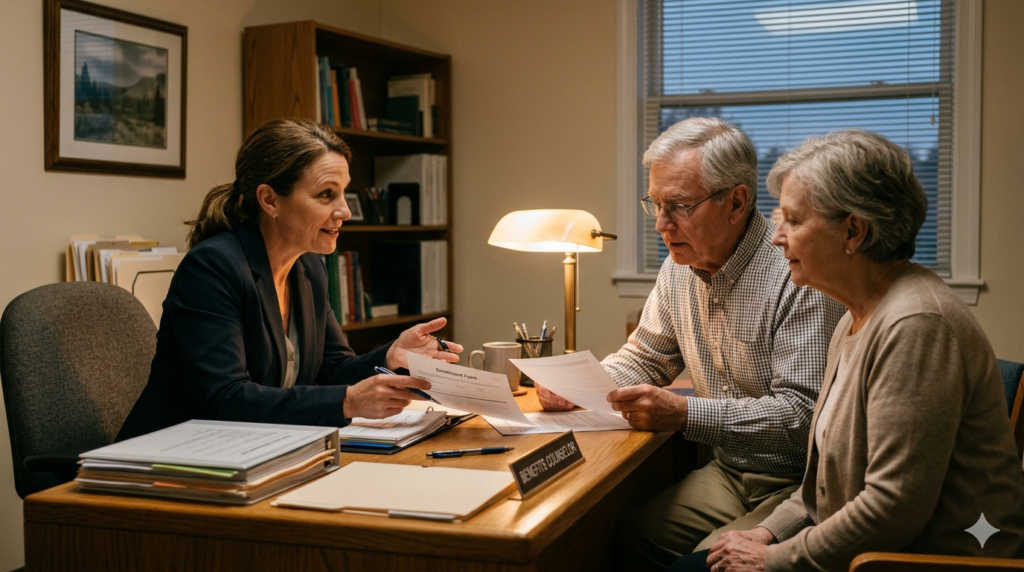
A surviving spouse in Washington is in a different position from the person who received the Medicaid, and usually a worse-understood one: the deferral that protects them during life does not necessarily end the matter, and community property law puts a half-interest in play that most families assume was never at risk. The Office of Financial Recovery can look at what passed from the recipient to the spouse after that spouse dies.
Most articles on this subject are written from the recipient’s chair. This one is written from the chair next to it — the spouse who is still living, still in the house, and trying to work out what happens to it. That perspective changes which rules matter and in what order.
Washington’s Medicaid program is Apple Health, administered by the Health Care Authority, with long-term services and supports delivered through the Aging and Long-Term Support Administration at the Department of Social and Health Services, largely via Community First Choice and the COPES waiver. Estate recovery is handled by the Office of Financial Recovery within DSHS. Figures are as of 2026 and should be confirmed with the office named beside them. This is education, not legal or eligibility advice.
In This Article
- The Spouse’s Position Is Not the Recipient’s Position
- Deferral Is Not Cancellation: What Happens After the Second Death
- Community Property, and the Half You Assumed Was Safe
- The Community Property Agreement, and Why It Is Not a Shield
- The Surviving Spouse’s Own Protections
- The Life Insurance a Surviving Spouse Actually Needs
- Where Washington Departs From the Federal Baseline, and Where It Follows
- Frequently Asked Questions
The Spouse’s Position Is Not the Recipient’s Position
Start with the four things that are true for a surviving spouse in Washington and are not true for an adult child.
- Recovery is deferred while you are alive. Federal law bars collection while a surviving spouse survives, and Washington applies that. Nothing can be taken from you during your lifetime on account of your late spouse’s Medicaid.
- You are not personally liable. Estate recovery is a claim against estate assets, not a debt you owe. A claim larger than the estate does not become your obligation.
- Your own future Medicaid eligibility is a separate question. If you need long-term care yourself, you will be assessed on your own resources under the same rules, and assets you received from your spouse are your assets for that purpose.
- The deferral is not automatically the end. This is the part that surprises people, and it is the subject of the next section.
The first practical step is a written question to the Office of Financial Recovery: does a deferred claim exist on file arising from your spouse’s Medicaid, and if so what amount is asserted and against what property? Ask for an itemized accounting by date of service and service category at the same time. Recovery is mandatory only for long-term care and related services furnished at age 55 or older, and Washington has narrowed the scope of what it pursues in recent legislative sessions, moving away from recovering for non-long-term-care medical services in that age group. Confirm the scope currently applied to your case rather than assuming an older description still holds. The general estate recovery framework sets the federal floor beneath all of it.
Deferral Is Not Cancellation: What Happens After the Second Death
Federal law permits a state to recover, after the surviving spouse’s death, from assets in which the Medicaid recipient held an interest at the time of their own death that passed to that spouse. Washington is among the states that use this authority, and this is the single most consequential difference between Washington and a state that simply closes the file when a spouse survives.
What that means in practice for the surviving spouse:
- The claim may be dormant rather than gone. Ask, in writing, and keep the answer with your own estate documents so that whoever handles your estate later is not blindsided.
- The measure is generally the recipient’s interest at their death, not everything you own now. Assets you acquired independently after the death, and your own separate property, are a different category — but the boundary is a legal question about characterization, and in a community property state that boundary is not intuitive.
- Your own executor will face the question. Leave them a file: the deferred claim correspondence, the marriage certificate, the recipient’s Medicaid identifiers, and the property records showing how title was held at the first death.
None of this makes planning impossible; it makes documentation essential. A Washington elder law attorney can tell you what is characterized as what, and that hour is worth more here than in almost any other state on this topic.
Community Property, and the Half You Assumed Was Safe
Washington is one of a small group of community property states, and that changes the arithmetic of an estate claim in a way most national guidance does not address.
In broad terms, property acquired during the marriage other than by gift or inheritance is community property, in which each spouse holds an undivided one-half interest. Property owned before the marriage, or received by gift or inheritance, is generally separate property. At the first death, the decedent’s half of the community property and all of their separate property make up what can pass by will or intestacy.
Two consequences for a surviving spouse:
First, the recipient’s half-interest in the family home is an interest they held at death, even where the surviving spouse continued living there and even where no probate was opened. That is the interest a state using the after-the-spouse authority is looking at later.
Second, characterization is contestable and worth getting right. Whether the house is community property, separate property, or a mix — because separate funds were used for a down payment, or because an inheritance was commingled — determines the size of the exposed interest. Families rarely have documentation of this, and it is far easier to establish while the surviving spouse is alive and remembers than for an executor to reconstruct afterward.
Assemble now: the deed and any prior deeds, closing statements, records of any inheritance or gift used in the purchase, and any community property agreement or prenuptial agreement. Then get it characterized by counsel and keep the memo.
| Question a Surviving Spouse Asks | Washington Answer | Who to Ask |
|---|---|---|
| Can they take the house now? | No. Recovery is deferred while you are living | Office of Financial Recovery, in writing |
| Am I personally liable for the claim? | No. It is a claim against estate assets | Washington elder law attorney |
| Is the claim gone once I survived my spouse? | Not necessarily. Washington may look again after your death | Office of Financial Recovery |
| Does our community property agreement solve it? | It avoids probate; it does not erase the interest held at death | Attorney, reading it with the deed |
| Is the death benefit I received exposed? | No, if it was paid to you as a living named beneficiary | The carrier, in writing |
| What if I need care myself? | Assessed on your own resources under the same rules | Health Care Authority |
The Community Property Agreement, and Why It Is Not a Shield
A community property agreement is a distinctly Washington instrument. Many Washington couples have one, often signed decades ago at a bank or with a will package, providing that on the first death all community property vests automatically in the surviving spouse. It is popular because it avoids probate entirely.
Its effect here is worth understanding precisely, because families draw the wrong conclusion in both directions.
What it does: it moves the property to the surviving spouse without probate. In a strictly probate-only recovery state, that would place the property outside the claim at the first death.
What it does not do: it does not erase the fact that the recipient held an interest in that property immediately before death. In a state that can look at what passed to the surviving spouse after that spouse dies, avoiding probate at the first death does not resolve the question at the second.
So a community property agreement is a probate-avoidance tool, not a Medicaid shield, and it should not be relied on as one. Equally, it is not a mistake — for most couples the probate avoidance is genuinely valuable. The error is treating it as the answer to a question it was never designed to address. If you have one, have a Washington elder law attorney read it alongside the deed and tell you what it actually does to your position, especially before making any change to titling that could count as a transfer inside the 60-month look-back.
The Surviving Spouse’s Own Protections
Set against all of this, a Washington surviving spouse has real protections worth claiming.
The home during your lifetime. Nothing can be collected while you are living. If you need Apple Health long-term care yourself later, your home is generally an exempt resource for your own eligibility, subject to the federal home equity limit for the year — roughly $750,000 under the lower federal figure and roughly $1.13 million under the higher one for 2026, with the state’s election to be confirmed with the Health Care Authority.
The spousal impoverishment rules. While your spouse was receiving care, these protected a share of the couple’s resources and a minimum monthly income for you as the community spouse. If you believe the calculation was done wrong, ask the Health Care Authority for the worksheet — errors are common and there is an appeal route with a deadline printed on any notice. See Washington Apple Health asset and income limits for the surrounding figures, including the $2,000 individual countable resource limit commonly cited for long-term care as of 2026.
Probate allowances. Washington provides a statutory award to a surviving spouse from the estate, claimed through the superior court rather than granted automatically, which is paid ahead of general creditor claims. Confirm the current amount and process with the court in the county where any estate is filed. Washington also offers a small estate affidavit route for modest personal property estates, commonly cited at $100,000 as of 2026.
The undue hardship waiver remains available and is requested in writing inside the window printed on any notice, supported by tax returns, benefit award letters, bank statements and property valuations.
The Life Insurance a Surviving Spouse Actually Needs
This is where a spouse-centred view produces the opposite advice from a generic one, and it is worth saying plainly.
If you are the surviving spouse and the policy is on your own life, the question is who depends on that benefit. If a disabled adult child, a family member with care needs, or a mortgage on the house depends on it, the right answer is very often to keep it. Keeping the policy is sometimes the correct outcome, and pages that never say so are selling something.
If the policy was on your late spouse, the beneficiary designation decided everything. Paid to you as a living named beneficiary, it passed by contract, never entered the estate, and is outside any recovery claim. Payable to the estate — including the accidental version where you were the sole named beneficiary and predeceased, or where a designation was never updated after a prior marriage — it became an estate asset and was exposed.
If your own eligibility is now the question, cash value counts as a resource against the individual limit. Life insurance with a total face value at or below $1,500 is generally excluded as a burial resource under the federal rule Washington follows, and an irrevocable funeral trust converts cash into a non-countable prepaid arrangement within state limits. Above that, the ordered options are reduce to paid-up, borrow, surrender, or sell.
On selling: a settlement converts a countable asset into countable cash that is itself subject to spend-down, and a transfer for less than fair value inside the look-back creates a penalty — see how a settlement interacts with the look-back. It can be right where premiums have become unaffordable and a policy is heading for lapse. It is generally wrong where a surviving spouse or a dependent still needs the coverage, where the face amount sits inside the burial exclusion, or where the insured is healthy with a long life expectancy.
Where Washington Departs From the Federal Baseline, and Where It Follows
Departures. Recovery is administered by the Office of Financial Recovery within the Department of Social and Health Services, not by the Health Care Authority that runs Apple Health — two agencies, two sets of correspondence. Washington is a community property state, which changes what interest a Medicaid recipient held at death. Washington is among the states that use the federal authority to look at assets that passed to a surviving spouse after that spouse’s death. Washington has narrowed the scope of recoverable services in recent legislative sessions and the current scope should be confirmed rather than assumed. And Washington is one of the few states with its own estate tax — the exclusion amount was increased by 2025 legislation and is subject to indexing, so confirm the current threshold with the Washington Department of Revenue, since it is another claim competing in the same estate.
What Washington follows. The age-55 trigger and the mandatory service categories. The full federal exemption set: a surviving spouse; a child under 21; a blind or disabled child of any age; a sibling with an equity interest and a year’s residence; and a caregiver child with two years’ residence whose care delayed institutionalization. TEFRA lien authority for permanently institutionalized recipients where no protected relative lives in the home. The mandatory undue hardship process. And the 60-month look-back.
If community care rather than a facility is the live question, look at Washington’s home and community-based long-term care options first — Community First Choice and COPES services cost the program far less per month than facility care, which means a much smaller eventual claim as well as a better life.
Where an in-force policy is part of the picture, a free policy review will establish what the contract is worth today before anyone decides whether to keep it, reduce it, or move it. Pine Lake Legacy provides education and policy reviews only; it does not purchase policies.
Frequently Asked Questions
Can Washington collect from me while I am still alive?
No. Federal law defers recovery while a surviving spouse survives, and Washington applies that rule. Nothing can be collected from you during your lifetime on account of your late spouse’s Medicaid, and you are not personally liable for the claim. Ask the Office of Financial Recovery in writing whether a deferred claim is on file.
Does Washington come back after the surviving spouse dies?
It can. Federal law permits recovery after the surviving spouse’s death from assets in which the recipient held an interest at their own death that passed to that spouse, and Washington is among the states that use this authority. A deferral is not automatically a cancellation. Document the position now and leave the file for your executor.
Does a community property agreement protect the house from recovery?
It avoids probate at the first death, which is genuinely useful, but it does not erase the fact that the Medicaid recipient held a community property interest immediately before death. In a state that can look at what passed to a surviving spouse, probate avoidance at the first death does not settle the question at the second.
Who handles Medicaid estate recovery in Washington?
The Office of Financial Recovery within the Department of Social and Health Services, not the Health Care Authority that administers Apple Health. Direct itemization requests, exemption documentation and hardship requests there in writing and keep dated proof of delivery. Long-term services questions go to the Aging and Long-Term Support Administration instead.
Was the life insurance my spouse left me part of the claim?
Not if it was paid to you as a living named beneficiary, because it passed by contract and never entered the estate. It would have been exposed if the policy had been payable to the estate, or if the only named beneficiary had predeceased with no contingent added. Confirm designations on your own policies now, in writing with the carrier.
Should a surviving spouse sell a life insurance policy?
Often not. If a disabled adult child, a dependent relative or a mortgage relies on the death benefit, keeping the coverage is usually the right answer. A sale converts a countable asset into countable cash and can create a look-back penalty. Price reduced paid-up status, a policy loan and an irrevocable funeral trust first, with your own attorney and CPA.
Find out what your policy is worth — free, confidential, no obligation.
A 15-minute educational review covers your eligibility, every alternative, and a realistic view of what each path would net you.
Related Reading
- Washington Medicaid Asset Income Limits
- What Is Medicaid Estate Recovery
- Medicaid Home Care Waivers Washington
- What Is The Medicaid Look Back Period
- Medicaid Lookback Selling Policy
- Keeping The Policy Is The Right Answer
- Life Settlement Taxes Washington
- Washington Insurance Department Consumer Help
Pine Lake Legacy does not purchase life insurance policies and does not provide legal, tax, or investment advice. Information provided is for educational purposes only. Eligibility for any option, including life settlements, is not guaranteed and depends on individual circumstances, policy terms, underwriting, and market conditions. Consult independent legal, tax, or financial professionals before making decisions regarding a life insurance policy.