

Yes — life settlements are legal in Florida. Florida residents who qualify can sell an unwanted life insurance policy for significantly more than its cash surrender value — typically 4–8× more on qualifying policies. Transactions are regulated by the Florida Office of Insurance Regulation, and every buyer and broker in the chain must comply with Florida’s life settlement law.
This guide covers who qualifies in Florida, how the state regulates the transaction, tax treatment, and how the process works from first call to funding.
In This Article
- Are Life Settlements Legal in Florida?
- Who Qualifies for a Life Settlement in Florida?
- How Florida Regulates Life Settlements
- How Much Do Florida Policyholders Receive?
- Taxes on a Life Settlement in Florida
- Where We Work in Florida
- How the Process Works
- Why Work With an Educational Firm
- Frequently Asked Questions

Are Life Settlements Legal in Florida?
Life settlements are legal throughout Florida. The legal right to sell a life insurance policy traces to Grigsby v. Russell (1911), in which the U.S. Supreme Court held that a life insurance policy is the personal property of its owner and may be sold like any other asset. In Florida, the transaction is governed by Florida Viatical Settlement Act, Fla. Stat. §§ 626.991–626.99295 (the Act covers both viatical and life settlements without distinction), administered and enforced by the Florida Office of Insurance Regulation.
Florida licenses viatical settlement providers through the Office of Insurance Regulation, and its statute treats life settlements and viatical settlements identically; settlement brokering is performed by licensed Florida life agents.
Before working with anyone, verify their license status directly with the Florida Office of Insurance Regulation. A legitimate broker or provider will never object to you checking.
Who Qualifies for a Life Settlement in Florida?
The eligibility profile in Florida mirrors the national market. The strongest candidates are policyholders who meet most of these criteria:
- Age: the insured is generally 65 or older — though a serious health impairment can qualify a younger insured
- Policy size: face value of $100,000 or more
- Policy type: universal life, indexed universal life, whole life, or survivorship policies; convertible term can qualify through a convert-and-settle approach
- Policy age: in force at least 2 years (most states require this to prevent stranger-originated life insurance)
Florida has one of the highest shares of residents age 65 and older of any state — roughly 21% of its population. With more than 4 million seniors, it is a top destination for retirees nationwide. That demographic reality means a large volume of in-force policies in Florida are held by people at or past the age where the coverage no longer matches their needs — exactly the situation a life settlement was designed for.
How Florida Regulates Life Settlements
Regulation is state-level, and Florida’s framework draws on the NAIC Life Settlements Model Act — the national consumer-protection standard. Core protections for Florida policyholders include:
- Licensing — providers (buyers) and brokers must be authorized to transact in Florida
- Mandatory disclosures — you are entitled to know your alternatives, the broker’s compensation, and how your medical information will be handled
- Rescission rights — 15 days after the viator receives the settlement proceeds (Fla. Stat. § 626.9924)
- Anti-fraud provisions — including prohibitions on STOLI (stranger-originated life insurance)
The regulator to contact with questions or complaints is the Florida Office of Insurance Regulation.
How Much Do Florida Policyholders Receive?
On qualifying policies, life settlements typically pay 10–35% of the policy’s face value — which works out to roughly 4–8× the cash surrender value in typical cases, a relationship documented in the U.S. Government Accountability Office report GAO-10-775. On a $500,000 policy, that range is $50,000–$175,000. The exact offer depends on the insured’s age and health, the policy’s annual premium load, available cash value, and prevailing capital-market conditions. See our full guide to how much you can sell a policy for.
| Option | What You Receive | Timeline |
|---|---|---|
| Let the policy lapse | Nothing | Immediate |
| Surrender to the carrier | Cash surrender value | 2–4 weeks |
| Life settlement | Typically 4–8× surrender value | 60–120 days |
Taxes on a Life Settlement in Florida
Federal tax treatment follows IRS Revenue Ruling 2009-13 as modified by the Tax Cuts and Jobs Act of 2017: proceeds up to your premium basis are tax-free; the portion between basis and cash surrender value is ordinary income; anything above cash surrender value is generally long-term capital gain. Florida has no state income tax, so life settlement gains are not taxed at the state level. Because the after-tax number is what actually matters, we recommend every Florida policyholder run the numbers with a CPA before accepting any offer. Our life settlement tax guide covers the mechanics in depth.
Where We Work in Florida
Educational reviews are conducted by phone or video, so we work with policyholders throughout Florida — including:
- Miami
- Tampa
- Orlando
- Jacksonville
- Sarasota
- Fort Myers
- West Palm Beach
- Naples
- St. Petersburg
- Fort Lauderdale
- Daytona Beach
- Ocala
Retirement-heavy areas such as The Villages, Sun City Center, Naples, Sarasota-Bradenton are home to exactly the policy profiles that tend to qualify: permanent coverage purchased decades ago whose original purpose has passed.
How the Process Works
The path from first conversation to funding follows the same sequence nationwide:
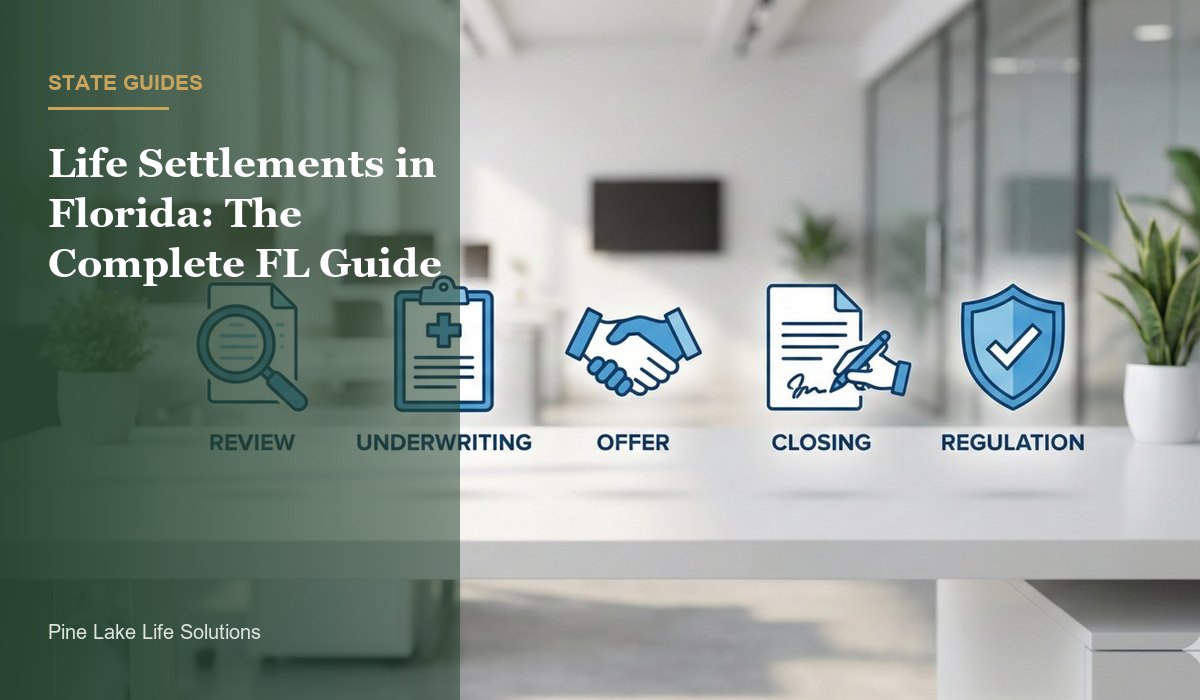
- Free educational review (15 minutes) — a high-level eligibility read plus an honest comparison of every alternative: surrender, reduced paid-up, 1035 exchange, accelerated death benefit, policy loans, and a settlement
- Authorizations — HIPAA medical release and carrier authorization so the case can be underwritten
- Underwriting (2–6 weeks) — two independent life expectancy reports are ordered
- Marketing and offers — the case is presented to licensed buyers; competing offers are negotiated
- Contracts and escrow — state-mandated disclosures, signing, carrier change-of-ownership paperwork, funds released from escrow
Total timeline: typically 60–120 days. The full sequence is detailed in our step-by-step process guide.
Why Work With an Educational Firm
Pine Lake Life Solutions is an educational firm — we do not buy policies, and we have no financial incentive tied to a specific outcome. Our job is to make sure Florida policyholders understand every option before making a decision that can’t be undone. For a meaningful percentage of the people we talk to, a settlement is not the right answer, and we say so plainly. When a settlement is the right path, we coordinate introductions to licensed providers and stay involved through closing.
Frequently Asked Questions
Can I sell my life insurance policy in Florida?
Yes. Life settlements are legal in Florida and regulated by the Florida Office of Insurance Regulation. Policyholders who qualify — generally age 65+, with a permanent policy of $100,000 or more that has been in force at least 2 years — can sell to a licensed buyer for more than the cash surrender value, typically 4–8× more on qualifying policies.
Who regulates life settlements in Florida?
The Florida Office of Insurance Regulation oversees life settlement activity in the state under Florida Viatical Settlement Act, Fla. Stat. §§ 626.991–626.99295 (the Act covers both viatical and life settlements without distinction). Florida licenses viatical settlement providers through the Office of Insurance Regulation, and its statute treats life settlements and viatical settlements identically; settlement brokering is performed by licensed Florida life agents. You can verify any party’s license status directly with the regulator before signing anything.
How much can I get for my life insurance policy in Florida?
Qualifying policies typically sell for 10–35% of face value — roughly 4–8× the cash surrender value. On a $500,000 policy, that’s $50,000–$175,000, depending on the insured’s age, health, premium costs, and market conditions. A free policy review is the only way to get a number specific to your situation.
Do I pay state taxes on a life settlement in Florida?
Federal three-tier treatment under IRS Rev. Rul. 2009-13 applies everywhere: basis is tax-free, basis-to-CSV is ordinary income, and gains above CSV are generally capital gains. Florida has no state income tax, so life settlement gains are not taxed at the state level. Confirm your specific situation with a CPA before accepting an offer.
How long does a life settlement take in Florida?
The formal process typically takes 60–120 days from signing authorizations to receiving funds. The longest step is medical underwriting — two independent life expectancy reports that take 2–6 weeks. The initial educational review takes about 15 minutes and tells you whether opening a case is worth it.
What types of policies can be sold in Florida?
Universal life, indexed universal life, variable universal life, whole life, and survivorship (second-to-die) policies are the most commonly settled types. Term insurance can qualify if it carries a conversion privilege that hasn’t expired — the policy is converted to permanent coverage and then sold.
Find out what your policy is worth — free, confidential, no obligation.
A 15-minute educational review covers your eligibility, every alternative, and a realistic view of what each path would net you.
Related Reading
- Sell Life Insurance Florida
- Life Settlement Broker Florida
- Cant Afford Life Insurance Premiums Florida
- Life Settlement Vs Surrender
Pine Lake Life Solutions does not purchase life insurance policies and does not provide legal, tax, or investment advice. Information provided is for educational purposes only. Eligibility for any option, including life settlements, is not guaranteed and depends on individual circumstances, policy terms, underwriting, and market conditions. Consult independent legal, tax, or financial professionals before making decisions regarding a life insurance policy.