
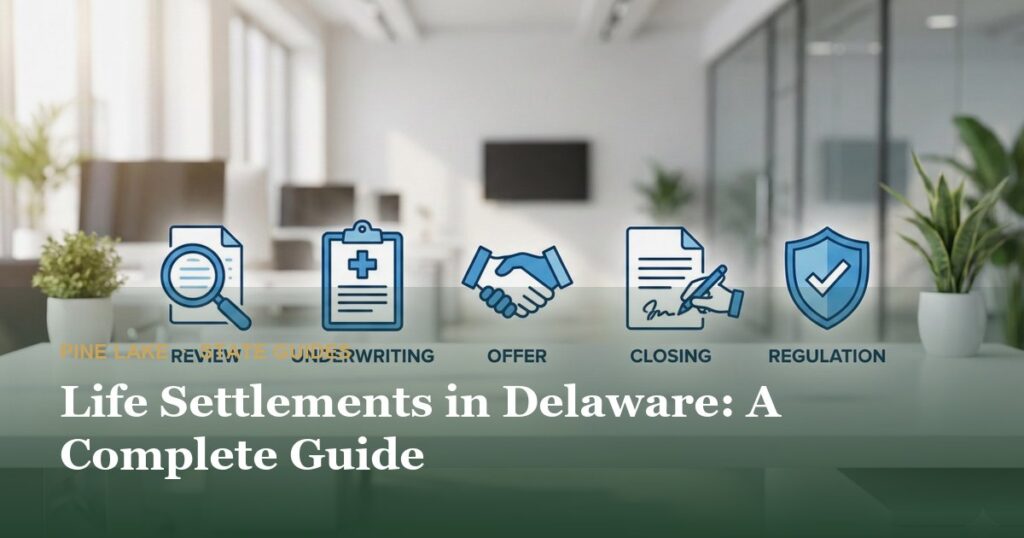
Delaware policyholders can sell a life insurance policy they no longer need or can no longer afford through a life settlement, a regulated transaction overseen by the Delaware Department of Insurance under the viatical and life settlement provisions of Title 18 of the Delaware Code. Sellers who qualify — generally 65 or older with a permanent policy of $100,000 or more that has been in force at least two years — typically receive 10–35% of face value, roughly 4 to 8 times what surrendering would pay according to federal GAO research. Delaware’s growing retiree population and its outsized role in American trust law make the topic unusually relevant here.
Below: how Delaware regulates these sales, who qualifies, what policies actually fetch, the tax picture for First State residents, and the special considerations for trust-owned policies.
In This Article
- The First State’s Secondary Market for Life Insurance
- How Delaware Regulates Life Settlements: Title 18 and the Department of Insurance
- Qualifying in Delaware: The Screens Buyers Apply
- What Delaware Policies Actually Sell For
- The Delaware Tax Picture: Friendlier Than Most Neighbors
- Trust-Owned Policies: The Delaware Specialty
- The Process for a Delaware Seller, Start to Finish
- Deciding Whether Selling Makes Sense in Your Situation
- Frequently Asked Questions
The First State’s Secondary Market for Life Insurance
A life settlement is the sale of an in-force life insurance policy to a licensed institutional buyer for immediate cash. The buyer takes over every future premium and collects the death benefit when the insured dies; the seller walks away with a lump sum and no further obligation. It is the third exit from a policy that most owners never learn about — the first two being surrender, which pays only the carrier’s cash surrender value, and lapse, which pays nothing at all.
The transaction is legally uncontroversial. In Grigsby v. Russell (1911), the U.S. Supreme Court confirmed that a life insurance policy is property its owner may sell, and today’s market operates under state statutes modeled on the NAIC Life Settlements Model Act. Buyers are licensed providers deploying institutional capital — pension funds, asset managers, and specialty investors — who price policies by running discounted cash flow analysis on independent life expectancy reports.
Delaware’s relevance to this market runs in two directions. First, the state has become a genuine retirement destination: Sussex County’s beach communities and the state’s low property taxes draw retirees from New Jersey, Pennsylvania, Maryland, and New York, and many arrive carrying permanent life insurance bought for reasons that no longer exist. Second, Delaware is the country’s preeminent trust jurisdiction, so a meaningful share of policies with Delaware connections are owned inside trusts — a wrinkle covered later in this guide. Either way, the starting point is the same: understand what a life settlement is before deciding what your policy is worth.
How Delaware Regulates Life Settlements: Title 18 and the Department of Insurance
Delaware’s insurance code — Title 18 of the Delaware Code — contains the state’s viatical and life settlement provisions, and the Delaware Department of Insurance administers them. The Department licenses market participants, fields consumer complaints, and can discipline bad actors, which makes it the first stop for any Delaware seller doing due diligence.
The core protections mirror the national framework described in the NAIC Life Settlements Model Act:
- Licensing of providers and brokers. The entities buying policies and the intermediaries representing sellers must hold appropriate authority. A license check through the Department costs nothing and eliminates the least trustworthy operators immediately.
- Mandatory disclosures. Sellers are entitled to know the alternatives to selling, the consequences of a sale, and how any broker is compensated.
- Rescission rights. A post-closing window — 15 to 30 days is the national pattern — lets a seller unwind the transaction and return the money.
- Escrow at closing. Sale proceeds are held by an independent escrow agent until the carrier confirms the ownership change, so the seller is never left having transferred a policy without payment in hand.
- STOLI prohibition. Policies originated at the outset for the benefit of investors — stranger-originated life insurance — are illegal everywhere the model framework applies.
Sellers who want the broader national context can compare Delaware’s approach with the survey in how life settlements are regulated. The short version: Delaware sellers transact inside a licensed, supervised market, and the protections work best for those who actively use them.
Qualifying in Delaware: The Screens Buyers Apply
Buyers apply the same underwriting screens in Delaware as everywhere else, because policy economics are national even when regulation is state-by-state.
- Age 65 or older is the general benchmark, with younger insureds qualifying when significant health impairments shorten life expectancy. Offers tend to improve with age.
- Face value of $100,000 or more. Below that threshold, transaction costs eat the economics and most providers pass.
- Two or more years in force. This requirement ties to contestability periods and the anti-fraud architecture of state law.
- Permanent coverage. Universal life, indexed and variable universal life, whole life, and survivorship contracts are all marketable. Term insurance qualifies only while its conversion privilege is alive — the buyer’s plan is to convert it — so the conversion deadline is the date that controls everything for term holders.
- Declining health helps, counterintuitively. A shorter life expectancy means fewer premiums for the buyer and a nearer death benefit, which raises the offer.
Delaware’s retiree profile fits these screens well. A couple who relocated to Lewes or Rehoboth after selling a business in Wilmington may hold survivorship coverage bought for estate taxes that the post-2017 federal exemption — now above $13 million per person — made unnecessary. A retired DuPont or bank professional may carry employer-related universal life whose premiums escalate sharply in their eighties. Each is a textbook candidate. The complete criteria, including edge cases, are laid out in who qualifies for a life settlement.
What Delaware Policies Actually Sell For
Realistic expectations start with the federal government’s own market research. The Government Accountability Office (GAO-10-775) found that policy sellers received roughly 4 to 8 times the cash surrender value they would have collected from the carrier. Offers commonly land between 10% and 35% of face value, with position inside that range driven by a handful of measurable factors.
Life expectancy dominates. Two independent underwriting firms review the insured’s medical records and issue life expectancy estimates, typically within 2 to 6 weeks. Everything else in the bid is arithmetic built on those reports.
Premium efficiency matters nearly as much. A policy costing 1% of face value annually to maintain is a far better asset than one costing 4%, because the buyer inherits the premium bill. This is why in-force illustrations — projections of exactly what it costs to keep the policy alive — are central documents in every file; owners can learn to read their own via how to read an in-force illustration.
Competition sets the final number. A single provider bidding against nobody has no reason to stretch. Policies marketed to multiple licensed buyers in documented rounds consistently price higher.
As a concrete sketch: an 81-year-old Sussex County retiree with a $400,000 universal life policy, moderate cardiac history, and a $12,000 surrender value might see competitive bids in the $50,000–$110,000 neighborhood. Only an actual auction establishes the real figure, and the owner’s baseline comparison should always be the surrender value — the analysis in life settlement vs. surrender shows how to run it.
| Exit Path for a Delaware Policy | What You Receive | Speed | Best Suited For | Main Drawback |
|---|---|---|---|---|
| Lapse | Nothing | Automatic after 30–31 day grace period | No one — always compare first | Every premium dollar paid is lost |
| Surrender | Cash surrender value | Days to weeks | Small or unmarketable policies | Often a fraction of secondary-market value |
| Life settlement | Typically 10–35% of face value (4–8× surrender per GAO-10-775) | 60–120 days | Age 65+, $100k+ permanent policy no longer needed | Heirs lose the death benefit; possible taxes and benefit-eligibility effects |
| Keep with adjustments | Reduced but continuing coverage | Weeks | Owners who still need some protection | Premiums may still climb at advanced ages |
| Trustee sale (ILIT-owned policy) | Market value paid into the trust | 60–120 days plus trust review | Delaware ILITs whose estate-tax purpose has lapsed | Requires trustee authority, documentation, and fiduciary care |

The Delaware Tax Picture: Friendlier Than Most Neighbors
Federal treatment comes first and applies identically in every state. Under Revenue Ruling 2009-13 as modified by the 2017 Tax Cuts and Jobs Act, settlement proceeds are taxed in three tiers: amounts up to your cost basis (total premiums paid) are tax-free; the portion between basis and cash surrender value is ordinary income; the remainder above cash surrender value is capital gain. Viatical settlements by terminally ill insureds with life expectancies under 24 months are often entirely tax-free under IRC Section 101(g). The IRS framework and worked examples live in the life settlement tax treatment guide.
At the state level, Delaware is comparatively gentle:
- No state estate tax. Delaware repealed its estate tax effective 2018, which removed a state-level reason many residents originally carried large policies.
- No sales tax — irrelevant to the settlement itself but part of why retirees choose the state and why fixed budgets stretch further here.
- Moderate income tax. Delaware taxes income, including the taxable tiers of a settlement, at graduated rates that top out lower than those of neighboring New Jersey, New York, and the District of Columbia.
The planning implication: for many Delaware retirees, the estate-tax purpose that justified a large permanent policy has evaporated twice over — once federally, when the exemption rose past $13 million per person, and once at the state level with the 2018 repeal. A policy kept out of inertia rather than purpose deserves a valuation. Have a CPA confirm your basis and surrender-value figures with the carrier before closing so the tax cost of selling is known, not guessed.
Trust-Owned Policies: The Delaware Specialty
No state guide to Delaware would be complete without the trust dimension. Delaware is one of the nation’s leading trust jurisdictions — favorable statutes, experienced corporate trustees, and long-duration dynasty trusts have drawn assets from across the country — and a significant share of large life insurance policies connected to Delaware are owned by irrevocable life insurance trusts (ILITs) rather than individuals.
A trust-owned policy can absolutely be sold in a life settlement, but the mechanics differ from an individual sale:
- The trustee is the seller. Authority comes from the trust instrument and applicable trust law, and the trustee signs everything. Beneficiary consent practices vary, but documentation of the decision process is essential in every case.
- Fiduciary duty frames the decision. A trustee who lets a valuable policy lapse — or surrenders it for a fraction of market value without checking — invites beneficiary claims. Obtaining bids is increasingly viewed as part of prudent administration; the duties are detailed in the ILIT trustee duties guide.
- Tax analysis shifts to the trust. Whether the ILIT is a grantor or non-grantor trust changes who reports the taxable tiers, and proceeds landing inside the trust are governed by its distribution terms.
- The decision matrix is bigger. Trustees weigh settlement against surrender, reduced paid-up coverage, premium restructuring, or distribution of the policy itself — the comparison mapped in ILIT surrender vs. settlement.
Corporate trustees in Wilmington administer thousands of ILITs funded during the era when the federal exemption was a fraction of today’s $13 million-plus figure. For many of those trusts, the insured no longer has a taxable estate, and the policy is a cash-consuming asset in search of a purpose. Trustees in that position should read life settlements for trustees before their next premium notice arrives.
The Process for a Delaware Seller, Start to Finish
The Delaware transaction follows the standard national arc, typically 60 to 120 days end to end:
- Free initial screen. Policy type, face amount, carrier, premium schedule, and the insured’s age and general health determine marketability in a matter of days.
- Authorizations and records. The owner signs HIPAA releases for medical records and orders an in-force illustration from the carrier. Expect two to five weeks; this stage sets the pace of the whole file.
- Independent life expectancy underwriting. Two firms issue estimates, usually inside 2–6 weeks, forming the pricing backbone.
- Competitive bidding. Licensed providers submit offers in documented rounds. This is where representation matters — a broker owes the seller loyalty, while a provider negotiates for its own portfolio, a distinction unpacked in broker vs. provider.
- Closing through escrow. Contracts are executed, change-of-ownership and change-of-beneficiary forms go to the carrier, and funds sit with an independent escrow agent until the carrier confirms the transfer. Then the money is released and the rescission clock starts.
Two practical Delaware notes. First, if a premium is due mid-process, mind the 30–31 day grace period — a lapse during the sale destroys the asset being sold. Second, after closing, the buyer will contact the insured periodically to verify health status for the rest of their life; it is routine, but sellers should expect it.
Deciding Whether Selling Makes Sense in Your Situation
The framework for a Delaware owner is the same disciplined comparison that serves owners everywhere, run with local numbers.
Start with need. If a surviving spouse would depend on the death benefit, if the policy secures a loan or business obligation, or if a genuine estate liquidity need remains, keeping or restructuring the policy leads. If the policy was bought for a Delaware or federal estate tax that no longer applies, or for dependents long since independent, it is a candidate for sale.
Then test sustainability. Pull the in-force illustration and look hard at projected premiums through the insured’s nineties. Universal life charges rise steeply at advanced ages, and a policy destined to lapse after years of further payments is the most expensive possible outcome. Owners already feeling that squeeze should compare every option in what to do when premiums become unaffordable.
Finally, price the alternatives honestly. Get the surrender value in writing, get competitive settlement bids through licensed parties, and estimate the after-tax proceeds of each. Layer in the soft costs: heirs lose the death benefit permanently, a lump sum can affect Medicaid and other means-tested benefit eligibility, and the decision cannot be revisited once the rescission window closes.
Delaware’s combination of retiree demographics, repealed estate tax, and trust-heavy ownership means an unusual number of policies in the state are held out of habit. Habit is not a reason to keep paying premiums — but neither is a single unsolicited offer a reason to sell. Run the comparison; let the numbers decide.
Frequently Asked Questions
Are life settlements legal in Delaware?
Yes. Delaware regulates viatical and life settlements through provisions in Title 18 of the Delaware Code, administered by the Delaware Department of Insurance. The right to sell a policy as personal property traces to the U.S. Supreme Court’s 1911 Grigsby v. Russell decision. Legality carries conditions: providers and brokers must hold appropriate authority in the state, sellers are owed written disclosures, escrow protects the purchase price at closing, and stranger-originated life insurance schemes are prohibited.
Who oversees life settlement companies in Delaware?
The Delaware Department of Insurance. It licenses the providers who buy policies and the brokers who represent sellers, takes consumer complaints, and can discipline violators. Any Delaware policy owner considering a sale should verify the license status of every party before sharing medical records or policy documents — the check is free and immediate. Delaware’s framework follows the NAIC Life Settlements Model Act pattern used across most of the country, so protections resemble those in surrounding states.
How much is my life insurance policy worth in a Delaware life settlement?
Typical offers run 10–35% of the death benefit, and federal GAO research found sellers receive roughly 4 to 8 times the cash surrender value. The specific number depends on the insured’s life expectancy as assessed by two independent underwriting firms, the annual cost of keeping the policy in force, any outstanding loans, and how many licensed providers compete for the file. A no-cost initial screen can tell you within days whether a policy is marketable at all.
Can a Delaware trust or ILIT sell a life insurance policy it owns?
Yes, and given Delaware’s role as a national trust hub this is common. The trustee acts as seller, drawing authority from the trust instrument and applicable trust law, and should document the decision thoroughly: competitive bids, independent life expectancy reports, and a comparison against surrender and continued funding. Many Delaware ILITs were funded when the federal estate exemption was far below today’s $13 million-plus level, leaving policies without their original purpose — exactly the situation where a valuation is part of prudent administration.
Does Delaware have an estate tax that affects whether I should keep my policy?
No — Delaware repealed its state estate tax effective 2018, and the federal exemption now exceeds $13 million per individual. Many large permanent policies and survivorship contracts were purchased specifically to pay estate taxes that no longer apply at either level for most households. That doesn’t automatically mean selling is right; it means the policy’s original job may be finished, and the owner or trustee should compare keeping, surrendering, and selling with current numbers rather than decades-old assumptions.
What taxes will I owe if I sell my policy as a Delaware resident?
Federally, three tiers apply under Revenue Ruling 2009-13 as modified by the 2017 tax law: proceeds up to your total premiums paid are tax-free, the amount between basis and cash surrender value is ordinary income, and anything above surrender value is capital gain. Delaware then taxes the taxable portions under its graduated income tax. Sales by terminally ill insureds with life expectancies under 24 months are often fully tax-free under IRC 101(g). Get basis figures from your carrier and involve a CPA before closing.
How long does the life settlement process take in Delaware?
Typically 60 to 120 days from initial inquiry to funds released from escrow. Medical records collection usually takes two to five weeks, the two independent life expectancy reports another 2 to 6 weeks (often overlapping), bidding several weeks more, and closing depends on how quickly the carrier processes the ownership change. Owners should keep the policy in force throughout — the grace period after a missed premium is only 30–31 days, and a lapse mid-process destroys the sale.
Can I sell a term life policy in Delaware, or only permanent insurance?
Buyers want permanent coverage — universal life, indexed and variable UL, whole life, and survivorship policies. Term insurance is sellable only while it can still be converted to permanent coverage, because the purchaser intends to convert it after buying. That makes your conversion deadline the critical date: once it passes, the policy generally has no secondary-market value. Delaware term holders should pull their policy’s conversion provision now and calendar the deadline before weighing any decision.
Find out what your policy is worth — free, confidential, no obligation.
A 15-minute educational review covers your eligibility, every alternative, and a realistic view of what each path would net you.
Related Reading
- Life Settlements Maryland
- Life Settlements New Jersey Complete Guide
- Life Settlement Process Step By Step
- Revenue Ruling 2009 13 Explained
Pine Lake Life Solutions does not purchase life insurance policies and does not provide legal, tax, or investment advice. Information provided is for educational purposes only. Eligibility for any option, including life settlements, is not guaranteed and depends on individual circumstances, policy terms, underwriting, and market conditions. Consult independent legal, tax, or financial professionals before making decisions regarding a life insurance policy.