
After 65, a life insurance policy is worth keeping when someone still depends on the death benefit, worth surrendering when nobody does and the policy has no market value, and worth selling when the policy would fetch more from an institutional buyer than the insurer will pay to take it back. The decision is rarely obvious from the premium notice alone, because the three paths are priced completely differently: keeping costs future premiums, surrendering pays a contractual floor, and selling pays whatever the secondary market bids. Most policyholders never compare all three numbers before acting.
This article lays out the case for each path, explains why premiums and health tilt the analysis, and walks through the exact steps to run the comparison yourself.
In This Article
- Turning 65 Changes the Life Insurance Math
- The Case for Keeping: When the Death Benefit Still Has a Job
- The Case for Letting Go: When Surrender or Lapse Is Rational
- The Case for Selling: When the Market Pays More Than the Insurer
- The Premium Squeeze: Why Costs Accelerate in Your Late 60s and 70s
- How Health Changes Rewrite the Whole Equation
- Running the Analysis: A Five-Step Comparison
- Side Effects to Check: Benefits, Taxes, and Timing
- Frequently Asked Questions
Turning 65 Changes the Life Insurance Math
Sixty-five is when the assumptions behind most life insurance purchases quietly expire. The policy was probably bought to replace a paycheck, retire a mortgage, or protect young children — and by 65, the paycheck is becoming Social Security and pension income, the mortgage may be gone, and the children are grown. At the same moment, the cost side of the ledger turns hostile: the internal price of insuring a 65-year-old is a multiple of what it was at 45, and it compounds from there every single year.
Meanwhile, new financial demands crowd in. Health expenses rise even with Medicare in place, and long-term care looms as the largest unfunded risk most retirees carry — national median costs for care run into the thousands of dollars per month, with Genworth’s Cost of Care Survey serving as the standard reference for planning purposes. A premium that once bought essential protection may now be competing directly with the money needed to fund care, travel, or simply a durable retirement income.
So the question is not “is life insurance good or bad after 65” — it is whether this specific policy, at this specific premium, still earns its place in this specific household’s plan. Three honest outcomes are possible: the policy is still doing vital work (keep it), it is a spent asset with no market appeal (surrender or lapse it), or it is an asset worth more to a buyer than to the insurer (sell it). Everything that follows is about sorting your policy into the right bucket with actual numbers instead of instinct.
The Case for Keeping: When the Death Benefit Still Has a Job
Plenty of policies deserve to stay in force well past 65, and it is worth being clear-eyed about which ones. The strongest cases share one feature: a specific person or obligation that the death benefit is contractually sized to protect.
- A financially dependent spouse or partner. When one spouse dies, the household typically loses a Social Security check and may lose part of a pension under a single-life or reduced survivor election. A death benefit that bridges that income cliff is doing real work.
- Estate liquidity. Illiquid estates — a family business, a farm, real estate that heirs want to keep — can force fire sales at death. Insurance delivers cash precisely when the estate needs it, and for larger estates it can cover taxes or equalize inheritances among children.
- A dependent with lifelong needs. A child or grandchild with a disability may need funding that outlives you, often through a special needs trust with the policy as its engine.
- Final expenses and modest legacies. Smaller paid-up policies that cost nothing to maintain are almost always keepers — there is no premium to save and no meaningful market to sell into.
Keeping also preserves optionality: it is the only one of the three choices you can reverse later, since surrendering and selling are both permanent. The catch is affordability. A keep decision made on sentiment, without an in-force illustration confirming the policy survives at a sustainable premium, is really just a slow-motion lapse. The question of whether seniors need life insurance at all has no universal answer — but for households on this list, it usually does.
The Case for Letting Go: When Surrender or Lapse Is Rational
The insurance industry rarely says this out loud, but walking away from a policy is sometimes the mathematically correct move. The clean cases look like this: no one depends on the death benefit, the premium is straining a fixed income, and the policy would attract no interest from secondary-market buyers — usually because it is small, the insured is young and healthy, or the contract type does not suit institutional purchasers.
Surrendering means formally cashing out. You receive the cash surrender value — account value minus surrender charges and any loan balance — within a few weeks, and coverage ends. Gains above your total premiums paid are taxed as ordinary income, so ask the insurer for a basis report first. For a whole life policy with decades of accumulation and no remaining purpose, surrender converts a premium drain into an investable or spendable lump sum.
Lapsing — simply stopping payment and letting the grace period run out — is almost never the right form of letting go for a permanent policy, because it can forfeit nonforfeiture value you were entitled to claim. If you truly want out, an intentional surrender or an election of reduced paid-up coverage nearly always beats passive abandonment.
The critical discipline before either move: confirm the policy really has no market value. Policyholders over 65 with any decline in health since the policy was issued are precisely the profile secondary-market buyers bid on, and the difference between the surrender floor and a market offer has historically been large. Letting go is rational only after the market has been checked — not instead of checking it.
The Case for Selling: When the Market Pays More Than the Insurer
A life settlement is the sale of your policy to a licensed provider backed by institutional capital. The buyer pays you a lump sum today, assumes all future premiums, and collects the death benefit when you pass away. It exists because an insurer’s surrender value is a contractual formula, while a buyer’s offer is a market price based on the death benefit, the projected premiums, and your actual life expectancy — and for older insureds with health changes, the market price is routinely several times the surrender value. Settlements typically pay 10–35% of the face amount, roughly four to eight times cash surrender value for policies that qualify, according to the federal government’s GAO review of the industry.
The profile that attracts offers: age 65 or older (younger with significant health impairments), face value generally $100,000 and up, a policy in force at least two years, and permanent coverage — universal life, whole life, survivorship — or term insurance that can still be converted. The transaction is regulated at the state level under frameworks based on the NAIC Life Settlements Model Act, with licensing requirements for the providers and brokers involved.
The honest trade-offs: your heirs give up the death benefit forever, part of the proceeds may be taxable, the process takes 60–120 days, and transaction fees reduce the net. Selling makes sense when the coverage need has genuinely ended and the offer meaningfully beats both the surrender value and the value of keeping. Understanding what a life settlement actually is — and how the process plays out for retirees specifically — is worth an hour of reading before you dismiss or embrace it.
| Factor | Keep the Policy | Surrender It | Sell It (Life Settlement) |
|---|---|---|---|
| Cash to you now | None | Cash surrender value (the contractual floor) | Market offer — typically 10–35% of face value when the policy qualifies |
| Death benefit for heirs | Preserved in full | Eliminated | Eliminated |
| Future premiums | You keep paying, often at rising cost | Stop immediately | Stop immediately — buyer assumes them |
| Typical timeline | Ongoing | Days to a few weeks | 60–120 days including life-expectancy reports |
| Tax exposure | None while in force | Ordinary income on gain above basis | Three-tier treatment; portion may be ordinary income and capital gain |
| Reversible later? | Yes — all options stay open | No | No, after the state rescission window closes |
| Best fit | Dependents, estate liquidity, affordable premiums | No coverage need and no market value | Age 65+, health changes, $100k+ face, coverage need ended |

The Premium Squeeze: Why Costs Accelerate in Your Late 60s and 70s
Understanding why premiums surge after 65 turns a frustrating bill into a predictable curve — and predictable curves can be planned around.
Universal life owners feel it first. UL policies deduct a monthly cost-of-insurance charge based on your current age, and that charge follows the mortality curve upward — slowly through the 60s, then steeply through the 70s and 80s. Policies funded at the “projected” premium from a 1990s illustration, when interest rates were far higher, often arrive at 65 underfunded: the credited interest never materialized, the cash cushion is thin, and the rising charges start consuming it. The result is the dreaded letter announcing that a policy you thought was fully paid needs dramatically higher premiums to avoid lapsing. Some insurers have also raised COI rate scales on older blocks of business, compounding the problem.
Term owners hit a cliff instead of a curve. When a 20- or 30-year level term period ends, the contract typically converts to annually renewable rates that can jump severalfold in a single year and climb from there — rates designed to push policyholders off the books. The live questions become whether a conversion privilege still exists and when it expires.
Whole life owners have contractually level premiums, but level is not the same as painless: a premium fixed decades ago can still be heavy against a fixed retirement income, and dividend scales that once offset premiums may have shrunk.
In every case the tool is the same: an in-force illustration showing what the policy actually requires from here forward. That document — not the original sales illustration — is the true price of the “keep” option.
How Health Changes Rewrite the Whole Equation
Here is the counterintuitive core of post-65 policy decisions: declining health makes your policy more valuable on every path at once, while excellent health makes letting go cheaper.
If your health has deteriorated since the policy was issued — heart disease, cancer history, COPD, diabetes with complications, cognitive decline — three things happen simultaneously. First, the keep option strengthens, because the death benefit will statistically pay sooner relative to the premiums remaining. Second, replacement becomes impossible or brutally expensive, so the coverage you hold is irreplaceable. Third, the sell option surges: institutional buyers price policies on independently prepared life-expectancy reports, and a shorter life expectancy means fewer premium years for the buyer and a closer death benefit — which translates directly into a higher offer. A policy that would fetch little for a healthy 70-year-old can command a substantial percentage of face value for the same 70-year-old after a serious diagnosis. Estimating how much a policy might sell for therefore starts with an honest medical picture, not just the policy statement.
If instead you are in excellent health at 65, the calculus flips. The death benefit is far away, keeping means decades of premiums, and settlement offers will be modest or absent because buyers face a long wait. For healthy policyholders with no coverage need, surrender value may genuinely be the best available exit — or keeping a paid-up reduced benefit may cost little enough to be worthwhile insurance against the health surprises that haven’t happened yet.
Either way, the lesson is the same: never make the keep-surrender-sell decision using the health profile you had when you bought the policy. Price it with the one you have now.
Running the Analysis: A Five-Step Comparison
The decision becomes tractable when you force all three options into dollars and compare them on the same page. Here is the sequence advisors use.
- Step 1 — Price the keep option. Order an in-force illustration showing the minimum annual premium that carries the policy to age 95 or 100. Multiply by a reasonable planning horizon. This is the real cost of keeping — often shockingly different from your current billed premium.
- Step 2 — Price the floor. Get the current net cash surrender value in writing, along with your cost basis so you can estimate the tax on surrender.
- Step 3 — Price the market. If you are 65+, the policy is $100,000+ in face value, and your health has changed since issue, request a no-obligation settlement estimate. Comparing that number against Step 2 is the heart of the settlement-versus-surrender question — and the comparison is free.
- Step 4 — Value the benefit honestly. Who receives the death benefit, and what problem does it solve for them? A benefit protecting a dependent spouse is worth paying for; a benefit padding the inheritance of financially secure adult children may not justify premiums that compromise your own care and comfort.
- Step 5 — Stress-test the decision. Ask how each choice looks if you live to 95, if you need long-term care at 80, and if your spouse survives you by fifteen years. The right answer should be tolerable in all three scenarios, not just the average one.
Put the results in front of a fee-only planner or your accountant before signing anything irreversible. An afternoon of analysis routinely changes five- and six-figure outcomes.
Side Effects to Check: Benefits, Taxes, and Timing
Whichever path wins the math, three sets of side effects deserve a check before you execute.
Means-tested benefits. A lump sum from surrendering or selling a policy counts as an asset, and for anyone on or approaching Medicaid — the primary payer of long-term nursing care in the United States — that matters enormously. Eligibility rules are set out at Medicaid.gov and vary by state; the interaction between Medicaid and life insurance is its own topic, including how cash value itself can count against asset limits even if you never sell. Supplemental Security Income has similar asset tests, described at ssa.gov. Standard Medicare eligibility is not means-tested, but a taxable gain from a surrender or sale raises that year’s income and can temporarily increase income-related Medicare premium surcharges — details at Medicare.gov.
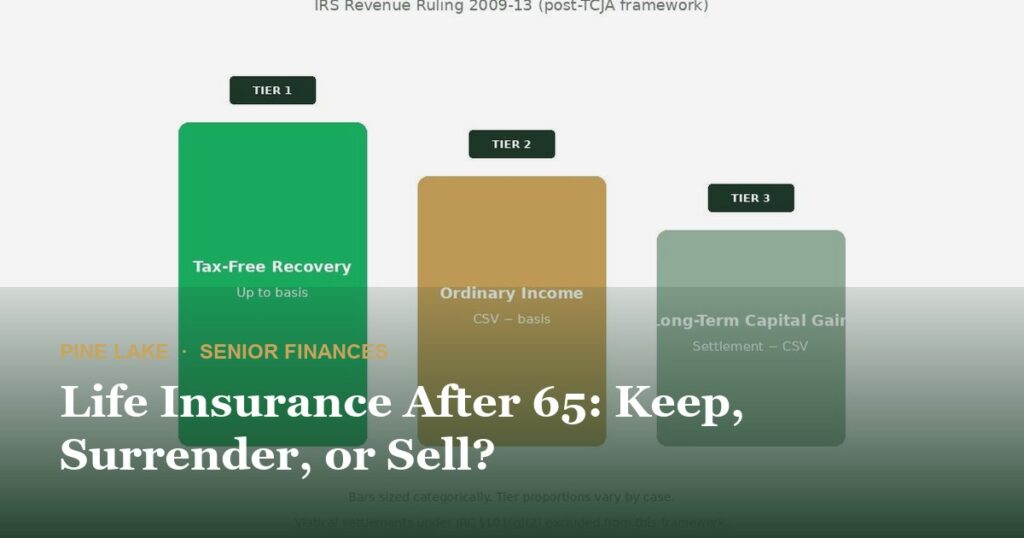
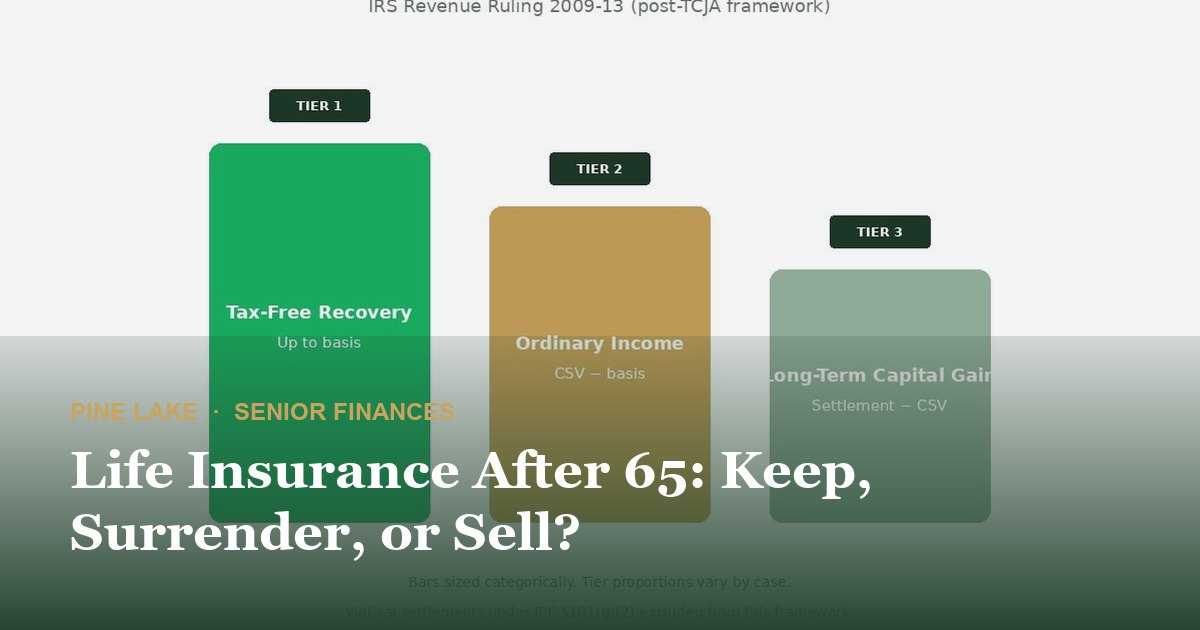
Taxes. Surrender gains above basis are ordinary income. Settlement proceeds follow a three-tier treatment: your basis comes back tax-free, the slice between basis and cash surrender value is ordinary income, and amounts above that are capital gain. Policyholders who are terminally ill may qualify for tax-free treatment under separate viatical rules. Model the tax before accepting any number.
Timing and reversibility. Keeping can be revisited every year; surrendering and selling cannot be revisited at all, though settlement contracts include a rescission window of roughly 15 to 30 days depending on the state. Term conversion privileges and rider deadlines expire on fixed dates. When in doubt, decide before a deadline forces you — a choice made in the grace period is rarely the best-priced one.
Frequently Asked Questions
Do I still need life insurance at 65 if my kids are grown and the house is paid off?
Not automatically — the honest test is whether anyone would face a financial cliff at your death. A surviving spouse losing a Social Security check or pension income, an illiquid estate that heirs would have to break up, or a dependent with a disability all justify coverage. If none of those apply, the policy has become an asset rather than a necessity, and the question shifts from protection to value: is it worth more kept, surrendered, or sold? Run the numbers before assuming the answer either way.
Why did the premium on my universal life policy jump so much in my seventies?
Universal life deducts a monthly cost-of-insurance charge tied to your current age, and that charge follows the mortality curve steeply upward through the seventies and eighties. If your policy was illustrated in a high-interest-rate era, the credited interest that was supposed to build a cushion never fully arrived, so the rising charges now bite directly into a thin cash value. Some insurers have also raised rate scales on older policy blocks. Order an in-force illustration to see what funding the policy actually requires from here.
Is it smarter to surrender or sell a life insurance policy after retirement?
Whichever pays more after tax — and you cannot know without pricing both. Surrender pays the insurer’s contractual cash value, available to anyone, quickly. A sale pays a market price, and for retirees over 65 with health changes and policies of roughly $100,000 or more, that price has historically run several times the surrender value. Get the surrender quote in writing, then get a no-obligation settlement estimate, then compare net-of-tax numbers side by side. Surrendering a policy the market would have paid multiples for is an unforced error.
Will selling my policy affect my Social Security, Medicare, or Medicaid?
Regular Social Security retirement benefits and standard Medicare eligibility are not means-tested, so a sale does not reduce them — though a taxable gain can raise that year’s income enough to trigger higher income-related Medicare premium surcharges temporarily. The serious exposure is means-tested programs: Medicaid and SSI both apply asset limits, and a lump sum can interrupt eligibility until it is spent down under the rules. Anyone on or near Medicaid should get eligibility advice before closing a sale, not after the wire arrives.
How do I get an in-force illustration and what should I ask for?
Call the insurer’s policyowner service department or have your agent request it — insurers provide illustrations to the owner at no charge. Ask for three projections: the policy at your current premium, at zero further premium, and at the minimum level premium that guarantees coverage to age 95 or 100. Also request your current net surrender value and cost basis in the same letter. Those few pages tell you the true cost of keeping, the floor value of leaving, and the tax picture — the raw material for the whole decision.
What happens to my term life insurance when the level period ends after 65?
The policy usually does not cancel — it converts to annually renewable term at rates that can jump severalfold in the first year and climb every year after, pricing designed to make you drop the coverage. Before that cliff, check two things: whether you still have a conversion privilege allowing a switch to permanent coverage without medical underwriting, and its expiration date. A convertible term policy can also qualify for a life settlement through conversion, which means an expiring term contract is sometimes an asset — but only until the conversion deadline passes.
Can poor health actually make my life insurance policy worth more money?
Yes, and it is the least intuitive fact in this decision. Institutional buyers price policies on independent life-expectancy reports: a shorter projected life expectancy means fewer premium payments for the buyer and a nearer death benefit, so offers rise as health declines. The same diagnosis that would make new coverage unaffordable makes your existing policy more valuable to keep and more valuable to sell. That is why the keep-surrender-sell analysis should always be re-run after any significant health change — the numbers genuinely move.
How long does it take to sell a life insurance policy, and can I change my mind?
A typical life settlement takes 60 to 120 days from application to funding. The timeline includes gathering policy and medical records, obtaining two independent life-expectancy reports (usually two to six weeks), collecting bids, and closing through an escrow arrangement. After closing, state law provides a rescission window — generally 15 to 30 days depending on the state — during which you can unwind the sale by returning the proceeds. Once that window closes, the transaction is permanent and the buyer owns the policy outright.
Find out what your policy is worth — free, confidential, no obligation.
A 15-minute educational review covers your eligibility, every alternative, and a realistic view of what each path would net you.
Related Reading
- What changes about life insurance after 65
- Life Insurance Checkup After 70
- What To Do With Old Life Insurance
- Life Insurance For 70 Year Olds
- Policy Review After Retirement
Pine Lake Legacy does not purchase life insurance policies and does not provide legal, tax, or investment advice. Information provided is for educational purposes only. Eligibility for any option, including life settlements, is not guaranteed and depends on individual circumstances, policy terms, underwriting, and market conditions. Consult independent legal, tax, or financial professionals before making decisions regarding a life insurance policy.