
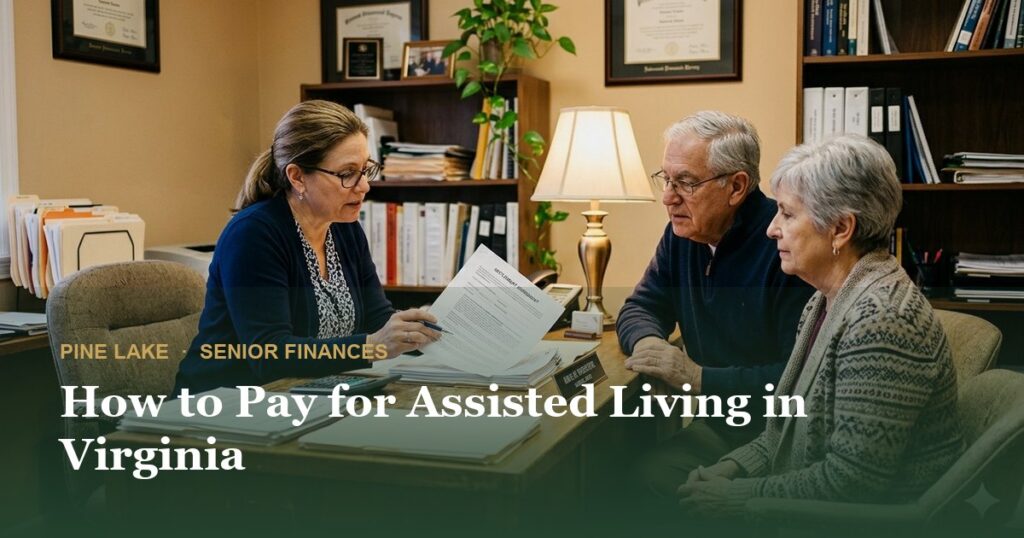
Virginia families typically pay for assisted living by combining several funding sources — personal savings, long-term care insurance, VA benefits, Medicaid waiver programs, home equity, and in many cases an overlooked asset: an existing life insurance policy. No single source covers everything for most families, and the right mix depends on the resident’s income, assets, health, and veteran status.
This guide walks through each funding source available to Virginia residents, in the order most families should evaluate them.
In This Article
- What Assisted Living Costs in Virginia: Start With Real Numbers
- Personal Savings and Retirement Income: The Default First Layer
- Long-Term Care Insurance and Hybrid Policies
- VA Aid & Attendance: The Benefit Virginia Veterans Miss
- Medicaid Waivers in Virginia: Rules and Realities
- Home Equity and the Life Insurance Policy in the Drawer
- Putting It Together: A Funding Order of Operations
- Frequently Asked Questions
What Assisted Living Costs in Virginia: Start With Real Numbers
Before choosing how to pay, get grounded in what you are actually paying for. Assisted living pricing varies widely across Virginia — communities in and around Virginia Beach, Norfolk, Richmond price differently from smaller markets, and base rent is only the starting point. Most communities layer on care-level charges, medication management fees, and annual increases, so the second-year cost is rarely the first-year cost.
The most widely used benchmark is the Genworth Cost of Care Survey, which tracks assisted living, home care, and nursing home costs by state and metro area and is updated regularly. Pull the current figures for your part of Virginia rather than relying on a national average — local labor markets and real estate drive large differences within a single state.
Roughly one in six Virginia residents is age 65 or older, and the state draws retirees to areas like Williamsburg, Charlottesville, and the Chesapeake Bay coast. That demographic weight means demand for care in Virginia is durable, which is one reason planning ahead matters: waiting rarely makes the funding question easier.
Personal Savings and Retirement Income: The Default First Layer
Most Virginia families begin with what they have: Social Security income, pensions, IRA or 401(k) withdrawals, and taxable savings. For many residents this covers a meaningful share of the monthly bill — but drawing down retirement accounts to pay for care has real costs. Traditional IRA and 401(k) withdrawals are taxable income, large withdrawals can push a retiree into a higher bracket, and accelerated drawdowns shorten how long the portfolio lasts, which matters if a spouse remains at home.
Two planning notes: first, check ssa.gov to confirm the resident is receiving every Social Security benefit they are entitled to, including spousal and survivor benefits that are frequently missed. Second, Virginia has a graduated state income tax with a top rate of 5.75% that can apply to taxable settlement gains. State tax treatment changes the real cost of every withdrawal strategy, so it is worth a conversation with a tax professional before committing to a drawdown plan.
Long-Term Care Insurance and Hybrid Policies
If the resident owns a long-term care insurance policy, it is usually the single best funding source — that is exactly what it was bought for. Dig the policy out and confirm four things: the daily or monthly benefit amount, the elimination period (the waiting period you self-fund before benefits start), the benefit period or lifetime maximum, and whether assisted living — not just nursing home care — is a covered setting. Older policies vary considerably on that last point.
Also check for hybrid products: many life insurance policies sold in the last two decades carry long-term care or chronic illness riders that allow the death benefit to be accelerated to pay for care. Policyholders often do not realize these riders exist. Request an in-force illustration and a copy of the policy from the carrier and have someone knowledgeable review what the contract actually provides before assuming it provides nothing.
| Funding Source | Best For | Key Caution |
|---|---|---|
| Savings & retirement income | The first layer for most families | Taxes on withdrawals; portfolio longevity |
| LTC insurance | Policyholders — use what you bought | Elimination periods; confirm assisted living is covered |
| VA Aid & Attendance | Wartime veterans & surviving spouses | Documentation takes time; beware paid “qualifiers” |
| Medicaid HCBS waivers | Lower income/asset residents | Waiting lists; room & board usually excluded; look-back rules |
| Home equity | Homeowners, esp. with a spouse at home | Reverse mortgage residency rules; costs |
| Life settlement | Policyholders 65+ with $100k+ policies no longer needed | Death benefit is lost; may affect Medicaid eligibility |

VA Aid & Attendance: The Benefit Virginia Veterans Miss
Wartime veterans and their surviving spouses may qualify for the VA’s Aid & Attendance benefit — a monthly, tax-free addition to a VA pension for those who need help with activities of daily living, which can be applied to assisted living costs. Eligibility depends on wartime service, care needs, and income and asset limits, and the application requires documentation, so start early.
Apply through va.gov or with help from an accredited Veterans Service Officer — their help is free, and Virginia’s county veterans service offices can prepare the claim. Be cautious of anyone charging a fee to “qualify” a veteran or recommending asset transfers to meet the limits: the VA has a look-back period for transfers, and aggressive restructuring pitched by annuity salespeople can do more harm than good.
Medicaid Waivers in Virginia: Rules and Realities
Medicaid is the largest payer of long-term care in the country, and states operate home- and community-based services (HCBS) waivers that can help cover care in assisted living settings — though coverage of room and board is generally excluded, and waiver programs commonly have waiting lists and limited enrollment. Eligibility is means-tested against both income and assets, with rules that differ for married couples when one spouse remains at home.
Start with the federal overview at medicaid.gov, then contact Virginia’s Medicaid agency or an Area Agency on Aging for the current waiver landscape. Two cautions: Medicaid has a look-back period on asset transfers, so last-minute gifting strategies typically backfire; and receiving a lump sum — from selling a home or a life insurance policy — affects eligibility, which is why sequencing decisions with an elder law attorney matters.
Home Equity and the Life Insurance Policy in the Drawer
For homeowners, equity is often the largest single asset. The main routes are selling the home outright (common when a single resident moves to assisted living permanently), a home equity line of credit, or a reverse mortgage — which generally requires a borrower to continue living in the home, making it more useful when one spouse remains there. Each route has costs and consequences worth professional advice; the FTC’s consumer guidance at consumer.ftc.gov covers reverse mortgage basics and warning signs.
One asset families routinely overlook is an existing life insurance policy. Policyholders who no longer need the coverage — or can no longer carry the premiums — may be able to sell the policy through a life settlement, which on qualifying policies typically pays 4–8× the cash surrender value. Qualification generally requires the insured to be 65 or older with a permanent policy of $100,000 or more in face value. A settlement is not the right answer for everyone — the death benefit is permanently lost to beneficiaries — but it belongs on any honest list of funding options, and checking eligibility costs nothing. For a policyholder moving into assisted living who was about to lapse or surrender coverage anyway, comparing a settlement offer against the surrender value is one of the few genuinely free financial checks available — see how life settlements work in Virginia.
Putting It Together: A Funding Order of Operations
A practical sequence for Virginia families: (1) benchmark local costs with the Genworth survey and tour communities to get real quotes; (2) inventory what exists — LTC policies, life insurance with riders, VA eligibility, home equity; (3) claim every benefit before spending assets, since Aid & Attendance and waiver slots take time to secure; (4) price the asset conversions — home sale versus HELOC, policy settlement versus surrender — before liquidating anything; and (5) involve an elder law attorney if Medicaid may ever be needed, because the order in which you spend determines eligibility later.
Families in Williamsburg (Ford’s Colony), Charlottesville, Smith Mountain Lake and across Virginia face the same core trade-off: spend income first, convert assets deliberately, and preserve eligibility for programs you may need in year three even if you do not need them in year one. If premiums on an existing policy are part of the squeeze, our guide on what to do when you can’t afford premiums covers every option before lapse.
Frequently Asked Questions
Does Medicaid pay for assisted living in Virginia?
Partially, for those who qualify. Virginia’s Medicaid program can cover care services in assisted living settings through home- and community-based waiver programs, but room and board are generally not covered and waiver enrollment is often limited with waiting lists. Eligibility is means-tested on income and assets. Start at medicaid.gov, then confirm current waiver details with Virginia’s Medicaid agency or an Area Agency on Aging.
How much does assisted living cost in Virginia?
Costs vary significantly by region — communities near Virginia Beach, Norfolk price differently from smaller markets, and care-level charges are added to base rent. Rather than relying on a single statewide number, check the Genworth Cost of Care Survey for current figures in your metro area and get written quotes from communities that include care charges, not just rent.
Can I use life insurance to pay for assisted living?
Often, yes — in three ways. Some policies carry long-term care or chronic illness riders that accelerate the death benefit for care costs. Policies with cash value can be borrowed against or surrendered. And policyholders who qualify (generally 65+, permanent policy, $100,000+ face value) may sell the policy through a life settlement, which typically pays 4–8× the cash surrender value. Compare all three against keeping the coverage before deciding.
What is VA Aid & Attendance and who qualifies?
Aid & Attendance is a tax-free monthly addition to a VA pension for wartime veterans and surviving spouses who need help with daily living activities. It can be used toward assisted living costs. Eligibility depends on wartime service dates, care needs, and income and asset limits. Apply through va.gov or a county Veterans Service Officer — legitimate application help is free.
Should we sell the house to pay for assisted living?
It depends on who remains in it and what Medicaid may be needed later. An outright sale makes sense for a single resident moving permanently, but it converts an asset with favorable treatment into countable cash. If a spouse remains home, a HELOC or reverse mortgage may fit better. Because home equity decisions interact with Medicaid eligibility rules, review the sequence with an elder law attorney first.
What happens when the money runs out in Virginia assisted living?
Plan for this before it happens. Some communities accept Medicaid waiver payments after a private-pay period; others require a move. Ask every community you tour, in writing, what happens when private funds are exhausted and whether they participate in Virginia’s waiver programs. Structuring spending with an elder law attorney early preserves options that disappear if you wait.
Find out what your policy is worth — free, confidential, no obligation.
A 15-minute educational review covers your eligibility, every alternative, and a realistic view of what each path would net you.
Related Reading
- Life Settlements Virginia
- Long Term Care Costs Virginia
- How To Pay For Assisted Living
- What Is A Life Settlement
- Life Settlements Guide Seniors
Pine Lake Legacy does not purchase life insurance policies and does not provide legal, tax, or investment advice. Information provided is for educational purposes only. Eligibility for any option, including life settlements, is not guaranteed and depends on individual circumstances, policy terms, underwriting, and market conditions. Consult independent legal, tax, or financial professionals before making decisions regarding a life insurance policy.