
When a loved one enters hospice, their life insurance policy usually offers immediate options: most policies include a terminal illness accelerated death benefit that pays a large portion of the face value directly from the carrier, generally income-tax-free, and a hospice-eligible patient almost always qualifies. Where no rider exists or more liquidity is needed, a viatical settlement — the sale of the policy by a terminally ill insured — typically pays the highest percentages available in the secondary market and is also generally tax-free under IRC 101(g). The essential first steps are simple: keep the policy in force, and ask the carrier in writing what living benefits it contains.
This guide covers each option, the practical steps in order of urgency, tax and benefit rules, and how families can handle these decisions with clarity during an overwhelming season.
In This Article
- First Things First: Protect the Policy
- The Accelerated Death Benefit: Usually the First and Best Door
- The Viatical Settlement: When Selling the Policy Serves the Family
- Choosing Between Acceleration and Sale — or Doing Both
- What the Money Protects: Uses That Matter in the Hospice Season
- Taxes, Medicaid, and Benefits: The Rules That Protect — and Trap
- A Gentle Checklist for an Overwhelming Season
- Frequently Asked Questions
First Things First: Protect the Policy
Hospice enrollment reorders a family’s attention, and financial paperwork understandably falls to the bottom of the pile. But the single most damaging life insurance mistake families make in this season is letting a policy lapse — missing premium payments in the shuffle of caregiving and losing coverage weeks or months before it would have paid. The protective steps take an afternoon. Locate every policy: individual policies in files or safe deposit boxes, employer or union group coverage, old policies from prior employers, and veterans’ coverage (see veterans’ life insurance and settlements for VGLI-specific rules). Confirm premium status: call each carrier, verify the policy is in force, and check when the next premium is due. Remember that missed payments enter a grace period — typically 30 to 31 days — during which coverage continues and can be restored by payment; a policy inside its grace period is not yet lost.
Stabilize payments: set up automatic payment or have a family member take over the premium calendar. If premiums are genuinely unaffordable, do not simply stop paying — options including acceleration, sale, reduced paid-up coverage, or using cash value to carry premiums all require an in-force policy. Establish authority: if the patient can still sign, ensure a durable power of attorney with insurance powers exists; carriers will not discuss or transact policy business with family members otherwise, a hurdle covered in adult children managing parents’ finances. These unglamorous steps preserve every option described below.
The Accelerated Death Benefit: Usually the First and Best Door
Most life insurance policies issued in recent decades include a terminal illness accelerated death benefit (ADB) — often automatically and at no premium cost — that pays a portion of the death benefit while the insured is living, once a physician certifies limited life expectancy. Contract windows are commonly 12 or 24 months; hospice eligibility, which under Medicare requires a physician’s certification of a six-month prognosis, satisfies virtually any ADB trigger. Typical accelerations run 25% to 75% of face value, sometimes more, paid within weeks of a completed claim.
The tax treatment is a genuine mercy: under IRC 101(g), accelerated benefits paid to a terminally ill insured — federally defined as a certified life expectancy of 24 months or less — are treated as death proceeds and generally excluded from income entirely, per IRS rules. The claim process is administrative rather than adversarial: request the carrier’s ADB claim form, have the attending or hospice physician complete the certification, and submit. Carriers may verify records but pay the contractual amount without negotiation.
Families should understand the arithmetic before filing: the acceleration reduces what beneficiaries later receive — dollar-for-dollar, or more under lien designs that accrue interest — and premiums generally continue on the remainder unless waived. Request a written illustration showing the post-acceleration policy. The complete mechanics, including chronic illness variants, are covered in the accelerated death benefit guide. For most hospice families with a rider available, this is the efficient first dollar: fast, tax-free, no third parties, and part of the death benefit preserved.
The Viatical Settlement: When Selling the Policy Serves the Family
A viatical settlement is the sale of a life insurance policy by a terminally or chronically ill insured to a licensed provider — the transaction the settlement industry was originally built around, and the option that matters when no rider exists, the rider’s cap is too low, or continuing premiums are untenable. Because the insured’s life expectancy is short, viatical pricing is the strongest in the secondary market: offers substantially exceed the 10–35%-of-face-value range typical of standard life settlements, frequently reaching well past half of face value depending on prognosis, premiums, and competition among buyers. The distinction between the two transaction types is drawn fully in life settlement vs. viatical settlement.
The tax treatment matches the ADB’s: under IRC 101(g), amounts received by a terminally ill insured (certified life expectancy under 24 months) from a licensed viatical settlement provider are treated as death proceeds — generally excluded from income entirely, as detailed in the viatical settlement tax exclusion. Regulation is protective by design: states license viatical providers and brokers under frameworks descending from the NAIC’s model acts, require disclosures and escrow, and provide rescission windows — often extended for viatical transactions — during which the family can unwind the sale. New Jersey’s Viatical Settlements Act, enforced by the NJ Department of Banking and Insurance, requires licensing of all parties.
Process timelines compress for hospice cases: providers expedite underwriting when prognosis documentation is clear, and transactions that normally run 60–120 days can move faster. The full walkthrough lives in the viatical settlement complete guide.
| Option | Who Pays | Typical Amount | Speed | Tax Treatment | Death Benefit After |
|---|---|---|---|---|---|
| Terminal illness accelerated death benefit | The insurance carrier | 25–75% of face value | Weeks after certification | Generally tax-free (IRC 101(g)) | Reduced by acceleration; remainder preserved |
| Viatical settlement | Licensed third-party provider | Often exceeds standard settlement range; scales with prognosis | Expedited; faster than the usual 60–120 days | Generally tax-free for terminal illness | None — policy transfers to buyer |
| Acceleration, then sale of remainder | Carrier, then provider | Combined proceeds can exceed either alone | Sequential | Both legs generally tax-free if terminal | None after final sale |
| Retained death benefit sale | Licensed provider | Reduced cash + preserved benefit slice | Similar to viatical timeline | Generally tax-free if terminal | Retained portion paid to beneficiaries, no premiums |
| Keep policy in force | — | Full death benefit at death | — | Death proceeds income-tax-free | 100% to beneficiaries |

Choosing Between Acceleration and Sale — or Doing Both
For a hospice family with both doors open, the comparison usually turns on four questions. How much does the family need now? An ADB caps at the rider’s percentage; a viatical sale monetizes the entire policy. If the rider advances $150,000 of a $300,000 policy but the family needs more — for care, debts, a mortgage payoff, or a spouse’s transition — the sale may serve better. Can the premiums continue? After acceleration, premiums generally continue on the remaining coverage; after a sale, they end. A family already strained by caregiving costs may value that relief. How much death benefit should remain? Acceleration preserves the unaccelerated remainder for beneficiaries; a full sale preserves nothing — though retained death benefit structures, where offered, split the difference with less cash now but a preserved slice payable at death with no further premiums. How fast? ADB claims pay in weeks; viatical sales take longer even when expedited.
The sequenced strategy deserves consideration: accelerate first, then sell the remainder. The rider typically pays more per dollar of benefit than any buyer can (the carrier takes no profit margin on its own contractual obligation), so capturing the rider’s advance and then marketing the reduced policy can maximize total proceeds — with full disclosure of the prior acceleration to bidders. The side-by-side framework is developed in life settlement vs. accelerated death benefit. Whichever way the family leans, both numbers should be real before deciding: a written carrier illustration and actual competing bids, not estimates. Both cost nothing to obtain.
What the Money Protects: Uses That Matter in the Hospice Season
It helps to name what these funds actually do, because the hospice season carries costs that surprise families. The Medicare hospice benefit covers the hospice team, medications related to the terminal diagnosis, and equipment — but it does not cover room and board at home or in most facilities, around-the-clock custodial caregiving, or the family’s own costs of presence. Families routinely fund: 24-hour home caregivers so the patient can die at home as most people wish — often $15,000–$25,000 per month at current aide rates, a scale documented in long-term care costs in 2025; residential hospice or facility room and board where home care is not possible, costs discussed in how to pay for assisted living; travel and lost wages for adult children keeping vigil; debt clearance — retiring a mortgage or medical debt so the surviving spouse starts from stability; and final arrangements planned without financial panic.
There is also a dignity dimension that families consistently report: a patient who spent a lifetime providing for others often finds real peace in seeing the policy do its work while they are present — funding the grandchild’s tuition contribution, the family gathering, the settled household. Accelerated benefits and viatical proceeds are among the very few financial tools that can honor that wish.
One planning caution accompanies every use: funds should flow to needs, not sit idle. Beyond the Medicaid issues addressed next, a large idle balance in the patient’s name can complicate the estate; spending on documented needs, or coordinated planning with an attorney, keeps the picture clean.
Taxes, Medicaid, and Benefits: The Rules That Protect — and Trap
The tax rules for hospice families are unusually favorable, but the benefit-eligibility rules require care. Taxes: both ADB payments and viatical settlement proceeds for a terminally ill insured (certified life expectancy under 24 months) are generally excluded from federal income tax under IRC 101(g) — no three-tier calculation, no capital gain, though the family should retain the physician certification and closing documents, and confirm treatment with a tax professional since business-owned policies and certain arrangements fall outside the exclusion. Death benefits later paid to beneficiaries remain income-tax-free as they always were, and with the federal estate exemption above $13 million per individual, estate tax touches very few families.
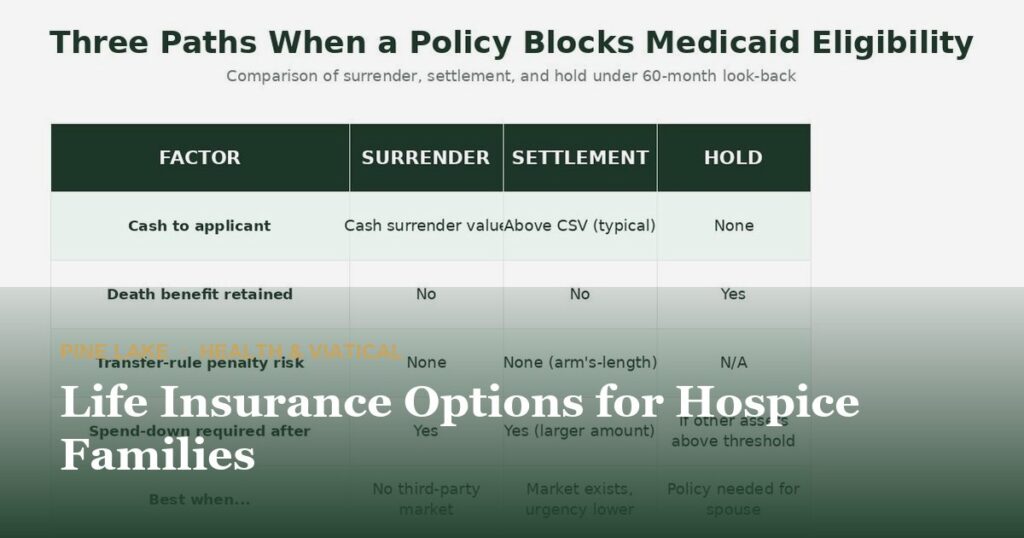
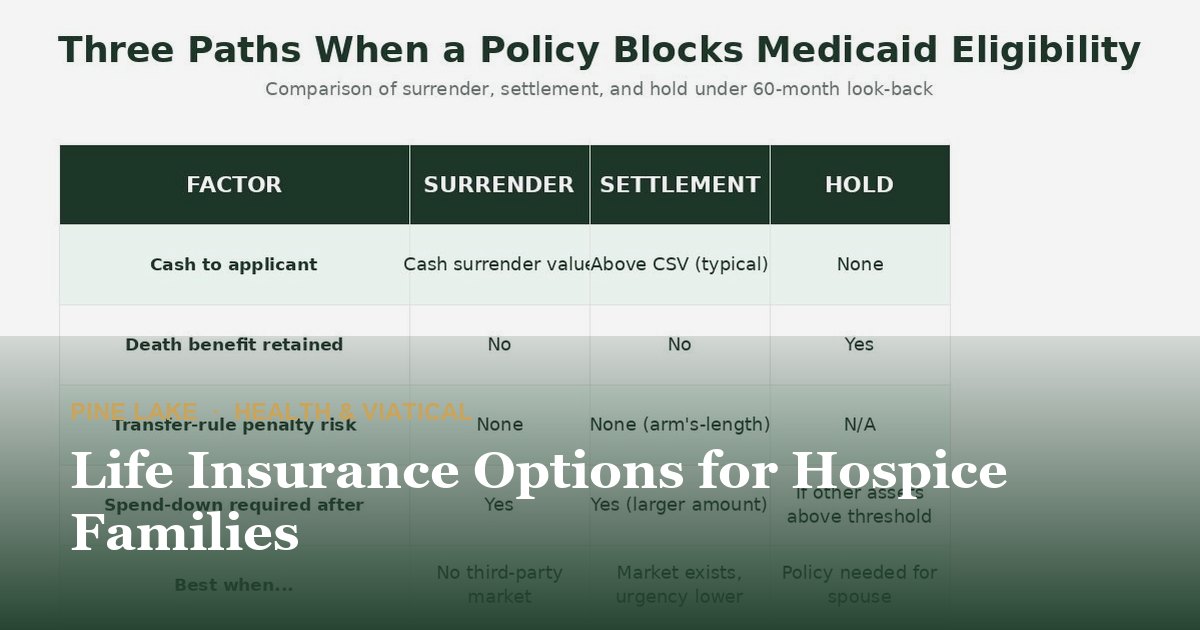
Medicaid is the trap to respect. Many hospice patients are on Medicaid or may need it (hospice can last longer than six months, and some patients stabilize and transition to long-term care). Accelerated benefits or settlement proceeds received and retained are countable assets under Medicaid rules and can suspend eligibility until spent down; the timing of receipt versus application matters enormously, and gifting proceeds to family triggers look-back penalties. SSI carries similar asset limits per the SSA. Medicare itself is unaffected — it is not means-tested — as is Social Security retirement or disability income.
The professional pairing for a hospice family: an elder law attorney whenever Medicaid is current or plausible, and a tax advisor for any six-figure transaction. Hospice social workers, who navigate these intersections daily, are an underused first referral source — ask them directly who local families work with.
A Gentle Checklist for an Overwhelming Season
Families in the hospice season need sequence, not homework. This checklist compresses everything above into the order that protects the most value with the least burden:
- Week one — stabilize. Locate all policies; confirm each is in force; automate or assign premium payments; verify the power of attorney works for insurance matters. Nothing else can happen without these.
- Week one or two — ask the carrier. One written request per policy: what living benefit riders exist, their triggers and maximums, and a claim illustration. Ask specifically about terminal illness ADB, chronic illness riders, and premium waiver provisions.
- Week two or three — file what qualifies. If an ADB exists, the hospice physician’s certification usually satisfies it; claims pay in weeks. Capture premium waivers where available.
- In parallel — price the market if needed. If there is no rider, the rider caps out below the family’s needs, or premiums cannot continue, request viatical settlement bids through licensed channels. Quotes are free and non-binding; hospice documentation typically expedites underwriting.
- Before signing anything — check the trap lines. Medicaid or SSI in the picture? Elder law attorney first. Six figures moving? Tax advisor confirms the 101(g) exclusion applies.
- Throughout — decide together. The patient’s wishes lead where capacity allows; beneficiaries deserve to see the same numbers; and no reputable counterparty ever pressures a hospice family to move faster than its own deliberation.
Pine Lake’s work with hospice families is educational and unhurried: explaining every option — including leaving the policy exactly as it is for the beneficiaries — so the family’s decision reflects its own values, made with complete information.
Frequently Asked Questions
Can you cash out life insurance while on hospice?
Usually yes, through one or both of two routes. Most modern policies include a terminal illness accelerated death benefit that pays 25–75% of the face value directly from the carrier once a physician certifies limited life expectancy — and hospice eligibility, which requires a six-month prognosis certification, satisfies virtually every rider’s trigger. Alternatively or additionally, the policy can be sold in a viatical settlement to a licensed provider, typically at the strongest pricing in the secondary market. Both are generally free of federal income tax under IRC 101(g) for a terminally ill insured. Start by asking the carrier, in writing, what living benefits the policy contains.
Does hospice enrollment automatically qualify my parent for an accelerated death benefit?
Not automatically, but nearly always practically. ADB riders require a physician’s certification that life expectancy falls within the contract window — commonly 12 or 24 months. Hospice enrollment already rests on a physician certifying a prognosis of six months or less, so the same medical facts satisfy the rider; the hospice or attending physician simply completes the carrier’s claim form. The carrier may review records but pays the contractual amount without negotiation once certification is accepted. If your parent lacks capacity to sign, an agent under a durable power of attorney with insurance authority can file the claim.
Is money from a viatical settlement taxable if my spouse is terminally ill?
Generally no. Under IRC 101(g), proceeds a terminally ill insured receives from selling a policy to a licensed viatical settlement provider are treated as if they were death benefits — excluded from federal income tax — when a physician has certified life expectancy of 24 months or less. The same exclusion covers accelerated death benefits from the carrier. Keep the certification and closing documents with your tax records, and confirm treatment with a tax professional: exceptions exist for certain business-owned policies, and selling to an unlicensed buyer can jeopardize the exclusion. State income tax treatment usually follows the federal rule but is worth verifying.
Should we accelerate the death benefit or sell the policy on hospice?
Run both numbers — they are free — but the general logic is: accelerate first when a rider exists, because the carrier pays more per dollar of benefit than any buyer can and part of the death benefit survives for beneficiaries. Sell instead, or sell the remainder after accelerating, when there is no rider, the rider’s cap leaves needs unmet, or continuing premiums on the remaining coverage are unaffordable. A viatical sale monetizes the entire policy and ends premiums permanently. Compare the carrier’s written acceleration illustration against actual competing bids, after confirming both would be tax-free in your situation.
Will hospice or Medicaid take my life insurance money?
Hospice itself never touches life insurance — the Medicare hospice benefit is not means-tested and has no claim on policy proceeds. Medicaid is the program requiring care: if the patient receives Medicaid or may need it, accelerated benefits or settlement proceeds received and retained are countable assets that can suspend eligibility until spent down, and gifting the money to family triggers look-back penalties. Spending on documented care and household needs is generally safe; large idle balances and transfers are not. If Medicaid is anywhere in the picture, have an elder law attorney sequence the transaction before funds arrive.
What happens if we miss premium payments while caring for someone on hospice?
Act quickly — the policy is probably still saveable. Missed premiums trigger a grace period, typically 30 to 31 days, during which coverage continues and payment restores everything. Even after lapse, many carriers allow reinstatement within a window, though it may require paperwork the family would rather avoid. Call the carrier immediately, bring premiums current, and automate future payments or assign them to one family member. If premiums are genuinely unaffordable, do not simply stop paying: acceleration, viatical sale, reduced paid-up coverage, and using cash value to carry premiums all require an in-force policy. A lapsed policy helps no one.
How fast can a viatical settlement close for a hospice patient?
Faster than standard transactions, though not instantly. Ordinary life settlements run 60 to 120 days, much of it spent gathering records and obtaining life expectancy reports. Hospice cases compress that: prognosis documentation is already clear and current, hospice records are well-organized, and providers expedite underwriting for terminal cases. Closings within several weeks are achievable when the family responds quickly to document requests and a power of attorney is in place. If cash is needed even sooner, an accelerated death benefit claim — payable in weeks — can bridge the gap while the sale proceeds, and some families deliberately do both in sequence.
Can the family keep part of the death benefit and still get cash now?
Often yes, two ways. First, a partial acceleration: claiming the rider for less than its maximum leaves the unaccelerated balance payable to beneficiaries at death. Second, a retained death benefit settlement: some licensed providers structure purchases where the family accepts less cash at closing but keeps a defined slice of the death benefit — with no further premium obligation — paid to beneficiaries when the insured passes. This hybrid suits families balancing immediate care costs against a surviving spouse’s future needs. Ask explicitly for retained-benefit quotes alongside full-sale bids; not every provider offers them, but the comparison costs nothing.
Find out what your policy is worth — free, confidential, no obligation.
A 15-minute educational review covers your eligibility, every alternative, and a realistic view of what each path would net you.
Related Reading
- Viatical Settlement Complete Guide
- Accelerated Death Benefit Guide
- Viatical Settlement Tax Exclusion
- Adult Children Managing Parents Finances
Pine Lake Life Solutions does not purchase life insurance policies and does not provide legal, tax, or investment advice. Information provided is for educational purposes only. Eligibility for any option, including life settlements, is not guaranteed and depends on individual circumstances, policy terms, underwriting, and market conditions. Consult independent legal, tax, or financial professionals before making decisions regarding a life insurance policy.