
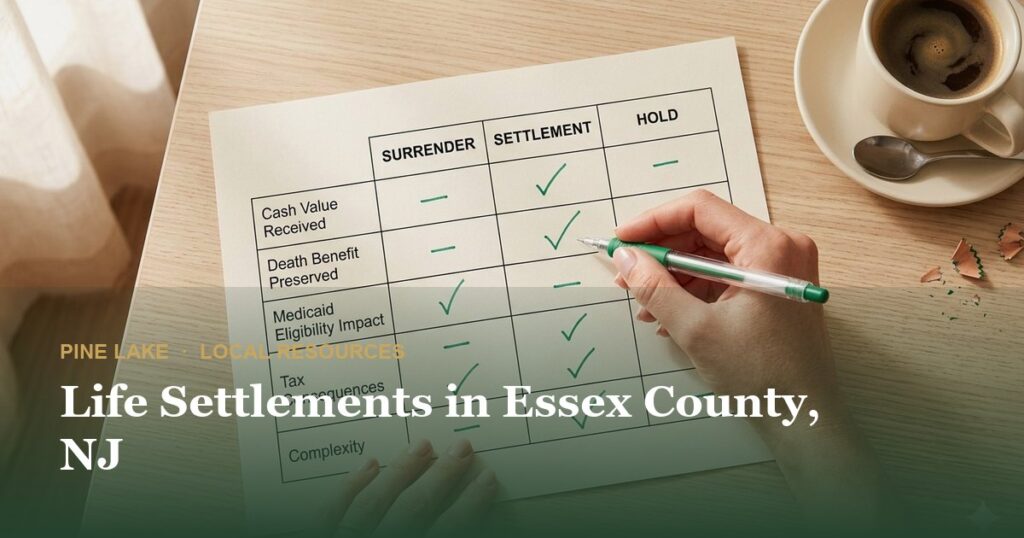
Essex County policyholders age 65 and up can often sell a life insurance policy they no longer want through a life settlement, receiving a lump sum that federal researchers found typically runs 4 to 8 times the policy’s cash surrender value. Essex County spans an unusually wide economic range — from Newark, the county seat and the state’s largest city, to some of New Jersey’s most affluent suburbs in Millburn, Short Hills, Livingston, and Montclair — and both ends of that spectrum produce policies that buyers want. Every transaction must run through participants licensed by the New Jersey Department of Banking and Insurance.
Below: how the market works from an Essex County perspective, eligibility, realistic pricing, the state rules that protect sellers, taxes, and the alternatives to check before signing anything.
In This Article
- The Essex County Picture: Big Policies, Changing Needs
- Eligibility Through an Essex County Lens
- Pricing Reality: What Offers Actually Look Like
- The Transaction Timeline, Stage by Stage
- New Jersey Law and the Licensing Backstop
- Taxes: The Three-Tier Rule Every Seller Should Understand
- Before Selling: The Checklist of Alternatives
- Finding Trustworthy Guidance Near Newark and the Suburbs
- Frequently Asked Questions
The Essex County Picture: Big Policies, Changing Needs
Essex County’s insurance footprint reflects its history. Newark was for generations one of America’s great insurance cities — Prudential was founded there in 1875 and still anchors the downtown skyline — and the habit of buying substantial life insurance ran deep among the professionals, business owners, and union households who built careers in and around the city. Meanwhile, the western suburbs along the South Mountain ridge — Millburn and Short Hills, Livingston, West Orange, Montclair, Maplewood, Verona, and the Caldwells — rank among the wealthiest communities in New Jersey, where permanent policies were routinely written into estate plans with face values in the high six and seven figures.
Decades later, many of those policies have outlived their original purpose. Children are grown and financially independent. Businesses secured by key-person or buy-sell coverage have been sold. Estate plans built around a much lower federal exemption no longer need insurance liquidity now that the exemption exceeds $13 million per individual. And universal life policies purchased in the 1980s and 1990s, when illustrated interest rates were far higher, now demand steep premiums to stay in force.
The result is a county full of policies that are simultaneously expensive to keep and valuable to sell. A life settlement — the regulated sale of a policy to a licensed institutional buyer — converts that stranded asset into cash. Start with the fundamentals of what a life settlement is if the concept is new.
Eligibility Through an Essex County Lens
Buyers underwrite people and policies, not zip codes, but the standard criteria map cleanly onto Essex County’s population:
- Insured age 65+ — or younger where meaningful health changes have occurred since issue. The county’s senior population is substantial across both its urban and suburban municipalities.
- Face value of roughly $100,000 or more. The estate-planning policies common in Livingston, Short Hills, and Montclair often far exceed this floor, which tends to attract competitive bidding.
- Permanent policy types — universal life, indexed and variable universal life, whole life, and second-to-die survivorship policies. Survivorship coverage is worth a special note: these policies were a staple of Essex County estate plans, and they can be settled, typically after one insured has died or when both insureds are elderly.
- Two-plus years in force, per New Jersey’s anti-STOLI safeguards.
- Convertible term qualifies only while the conversion right remains alive.
Health status matters as much as age: a 72-year-old with cardiac disease may receive a stronger offer than a healthy 80-year-old, because pricing turns on life expectancy. The full criteria, including common edge cases, are covered in who qualifies for a life settlement.
Pricing Reality: What Offers Actually Look Like
The most reliable public benchmark remains the Government Accountability Office’s study of the industry, GAO-10-775, which found that policy owners who sold received multiples of what surrender would have paid — typically 4 to 8 times cash surrender value — with gross proceeds commonly in the range of 10% to 35% of face value.
An illustration in Essex County terms: suppose a 81-year-old West Orange widow owns a $750,000 survivorship policy that became a single-life exposure when her husband died. Cash surrender value is $61,000; annual premiums are $27,000 and rising. Surrender pays $61,000 once. A life settlement, if underwriting supports it, could pay a multiple of that figure — money that might fund years of assisted living locally. Alternatively, if her health is excellent and the premium schedule steep, providers may decline entirely. Both outcomes are normal; the only way to know is to test the market.
What moves the number: the life expectancy reports from independent underwriters (shorter life expectancy generally means higher offers), the premium stream the buyer must fund, the insurer’s credit rating, current institutional demand, and — critically — competition. Policies auctioned to multiple licensed providers routinely see bids climb across rounds. The mechanics of maximizing an offer are detailed in how much can I sell my life insurance policy for.
The Transaction Timeline, Stage by Stage
Essex County sellers should budget 60 to 120 days from first paperwork to funded escrow. The stages:
- Authorization and records (weeks 1–4). HIPAA releases let underwriters pull medical records; the carrier supplies the policy contract and an in-force illustration showing required future premiums.
- Independent life expectancy underwriting (weeks 3–8). Two independent LE reports are the norm; they take two to six weeks and are the single biggest pricing input.
- Market bidding (weeks 6–10). The policy is presented to licensed providers. Serious policies often go through several rounds of bidding before a high offer emerges.
- Closing documents (weeks 8–14). New Jersey mandates written disclosures covering alternatives to selling, tax consequences, broker compensation, and the buyer’s identity and license status.
- Escrow and transfer (weeks 10–16). Funds are deposited with an independent escrow agent; when the insurer confirms the ownership and beneficiary changes, the escrow releases payment to the seller.
After funding, New Jersey provides a rescission period — generally 15 to 30 days depending on circumstances — during which a seller can reverse the sale and return the money. Once that window closes, the transaction is permanent: the buyer owns the policy, pays its premiums, and will collect its death benefit.
| Scenario (Illustrative) | Face Value | Cash Surrender Value | Surrender Outcome | Life Settlement Range (10–35% of face) |
|---|---|---|---|---|
| UL policy, insured age 78 | $250,000 | $14,000 | $14,000 | $25,000–$87,500 |
| Survivorship policy, surviving insured 84 | $750,000 | $61,000 | $61,000 | $75,000–$262,500 |
| Whole life, insured age 71 (health impaired) | $400,000 | $52,000 | $52,000 | $40,000–$140,000 |
| Convertible term, insured age 74 | $500,000 | $0 | $0 | $50,000–$175,000 |

New Jersey Law and the Licensing Backstop
Every life settlement touching an Essex County resident is governed by the New Jersey Viatical Settlements Act, N.J.S.A. Title 17B, administered by the New Jersey Department of Banking and Insurance. The Act requires licensing of both brokers — who owe their duties to the policy seller — and providers, the entities that actually purchase policies with institutional capital. Verifying a license with DOBI takes minutes and eliminates most bad actors at a stroke.
New Jersey’s statute sits within a national framework built by the National Association of Insurance Commissioners. The NAIC Life Settlements Model Act supplies the template most states follow: mandatory disclosures before signing, strict confidentiality of medical records, escrow requirements so sellers are paid before buyers take control, rescission rights, and an outright ban on stranger-originated life insurance (STOLI), the abusive practice of manufacturing policies for investors.
The underlying property right predates all of this regulation. In Grigsby v. Russell, 222 U.S. 149 (1911), Justice Oliver Wendell Holmes wrote that life insurance possesses “the ordinary characteristics of property” and may be sold like any other asset. That 1911 holding is why a Montclair retiree today can lawfully sell a policy — and why the regulatory question is never whether, but how. Statewide specifics live in our complete New Jersey guide.
Taxes: The Three-Tier Rule Every Seller Should Understand
Life settlement proceeds are usually taxable, and the federal rule has three layers. Under IRS Revenue Ruling 2009-13, as simplified by the 2017 Tax Cuts and Jobs Act, a seller recovers cost basis — total premiums paid, with no reduction for cost-of-insurance charges under current law — tax-free; pays ordinary income rates on the slice between basis and the policy’s cash surrender value; and pays long-term capital gains rates on everything above cash surrender value.
For high-income Essex County households, the ordering matters. In a surrender, all gain above basis is ordinary income. In a settlement, a meaningful portion of the gain often lands in the capital-gain tier instead, which can produce a lower blended rate on the same dollars. The comparison is worked through with numbers in life settlement tax vs. surrender tax.
Two more wrinkles deserve attention. First, since the 2017 law, buyers and insurers file information returns (Forms 1099-LS and 1099-SB), so the IRS sees the transaction — accurate reporting is not optional. Second, sellers who are terminally ill with a life expectancy under 24 months may exclude proceeds from income entirely under IRC Section 101(g), the viatical settlement exclusion. New Jersey’s Gross Income Tax raises its own questions, best handled by a CPA reviewing the specific policy; the state angle is covered in the NJ life settlement tax guide.
Before Selling: The Checklist of Alternatives
An honest evaluation starts with everything a policyholder could do other than sell, because several alternatives preserve value that a sale gives up forever:
- Retain and pay. If the household still needs the death benefit — a dependent spouse, a special-needs child, an estate equalization plan — keeping the policy usually beats any sale price.
- Reduce the death benefit to bring premiums down while keeping partial coverage in force.
- Premium financing from cash value via loans or withdrawals, understanding the drag on the death benefit.
- Reduced paid-up conversion on eligible whole life contracts, ending premiums permanently in exchange for a smaller guaranteed benefit.
- Accelerated death benefits or chronic-illness riders, which some carriers pay directly to ill insureds without any sale.
- 1035 exchange into a different policy or annuity where the goal is restructuring rather than cash.
The downsides of selling are real: heirs lose the death benefit permanently, proceeds are taxable, and a lump sum can jeopardize means-tested benefits — a live issue for seniors relying on programs administered through Medicaid or receiving SSI. Essex County has extensive elder-law and CPA resources; use them before closing, not after. A structured comparison appears in life settlement vs. surrender.
Finding Trustworthy Guidance Near Newark and the Suburbs
Essex County residents are surrounded by financial infrastructure — major accounting firms in Newark and Roseland, estate planners in Millburn and Montclair, and hospital systems whose social workers regularly field long-term-care funding questions. Any of these professionals can serve as a first sounding board when a policy stops making sense.
When the conversation turns to a possible sale, the screening standard is straightforward. Deal only with DOBI-licensed brokers and providers. Insist that the policy be shopped competitively rather than sold to the first bidder. Demand written disclosure of every offer received and every dollar of intermediary compensation, both of which New Jersey law requires. Confirm that sale proceeds will sit with an independent escrow agent until the carrier records the ownership change. And never pay an upfront fee to have a policy “appraised” — legitimate market participants are compensated from completed transactions.
Pine Lake Legacy operates from Lakewood, about an hour south of the Oranges, as an educational firm: we do not purchase policies, and our work is helping New Jersey policyholders understand the full option set — hold, restructure, surrender, or sell — before anything is signed. When a client chooses to pursue offers, we coordinate introductions to licensed providers. For an Essex County family staring at a premium notice that no longer makes sense, the essential first step is simply learning what the policy is actually worth on the open market.
Frequently Asked Questions
Is it legal to sell a life insurance policy in Essex County, New Jersey?
Yes. The U.S. Supreme Court established in Grigsby v. Russell (1911) that a life insurance policy is the owner’s property and may be sold, and New Jersey regulates the practice under the Viatical Settlements Act in N.J.S.A. Title 17B. The requirement is that the transaction run through brokers and providers licensed by the New Jersey Department of Banking and Insurance, with mandatory disclosures, escrowed funds, and a post-closing rescission period protecting the seller.
What kinds of life insurance policies sell best in a life settlement?
Universal life is the most commonly settled policy type, followed by whole life, indexed and variable universal life, and survivorship (second-to-die) policies — the last being especially common in Essex County estate plans. Term insurance qualifies only while it remains convertible to permanent coverage. Across all types, buyers favor policies of $100,000 or more in face value, in force at least two years, on insureds who are 65 or older or who have developed significant health conditions since the policy was issued.
How do life expectancy reports affect my life settlement offer?
They are the single largest pricing input. Independent underwriting firms review the insured’s medical records and produce a life expectancy estimate; buyers then model how many years of premiums they expect to pay before collecting the death benefit. Two independent reports are standard, and they take two to six weeks. Generally, a shorter life expectancy supports a higher offer because the buyer’s expected costs are lower. Sellers in excellent health may receive modest offers or none, since the buyer would anticipate decades of premium payments.
How are life settlement proceeds taxed if I live in New Jersey?
Federally, in three tiers: proceeds up to your total premiums paid come back tax-free as return of basis; the amount between basis and the policy’s cash surrender value is ordinary income; and anything above the cash surrender value is long-term capital gain. The 2017 tax law also requires buyers and insurers to report sales on Forms 1099-LS and 1099-SB. New Jersey’s Gross Income Tax treatment involves separate analysis, so a CPA should review both layers before you accept an offer.
Can I sell a survivorship or second-to-die life insurance policy?
Often, yes. Survivorship policies — which pay only after both insureds have died — were widely used in New Jersey estate planning when the federal exemption was much lower, and many are now unneeded with the exemption above $13 million per person. Buyers evaluate them readily, particularly after one insured has passed away, which converts the actuarial picture to a single life. Pricing follows the same logic as single-life policies: ages and health of the insureds, premium requirements, and face amount.
What happens to my life insurance policy after I sell it?
The buyer — a licensed provider backed by institutional capital such as pension funds and asset managers — becomes the owner and beneficiary, takes over all premium payments, and collects the death benefit when the insured dies. The buyer will periodically request health status updates, typically through a servicing company. Your heirs receive nothing from the policy at death; the sale proceeds you received, minus taxes, are the family’s entire realization from the coverage. That permanence is why New Jersey provides a rescission window after closing.
Do I need a broker to sell my life insurance policy, or can I go direct?
You can sell directly to a licensed provider, but going direct means one buyer sets the price with no competition. A licensed broker owes duties to you as the seller and shops the policy to multiple providers, which frequently triggers bidding that raises offers substantially — often by more than the broker’s disclosed compensation. New Jersey law requires that compensation to be shown to you in writing. Whichever route you take, confirm every participant’s license with the New Jersey Department of Banking and Insurance first.
Will a life settlement affect my Medicaid eligibility in New Jersey?
It can, immediately. Settlement proceeds are countable resources, and receiving a lump sum can put a senior over Medicaid’s asset limits, potentially interrupting benefits or affecting long-term-care eligibility timelines. For Essex County seniors anticipating nursing home care, this deserves attention before closing, not after — an elder law attorney can advise whether spend-down planning or timing strategies apply. Note that an insured who is terminally ill may also have viatical options with different tax and planning consequences.
Find out what your policy is worth — free, confidential, no obligation.
A 15-minute educational review covers your eligibility, every alternative, and a realistic view of what each path would net you.
Related Reading
- Morris County Life Settlement Guide
- Middlesex County Life Settlement Guide
- Life Settlements Monmouth County Nj
- Three Tier Tax Treatment Life Settlement
Pine Lake Legacy does not purchase life insurance policies and does not provide legal, tax, or investment advice. Information provided is for educational purposes only. Eligibility for any option, including life settlements, is not guaranteed and depends on individual circumstances, policy terms, underwriting, and market conditions. Consult independent legal, tax, or financial professionals before making decisions regarding a life insurance policy.