
A life settlement takes eight to sixteen weeks from first document request to funded closing, and an elder law matter almost never has sixteen weeks of slack in it. Practitioners who understand where the time actually goes can compress the front end, run the Medicaid analysis in parallel rather than in sequence, and tell a family early and honestly when the calendar does not work.
This guide walks the timeline rather than the doctrine. It is written for South Dakota practitioners handling long-term care eligibility through the Department of Social Services, conservatorships under the state’s probate code, and rural matters where the client, the clinic, the notary, and the courthouse are in three different counties. It also flags the parallel Medicaid analysis that has to be running the whole time, because the most expensive mistake in this area is a clean settlement followed by a distribution that creates a penalty period.
In This Article
- Day One: Three Documents Determine Everything
- Weeks One to Three: The In-Force Illustration and the Screen
- Weeks Three to Six: Underwriting, Life Expectancy Reports, and Offers
- Closing: Escrow, Rescission, and a Spend-Down That Already Exists
- The § 1396p(c) Analysis Running Alongside
- Authority: Conservatorship and Powers of Attorney
- Regulator, Statute, and the 2026 South Dakota Numbers
- Frequently Asked Questions
Day One: Three Documents Determine Everything
Before any valuation question can be answered, three items have to be in hand.
The policy cover page — also called the specifications or data page — for every contract. Face amount, chassis type, issue date, insured, owner, premium mode. This is the sheet that lets you screen in ten minutes, and it is almost never what a client brings. Clients bring the annual statement, which reports cash surrender value and conceals the asset.
The next premium due date and the grace period status. This is the real deadline in most matters. A universal life contract typically has a 31- to 61-day grace period after a missed premium; once it lapses the asset is gone, because there is no market for a lapsed contract. Establish this before anything else, because it determines whether the timeline works at all.
An honest health summary. Not a diagnosis list from the client’s memory — the actual treating physicians, the conditions, the hospitalizations. This drives everything downstream, because the price of the asset is a function of life expectancy.
Ask by source rather than by category when hunting for policies. South Dakota files regularly turn up coverage from an agricultural cooperative, a rural electric association, a school district, a fraternal certificate, or group life converted out of a job in Sioux Falls or Rapid City decades ago. Clients do not classify any of that as insurance they own. Also ask whether the client owns a policy on someone else’s life — a deceased spouse’s second-to-die contract, a key-person policy from a closed business. A full list of what a process actually requires is at the life settlement document checklist.
Weeks One to Three: The In-Force Illustration and the Screen
Request a current in-force illustration from the carrier in writing, run at both guaranteed and current assumptions, showing the premium required to carry the contract to maturity and the lapse date if the current premium continues. Carriers commonly take two to four weeks, which is why this goes out on day one rather than after the client decides.
While that is in flight, run the screen. Policies that clear the practical market threshold: insureds generally over 70 or younger with a significant impairment, face amounts above roughly $100,000, health materially worse than at underwriting, and a universal life, guaranteed universal life, or convertible term chassis.
Two categories deserve specific mention. Guaranteed universal life is engineered with essentially no cash value — that is how the carrier prices the no-lapse guarantee — so the annual statement reads near zero and families conclude the policy is worthless. It is frequently the strongest candidate in the file. Convertible term has value only while the conversion right is alive; convert first, then market the permanent contract. Once the conversion window closes the value largely goes with it.
Policies that do not clear: final expense and burial coverage under roughly $75,000, accidental-death-only policies, credit life on a retired debt. The fixed transaction costs of a settlement — two independent life expectancy reports, legal review, escrow, carrier verification of coverage — run into the thousands regardless of face amount, and there is no room on a $12,000 contract. For those, consider irrevocable assignment to a licensed funeral establishment to create an exempt burial arrangement, and check whether the client is still drafting premiums on coverage they no longer need.
Pine Lake Life Solutions is an educational resource for professionals and families; it does not purchase policies. A no-cost review through a licensed broker produces an indicative range, and licensed providers do the actual pricing.
Weeks Three to Six: Underwriting, Life Expectancy Reports, and Offers
Once a file goes to market, three things happen in parallel and each has a failure mode.
Medical records retrieval. The single largest source of delay. Records have to be obtained from every treating provider, and rural South Dakota practices, critical access hospitals, and clinics on tribal lands have varying turnaround. Sign the HIPAA authorizations at the outset and follow up weekly; a file waiting on one clinic’s records for five weeks is common and avoidable.
Life expectancy reports. Buyers commission independent life expectancy estimates from specialized underwriting firms. Two reports on the same insured frequently disagree, sometimes materially, because they use different mortality tables and different debit-and-credit methodologies. Keep both. A file with one convenient report and no others invites the argument that the process was not rigorous.
Offers. A competitive process produces multiple bids. This matters for two reasons beyond price: it is the evidence of fair market value that protects the Medicaid analysis, and it exposes whether a broker is actually shopping the policy. Insist on seeing every offer received, not a summary. Also insist on the broker’s written compensation disclosure — in the model framework adopted broadly across the states, a life settlement broker owes a duty to the policy owner rather than to the buyer, and the amount of compensation is disclosable.
A red flag worth stating to clients plainly: no legitimate process asks a seller for money up front. No application fee, no appraisal fee, no escrow deposit from the seller. A demand for advance payment ends the conversation and belongs in a complaint to the Division of Insurance.
| Stage | Typical elapsed time | What can go wrong |
|---|---|---|
| Cover page and grace-period check | Day 1 | Policy already in grace; asset lost if premium missed |
| In-force illustration from carrier | 2–4 weeks | Requested late, delaying the whole file |
| Medical records retrieval | 2–6 weeks | Single slow clinic stalls the entire process |
| Life expectancy reports | 2–4 weeks | Two reports disagree; keep both, do not discard one |
| Offers and negotiation | 1–3 weeks | Only one bid obtained; no fair-market-value proof |
| Escrow and closing | 2–4 weeks | No spend-down plan; over-resource month created |

Closing: Escrow, Rescission, and a Spend-Down That Already Exists
Closing runs through an independent escrow agent. Funds are deposited before the change of ownership and beneficiary forms are released to the carrier, and they are disbursed to the seller once the carrier confirms the change on its records. That sequence protects the seller from transferring a policy and then chasing payment; the mechanics are described at how escrow works in a life settlement. Confirm the escrow agent is independent of the buyer.
State settlement acts give the seller a right of rescission for a defined period after receiving proceeds — the seller returns the money and the policy comes back. Confirm South Dakota’s specific window against the current statute rather than importing another state’s number, and calendar it. The general framework is at the rescission period after signing.
The item that should already exist by closing day is the spend-down plan. Proceeds are a countable resource on the first day of the month after receipt. A closing on the 27th with no plan drafted manufactures an over-resource month that then has to be explained to a caseworker. The landing spots are the familiar ones: exempt asset purchases, an irrevocable prepaid funeral arrangement, home modifications, a vehicle, payment of legitimate debt, and a Medicaid-compliant annuity where the facts support one. Draft it in week three, not week fourteen.
Also verify before closing who receives the tax reporting. The federal reporting regime for a reportable policy sale generates information returns to the seller and to the carrier, and the seller’s basis analysis matters. That computation belongs with the client’s CPA, not with elder law counsel, and the referral should be made before closing rather than in March.
The § 1396p(c) Analysis Running Alongside
Under 42 U.S.C. § 1396p(c), a disposition of assets for less than fair market value during the 60-month look-back produces a period of ineligibility. A documented sale at fair market value is a conversion of one countable resource into another and is not a penalized transfer. That is the answer to the question every family asks, and it holds in South Dakota as everywhere.
The four adjacent exposures:
- Timing against the resource limit, addressed above.
- Post-closing gifts. Compensating an adult child for years of caregiving without a written personal care agreement executed before the services, at a defensible rate, is the most common way a clean transaction becomes a penalty.
- Land and ag transfers. Using proceeds to equalize among children, or to transfer an interest in family ground below value to the child who stayed to farm, is a transfer event dressed as estate planning. Value it and paper it.
- Below-market sale. This is why the competitive process and the retained offers matter.
Apply the face-value rule as well: total life insurance face value at or below $1,500 per insured is excluded entirely for SSI-linked eligibility; exceed it and the full cash surrender value of every policy on that insured becomes countable. Aggregate small policies before concluding a client is under the line. Broader treatment at the look-back and selling a policy.
One South Dakota-specific note. The state is home to nine tribal nations, and long-term care planning for tribal members involves the interaction of Indian Health Service coverage, tribal programs, and Medicaid. Federal law provides specific income and resource exclusions for American Indian and Alaska Native applicants, including certain trust land and distributions. Confirm the applicable exclusions with the Department of Social Services in any matter where they may apply rather than working from general Medicaid guidance.
Authority: Conservatorship and Powers of Attorney
A settlement requires a change of ownership on the carrier’s records, and both the carrier and the provider examine signing authority closely. Nothing about the timeline above works if authority is defective, so this question belongs in week one.
South Dakota’s guardianship and conservatorship provisions sit within the state’s probate code at Title 29A of the South Dakota Codified Laws. A conservator’s power over property comes from the appointment order. If that order does not clearly authorize disposition of a significant asset, petition for instructions rather than making a judgment call, and give notice to interested parties even where it is not strictly required. Beneficiaries have no legal veto over an owner’s disposition of a policy, but a beneficiary who learns of a sale from an accounting creates a problem that notice would have prevented.
Where a durable power of attorney is being used instead, read it for an express power reaching transfer of ownership of an insurance contract. Authority to surrender the policy, borrow against it, or change beneficiaries is not the same authority. Providers decline ambiguous instruments as a matter of routine, and carriers refuse ownership changes on unclear authority. If the client retains capacity, executing a new instrument with express language is faster and cheaper than arguing implied powers to a provider’s counsel.
Independent of either route, settlement providers require a contemporaneous capacity attestation from a physician or licensed clinician stating the seller understood the transaction. In rural South Dakota, where a client may see a physician twice a year and the nearest clinic may be forty miles away, schedule that appointment at the front of the process. Where the policy is trust-owned, the trustee’s powers and the trust’s continuing purpose control instead, and those questions are developed at the South Dakota estate planner guide.
Regulator, Statute, and the 2026 South Dakota Numbers
The regulator is the South Dakota Division of Insurance, housed within the Department of Labor and Regulation and headed by the Director of Insurance. The Division licenses producers and settlement market participants, maintains a licensee lookup, and takes consumer complaints — which a family can file without a lawyer and at no cost. See South Dakota insurance consumer help.
South Dakota’s insurance law is codified at Title 58 of the South Dakota Codified Laws, with viatical and life settlement provisions within that title and implementing rules in the Administrative Rules of South Dakota. We are not publishing a specific chapter and section number. The provisions have been amended over time; pull the current chapter from the Legislative Research Council’s statute portal or confirm with the Division before citing it in a memo. Licensing detail is at South Dakota life settlement licensing.
Figures for a 2026 file, each to be confirmed with the agency:
- Medicaid agency: South Dakota Department of Social Services administers eligibility; long-term services and supports are coordinated with the Department of Human Services.
- Individual countable resource limit: $2,000 for aged, blind, disabled, and institutional categories as of 2026.
- Spousal impoverishment: federal figures adjusted each January; the 2025 maximum community spouse resource allowance was $157,920 against a $31,584 floor.
- State estate tax: none. South Dakota repealed its inheritance tax effective for deaths after 2000, and its pick-up estate tax lapsed with the federal state death tax credit.
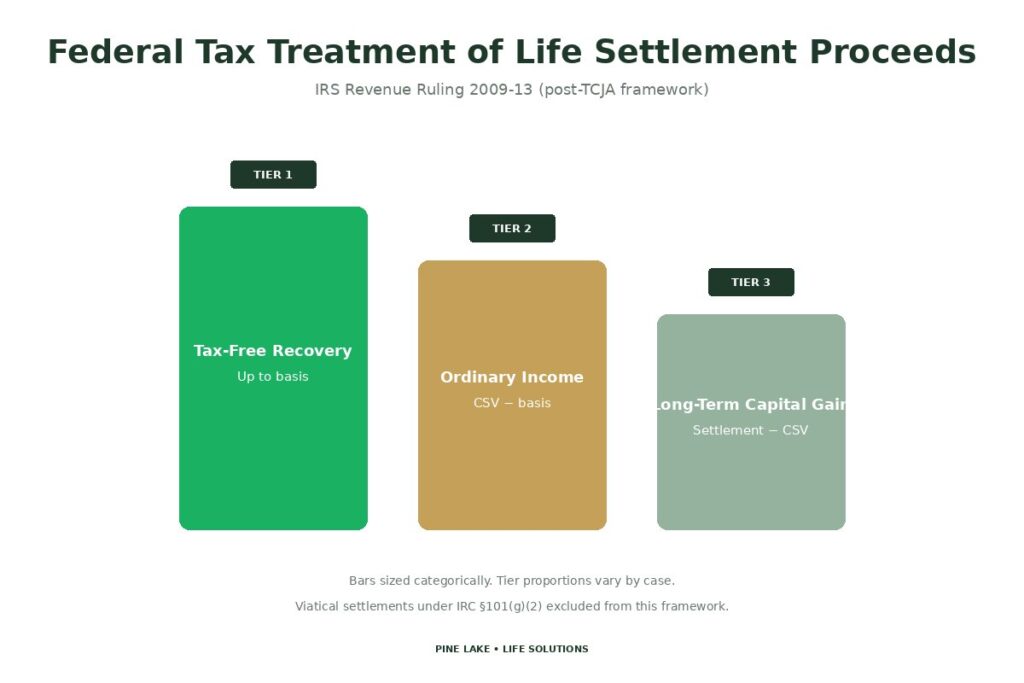
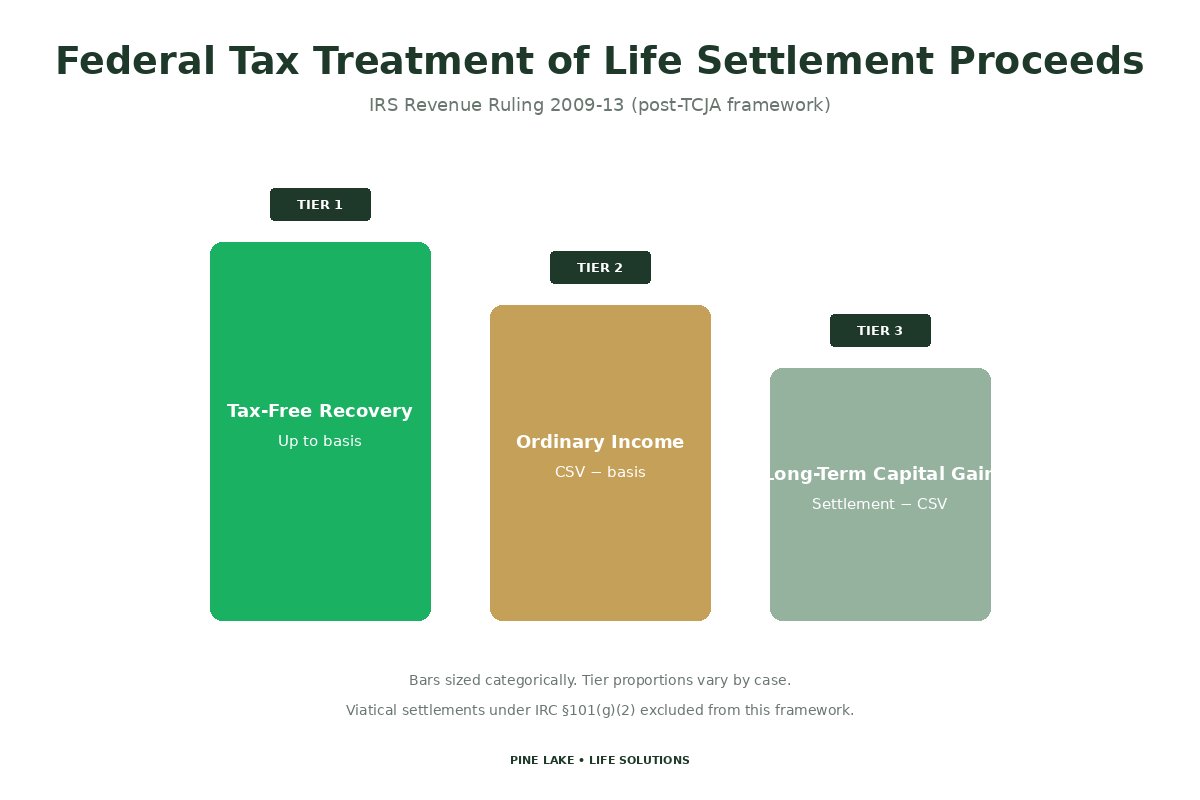
- State income tax: none. There is no South Dakota layer on a federally taxable settlement gain, which leaves a purely federal analysis under IRC § 101 and the reportable policy sale rules. Framework at South Dakota life settlement taxes; the computation belongs with the client’s CPA.
- Cost of care: South Dakota skilled nursing has run below the national median in recent cost surveys, commonly quoted in the range of $7,000 to $9,500 per month. Facility availability has tightened in rural counties following closures over the past decade, and the legislature has raised provider rates in response. Verify the specific facility’s private-pay rate and current availability.
Frequently Asked Questions
How long does a life settlement take from start to funding?
Commonly eight to sixteen weeks. The largest single variable is medical records retrieval, which can run two to six weeks depending on how many providers are involved and how quickly rural clinics respond. Request the carrier’s in-force illustration and sign HIPAA authorizations on day one; both are gating items that practitioners routinely start too late.
What is the real deadline in a South Dakota elder law matter involving a policy?
The grace period, not the Medicaid application date. A universal life contract typically has 31 to 61 days after a missed premium before it lapses, and once it lapses there is no market for it. Establish grace-period status before spending any time on valuation, because it determines whether the eight-to-sixteen-week timeline works at all.
Why do two life expectancy reports on the same insured disagree?
Because underwriting firms use different mortality tables and different debit-and-credit methodologies for the same medical record. Material disagreement is normal. Keep both reports in the file. A file containing one convenient report and no others invites the argument that the valuation process was not rigorous, which is exactly the argument a Medicaid caseworker would make.
Does South Dakota tax life settlement proceeds?
There is no South Dakota personal income tax, no state estate tax, and no inheritance tax, so there is no state layer on a settlement gain. The analysis is purely federal, involving IRC § 101, cost basis, the transfer-for-value rules, and the reportable policy sale information returns. That computation belongs with the client’s own CPA, not with elder law counsel.
How does escrow protect a South Dakota seller?
Funds are deposited with an independent escrow agent before the change of ownership and beneficiary forms are released to the carrier, and they are disbursed to the seller once the carrier confirms the change on its records. That sequence prevents the seller from transferring the policy and then chasing payment. Confirm the escrow agent is independent of the buyer.
Do federal Medicaid rules treat tribal members differently in South Dakota?
Federal law provides specific income and resource exclusions for American Indian and Alaska Native applicants, including certain trust land and distributions. South Dakota is home to nine tribal nations, and planning frequently involves the interaction of Indian Health Service coverage, tribal programs, and Medicaid. Confirm the applicable exclusions with the Department of Social Services rather than working from general guidance.
Find out what your policy is worth — free, confidential, no obligation.
A 15-minute educational review covers your eligibility, every alternative, and a realistic view of what each path would net you.
Related Reading
- South Dakota Medicaid Asset Income Limits
- South Dakota Insurance Department Consumer Help
- Life Settlement Licensing South Dakota
- Life Settlement Taxes South Dakota
- Medicaid Lookback Selling Policy
- Escrow In A Life Settlement
- Rescission Period After Signing
- Documents Checklist Life Settlement
- Estate Planner Life Settlement Guide South Dakota
Pine Lake Life Solutions does not purchase life insurance policies and does not provide legal, tax, or investment advice. Information provided is for educational purposes only. Eligibility for any option, including life settlements, is not guaranteed and depends on individual circumstances, policy terms, underwriting, and market conditions. Consult independent legal, tax, or financial professionals before making decisions regarding a life insurance policy.