

A critical illness rider pays a defined benefit from your own insurance carrier upon diagnosis of a specifically listed condition — heart attack, stroke, invasive cancer, kidney failure — while a life settlement sells your entire policy to a licensed third-party buyer for a negotiated lump sum. The rider is fast, contractual, and preserves the rest of your coverage; the settlement typically unlocks far more total cash — historically 10–35% of face value per GAO data — but permanently ends the death benefit. Because the two are not mutually exclusive, many policyholders can claim the rider first and evaluate a sale afterward.
This comparison covers how each works, the diagnosis-definition traps in rider contracts, tax differences, payout math, and a decision framework for policyholders facing a serious diagnosis.
In This Article
- How a Critical Illness Rider Actually Works
- The Fine Print: Why Diagnosis Definitions Decide Claims
- How a Life Settlement Works for the Same Policyholder
- The Money Comparison: Scheduled Benefit vs. Market Price
- Tax Treatment: A Meaningful Gap
- Eligibility Realities: Who Can Actually Use Each Option
- A Decision Framework for the Newly Diagnosed
- Frequently Asked Questions

How a Critical Illness Rider Actually Works
A critical illness rider is an add-on to a life insurance policy (versions also exist as standalone policies or employer benefits) that pays a lump sum when the insured is diagnosed with one of the conditions enumerated in the contract. Typical covered events include heart attack (myocardial infarction), stroke, invasive/life-threatening cancer, end-stage renal failure, major organ transplant, ALS, coma, paralysis, severe burns, and sometimes coronary bypass surgery at a reduced percentage. The payment is usually structured either as an acceleration of the death benefit — the payout reduces what beneficiaries later receive — or as an additional indemnity that leaves the death benefit intact, depending on the rider’s design.
Benefit amounts are defined in advance: a fixed dollar amount (say $50,000) or a percentage of face value (commonly 10–25%, sometimes to a cap). Some riders tier payouts by severity — 100% for a major cancer diagnosis, 25% for early-stage — and some allow multiple claims for different conditions with waiting periods between them.
The rider’s virtues are speed and certainty. Once the diagnosis documentation matches the contract definition, the carrier pays the scheduled amount, typically within weeks, with no negotiation, no marketing of your medical file, and no change in policy ownership beyond the benefit reduction. Its limits are equally structural: it pays only for listed conditions, only the scheduled amount, and only if the clinical facts match contract wording — the subject of more disputes than any other feature, covered next. For background on the broader rider family, see the complete accelerated death benefit guide.
The Fine Print: Why Diagnosis Definitions Decide Claims
Critical illness riders pay on contract definitions, not on how sick you feel or even how serious your doctor says the condition is. The gap between clinical reality and contract wording is where claims fail. Common examples:
- Cancer: most riders cover “invasive cancer” or “life-threatening cancer” but exclude carcinoma in situ, many early prostate cancers, and most skin cancers other than metastatic melanoma. A frightening diagnosis can still be a non-covered one.
- Heart attack: contracts often require specific clinical evidence — troponin elevation plus EKG changes, for instance. Severe coronary artery disease requiring stents or bypass, without a qualifying infarction, may pay nothing or only a reduced “coronary procedure” benefit. This is a crucial gap for the many seniors whose heart disease is progressive rather than event-driven.
- Stroke: definitions typically require persistent neurological deficit measured at 30 or more days; transient ischemic attacks are excluded.
- Progressive diseases: COPD, Parkinson’s, most dementias, and chronic conditions like advancing diabetes complications rarely appear on covered-condition lists at all — no discrete “event” occurs to trigger payment.
Add survival periods (the insured must survive 14–30 days post-diagnosis for some riders to pay), waiting periods after issue, and pre-existing condition exclusions, and the lesson is clear: read the rider form before counting on it. State insurance regulators, coordinated through the NAIC, require disclosure documents that summarize these definitions — request yours from the carrier in writing along with a claim-scenario illustration.
How a Life Settlement Works for the Same Policyholder
A life settlement approaches the same problem — a serious diagnosis creating financial need — from the property side. Since Grigsby v. Russell (1911), a life insurance policy has been recognized as the owner’s transferable property. In a settlement, the owner sells the policy to a licensed provider backed by institutional capital; the buyer takes over premiums and collects the death benefit at maturity, and the seller receives a lump sum priced off independent life expectancy underwriting.
The diagnosis that might or might not fit a rider definition works differently here: any condition that shortens underwritten life expectancy increases the offer, with no covered-condition list. A senior with severe multi-vessel coronary disease and no qualifying “heart attack,” or with progressive COPD absent from every rider list, is exactly the profile that prices well in the settlement market. Baseline criteria apply — generally age 65+ (younger with significant impairments), face value around $100,000+, policy in force two-plus years, permanent or convertible-term coverage — as detailed in who qualifies for a life settlement.
The process runs 60–120 days: medical records collection, two independent life expectancy reports (two to six weeks), competitive bidding among providers, then closing through escrow with a 15–30 day state rescission window. Historical results documented by the GAO put settlements at roughly 10–35% of face value and four to eight times cash surrender value. The costs are equally concrete: the entire death benefit transfers to the buyer, transaction compensation applies, and most proceeds face the three-tier tax treatment discussed below.
| Factor | Critical Illness Rider | Life Settlement |
|---|---|---|
| Trigger | Diagnosis matching a listed contract condition | None — any health profile priced by the market |
| Payer | Your own insurance carrier | Licensed third-party provider (institutional capital) |
| Typical amount | Scheduled: fixed sum or 10–25% of face (varies) | Negotiated: historically 10–35% of face value (GAO) |
| Speed | Weeks after documented diagnosis | 60–120 days including LE underwriting |
| Death benefit after | Reduced (acceleration) or intact (indemnity design) | Transferred entirely to buyer |
| Premiums after | Continue on remaining coverage | End permanently |
| Tax treatment | Generally tax-free for individually paid riders | Three-tier taxation; tax-free only if viatical-qualified |
| Fails when | Diagnosis misses contract definitions or no rider exists | Policy too small, too new, or health too strong for market pricing |
The Money Comparison: Scheduled Benefit vs. Market Price
Run the numbers on a concrete scenario. A 72-year-old owns a $400,000 universal life policy with a critical illness rider allowing acceleration of up to 25% of face value. She suffers a qualifying stroke with lasting deficits. Rider path: the carrier pays $100,000 (less any actuarial discount or fee per the rider design), her death benefit drops to $300,000, and premiums continue on the remainder. Payment arrives within weeks. Settlement path: her post-stroke life expectancy estimates come in materially shortened; in competitive bidding, offers might plausibly reach $80,000–$140,000 for the entire policy — but the death benefit is gone and premiums end.
Combined path: she claims the $100,000 rider benefit first, then sells the remaining $300,000 policy — now smaller but still marketable — for an additional sum. Total cash can exceed either single path, at the cost of the full death benefit. Sequencing matters: rider first, sale second, because a sold policy’s riders belong to the buyer.
Which single path pays more depends on rider generosity versus health severity. A rich rider (50%+ acceleration) with a modest health impact favors the rider. A capped rider (10–15%) with severe multi-system illness favors the market — settlement pricing scales with life expectancy compression while rider schedules do not, a dynamic explained in life expectancy and settlement pricing. And when the diagnosis misses rider definitions entirely, the market is the only path with a payout. No outcome is guaranteed in either direction; competitive bids and a written carrier illustration convert the comparison from theory to arithmetic.
Tax Treatment: A Meaningful Gap
Taxes can swing this comparison by five figures. Critical illness rider benefits are generally received income-tax-free when the premiums were paid with after-tax dollars — the common case for individually owned policies — under the same principles that exempt accident and health benefits, and accelerations for insureds who are terminally or chronically ill fall under IRC 101(g)’s exclusion. Employer-paid critical illness coverage can produce taxable benefits, and specifics vary, but the individual policyholder claiming a rider usually keeps every dollar.
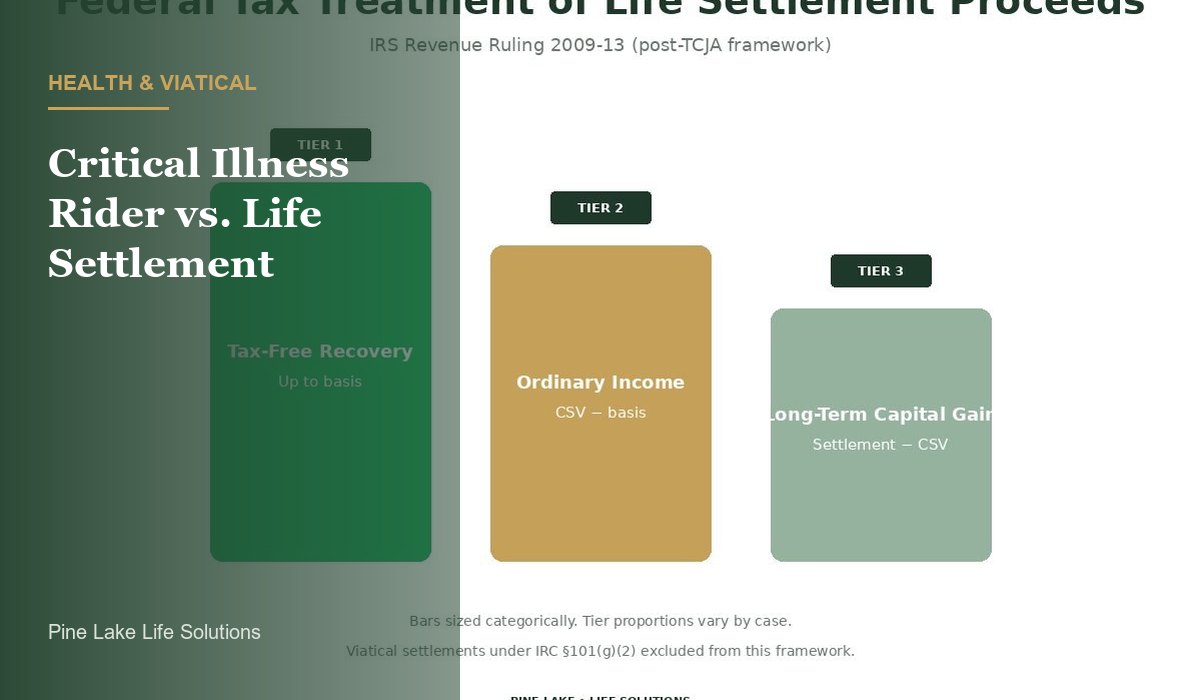
Life settlement proceeds follow the three-tier framework of IRS Rev. Rul. 2009-13, as modified by the 2017 Tax Cuts and Jobs Act: proceeds up to total premiums paid (basis) are tax-free; the slice between basis and cash surrender value is ordinary income; anything above is capital gain. Per IRS guidance, the seller’s carrier issues Form 1099-LS reporting the sale. The major exception: if the insured is terminally ill (certified life expectancy under 24 months) or qualifies as chronically ill with proceeds used for care, a sale to a licensed provider is a viatical settlement and generally income-tax-free under IRC 101(g) — see the viatical settlement tax exclusion.
Practical upshot: for a non-terminal insured, the rider’s tax-free dollars are worth more per dollar than a settlement’s partially taxed dollars, so after-tax comparison — not gross offer versus gross benefit — is the honest math. Both paths can also interact with means-tested benefits: cash retained from either source counts against Medicaid asset limits, a critical planning point when a critical illness may lead to long-term care.
Eligibility Realities: Who Can Actually Use Each Option
The comparison is academic unless both doors are actually open, and often only one is. The rider door requires that a critical illness rider exists on the policy — far from universal, since these riders typically had to be elected at purchase for additional premium — and that the diagnosis matches a covered condition, survives definitional scrutiny, and falls outside waiting periods and exclusions. There is no age requirement and no minimum face value beyond the rider’s own terms; a 55-year-old with a qualifying cancer diagnosis claims exactly as an 80-year-old does.
The settlement door has no diagnosis list but has market criteria: buyers generally want insureds 65 or older (younger works when health impairment is significant — and a critical illness usually is significant), face value around $100,000 or more, policies in force at least two years, and permanent coverage or term still within its conversion window. A 58-year-old with a serious cancer diagnosis and a $250,000 convertible term policy can be a viable settlement case precisely because illness substitutes for age; the same person with a $40,000 policy likely cannot transact at all.
Regulatory footing differs too. Rider claims are insurance claims, with disputes handled through the carrier and state insurance department — in New Jersey, the Department of Banking and Insurance. Settlements are separately regulated transactions: most states license providers and brokers under laws modeled on the NAIC Life Settlements Model Act, mandate disclosures, require escrow, and provide rescission windows. Whichever path fits, dealing only with the carrier directly (riders) or licensed parties (settlements) is non-negotiable.
A Decision Framework for the Newly Diagnosed
A serious diagnosis compresses decision-making at the worst possible time. This sequence keeps the choices straight:
- 1. Inventory the policy within the first weeks. Request from the carrier, in writing: all riders on the policy, their trigger definitions, benefit schedules, and a claim illustration. Many families discover riders they forgot — or discover their “coverage” excludes the actual diagnosis.
- 2. Match the diagnosis to definitions with your physician. The doctor’s documentation should speak the contract’s language where clinically accurate — troponin values, staging, persistent deficits — because claims succeed on records.
- 3. Claim what the rider owes. If the diagnosis qualifies, the rider is almost always the efficient first dollar: fast, tax-favored, and death-benefit-preserving.
- 4. Assess the gap. If rider proceeds (or no rider) leave real needs unmet — treatment costs, lost income, premiums now unaffordable — obtain settlement market feedback on the policy as it now stands. Bids are free and non-binding.
- 5. Compare after-tax, after-premium, with beneficiaries in the room. Value the surviving death benefit honestly against present cash needs.
- 6. Check the terminal/chronic thresholds. If prognosis approaches 24 months, viatical classification changes both payout levels and taxes — evaluate before accepting any standard offer, as covered in the viatical settlement guide and life settlements with a serious health condition.
Pine Lake’s role is educational at every step — mapping the options, including keeping the policy untouched, so families choose from knowledge rather than urgency.
Frequently Asked Questions
Should I use my critical illness rider or sell my life insurance policy?
If your diagnosis matches the rider’s covered-condition definition, claim the rider first in most cases: it pays within weeks, is generally tax-free for individually owned policies, and preserves the remaining death benefit. Then assess whether unmet needs justify also selling the now-smaller policy. Go straight to the settlement market when no rider exists, the diagnosis misses the contract definitions (common with progressive diseases like COPD or coronary disease without a qualifying heart attack), the rider’s cap is too low, or continuing premiums are unaffordable. Compare real numbers — a carrier illustration versus competing bids — rather than deciding in the abstract.
What conditions does a critical illness rider typically cover?
Standard covered events include heart attack (defined by specific clinical criteria), stroke with persistent neurological deficit, invasive or life-threatening cancer, end-stage renal failure, major organ transplant, ALS, coma, paralysis, and severe burns; some riders add coronary bypass surgery at a reduced benefit. Equally important is what is excluded: carcinoma in situ and most early-stage or skin cancers, TIAs, coronary disease without an infarction, and virtually all progressive chronic conditions — COPD, Parkinson’s, dementia, diabetes complications — which have no discrete triggering event. The rider form’s definitions section, not the marketing brochure, controls every claim.
Can I claim a critical illness rider and still do a life settlement later?
Yes, and sequencing this way is often optimal. Claiming the rider reduces the death benefit by the accelerated amount, leaving a smaller policy you still own. That remaining policy can be sold in a life settlement if it meets market criteria — buyers generally want remaining face value around $100,000 or more, a policy in force two-plus years, and a health profile that prices attractively, which a critical illness usually supports. Disclose the prior acceleration during the settlement process since it affects what the buyer ultimately collects. The reverse order is impossible: once sold, the policy and its riders belong to the buyer.
Is a critical illness rider payout taxable?
For individually owned policies where you paid premiums with after-tax dollars, critical illness benefits are generally received income-tax-free, similar to other accident and health benefits, and accelerations for terminally or chronically ill insureds fall under the IRC 101(g) exclusion. The picture changes with employer-paid coverage — benefits from premiums an employer deducted can be taxable — and with certain business-owned arrangements. Life settlement proceeds, by contrast, are partially taxable for most sellers under the IRS three-tier framework unless the seller qualifies as terminally ill. Because the tax gap can be substantial, compare the two options after-tax with a professional’s help.
My heart condition doesn’t meet the rider’s heart attack definition — what are my options?
This is one of the most common gaps: severe coronary artery disease, stents, bypass surgery, or heart failure without a contract-defined myocardial infarction may pay little or nothing under a critical illness rider. Your remaining options include a chronic illness or terminal illness rider if the policy carries one and your functional status or prognosis qualifies, and the life settlement market, which prices your actual cardiac severity rather than checking a definition box. Progressive heart disease with reduced ejection fraction or recurrent hospitalizations typically supports shortened life expectancy estimates and correspondingly stronger settlement offers. Get the policy’s full rider list before assuming anything.
How fast does a critical illness rider pay compared to a life settlement?
The rider is dramatically faster. Once your physician’s documentation matches the contract definition and any survival period (often 14–30 days post-diagnosis) passes, carriers typically pay within a few weeks of a complete claim. A life settlement runs 60 to 120 days end to end: gathering roughly five years of medical records, obtaining two independent life expectancy reports (two to six weeks), marketing the policy for competing bids, and closing through escrow with a state rescission window after. Families needing immediate treatment funds often claim the rider for speed and pursue the settlement in parallel for the larger sum.
Do I need a critical illness rider if I already have an accelerated death benefit?
They cover different scenarios, so check which triggers your policy actually has. A terminal illness accelerated death benefit requires a certified life expectancy of typically 12–24 months — most critical illness survivors do not qualify. A chronic illness rider requires losing two of six activities of daily living or severe cognitive impairment — a recovered heart attack patient does not qualify. A critical illness rider pays on the diagnosis event itself, regardless of prognosis or function. Many policies carry the terminal rider only, leaving event-driven and function-driven gaps. Knowing precisely which riders you hold determines whether a settlement is your only liquidity path.
Can I get a life settlement at age 60 after a cancer diagnosis?
Possibly. While the settlement market’s traditional floor is age 65, buyers regularly purchase policies on younger insureds when health impairment meaningfully shortens life expectancy — and a serious cancer diagnosis often does. You would still need to meet policy criteria: face value generally $100,000 or more, coverage in force at least two years, and a permanent policy or term insurance still within its conversion window. If your prognosis is certified under 24 months, the transaction may instead qualify as a viatical settlement, with higher payout percentages and generally tax-free proceeds under IRC 101(g). Licensed brokers can obtain market feedback without obligation.
Find out what your policy is worth — free, confidential, no obligation.
A 15-minute educational review covers your eligibility, every alternative, and a realistic view of what each path would net you.
Related Reading
- Accelerated Death Benefit Guide
- Chronic Illness Accelerated Death Benefit
- Life Settlement Vs Accelerated Death Benefit
- How Health Affects Life Settlement Value
Pine Lake Life Solutions does not purchase life insurance policies and does not provide legal, tax, or investment advice. Information provided is for educational purposes only. Eligibility for any option, including life settlements, is not guaranteed and depends on individual circumstances, policy terms, underwriting, and market conditions. Consult independent legal, tax, or financial professionals before making decisions regarding a life insurance policy.